Alberto - Right now they are being custom cast at a local foundry. Pretty labor intensive and thus expensive. I'm trying to price them at $100 each. At that price I can't cover the actual cost to make them in a custom lose pattern one at a time. I'm looking at other methods to keep quality and lower the cost. There are options to do to custom finishes but that will cost a little. I just had one polished. The results were pretty impressive.

You are using an out of date browser. It may not display this or other websites correctly.
You should upgrade or use an alternative browser.
You should upgrade or use an alternative browser.
Your Comments are requested for a new tool
- Thread starter jpoint
- Start date

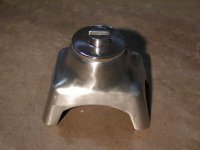
Im not gonna lie, that open end makes me nervous. I understand its tested and rated and all the other good stuff, but the people casting them can make mistakes and sometimes **** just happens. I would feel comfortable doing suspension or brake work, but there is no way I would crawl under a vehicle with those in place. I rack many vehicles all day long (mostly midlevel stuff) and I have yet to have trouble jacking a vehicle, then placing a stand.
I could see where the stands would have their place with higher end race cars and vintage stuff, but they look impractical for everyday work....at least in my opinion.
Props to you on making a very nice design though, Out of all the versions shown yours looks the most user friendly. You can tell someone who actually works on vehicles designed it.
I also liked the idea of using "stackable" rings to make it adjustable height
I could see where the stands would have their place with higher end race cars and vintage stuff, but they look impractical for everyday work....at least in my opinion.
Props to you on making a very nice design though, Out of all the versions shown yours looks the most user friendly. You can tell someone who actually works on vehicles designed it.
I also liked the idea of using "stackable" rings to make it adjustable height
srmofo - I can't argue with anything you said. In fact it's true about virtually every jack stand you buy. I haven't done the research, but I wouldn't be surprised if more jack stand "failures" are the result of an initial slip or tipping of an ill placed stand. These stands have a 14" wide base and go where they ought to be. That said, I've never been a fan of under car work on a jack stand. I prefer a lift. But in the "**** happens" catagory - I've read about guys having lifts fail too. I'll say this - I've seen lots of cars with twisted up pinch welds from jacks, jack stands and lifts. I won't pretend this is the answer to every lifting problem, but your reaction is actually right on target. The current height and price of the stand puts it in the market for wheel, brake, suspension, and fender work. You could crawl under your car with it but its not going to be like working under a 19" high stand (nor as scary to me). I won't say it's aimed at only high end cars, but it is aimed at guys who already own stands and don't like jack or jack stand hunting under their car for a secure lift spot. Lots of guys are going to buy a cheaper stand. With luck I'll be able to bring the price down to cheap if it ever goes into mass production. I put the front corner of an LS430 on it today in a parking lot on a slight grade just to demo it. I would never recommend doing that, but the guy watching was impressed with the stability. I'll say to you what he said to me "it's hard to imagine until you see it work". Thanks for the comments.
Alberto - Right now they are being custom cast at a local foundry. Pretty labor intensive and thus expensive. I'm trying to price them at $100 each. At that price I can't cover the actual cost to make them in a custom lose pattern one at a time. I'm looking at other methods to keep quality and lower the cost. There are options to do to custom finishes but that will cost a little. I just had one polished. The results were pretty impressive.
I received a comment that the stand needs to be painted to "look more like a jack stand". The brushed finish was cool, but it didn't look like it would be in a garage. Any thoughts? I was thinking it shouldn't look like a traditional jack stand because it's not. Maybe I'm wrong.
Garage_Mahal
Well-known member
- Joined
- May 31, 2008
- Messages
- 551
A polished set of those could be huge on the show-car circuit.
I think people here aren't getting the scale of these, Perhaps you could show them next to a typical dime-store jackstand so they could see how substantial they are.
I think people here aren't getting the scale of these, Perhaps you could show them next to a typical dime-store jackstand so they could see how substantial they are.
Stick Figure
Well-known member
Regarding height..... To give you an idea, i use the overly tall "truck" jack stands to usually do the work on my cars if i have to be under them for something like exhaust work or really more than a quick sensor swap. I do think its a great idea though, my pinch weld would look much better on my Lexus if i had something like that.
Here's a fairly typical 3 ton stand inside mine. This demonstrates my point about stability. Some guys have looked at it and thought it would interfere with the tire on some jacking locations. Thus far I haven't found that to be a problem on any car. Believe it or not - when placed on the factory jacking location, the stand is amazingly unobtrusive. But then that is probably the point in designing the jacking locations where they are - in a place strong enough to support the car but not in the way of any mechanicals.
What I like is when you're really pushing on a wrench, the car feels like it's really grounded.
Stick - I plan to make a couple different stand heights and some adjustment spacers. Funny - the rear pinch weld on my Lexus is also bent and my car has always been dealer serviced. Seems they could use the cap at the very least.
How about an adaptor so guys could use these with the widow maker jacks in their trunks? Does anybody still use those things at home now that floor jacks have gotten reasonable?
What I like is when you're really pushing on a wrench, the car feels like it's really grounded.
Stick - I plan to make a couple different stand heights and some adjustment spacers. Funny - the rear pinch weld on my Lexus is also bent and my car has always been dealer serviced. Seems they could use the cap at the very least.
How about an adaptor so guys could use these with the widow maker jacks in their trunks? Does anybody still use those things at home now that floor jacks have gotten reasonable?
Attachments

Last edited:
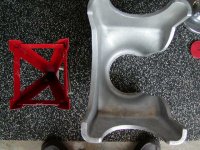
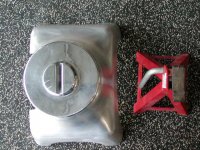
Here's a fairly typical 3 ton stand inside mine. This demonstrates my point about stability. Some guys have looked at it and thought it would interfere with the tire on some jacking locations. Thus far I haven't found that to be a problem on any car. Believe it or not - when placed on the factory jacking location, the stand is amazingly unobtrusive. But then that is probably the point in designing the jacking locations where they are - in a place strong enough to support the car but not in the way of any mechanicals.
Wow, bigger than I thought. You should post more comparo size shots.
I'd have two flavors: polished and powder coated in whatever color.
Wow, bigger than I thought. You should post more comparo size shots.
I'd have two flavors: polished and powder coated in whatever color.
srmofo commented about the open front. As I indicated the testing indicates that won't be a problem. The 3 ton jack stand I'm using for comparison is one of a pair I bought when I "upgraded" the quality of my jack stands. I'm sure (or at least I hope) most readers on this thread are using something much better now, but I'm betting many of us have trusted our cars and selves to something that looked like this in the past.
For comparison - the two stands are shown at 13" height. The standard stand will go higher but
 looking at the construction I'm not sure I'd use it at max height. I'm using 1/2 minimum thickness walls that are heavier in load and stress areas.
 All the comments I've received positive and critical are really helpful.
Attachments


Hurricane_Whisperer
Well-known member
- Joined
- Nov 2, 2009
- Messages
- 359
Alberto - Right now they are being custom cast at a local foundry. Pretty labor intensive and thus expensive. I'm trying to price them at $100 each. At that price I can't cover the actual cost to make them in a custom lose pattern one at a time. I'm looking at other methods to keep quality and lower the cost. There are options to do to custom finishes but that will cost a little. I just had one polished. The results were pretty impressive.
Your product is solving the exact problem that I had when I bought an ez car lift.
I have a 2008 Mustang Bullitt. I didn't care about damaging pinch welds when I had a Saturn, but I couldn't bear to bend sheet metal on the bottom of the Bullitt. And jacking it is a problem as you are suppossed to jack it at the pinch welds which now makes it hard to get to other areas for jack stands. The car was made to be lifted with a lift or a scissor jack for tire changing purposes.
Your product therefore fills a much needed purpose, at least for a small set of people.
The overall design is pretty nice, very simple, and I consider it an elegant solution, although it doesn't allow much lift. You could remedy that with a spacer on top or on the bottom. Possibly sort of a reverse jack stand where the legs ratchet down instead of the support ratcheting up.
A casting is absolutely the wrong way to go for this part. Castings can get porosity or holes and are labor intensive to make, not to mention heavy. (I take it the part is aluminum?)
The casting looks good and provides for nesting storage, but I think it is a problem.
I suggest a fabrication. You could make an open ended stand from pipe or angle or box tubing. It would have straight sides and a flat or or cone shaped top.
Last edited:

Hurricane_Whisperer
Well-known member
- Joined
- Nov 2, 2009
- Messages
- 359
Hurricane - Actually I've also done it that way.
Yes. I admit it won't look as pretty, but I think you can get a very good and inexpensive design.
Consider a rolled cone.
Another thing I was thinking, but haven't put on paper, is a tripod type frame work.
Tripod's don't rock. Very stable. The trick would be whether the open area is enough to get a floor jack in there.
Last edited:
It's funny, but some peaple actually like the looks of the fabricated one better and that design hasn't been abandoned. Also funny is I started with a cone for the cast design and considered a rolled cone. I won't say that those can't work for some applications, but what you see is the result of having tried quite a few options both from a production and an application perspective.
I think its a great idea. Lots of times I have jacked something up and wished I had a jack stand right where the jack was. Though I don't work under cars for a living and don't have all the tools the pros do. I wouldnt get discouraged from the pros saying they have no need for it. I think it could sell to different crowds, just advertise it to the right people. Nothing wrong with something gimmicky (if you dont mind me calling it that) if it works and is high quality.
Hurricane_Whisperer
Well-known member
- Joined
- Nov 2, 2009
- Messages
- 359
It's funny, but some peaple actually like the looks of the fabricated one better and that design hasn't been abandoned. Also funny is I started with a cone for the cast design and considered a rolled cone. I won't say that those can't work for some applications, but what you see is the result of having tried quite a few options both from a production and an application perspective.
I am enjoying this thoroughly. I think you have a great idea. I am an engineer and I own a machine shop that makes industrial machinery and if I can avoid a casting, I will. Unfortunately, castings are a big part of our production. CNC machinery, small lots, and design flexibilty mean we often machine from solid bar stock rather than mess with having expensive patterns made and having to deal with the foundries. Bar stock is fast to production and sale.
Your casting looks great. I would rather find a way to avoid them. Ultimately, stamping or rolling is the way to go, but that leads to expensive dies, that you must invest in up front.
For low production numbers CNC lathe or mill work and welding fabrications means you don't have a very high up front investment, although the part cost may be high.
The fabrication you showed looks a lot lighter than the casting. There are a lot of very stubborn people in the world that can't get over what they think things should look like, so you have that to consider too.
I have had customers who have equipment break and then I fix it and it doesn't break anymore and they get all hung up about why I had to modify it to stop it from breaking. They always say, it's been like that for 20 years. Was it breaking 20 years ago? No. Was it breaking repeatably before I fixed it? Yes. Is it breaking now? No. Then the reason is it wasn't 20 years old 20 years ago or you are running it differently than 20 years ago and you won't tell me. But I fixed it, so accept that or pay me more money to figure out what you night shift is doing to it.
Last edited:
Hurricane_Whisperer
Well-known member
- Joined
- Nov 2, 2009
- Messages
- 359
I think its a great idea. Lots of times I have jacked something up and wished I had a jack stand right where the jack was. Though I don't work under cars for a living and don't have all the tools the pros do. I wouldnt get discouraged from the pros saying they have no need for it. I think it could sell to different crowds, just advertise it to the right people. Nothing wrong with something gimmicky (if you dont mind me calling it that) if it works and is high quality.
I agree. Except it is not gimmicky. New cars are often low and don't have a lot of great places to jack them and support them. This solves that. Cheaper than a lift, or an ez car lift, like I bought, and it saves room.
I still like my ez car lift, because it's quick and get's the car high if needed or low if wanted. But I probably would have spent 200-400 dollars on jack stands like this if they got the car high enough for working under it.
Well I probably used a poor choice of words, but I didnt mean gimmicky in a bad way.I agree. Except it is not gimmicky. New cars are often low and don't have a lot of great places to jack them and support them. This solves that. Cheaper than a lift, or an ez car lift, like I bought, and it saves room.
I still like my ez car lift, because it's quick and get's the car high if needed or low if wanted. But I probably would have spent 200-400 dollars on jack stands like this if they got the car high enough for working under it.
gim·mick (gmk)
n.
1.
a. A device employed to cheat, deceive, or trick, especially a mechanism for the secret and dishonest control of gambling apparatus.
b. An innovative or unusual mechanical contrivance; a gadget.
2.
a. An innovative stratagem or scheme employed especially to promote a project: an advertising gimmick.
b. A significant feature that is obscured, misrepresented, or not readily evident; a catch.
3. A small object whose name does not come readily to mind.
I am enjoying this thoroughly. I think you have a great idea. I am an engineer and I own a machine shop that makes industrial machinery and if I can avoid a casting, I will. Unfortunately, castings are a big part of our production. CNC machinery, small lots, and design flexibilty mean we often machine from solid bar stock rather than mess with having expensive patterns made and having to deal with the foundries. Bar stock is fast to production and sale.
Your casting looks great. I would rather find a way to avoid them. Ultimately, stamping or rolling is the way to go, but that leads to expensive dies, that you must invest in up front.
For low production numbers CNC lathe or mill work and welding fabrications means you don't have a very high up front investment, although the part cost may be high.
The fabrication you showed looks a lot lighter than the casting. There are a lot of very stubborn people in the world that can't get over what they think things should look like, so you have that to consider too.
.
I should have come to your shop. Most of the local machine shops and manufacturers around here were very high for small production numbers. You're right about the up front costs for CNC being lower than tooling , but the unit cost remained higher over time. The casting is thicker true - but the final weight with the alloy is about the same as the fabricated steel.
dclafleur
Active member
It's a cool idea, I think it would be great if you can figure out a way to get your cost down, 100 bucks each is a bit rich for my blood.
I would eventually like to get a lift so that all I need to use my jack and stands for is wheel and suspension work.
Best of luck!
I would eventually like to get a lift so that all I need to use my jack and stands for is wheel and suspension work.
Best of luck!
I'm working on cost reduction, but want to maintain quality. $100 is alot of money, but then I look at the chewed up pinch welds and damage to the underside of my car. Sure - it is the underside of the car that nobody ever sees . . . except the guys who work on their own cars because they like to save money AND get work done to their high standards. Maybe I'm a nut, but it still pisses me off when I go under my car and see the twisted metal results from ham fisted techs who beat on the car before I bought it. Am I the only guys that gets bugged by that?
The web site is up and walking (not quite at a full run yet) www.jackpointjackstands.com . Talk about learning curves. I've got a long way to go to figure out this web technology. I guess I'm the ham fisted web tech. Guys who know site building are gonna say "And he was upset about a little twisted metal?"
The web site is up and walking (not quite at a full run yet) www.jackpointjackstands.com . Talk about learning curves. I've got a long way to go to figure out this web technology. I guess I'm the ham fisted web tech. Guys who know site building are gonna say "And he was upset about a little twisted metal?"
Last edited:
It's a cool idea, I think it would be great if you can figure out a way to get your cost down, 100 bucks each is a bit rich for my blood.
I would eventually like to get a lift so that all I need to use my jack and stands for is wheel and suspension work.
Best of luck!
That's my current situation. However, I'm also looking at using a version of this jack stand on my four post lift. I believe it's do-able.
Several months back I requested comments about these jack stands. They are now available for purchase at IMGT3performance. I want to thank all who posted comments as I learned from your insights. If you would like to read a bit more and see some shots of them in use - check out this link. though this discussion is somewhat marque specific, there are configurations of these stands for most unibody cars. Thanks again and be safe!
http://forums.rennlist.com/rennforums/997-gt2-gt3-forum/605569-jackpoint-jackstands.html
Final retail prices ended up higher than I expected, but so were costs for early, limited number production. The thread has some details on the production process that may be of interest.
http://forums.rennlist.com/rennforums/997-gt2-gt3-forum/605569-jackpoint-jackstands.html
Final retail prices ended up higher than I expected, but so were costs for early, limited number production. The thread has some details on the production process that may be of interest.
Last edited: