OK, bear with me, this is going to be long and probably boring to some, but it's been a hell of a week. I thought I would share this week's struggles. Maybe it's just me that feels this way at times, but I hope not and if so, maybe it will resonate with others.

I haven't been as active on here this week, but I have come here to seek a reprieve from the mental anguish and reading about fellow members projects and work has helped.
I have had my *** kicked this week by probably one of the most basic systems on any vehicle, the power steering system. I really didn't feel like posting this, mainly because it was self-inflicted and I didn't want to rehash it all over in my mind again. Maybe others feel this way at times and maybe not, but at one time during the past week, I felt like I was really questioning my career choice and really questioning my abilities as a mechanic. However, my son thought I should share this as maybe it would prevent someone else from making the same mistake and save them the time and frustration that it caused me, as well as show that I am not free from such frustration and mental struggles.
I left off showing the return line repair on my Jeep's power steering line. The WHOLE reason why I chose to cut the line and bubble the end IN the Jeep was to save time from having to remove the line and do it on the bench, which I knew in my head was the right way to do it. But nope, I chose to do it in the vehicle to "save time".
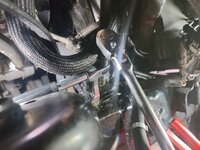
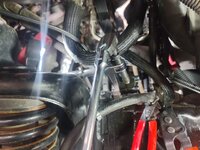
With access being so tight and limited, I had used a cutoff tool to reach in through the inner fender to cut the crimp off the hose where it connected to the rigid line as well as to cut the tubing for the bubble. I also dressed the burr on the end with a small 2" Roloc disc trying not to cut across the face of the cut and introduce metal shavings into the system. Well that didn't go as planned, not even close. Yes, I made the cut and deburred it fine which allowed me to reach in with my Imperial Eastman crimping tool and create the bubble on the line, however, even after a quick fire to flush the line, then fill, then quick fire to flush more, I ended up with metal shavings in the system. Enough that it stuck the flow control/pressure relief valve in the bore AND this is where I made matters worse.
After a couple of reservoir fills, firing to flush and going through a couple quarts of fluid, I reconnected the line and bled the system. I then started it and had power steering for a brief time, then it went away. I was on the right track with my thinking in that I must have stuck the valve. Sure enough, I disconnected the high pressure line, removed the threaded fitting/union from the pump and as I was removing the union I didn't feel any spring pressure which I knew I should have pushing on the union. Nope, the union came out and no valve and no spring. I grabbed a mirror, looked up inside and sure enough it was stuck up inside the bore. I was able to reach in with some long needle nose pliers and finally pull it free from the bore along with the spring.
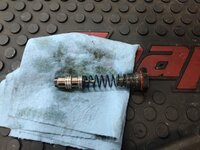
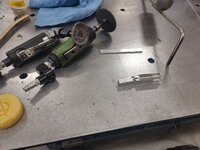
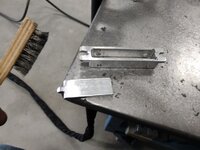
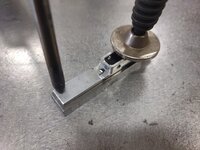
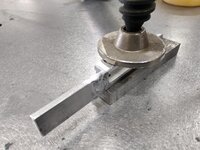
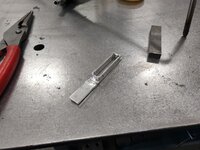
I felt around the valve and sure enough I felt grit on it. DAMN IT! After I was so cautious to flush the system and not connect any lines until I did so, I still got **** in the system. I noticed some slight scoring on the OD of the valve to where I could catch it with my finger nail so I knew I had to clean that up as well as remove the pressure relief check ball, spring and anvil from inside but didn't want to create more damage by just clamping it in the vise as the nut on the end is quite tight. I machined a piece of aluminum and bored it to the exact OD of the valve, then cut a slit in it using the bandsaw. I slid the valve inside the aluminum then clamped it in the vise to hold the valve so I could remove the internal components. The tool worked great.

Here is where I made a bad situation worse. Once the valve was completely disassembled for cleaning, I chucked the spool valve up in a collet in the lathe to deburr the OD. I knew these were precision machined, BUT yet I thought I had plenty to work with and by just "touching up" the OD with some fine emery paper it would deburr the valve and help it slide in the bore better. Yes, it did, a little too good I guess. I reassembled it and upon the bleeding and testing I had "some" power assist, but at idle it fell on its face.

All of this was on Monday evening and I was so frustrated by this time, when the wife got home I just threw in the towel and called it a day. Tuesday evening, I went back at it diagnosing the problem. After multiple times removing and reinstalling the valve thinking there must still be debris in the system, but not really finding any in the valve each time, I began thinking maybe something else was wrong. I went back to the basics of the system component by component trying to think of something, but the only thing that came to my mind was how can I not figure this out, this is the simplest system in the entire Jeep.....
This is where I really started missing my good friend and mentor as we would talk through such dilemmas often and bounce things around between the two of us. I never felt inferior and often he made me feel better about the situation if for no other reason than talking through it. I really don't feel like I have that person any longer other than my son and he has his own family and stress so he doesn't need mine.
I talked with a couple of my coworkers whom I have worked with for nearly 3 decades and I respect as mechanics, but to be honest, was quite disappointed in the conversations. I had inquired about how many power steering systems they had worked on and began explaining my situation. One guy even said "there's a valve in there?" What? Are you shitting me, you didn't even know there was a valve in the pump?
He said he had replaced multiple pumps and gearboxes over his lifetime but never had an issue and never had the need to dive any deeper into the systems. I guess that kind of makes sense, but this kind of deep dive into things is something that I used to discuss with my friend and mentor because we were both likeminded in the fact that we wanted to know the "why" behind things and "how" they worked, not necessarily R&R components and hope they work.
So without any more information, I went home and started at the source and tore the pump out of the Jeep and tore it apart thinking maybe debris got into the pump and it ate itself from the inside. Upon teardown, I didn't find anything inside. I then opened the metrology drawer and began taking measurements of the bore and valve to gain a better understanding of the clearances and here is where I discovered my error. These tolerances are supposed to be much tighter than I originally thought them to be, think more like an automatic transmission's valve body where tolerances are in the 20-30 micron range, not necessarily thousandths of an inch. Upon inspection the flow path and seeing how an excessive tolerance between the valve and the bore could bypass and return to the pump, this became my working theory.
I figured I had removed to much material when I was trying to clean up the spool valve and fluid was bypassing the valve and recirculating back into the pump body, exacerbated at idle due to lower flow anyways. A blip of the throttle gained me "some" power assist, but this was merely because flow increased. Part of my conversation with my coworkers was trying to correct them in their thinking that pumps create pressure. They kept telling me that the pump's pressure output should overcome any leakage, but I was trying to explain that pumps don't necessarily create pressure, they create flow and the pressure comes from resistance in the system, not the other way around.
Well, with my working theory my son came by the other night and after a nice discussion, we figured we were onto something but a new spool valve was next to impossible to come by. I even called my local Dodge/Chrysler dealer and gave them the pump # to see if they had one in stock. Shocking to me was to find out the Mopar has discontinued the power steering pumps for the Jeep JK. Holy ****, with all of them on the road, I was shocked to see the manufacturer had decided to discontinue that. So I had no choice but to go aftermarket. I have used a few different brands over the years purchased through my local NAPA, but the past several years have tried to use OEM when possible.
I did read good things about Remy pumps and my local NAPA had one in their warehouse, which came as a kit. It had a new pump WITH the pulley included as well as a new reservoir and an inline filter which they recommended installing. I have only installed filters in the power steering systems in the past on a few specialized systems, but as a general rule I have not. Mainly because I didn't want to add any form of restriction into the system, however, with mine having some debris I figured the kit would be the way to go and I would install an inline filter but make it easy to replace and add it to my checklist as a routine maintenance item, that way it wouldn't end up being a restriction unless it starts to become plugged.
I have also found on these earlier JK's the high-pressure hose deteriorate from the inside and create blockages in the system. I didn't think that was my problem, but my local NAPA had a new high-pressure line in stock so I thought it would be cheap insurance to replace it while the system was open.
With the entire system open now I was able to flush and clean it thoroughly component by component as it was going back together. Here is the new high-pressure line next to the OEM. Perfect match and clocking of the fittings.

With each component disconnected one by one, they were flushed and cleaned before reconnecting. I think I had half my toolbox out for this job.

OEM pump still disassembled on the bench as I began reassembling the power steering system in the Jeep.
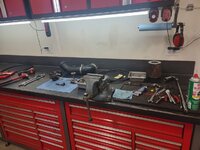
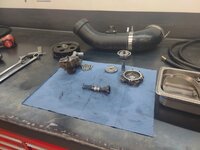
With the rest of the system cleaned the pump could now be installed as well as the new reservoir. Also, at this time I figured I would address another issue. I wanted to have my air intake duct to sit slightly lower between the engine and radiator, however, the main connector to the Camaro SS fan was right under the intake duct, preventing it from sitting any lower. I fabricated a Z-bracket to standoff the connector about 2 inches and allow a bit of space which will allow the air intake to sit about a half inch lower. I wanted the connector to have a good mount though because it will now be closer to the power steering pulley, so a new bracket was fabricated in which to attach the connector to.
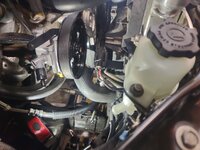
New O-ring installed on the high-pressure line and the high-pressure side was completed. There is still a good 1.5" between the Camaro SS fan connector and the pulley.

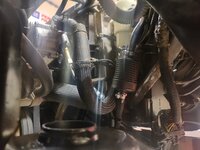
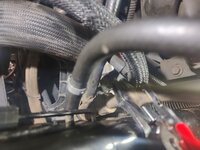
Now to move onto the supply side and the return hose. I installed the inline filter just inside the inner fender which will be easily accessible for maintenance. While I had the lines disconnected, I also took the time to put some slip through abrasion protection on each of the return lines as well as the feed line from the reservoir.
Stay tuned for a few more pictures.












 Love the photos from your last trip too!
 Ideal application for that tool…