Garcky
Well-known member
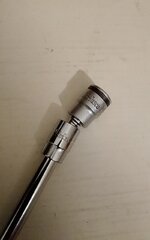
A set of wobble extensions should be in every toolset, in at least 3/8" drive, but preferably in all drive sizes. Some guys don't think they need them, because they have full sets of shallow and deep wobble sockets. They're wrong, though, especially in some situations. I'll give you one example of how a 10" wobble extension pretty much saved my life.
I didn't have a shop where I could work on cars. Much less did I have a lift. What I had was a 1991 Volvo 740 wagon with an exhaust leak at the manifold flange that car's exhaust pipe flange has a double exhaust pipe and a three-hole flange. A simple flat gasket seals the connection. Two of the fasteners on that flange are pretty accessible. The third fastener, though, is on the back side of the exhaust pipe and can't even be seen or touched from the top. Nope. Ain't happening.
So, I was going to have to get down and crawl under the car. I put the front end up on ramps and carefully blocked the rear wheels and also made sure I was in Park with the parking brake fully engaged. I crawled under, but it was still a tight fit and I could barely move. This was not going to be fun, I could tell.
Now Volvo, in its questionable wisdom, used distorted, long brass nuts on the exhaust manifold studs. While they didn't work themselves loose and didn't corrode and lock everything up so you'd have break something, they were really, really hard to turn, because of the distorted threads. Lying under the car, with a strong light pointing upward, I could just see that last nut, about 18" above the bottom of the exhaust pipe. If I jammed my arm between the exhaust pipe and the engine, I could just touch the nut, which was a 17mm hex fastener. However, I could also see that there was no straight shot at the nut. Worse, a good deal of the stud protruded through the nut, meaning that a deep socket was going to be essential.
I dragged myself from under the car and sat on my work stool to ponder the situation. How was I going to get a deep socket on that distorted nut and wind that nut off the stud while lying on my back with almost no room to work. Did I say that I hated lying on the pavement under a car? Maybe I forgot to say that...
After considerable thinking, I came up with the solution. I needed a long 3/8" drive flex ratchet, one 10" regular extension, and one 10" wobble extension. Along with the deep 17mm socket. Thinking about the path to the nut, I assembled my stuff. The wobble extension went on the ratchet. The plain extension went on the wobble extension, the socket went on the plain extension. I crawled back under the Volvo.
With some maneuvering, I managed to get the socket on the distorted brass nut, with the wobble extension letting me get past the obstructing exhaust pipe. There was just enough flexibility in the extension chain to make that happen. Slowly, and little by little, I creaked that distorted brass exhaust nut off the stud. I had to put the socket on the nut, and then move over a bit so I would be able to work the ratchet. After about five minutes, I managed to get the nut off the stud and down came the exhaust pipe. I scooted back out from under the car. Time for a rest. I was sweating profusely.
I decided that the distorted brass nut was NOT going back onto the stud. Not a chance. So, I got in the car, went to my favorite ACE hardware with the aisle of drawers full of fasteners. I found stainless steel nuts of the right size in one of the stainless steel metric drawers and bought two of them. Then, rested, I went home.
After replacing the old burnt out gasket and getting the exhaust pipe up and hanging from the three studs, I put the two accessible distorted brass nuts on the two accessible studs and ran them up until they were almost tight. Then, I grabbed my extension chain, along with a shallow socket to supplement the deep one. I put one of the stainless steel nuts in the shallow socket, along with a little grease to keep it in place and snaked my extension chain up and carefully started that nut on the threads of the stud, turning it by hand so that it was up on the stud as far as the shallow socket would take it. Then, I swapped over to the deep socket and ran it up the rest of the way, finally tightening it and the other two nuts to finish attaching the flange to the manifold. Finally, using the shallow socket, I got the second stainless nut started on the stud and finished up by jamming it against the first nut, using the deep socket again. Double-nutting was my solution to replace the distorted brass nut. I tightened up the exhaust pipe connections and hangers and finally got out from under the car. No exhaust leak.
I went back in the house and poured a tall gin and tonic to complete the job.
So, without that wobble extension in the right place on the extension train, the job would have been impossible, which is why you need a set of those, at least in the drive size you use most often. Or you can buy a set with all lengths and drive sizes. Harbor Freight has one for about $20, or you can get a set from the tool truck, I guess. Creativity is often needed to reach fasteners effectively.
I know. I know. TLDR!
I didn't have a shop where I could work on cars. Much less did I have a lift. What I had was a 1991 Volvo 740 wagon with an exhaust leak at the manifold flange that car's exhaust pipe flange has a double exhaust pipe and a three-hole flange. A simple flat gasket seals the connection. Two of the fasteners on that flange are pretty accessible. The third fastener, though, is on the back side of the exhaust pipe and can't even be seen or touched from the top. Nope. Ain't happening.
So, I was going to have to get down and crawl under the car. I put the front end up on ramps and carefully blocked the rear wheels and also made sure I was in Park with the parking brake fully engaged. I crawled under, but it was still a tight fit and I could barely move. This was not going to be fun, I could tell.
Now Volvo, in its questionable wisdom, used distorted, long brass nuts on the exhaust manifold studs. While they didn't work themselves loose and didn't corrode and lock everything up so you'd have break something, they were really, really hard to turn, because of the distorted threads. Lying under the car, with a strong light pointing upward, I could just see that last nut, about 18" above the bottom of the exhaust pipe. If I jammed my arm between the exhaust pipe and the engine, I could just touch the nut, which was a 17mm hex fastener. However, I could also see that there was no straight shot at the nut. Worse, a good deal of the stud protruded through the nut, meaning that a deep socket was going to be essential.
I dragged myself from under the car and sat on my work stool to ponder the situation. How was I going to get a deep socket on that distorted nut and wind that nut off the stud while lying on my back with almost no room to work. Did I say that I hated lying on the pavement under a car? Maybe I forgot to say that...
After considerable thinking, I came up with the solution. I needed a long 3/8" drive flex ratchet, one 10" regular extension, and one 10" wobble extension. Along with the deep 17mm socket. Thinking about the path to the nut, I assembled my stuff. The wobble extension went on the ratchet. The plain extension went on the wobble extension, the socket went on the plain extension. I crawled back under the Volvo.
With some maneuvering, I managed to get the socket on the distorted brass nut, with the wobble extension letting me get past the obstructing exhaust pipe. There was just enough flexibility in the extension chain to make that happen. Slowly, and little by little, I creaked that distorted brass exhaust nut off the stud. I had to put the socket on the nut, and then move over a bit so I would be able to work the ratchet. After about five minutes, I managed to get the nut off the stud and down came the exhaust pipe. I scooted back out from under the car. Time for a rest. I was sweating profusely.
I decided that the distorted brass nut was NOT going back onto the stud. Not a chance. So, I got in the car, went to my favorite ACE hardware with the aisle of drawers full of fasteners. I found stainless steel nuts of the right size in one of the stainless steel metric drawers and bought two of them. Then, rested, I went home.
After replacing the old burnt out gasket and getting the exhaust pipe up and hanging from the three studs, I put the two accessible distorted brass nuts on the two accessible studs and ran them up until they were almost tight. Then, I grabbed my extension chain, along with a shallow socket to supplement the deep one. I put one of the stainless steel nuts in the shallow socket, along with a little grease to keep it in place and snaked my extension chain up and carefully started that nut on the threads of the stud, turning it by hand so that it was up on the stud as far as the shallow socket would take it. Then, I swapped over to the deep socket and ran it up the rest of the way, finally tightening it and the other two nuts to finish attaching the flange to the manifold. Finally, using the shallow socket, I got the second stainless nut started on the stud and finished up by jamming it against the first nut, using the deep socket again. Double-nutting was my solution to replace the distorted brass nut. I tightened up the exhaust pipe connections and hangers and finally got out from under the car. No exhaust leak.
I went back in the house and poured a tall gin and tonic to complete the job.
So, without that wobble extension in the right place on the extension train, the job would have been impossible, which is why you need a set of those, at least in the drive size you use most often. Or you can buy a set with all lengths and drive sizes. Harbor Freight has one for about $20, or you can get a set from the tool truck, I guess. Creativity is often needed to reach fasteners effectively.
I know. I know. TLDR!