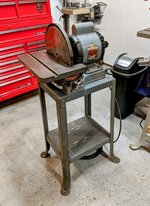
Beautiful restoration. I’m jealous of that perfectly polished tornado. Good work on it all.The completion of my '45-'46 Delta (ABS 31-506) 6x48 sander took over a year between other shop activities, the Breuer Tornado rebuild, a light restore on the motor and base. After completion I found I use it daily when actually WW'ing and can't recall how I ever lived without it.
I picked the machine up locally in January of '18. It came pretty much complete, but with an open stand and a monstrous GE Triclad 1hp motor. The table was broken and after several unsuccessful attempts to repair it I picked up another. I've since read of an alternate way of fixing it, just need the time. The platter was worn, so I filled it and covered it with graphite material. I replaced all bearings in the machine and motor along with numerous repairs, paint, buffing and so on on to get her back to factory. Not one nut, washer or otherwise went uncleaned repaired or replaced. There's only a small bit of Chinese zinc hardware that's soon be replaced as I can't stand the stuff. Although the crown on the drums are really good, it still needs a bit of finesse tracking if it sits unused for a few days.
Later in the restoration I bought the CI base from a friend and restored that as well. Sold the open stand to recoup some cash. Another friend texted me about the Tornado which I didn't hesitate on buying. It dates late 30's - early 40's and came with a DS21 (Disc sander) adapter that I sold off to again recoup half the cash I spent on it's original purchase. The rebuild of that was nerve racking and quite challenging at times. I couldn't find any documentation to show what to expect inside and if something broke or otherwise I'd be screwed, but it all worked out in the end. Only one rough spot on the head wouldn't completely buff out. After rebuilding it I tracked down a NOS adapter to connect it to the sander's DC port. The Tornado is extremely loud, yet powerful. I have a collector bag and filter jimmy-rigged to it for the time being and no I won't embarrass myself with pics of it.
I also picked up the fence and backstop (not pictured) and added the maple/walnut fence based on OEM specs, but species varied at Delta as they used what was readily available.
I'm extremely happy with this machine, now if I can just nail down an OEM Tornado bag it would be 100% complete.
Note: paint color is most accurate in first image below, Rustoleum Dark Machine Grey.

You are using an out of date browser. It may not display this or other websites correctly.
You should upgrade or use an alternative browser.
You should upgrade or use an alternative browser.
1920-60s DELTA / ROCKWELL picture thread - Post your Delta!
- Thread starter Hoorn
- Start date
Thank you Hoorn for the very informative post. I just picked up this Rockwell today and looking at your post on logos, would this make it between 1966-1973? It came out of the Spirit factory in Wichita but it doesn’t look all that old to me. 
One of my favorite aspects of Delta has always been their earlier badges. Because they spent so much time fiddling with one new logo after another in the 1930's, there is quite a variety.
In the early to mid 1930s Delta would use a decal that had "Delta" within a blue banner. This decal would continue to appear on Delta tools for awhile even after several new badges were introduced.
In 1936 Delta introduced their first metal badge. It was a beautiful round logo and the first adaptation of a triangle to represent the Greek letter "Delta". It's also when Delta started using the full "Made in the United States of America" which I think is awesome. Since this era was "pre-serial numbers", the type badge on your Delta can be used to narrow down the year it was produced.
For 1937 the new badge was modified and much of the black was switched to red.
1938, modified again.
Delta made a dramatic change in 1939 and abandoned the triangle and banner design altogether. This rather plain logo would span 1939-mid 1941
In mid 1941 Delta changed their logo back to the triangle again, and now made the city of Milwaukee a big part of the design. This lasted until the employees in Milwaukee went on strike in 1952. By 1945 Rockwell had already purchased Delta and since "Colonel Rockwell" had vowed to close up shop rather than deal with strikers, in 1952 he did just that and moved all Delta production out of Milwaukee. This badge lasted from 1941-1952.
In 1947 during the time of the "Delta Milwaukee" badges, serial number plates appeared that indicated Delta was a division of Rockwell Manufacturing. Prior to this plate there were plain aluminum plates that changed material often during the war. Brass, steel and oil boards were used at various times between 1942-45
Here is the redesigned badge that lasted from 1953-1966.
Delta / Rockwell would go on to have many more badge changes, including dropping the name Delta altogether in 1966 to go with "Rockwell" and eventually Rockwell International would follow in 1973.
Of some interest, Colonel Rockwell's son took Rockwell International in a completely different direction, selling off Delta to Pentair and by the 1980s becoming one of America's largest defense contractors (B-1 Bomber) as well as NASA's biggest contractor with the Space Shuttle. But the cold war did end and the Space Shuttle program became too expensive and Rockwell International went from #27 on Forbes largest companies, to defunct, sold off in bits and pieces.
Aside from the many logo design changes, there are also countless different badges for motors, pulley guards, pedestals, etc. If you have a unique or uncommon Delta badge or decal, lets see it!
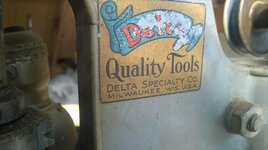

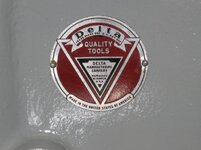


@calandrod the first introduction of the Rockwell International "peace sign" as it's normally called is 1973. However many other machines still had the lower case "r" Rockwell / Delta logo. By 1975 all the machines had the peace sign. There should be a serial number on the cast iron base close to the dust port. If that is there you can narrow it down precisely, and typically where it was made also. Those belt sanders are outstanding and will serve you well, as a testament to just how great they are, they more or less remained unchanged for 40 years. Talk about getting it right with your initial design.
Last edited:
In 1938 Delta introduced what would become a very popular tool for small machine and wood shops, as well as the homeowner; the 12-inch disc sander. This efficient sander remained virtually unchanged from 1938 until the 1970s. It is yet another testament to the outstanding engineers Delta had on staff throughout the 1930s. So many of their initial offerings in this era would not require any modernization for 20, 30, or even 40 years. Here it is as it appeared in the 1938 Delta catalog:

The disc sander was designed to be used with the large frame 8.5-in 1/2 hp Delta motors. As with most tools of this era, it did not come with a motor. The price tag for the No. 1426 direct drive disc sander was $18.85, or $382 in today's currency. The 1/2 hp No. 820 repulsion induction motor Delta recommended was $31.85, or $679 today. So a 12-in. disc sander would set you back well over $1000, and you still had to purchase a stand for it. Here are a few of the motors Delta offered in 1938:

By the 1940s, Delta included the steel stand which put the unit at 123 lb without the motor. Typical Delta 8.5-in. motors weighed approximately 60 lb., Putting the unit at roughly 180+ lb total.
Here is how it appeared in the 1941 catalog:

One of the accessories available for this disc sander was a dust port and the now unobtainium Hamilton Beach sawdust blower as shown in the catalog picture above.
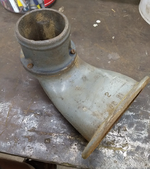
The dust ports themselves are now very expensive and in some cases sell for more than a complete disc sander with stand. Mounted below the disc sander base, with a cutout in the stand to accommodate it, it was effective at capturing much of the sawdust or metal shavings produced, even more so if it was attached to a sawdust blower vacuum.
Here is an image of the dust port attachment:
Unlike so many other Delta tools, the disc sander was not designed to be attached to a cast iron pedestal. Much later in its run, in the 1960s an enclosed sheet metal base was an option. Here we can see the retractable casters on the steel stand offered by the 1950s and a REALLY rare accessory, the metal dust collector.
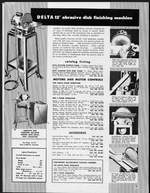
Both pages of the disc sander manual from the original introduction:


All in all just a reliable, sturdy machine that does what it's supposed to do. Gents, please post yours.
The disc sander was designed to be used with the large frame 8.5-in 1/2 hp Delta motors. As with most tools of this era, it did not come with a motor. The price tag for the No. 1426 direct drive disc sander was $18.85, or $382 in today's currency. The 1/2 hp No. 820 repulsion induction motor Delta recommended was $31.85, or $679 today. So a 12-in. disc sander would set you back well over $1000, and you still had to purchase a stand for it. Here are a few of the motors Delta offered in 1938:
By the 1940s, Delta included the steel stand which put the unit at 123 lb without the motor. Typical Delta 8.5-in. motors weighed approximately 60 lb., Putting the unit at roughly 180+ lb total.
Here is how it appeared in the 1941 catalog:
One of the accessories available for this disc sander was a dust port and the now unobtainium Hamilton Beach sawdust blower as shown in the catalog picture above.
The dust ports themselves are now very expensive and in some cases sell for more than a complete disc sander with stand. Mounted below the disc sander base, with a cutout in the stand to accommodate it, it was effective at capturing much of the sawdust or metal shavings produced, even more so if it was attached to a sawdust blower vacuum.
Here is an image of the dust port attachment:
Unlike so many other Delta tools, the disc sander was not designed to be attached to a cast iron pedestal. Much later in its run, in the 1960s an enclosed sheet metal base was an option. Here we can see the retractable casters on the steel stand offered by the 1950s and a REALLY rare accessory, the metal dust collector.
Both pages of the disc sander manual from the original introduction:
All in all just a reliable, sturdy machine that does what it's supposed to do. Gents, please post yours.
I'm following an auction on a Delta Milwaukee Floor Standing Drill Press (DP220) with a 1/3 HP Delta Milwaukee motor, not that I need a second DP, but I kind of like this one better than my benchtop Craftsman 150.... Realizing that markets around the country vary on what these are worth, but I'm hoping the Delta experts here can chime in on what a reasonable price for this unit might be. Current bidding is at $59.76 with a few more days to go.... Seems to be in really good condition...


@Snip's that looks to be about a 1947-48 model based on the fact it has the smaller window in front, but still has the old serial number style. Slo-speed model. Appears to have original paint, hardware is in great condition, table seems to be devoid of drill marks, it has the retirement light accessory as well as the on-off pull switch. It appears that it does not have an original Delta motor?
If this were in the Southern California area I would say under $100 is an outstanding deal, $100-150 is a pretty good deal, $150-200 is an okay deal, $200-250 is getting into that "how bad do you really want it" area, and anything beyond that you overpaid. Only the fact that it appears not to have an original Delta motor sets it back a bit. Very hard to judge value without seeing something in person as you are not able to tell how smooth it operates, if it vibrates, if there's chips in the cast iron or the condition of the pulleys, etc. From a picture you can't even tell if the motor works. I'm assuming everything is in good working order.
Is there a modification to the top of the drill press pulley cover? Is it stated the manufacturer of the motor?
If this were in the Southern California area I would say under $100 is an outstanding deal, $100-150 is a pretty good deal, $150-200 is an okay deal, $200-250 is getting into that "how bad do you really want it" area, and anything beyond that you overpaid. Only the fact that it appears not to have an original Delta motor sets it back a bit. Very hard to judge value without seeing something in person as you are not able to tell how smooth it operates, if it vibrates, if there's chips in the cast iron or the condition of the pulleys, etc. From a picture you can't even tell if the motor works. I'm assuming everything is in good working order.
Is there a modification to the top of the drill press pulley cover? Is it stated the manufacturer of the motor?
Last edited:
Thanks for your expert analysis Hoorn...
There are several other Delta items in the auction... Jig Saw, Table Saw, Planer.... But the DP caught my interest...
The motor on the DP220 is a Delta unit at 1/3 HP, but from what I've read, they may be putting out higher than whats on the label???
Motor label..

There are several other Delta items in the auction... Jig Saw, Table Saw, Planer.... But the DP caught my interest...
The motor on the DP220 is a Delta unit at 1/3 HP, but from what I've read, they may be putting out higher than whats on the label???
Motor label..
An Electro made Delta motor! That Delta motor is very uncommon and would provide me just the impetus I need to bid higher than what is reasonable lol.
Typical Delta motors, manufactured by Marathon, had a steel band that was light blue gray in color, with black cast iron end caps. That Electro made Delta motor is a needle in a haystack; I myself have had probably 40 or more Delta drill presses through my workshop and have never had that style with that unique badge. I would make every effort to secure that drill press if you really need one.
To answer your question about power rating, that motor will provide more than enough power for your drill press, older motors are bigger, heavier, use more copper, and are more reliable than what has been produced in the last 30 years.
Electro Machines, Inc was formed about 1941 and was reorganized into the Doerr Electric Corporation in 1951. It was acquired by Grainger in 1969 for $20 million, then sold to Emerson in 1986 for $24 million. Very nice motor!
Typical Delta motors, manufactured by Marathon, had a steel band that was light blue gray in color, with black cast iron end caps. That Electro made Delta motor is a needle in a haystack; I myself have had probably 40 or more Delta drill presses through my workshop and have never had that style with that unique badge. I would make every effort to secure that drill press if you really need one.
To answer your question about power rating, that motor will provide more than enough power for your drill press, older motors are bigger, heavier, use more copper, and are more reliable than what has been produced in the last 30 years.
Electro Machines, Inc was formed about 1941 and was reorganized into the Doerr Electric Corporation in 1951. It was acquired by Grainger in 1969 for $20 million, then sold to Emerson in 1986 for $24 million. Very nice motor!
Last edited:
Straightgrain
Well-known member

@Straightgrain that's a beauty right there! Great spot for it and I bet it does everything it's supposed to.


Hoorn, I appreciate your insight... It was very helpful in my bidding decision...An Electro made Delta motor! That Delta motor is very uncommon and would provide me just the impetus I need to bid higher than what is reasonable lol.
Typical Delta motors, manufactured by Marathon, had a steel band that was light blue gray in color, with black cast iron end caps. That Electro made Delta motor is a needle in a haystack; I myself have had probably 40 or more Delta drill presses through my workshop and have never had that style with that unique badge. I would make every effort to secure that drill press if you really need one.
To answer your question about power rating, that motor will provide more than enough power for your drill press, older motors are bigger, heavier, use more copper, and are more reliable than what has been produced in the last 30 years.
Electro Machines, Inc was formed about 1941 and was reorganized into the Doerr Electric Corporation in 1951. It was acquired by Grainger in 1969 for $20 million, then sold to Emerson in 1986 for $24 million. Very nice motor!
I was able to secure the DP220, with my winning bid of $205.50.... I'll be driving the 74 miles this friday to pick it up along with a Delta Rockwell 24" 40-440 Scroll Saw for $135.00.... I really wasn't planning to bid on the saw, which unfortunately doesn't have a Delta motor... The motor is made by Century and appears to be a repulsion motor....
I'll post up some pictures after I have a chance to do a quick cleanup...
Last edited:
@Snip's you did well and chose wisely. Rather than: ...which unfortunately doesn't have a Delta motor... The motor is made by Century and appears to be a repulsion motor....
You might say: fortunately it has a Century repulsion induction motor with skeletonized end caps which are more valuable than Delta motors!
Century motors are terrific, and look spectacular cleaned up/restored. Because of the era of that Century motor it almost certainly has bronze sleeves with wool wicking instead of bearings. Although it sounds archaic, it works very well and will give you another 100 years of service.
Vintage repulsion induction motors are much better than capacitor motors. Although this is material from Delta, here is what Delta stated in 1939:
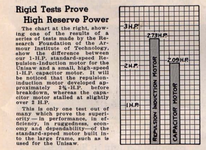
You can see here in the 1939 catalog Delta did push the repulsion motors, but by 1942 the war demands on copper and the overall time and expense of RI motors contributed to cheaper motors becoming ascendant.

I can not find any literature from Century dated to yours, most likely 1920s or before, but here is their take on the repulsion motor from 1934:


Note here even in the 30s, when almost everyone else had long switched to ball bearings, Century still used sleeved bearings with wool wicking.

Congratulations @Snip's !
You might say: fortunately it has a Century repulsion induction motor with skeletonized end caps which are more valuable than Delta motors!
Century motors are terrific, and look spectacular cleaned up/restored. Because of the era of that Century motor it almost certainly has bronze sleeves with wool wicking instead of bearings. Although it sounds archaic, it works very well and will give you another 100 years of service.
Vintage repulsion induction motors are much better than capacitor motors. Although this is material from Delta, here is what Delta stated in 1939:
You can see here in the 1939 catalog Delta did push the repulsion motors, but by 1942 the war demands on copper and the overall time and expense of RI motors contributed to cheaper motors becoming ascendant.
I can not find any literature from Century dated to yours, most likely 1920s or before, but here is their take on the repulsion motor from 1934:
Note here even in the 30s, when almost everyone else had long switched to ball bearings, Century still used sleeved bearings with wool wicking.
Congratulations @Snip's !
Hoorn... Amazing information on the Century motor.... Thank you for the posted Century literature....
I'm pretty amazed with their knowledge and development of electric motors at the turn and early part of the century....
It's easy to think technology back then would be primitive, but obviously that is not the case....
I noticed the electrical connection has 4 wires exiting through the side of the stator, which I find somewhat strange...
The wires are bunched 2x2 then connected to the power lead... I'll want to use a grounded 3 wire cable...
I'll have to figure which is the paired hot lead...
Even though the Century motor is from an earlier period than the scroll saw, I've changed my opinion, and consider it unique...
It will be fun giving the old girl a spa treatment....

I'm pretty amazed with their knowledge and development of electric motors at the turn and early part of the century....
It's easy to think technology back then would be primitive, but obviously that is not the case....
I noticed the electrical connection has 4 wires exiting through the side of the stator, which I find somewhat strange...
The wires are bunched 2x2 then connected to the power lead... I'll want to use a grounded 3 wire cable...
I'll have to figure which is the paired hot lead...
Even though the Century motor is from an earlier period than the scroll saw, I've changed my opinion, and consider it unique...
It will be fun giving the old girl a spa treatment....
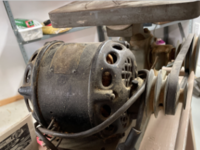
Not to divert the Delta thread, but here are a few pictures of my own Century motor that I had to put on the backburner because of other pressing projects. if cracking yours open is needed, here is what you may expect. Either black or reddish brown varnish or glyptal, protecting the copper windings.

The end bell with brass and copper brush rentention ring.
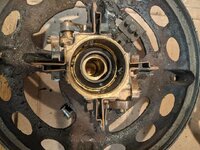
The sheer amount of machining involved to produce this entire retention ring is astounding to me.

Here is the wool wick outside of the oil chamber. Sleeves are still in fantastic condition and ready for another 100 years.

Massive frontal facing copper bars on this repulsion start motor. Note that despite being over 100 years old, the shafts are still in great condition.

Finally, to help you with your Century motor, here is a link to a guy who could probably restore them with his eyes closed. He has done a number of the Century type motors and other similar era motors.
The end bell with brass and copper brush rentention ring.
The sheer amount of machining involved to produce this entire retention ring is astounding to me.
Here is the wool wick outside of the oil chamber. Sleeves are still in fantastic condition and ready for another 100 years.
Massive frontal facing copper bars on this repulsion start motor. Note that despite being over 100 years old, the shafts are still in great condition.
Finally, to help you with your Century motor, here is a link to a guy who could probably restore them with his eyes closed. He has done a number of the Century type motors and other similar era motors.
Seems like back then companies were more focused on quality, longevity, and reputation.... Unlike today....
I guess that's what draws me to the older offerings produced by Delta and others as an example...
That's some massive wool wick... Keeping those sleeve bearing lubed up...
On the second Century picture above. That sliding bracket (2 o'clock position) is used to change rotation direction, as you rotate the entire brush assembly on either side of TDC.... If I'm not mistaken...
I guess that's what draws me to the older offerings produced by Delta and others as an example...
That's some massive wool wick... Keeping those sleeve bearing lubed up...
On the second Century picture above. That sliding bracket (2 o'clock position) is used to change rotation direction, as you rotate the entire brush assembly on either side of TDC.... If I'm not mistaken...
Last edited:
That is correct. With R-I motors, you change the rotation by changing the position of the repulsion ring over the copper commutator; the induction motor must be set to rotate one way or the other otherwise it will typically hum if it is in the intermediate or neutral position.
Last edited:
EvilW
Active member
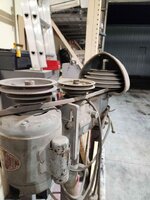
I Love this thread and have been watching for some time. Today I actually get to add one. I had been following a Facebook Marketplace listing for a "DP 22" for months now, but could not make arrangements to transport it from N. AZ to SoCal. The seller wanted $100 which seemed more than fair to me as it had the middle pulley and a great , somewhat original patina. Yesterday, I was talking to a friend who had just moved to AZ and asked if there would ever be a possibility that they would ever be venturing this way in a vehicle that would have room for a heavy, crusty drill press? When we realized that the Delta was only 6 miles from their home (what are the chances?) and that they were bringing an empty trailer this way next week, they said "No Problem!". I still can't believe it as I have been trying to buy it since November 29th.
My friend picked it up in his truck and could not resist the temptation to plug it in. Attached are some pics and a video. Can you experts please tell me a little more about this unit that I am so proud to add to my garage? Thanks!
https://www.dropbox.com/s/018dprfv0mexmty/IMG_6449.MOV?dl=0
My friend picked it up in his truck and could not resist the temptation to plug it in. Attached are some pics and a video. Can you experts please tell me a little more about this unit that I am so proud to add to my garage? Thanks!
https://www.dropbox.com/s/018dprfv0mexmty/IMG_6449.MOV?dl=0
Attachments



Last edited:
@EvilW I'm glad that worked out for you, seems to be in decent shape. That is most likely an early to mid 1940s model, with the slo-speed pulley. Tell me what the serial number is on the side of the drill press head and I'll narrow down what year it was made.
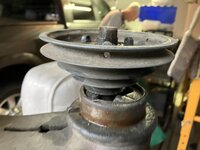
As far as the middle pulley goes, that is not a Delta but a Craftsman and will not perform as it was designed because of different mounting heights as well as the pulley sheave size.
I've had them both, the Delta is on the right, the Craftsman is on the left. You can clearly see mounting issues will arise.

Not to worry, the Craftsman MSA is worth more than what you paid for your DP220. Unless you have a King-Seeley era Craftsman drill press you could sell it on eBay for over $200 and still come out ahead.
It would be worthwhile to change out the bearings on the motor and give it a light cleaning. Blow out any sawdust or other debris with a compressor. Removal of the spindle from a DP220 is very straightforward and you could shine 'er up and lightly coat with oil for better movement within the cast iron head.
Congratulations on your drill press, not many of them have the patent fine print on the pulley guard Delta Milwaukee badge. And those on-off pull handles are an accessory I have always enjoyed finding on a Delta. Post some more pictures when you get it all cleaned up!
As far as the middle pulley goes, that is not a Delta but a Craftsman and will not perform as it was designed because of different mounting heights as well as the pulley sheave size.
I've had them both, the Delta is on the right, the Craftsman is on the left. You can clearly see mounting issues will arise.
Not to worry, the Craftsman MSA is worth more than what you paid for your DP220. Unless you have a King-Seeley era Craftsman drill press you could sell it on eBay for over $200 and still come out ahead.
It would be worthwhile to change out the bearings on the motor and give it a light cleaning. Blow out any sawdust or other debris with a compressor. Removal of the spindle from a DP220 is very straightforward and you could shine 'er up and lightly coat with oil for better movement within the cast iron head.
Congratulations on your drill press, not many of them have the patent fine print on the pulley guard Delta Milwaukee badge. And those on-off pull handles are an accessory I have always enjoyed finding on a Delta. Post some more pictures when you get it all cleaned up!
EvilW
Active member
Thank you so much for that information! I thought that that pulley looked a little bit low. Who knows, someone may want to do a trade for the Delta version or for a retirement lamp? Pretty excited about this and to be honest, I don’t think I would’ve even plugged it in before I checked it out a little bit. Lol. I will be seeing it in person here in SoCal on the 11th if all goes to plan.@EvilW I'm glad that worked out for you, seems to be in decent shape. That is most likely an early to mid 1940s model, with the slo-speed pulley. Tell me what the serial number is on the side of the drill press head and I'll narrow down what year it was made.
As far as the middle pulley goes, that is not a Delta but a Craftsman and will not perform as it was designed because of different mounting heights as well as the pulley sheave size.
I've had them both, the Delta is on the right, the Craftsman is on the left. You can clearly see mounting issues will arise.
Not to worry, the Craftsman MSA is worth more than what you paid for your DP220. Unless you have a King-Seeley era Craftsman drill press you could sell it on eBay for over $200 and still come out ahead.
It would be worthwhile to change out the bearings on the motor and give it a light cleaning. Blow out any sawdust or other debris with a compressor. Removal of the spindle from a DP220 is very straightforward and you could shine 'er up and lightly coat with oil for better movement within the cast iron head.
Congratulations on your drill press, not many of them have the patent fine print on the pulley guard Delta Milwaukee badge. And those on-off pull handles are an accessory I have always enjoyed finding on a Delta. Post some more pictures when you get it all cleaned up!
Last edited:
@EvilW really awesome that you are so enthusiastic about this drill press, savor that feeling. Vintage machinery will do that to you, and it's very contagious.
A Delta retirement lamp in spectacular condition may go for $100, a cleaned up Craftsman MSA in spectacular condition could go for $250, just a friendly FYI.
Delta MSA pulleys are significantly harder to find then the Craftsman equivalent. I've had at least 10, maybe more Craftsman MSAs go through my shop, and one Delta MSA. Best of luck on your search!
A Delta retirement lamp in spectacular condition may go for $100, a cleaned up Craftsman MSA in spectacular condition could go for $250, just a friendly FYI.
Delta MSA pulleys are significantly harder to find then the Craftsman equivalent. I've had at least 10, maybe more Craftsman MSAs go through my shop, and one Delta MSA. Best of luck on your search!
EvilW
Active member
I appreciate that tip! Thank You!!
I tend to get obsessed with these things too. I went through it with my Rock Island vise a few years back.
I tend to get obsessed with these things too. I went through it with my Rock Island vise a few years back.
EvilW
Active member
Tell me what the serial number is on the side of the drill press head and I'll narrow down what year it was made.
1946?
Attachments

Last edited:
EvilW
Active member
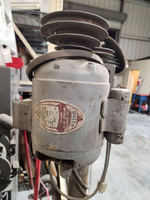
One more question, do you think that the motor is installed upside down to accommodate for the on/off being on the operator's right? I noticed the exposed wires on the bottom where a plate may go. Thank you! (sorry about these neophyte questions)
Last edited:
@EvilW the on-off pull switch was designed to be on the left side of the drill press while looking at it, because the feed stop is on the right. This doesn't mean that someone can't modify it because of personal preference.
If you do flip it to have the switch on the left side, you will have to reverse the rotation of the motor. Here is a Delta manual from the 1940s that indicate what you will need to do for your given motor.

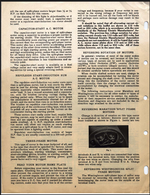
If you do flip it to have the switch on the left side, you will have to reverse the rotation of the motor. Here is a Delta manual from the 1940s that indicate what you will need to do for your given motor.
EvilW
Active member

EvilW
Active member

alfadan
Well-known member
So much more satisfying to power up an old USA machine than a Horrible Freight Special.
@EvilW on top of the cast iron body of the MSA, you should see a notch, and in that notch you will find a set screw. Back out the set screw and the inner body and outer sleeve should slide out of the column unless it is rusted in there, or is a very tight fit. If that is the case you may have to tip the drill press over and use a sturdy length of wood to run through the column and tap it out from the bottom. I've never had to do that, but I've never had a Craftsman MSA in a Delta column and I'm not sure how snug it is in there.

Set screw location.
Set screw location.
Last edited:
EvilW
Active member
Boy am I glad my old age has taught me to stop when I am not sure. Thank you for explaining the process to me!@EvilW on top of the cast iron body of the MSA, you should see a notch, and in that notch you will find a set screw. Back out the set screw and the inner body and outer sleeve should slide out of the column unless it is rusted in there, or is a very tight fit. If that is the case you may have to tip the drill press over and use a sturdy length of wood to run through the column and tap it out from the bottom. I've never had to do that, but I've never had a Craftsman MSA in a Delta column and I'm not sure how snug it is in there.
Set screw location.
I'll soon be starting on a cleanup for both of my estate sale DP220 and 40-440 machines... The OEM paint seems to be in really great condition... Just what appears to be mostly a yellow oil staining on the paint.... I use Simple Green in plastic tubs on parts where I want to gently remove all of the paint... The green product contains lye which melts off the paint in 24 hrs without damaging the metal surfaces... I'm concerned the SG might damage the OEM paint if I use the product on a rag or nylon bristle brush for scrubbing the paint surfaces... I tried Windex and mineral spirits with no effect... Not knowing the type of paint used when the machines were built, what is the general consensus for the best approach for cleanup without causing paint damage?

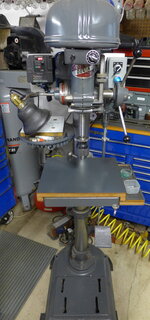

I'll soon be starting on a cleanup for both of my estate sale DP220 and 40-440 machines... The OEM paint seems to be in really great condition... Just what appears to be mostly a yellow oil staining on the paint.... I use Simple Green in plastic tubs on parts where I want to gently remove all of the paint... The green product contains lye which melts off the paint in 24 hrs without damaging the metal surfaces... I'm concerned the SG might damage the OEM paint if I use the product on a rag or nylon bristle brush for scrubbing the paint surfaces... I tried Windex and mineral spirits with no effect... Not knowing the type of paint used when the machines were built, what is the general consensus for the best approach for cleanup without causing paint damage?
Use "cleaner wax" made by Maguires or similar, I've had great success with that. Will remove dirt, grease and soil and not destroy the paint.
Southern83
Well-known member
If you're referring to the lazy susan side table it just clamps to the column. It's only for small lightweight items.@Davefr Awsome job on the press. How is the side table attached?