

You are using an out of date browser. It may not display this or other websites correctly.
You should upgrade or use an alternative browser.
You should upgrade or use an alternative browser.
Pliers That I Find Useful and Some I Don't. Tell Me Your Preferences
- Thread starter Garcky
- Start date
AntiqueBen
Well-known member
- Joined
- Aug 4, 2021
- Messages
- 1,442
Gotcha. Thanks 
jessesandy
Well-known member
Parallel jaw pliers. Like having a vise in your hand.
AntiqueBen
Well-known member
- Joined
- Aug 4, 2021
- Messages
- 1,442
Yes. These are my go to pliers. I have a couple pair of them. They work great. I have a new found appreciation for Barcalo.
Since I'm not working on cars any longer, I wouldn't need those, but they do look useful.
Long-reach needle-nose pliers are very useful for fishing stuff that shouldn’t be in a garbage disposal out of one.
For fencing pliers, I'm excited by these ones from Crescent:

I got them last year, but for whatever reason I did far less fence work than I would normally, so I'm not ready to give a full review just yet. However, there's a couple "tweaks" from the ordinary design than seem like they were added by someone who actually has worked on barbed-wire fencing.
First, the small "bump" or projection at the top of the pliers where you grab onto wire or a staple. It's a small thing, but sometimes you're trying to grab onto something and the wide head of the plier prevents you from grabbing something sitting flush against a post. The small extension helps.
Here's a photo from Channellock of what I'm describing:

Second, the sharp spike. Most fencing pliers all share the wide, round spike design. However, it's too thick to wedge under a staple that's been driven in all the way (since I often have a hammer with me too, I just line up the spike and hit the "hammer" face of the pliers with my hammer). The sharper spike on the Crescent design gives you much better odds.
Here's the traditional design:

The only thing keeping me from raving about the Crescents is that I don't think I've had them long enough to comment on how well they hold up. It's also important to me that the hammer face doesn't mushroom and that the cutters continue to cut - both of which can be problems if the pliers aren't hardened properly.
I got them last year, but for whatever reason I did far less fence work than I would normally, so I'm not ready to give a full review just yet. However, there's a couple "tweaks" from the ordinary design than seem like they were added by someone who actually has worked on barbed-wire fencing.
First, the small "bump" or projection at the top of the pliers where you grab onto wire or a staple. It's a small thing, but sometimes you're trying to grab onto something and the wide head of the plier prevents you from grabbing something sitting flush against a post. The small extension helps.
Here's a photo from Channellock of what I'm describing:
Second, the sharp spike. Most fencing pliers all share the wide, round spike design. However, it's too thick to wedge under a staple that's been driven in all the way (since I often have a hammer with me too, I just line up the spike and hit the "hammer" face of the pliers with my hammer). The sharper spike on the Crescent design gives you much better odds.
Here's the traditional design:
The only thing keeping me from raving about the Crescents is that I don't think I've had them long enough to comment on how well they hold up. It's also important to me that the hammer face doesn't mushroom and that the cutters continue to cut - both of which can be problems if the pliers aren't hardened properly.
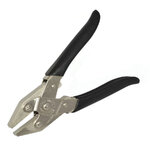
Do you have a pliers wrench? I'm only asking since I've considered parallel-jaw pliers before and dismissed them as redundant. I'll still probably try them eventually, but I'm not sure how often they'd be used.No plier collection is complete without a set of precision parallel jaw pliers. It's one of those tools that isn't used very often but when it is, "it's worth it's weight in gold".
Bubba Fett
Well-known member
Oil filter pliers are great for stuck jar lids, but they can damage the lid, so whatever you are opening, you probably need to use all of it.
Often, I get a 20oz drink from the vending machine at work. Sometimes, the screw caps are on super tight, but my 8" Proto (Wilde) slip joint make quick work of the cap, allowing me to enjoy a cold, crisp, fizzy drink.
I've used Channellocks to open beer bottles, allowing me to enjoy a cold, crisp, fizzy drink with alcohol.
Often, I get a 20oz drink from the vending machine at work. Sometimes, the screw caps are on super tight, but my 8" Proto (Wilde) slip joint make quick work of the cap, allowing me to enjoy a cold, crisp, fizzy drink.
I've used Channellocks to open beer bottles, allowing me to enjoy a cold, crisp, fizzy drink with alcohol.
I gave out a few of the cheap HF rubber strap wrenches to friends that had trouble opening jar lids. They work well for that with less chance of damaging the lid.Oil filter pliers are great for stuck jar lids, but they can damage the lid, so whatever you are opening, you probably need to use all of it.
Often, I get a 20oz drink from the vending machine at work. Sometimes, the screw caps are on super tight, but my 8" Proto (Wilde) slip joint make quick work of the cap, allowing me to enjoy a cold, crisp, fizzy drink.
I've used Channellocks to open beer bottles, allowing me to enjoy a cold, crisp, fizzy drink with alcohol.
I recently got some old-ish Channellocks. These types of pliers are unusual here in Europe. They are nice to have and I like how easily they cut normal wire though hardened steel wire will roll the cutting edge (I rarely use that, but I have some of it cause I got it for free...).For fencing pliers, I'm excited by these ones from Crescent:
I got them last year, but for whatever reason I did far less fence work than I would normally, so I'm not ready to give a full review just yet. However, there's a couple "tweaks" from the ordinary design than seem like they were added by someone who actually has worked on barbed-wire fencing.
First, the small "bump" or projection at the top of the pliers where you grab onto wire or a staple. It's a small thing, but sometimes you're trying to grab onto something and the wide head of the plier prevents you from grabbing something sitting flush against a post. The small extension helps.
Here's a photo from Channellock of what I'm describing:
Second, the sharp spike. Most fencing pliers all share the wide, round spike design. However, it's too thick to wedge under a staple that's been driven in all the way (since I often have a hammer with me too, I just line up the spike and hit the "hammer" face of the pliers with my hammer). The sharper spike on the Crescent design gives you much better odds.
Here's the traditional design:
The only thing keeping me from raving about the Crescents is that I don't think I've had them long enough to comment on how well they hold up. It's also important to me that the hammer face doesn't mushroom and that the cutters continue to cut - both of which can be problems if the pliers aren't hardened properly.
However I use them to set up and fix my electric wire fence. Just normal straight steel wire up to max ~3mm thick, and it's attached to chestnut poles through pieces of PE tubing (really cheap and durable insulation, the insulators they sell in stores specifically for electric fences is flimsy and pricey). Added some photos of the kind of fence/barrier I'm talking about...
For me, the pliers would be way more useful if I could pull normal nails with them. I'm thinking about cutting a wedge in the "claw" with an angle grinder, so I could pull out nails, but I'm not quite sure yet.
Attachments


pooterguy
Well-known member
In all of existence, there are only two (2) types of pliers:Generally if Knipex is an answer then Knipex is the answer.
Cobras, flush cuts, dykes, needle nose, and the basic vise grips are what I find gets used the most.
1. Knipex
2. Other
ThePostman
Well-known member
Drum brakes, needle nose vise grips for every part of that job except for spreading the horseshoe clip that holds the parking brake lever to the shoe.
I have and swear by a pair of these for my saltwater fishing adventures The brand I currently have is a 6 & 1/2" Manley set. I believe the ones these replaced 20 years ago were branded Sargeant. They went overboard in 2001 and Manley were the only ones I could find, I never had a use for them anywhere but Saltwater fishing.No plier collection is complete without a set of precision parallel jaw pliers. It's one of those tools that isn't used very often but when it is, "it's worth it's weight in gold".
On a side note I purchased a pair of the new Snap-On slip joint needle nose and think these will be handy for me with having severe arthritis.
Last edited:
I think the first pair of pliers i bought about 50 years was a pair of vice grips,still got them and many more.My Dad, who was a master mechanic and very handy with all things that involved using tools, absolutely detested ordinary slip-joint pliers. If you wanted to rile him up, all you had to do is grab a pair of ordinary slip-joint pliers and look like you were thinking of using them for something.
"Put down those damned pliers!" he'd roar. And he meant it, too. And with good reason. Using them to do anything with a fastener would quickly turn that fastener into something worthless that no tool could ever grasp again in any useful way.
He wasn't opposed to all pliers - just the garden variety of slip-joint pliers. It didn't matter who made them. He hated the solid-gold ones from Snap-On as much as he did a pair from the dollar store. Because of this, I have always cringed from just looking at a pair of them. Is that wrong of me?
Anyhow, as I've gotten older - very much older - I've grown to recognize that there are some very useful pliers. Some of my favorites are:
Channellock Pliers - Sometimes called "water pump pliers," or a variety of other names, these actually have many uses. Adjustable so their parallel jaws can fit almost any size of object, while allowing a strong grip with their long handles, they are very useful for holding and grasping round things when you don't need something like a pipe wrench . Their disadvantage is their tendency to pinch your fingers if they slip while you're putting pressure on something. You can have several pairs of these in sizes from 4" to 24". You should, too.
Vise-Grip Pliers - Available in a bewildering range of jaw shapes and sizes, they are something like the channellock pliers described above, but they can clamp down on an object without continued hand pressure. As a wrench of last resort, they are the tool you reach for when nothing else will do. They can also be used for jobs like permanenty replacing the handle on a LaZBoy reclining chair. In fact, everyone should have a spare pair for that use - just in case. You cannot have too many pairs of these, so buy them frequently and put them everywhere.
Side-Cutting Pliers - Also known as diagonal cutting pliers or "Dikes," these are the go-to tool for two jobs. Cutting wires and gripping cotter pins for removal, using the pliers as a lever. Always buy a good brand of these, because the cheap ones will be ruined when you try to cut a wire coat hanger, which you will do at some point, ruining them forever. Don't cut heavy piano wire or spring steel wire with them, either. Trust me on this.
Lineman's Pliers - These combination pliers include both side cutters and toothed jaws. If you buy a good pair, they will cut coat-hanger wire quite easily, due to the increased leverage of cutters close to the pivot point. For substituting as a wrench, though, they're not much better than the detested slip-joint pliers. Get a pair at least 8" long, to make cutting coat-hanger wire easier. And trust me, you will need to cut coat-hanger wire often.
Needle-Nose Pliers - Also called long-nose pliers, you will need several pairs of these in different lengths and thinness of their tips. Long ones, capable of almost reaching that nut that fell down behind the bell housing, are also available. But, so are extendable magnets. I'd get the magnet thingie. Some needle-nosed pliers also have side cutters near the pivot. Don't use those cutters. You'll ruin the pliers. Seriously. Nobody knows why the put them there.
The pliers listed above are tools worth owning, in my opinion. There are other types of pliers, but most are just variations on the five on this list. However, if you commonly work on drum brakes on vintage cars, you will definitely need a pair of brake spring pliers. If you don't work on such cars, those will be of no use to you whatsoever.
Now, you might have other favorite plier types. We'd all like to know about those, too, as long as they are not slip-joint pliers, so...
I use those hose pliers all the time working on small engines.I usually hold tools from Horrible Freight in disdain but I bought a set of these after using one from a co-worker. They're great for pulling/installing water line hoses in tight places on injection molds. As for other pliers, when I use them per the design intent they all work just fine. Vise grip types are a last resort, never a first choice.

Long Reach Hose Grip Pliers, 3-Piece
Amazing deals on this Long Reach Hose Grip Pliers 3Pc at Harbor Freight. Quality tools & low prices.www.harborfreight.com
woody 73
Well-known member
For me and I love all kinds of pliers, but I grab every small object with a vise Grip pliers, when I use the bench grinder, it sure saves my fingers and it never leaves me screaming where's the fxxxing flying part.
oldschoolcraft
Well-known member
I love this thread!
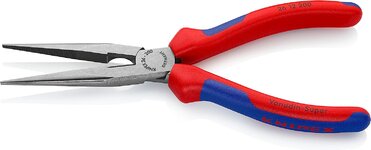
Here are the most worthless needle nose pliers on the planet. I generally really like Knipex but not these because they do nothing well. They are too flimsy for real work yet they are not thin enough for precision work. The cutters engage slightly before the tips close so the grip isn't very tight for small objects. The "primitive" trangential serration pattern only grips in one direction. (push and pull only. No grip when twisting).
I've heard unflattering things about Knipex needle nose so I bought a pair of Proto needle nose and ended up sending them back. Poor alignment of the tips. Uneven jaws. Just not the quality I expected from a USA pair of pliers. Embarrassing almost. On a whim, I ordered a set of Wiha and was so impressed that I bought the shorter version as well. Wiha is the red headed stepchild of European companies, it seems. But thet were transparent about COO and priced competitively. I've used them quite a bit now and don't regret the purchase.
I've also been buying the occassional Fujiya and Tsunoda pliers and am impressed with the quality to dollar ratio. I'm wanting to try some Keiba's but I don't need them and they're pretty pricy for my budget.
I've also been buying the occassional Fujiya and Tsunoda pliers and am impressed with the quality to dollar ratio. I'm wanting to try some Keiba's but I don't need them and they're pretty pricy for my budget.
I've heard unflattering things about Knipex needle nose so I bought a pair of Proto needle nose and ended up sending them back. Poor alignment of the tips. Uneven jaws. Just not the quality I expected from a USA pair of pliers. Embarrassing almost. On a whim, I ordered a set of Wiha and was so impressed that I bought the shorter version as well. Wiha is the red headed stepchild of European companies, it seems. But thet were transparent about COO and priced competitively. I've used them quite a bit now and don't regret the purchase.
I've also been buying the occassional Fujiya and Tsunoda pliers and am impressed with the quality to dollar ratio. I'm wanting to try some Keiba's but I don't need them and they're pretty pricy for my budget.
I have at least four pairs of these and the quality is pretty good, hard to beat the price.
https://www.ebay.com/itm/382456185209
Dave455
Well-known member
I refer you to post No.34…Here are the most worthless needle nose pliers on the planet. I generally really like Knipex but not these because they do nothing well. They are too flimsy for real work yet they are not thin enough for precision work. The cutters engage slightly before the tips close so the grip isn't very tight for small objects. The "primitive" trangential serration pattern only grips in one direction. (push and pull only. No grip when twisting).
On this side of the pond, we have (relatively) slim nose combination pliers, which tend to be the “go to” for a lot of folks, me included.

Consequently, we only use the “snipe nose” pliers when we really need the thin jaws - typically when assembling stuff. They seldom get used for twisting, but you’re right, the teeth could be better!
Your side of the pond, combination pliers are rare, so the snipe nose pliers have to do a lot more. This is why they tend to be stronger.
The Garage Journal solution, is of course to have both patterns. This works well for me!
Bubba Fett
Well-known member
If you want really good needle nose pliers, check out Tsunoda.
oldschoolcraft
Well-known member
They’re expensive but I love snap on needle nose pliers.
I agree. These are the best I've used. For a large plier, it's pretty impressive that they can grip a #40 wire.They’re expensive but I love snap on needle nose pliers.

If you ever find SO E703BCG buy them. They are the best precision needle nose pliers I've ever used. (discontinued) Combined with 196CF it's a marriage made in heaven.


Last edited:
KnurledNut
Well-known member
I refer you to post No.34…
On this side of the pond, we have (relatively) slim nose combination pliers, which tend to be the “go to” for a lot of folks, me included.
Consequently, we only use the “snipe nose” pliers when we really need the thin jaws - typically when assembling stuff. They seldom get used for twisting, but you’re right, the teeth could be better!
Your side of the pond, combination pliers are rare, so the snipe nose pliers have to do a lot more. This is why they tend to be stronger.
The Garage Journal solution, is of course to have both patterns. This works well for me!
Or just get these:

This!I too, hated slip joint pliers until I discovered the 47ACF pliers. Will make anyone a believer.
Snap-on Store
shop.snapon.com
Those and Knipex twin grip

KNIPEX 8201200 - 8" TwinGrip Pliers
The Knipex tool is designed for high-performance and durability, ensuring precision and efficiency in professional applications. Built with - Wise Line Toolswiselinetools.ca
kaymccampbell
Well-known member
I love my slip joint pliers. They're wicked handy for getting covers off small bottles. I've got a pair dedicated to my ANC box.
Dave455
Well-known member
Already got those - far left in the picture below. Good versatile tools, the short / stout jaws are a useful pattern, especially if you tend to carry tools with you!Or just get these:
Here’s a possibly useful comparison.
The Knipex (2 and 3 from left) definitely have the slimmest jaws, which can be useful, or not. This is particularly noticeable on the 8 inch, which just get longer, rather than bigger, compared to the shorter versions.
The Channellock (6 from left) are a relatively traditional American pattern. A stronger pattern for sure, but at the expense of bulk.
The British Records (4 from left) and the traditional Snap On (5 from left) are somewhere between the two other styles.
The latest Snap On (far right) are step towards the traditional American pattern, but with a simpler joint

As to which is to be preferred, this is garage journal, you need them all…!
these saved my *** working on a German car.I usually hold tools from Horrible Freight in disdain but I bought a set of these after using one from a co-worker. They're great for pulling/installing water line hoses in tight places on injection molds. As for other pliers, when I use them per the design intent they all work just fine. Vise grip types are a last resort, never a first choice.
Long Reach Hose Grip Pliers, 3-Piece
Amazing deals on this Long Reach Hose Grip Pliers 3Pc at Harbor Freight. Quality tools & low prices.
KnurledNut
Well-known member
The ones I pictured are the brand-spankin’-new longer version 185’s. ;-)Already got those - far left in the picture below. Good versatile tools, the short / stout jaws are a useful pattern, especially if you tend to carry tools with you!
Here’s a possibly useful comparison.
The Knipex (2 and 3 from left) definitely have the slimmest jaws, which can be useful, or not. This is particularly noticeable on the 8 inch, which just get longer, rather than bigger, compared to the shorter versions.
The Channellock (6 from left) are a relatively traditional American pattern. A stronger pattern for sure, but at the expense of bulk.
The British Records (4 from left) and the traditional Snap On (5 from left) are somewhere between the two other styles.
The latest Snap On (far right) are step towards the traditional American pattern, but with a simpler joint
As to which is to be preferred, this is garage journal, you need them all…!
seber
Well-known member
I must have 100 pairs of pliers. Mostly high quality. But the ones that get used most are water pump pliers and then slip joint. I do however, cuss when I think about the cheap junk slip joints I grew up with.
Dave455
Well-known member
Ahh, so I see!The ones I pictured are the brand-spankin’-new longer version 185’s. ;-)
These are actually quite a unique pattern of tool - a sort of taper jaw.
To be honest, these are something that has been needed for a while. Sometimes I need a narrow tip, but with a bit of strength, rather than long delicate jaws.
The only similar tools I can think of are the Merry Y75. I have a pair on my wish list but it’s looking like the Knipex need to be considered!

guitarbutt
Well-known member
- Joined
- Sep 29, 2017
- Messages
- 237
The $2 mini needle nose pliers from Harbor Freight get a lot of use as a mechanic. I pulled the coating off the handles to save a tiny bit more room and it's really made a difference. Picking up small things, holding things just out of reach, etc. Definitely worth $2
I have Tsunoda needle nose and just being honest they aren’t even in the same ball park as Snap-on. Pliers are one of the things we’re the high snap on prices actually get you something above the rest.If you want really good needle nose pliers, check out Tsunoda.
Already got those - far left in the picture below. Good versatile tools, the short / stout jaws are a useful pattern, especially if you tend to carry tools with you!
Here’s a possibly useful comparison.
The Knipex (2 and 3 from left) definitely have the slimmest jaws, which can be useful, or not. This is particularly noticeable on the 8 inch, which just get longer, rather than bigger, compared to the shorter versions.
The Channellock (6 from left) are a relatively traditional American pattern. A stronger pattern for sure, but at the expense of bulk.
The British Records (4 from left) and the traditional Snap On (5 from left) are somewhere between the two other styles.
The latest Snap On (far right) are step towards the traditional American pattern, but with a simpler joint
As to which is to be preferred, this is garage journal, you need them all…!
The new Snap On hinge design seems weaker. Since it is Snap On it is probably more than fine, but in general I much prefer the other pliers with the precision hinge. Just seems like that design gives the higne lots of areas of contact when stressed, so it should be stronger.
Ahh, so I see!
These are actually quite a unique pattern of tool - a sort of taper jaw.
To be honest, these are something that has been needed for a while. Sometimes I need a narrow tip, but with a bit of strength, rather than long delicate jaws.
The only similar tools I can think of are the Merry Y75. I have a pair on my wish list but it’s looking like the Knipex need to be considered!
I think I do not need these, but I'm buying them! Really cool design.
driftpin
Well-known member
Not a fan of most slip-joints, and I've always bought decent tools, mostly new. Not a Snappy guy though I do have a few things S-O.As I get older, the standard slip joints get used more and more. They are just about perfect for opening bottles with stuck caps. Another one I use often are parrot beak. I use them where most of the people here seem to think pliers wrench is the answer.
Here are some pliers I have used recently or which have characteristics or markings I find to possibly be of interest to thread-readers.
1] Diamalloy 9" slip-joint pliers
2] Sealed Power piston ring pliers
3] British Greater 6-1/2" parallel-jaw pliers w/a staking tool and a cutter. Beautiful action and first-class finish

I keep my Diamalloy slip joint pliers, 9" long, in the kitchen 'junk drawer.' They're labelled, "Groove-Joint HL110P." I keep them there for ease of champagne cork removal, which is what they did last night. Their useful opening is probably a bit-less than 2" so they aren't any use for something like a peanut butter jar or a pickle jar, but after using my 'Rabbit' wine bottle cork remover, they make it easy to get the cork off the corkscrew. Sometimes I use a kitchen towel and the Rabbit, but the slip-joint pliers is a better gripper.I have a pair of Craftsman RoboGrip pliers for those tight bottle caps. My wife uses them, too. Simple. They're in the cooking utensil drawere next to the refrigerator.

'appropriate sized channellocks,' that would be water pump pliers for those 4" Mt. Olive pickle jars.With corks (plastic & real) on wine bottles, we use a pair of gas and burner pliers to get the !@##!! thing off the corkscrew when it's too tight for removal by hand. Same pliers also work to remove screw-off bottle caps that are too stiff to turn. I've used appropriate sized channellocks to bust the vacuum seal on jars of jam, marmalade, olives, and such.
No end to clever parlor tricks you can do with pliers & pliers-like tools....
Here's a vintage pair of piston ring pliers, labeled as Sealed Power. See the other pic for a full picture. The two mid-jaw 'wings' allow adjustment of the spread to open the ring gap.

I always pack a pair of straight-jaw Vise-Grip pliers in any toolbag I'm going to use.
A question: what are the 'vices' found in 'vice-grips?


Last edited:
Joe Reed
Well-known member
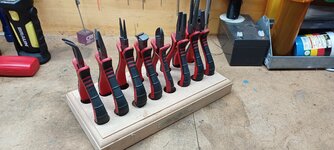
One of my sons gave me this set of small pliers a couple of years ago. They live on my workbench. Most of what I do there is fairly small so these are perfect. I have over 50 pliers of many types, but having these at hand means I almost never go into my tool chest for any. If I do, it's usually for the extra long pliers from HF.
Attachments
Joe, who made that pliers set? It looks quite useful & handy for small jobs as you say.One of my sons gave me this set of small pliers a couple of years ago. They live on my workbench. Most of what I do there is fairly small so these are perfect. I have over 50 pliers of many types, but having these at hand means I almost never go into my tool chest for any. If I do, it's usually for the extra long pliers from HF.
I haven’t seen the FEA or whatever that might answer these questions properly, but I think this new hinge / lever design (actually used by Snap-on for a long time in other pliers and anyway ancient: https://en.wikipedia.org/wiki/Pliers#/media/File:Kneifzange_HH-Harburg.jpg ) must have higher handle stiffness where it counts, near the pivot where bending forces from the squeezing hand are greatest.The new Snap On hinge design seems weaker. Since it is Snap On it is probably more than fine, but in general I much prefer the other pliers with the precision hinge. Just seems like that design gives the higne lots of areas of contact when stressed, so it should be stronger.
Maybe that stiffness (and strength too) beats any increase in strength from the greater abutting area of the classic Knipex-style design that you mention?
I doubt strength is the problem, as you say (it’s Snap-on, so they’ve done the hard engineering). Rather, a problem with the Snap-on design is that the handles have a travelling pinch zone as they close.
With the Knipex style, the handles can also pinch a finger, of course, but there is no scissor action as they close to catch the unaware. So it’s more obvious where to avoid putting a finger.
Of course no adult who uses pliers regularly (all readers) would be unaware of this risk, but Knipex probably worries more than Snap-on about non-expert tool users or children using their products.
Ha. I suppose they’ve been guilty of many offences against innocent nuts and bolts. But if you’re gently poking fun at a perceived misspelling, vice is just how Brits (and most of the English-speaking world) spell vise. Apologies if you know this.A question: what are the 'vices' found in 'vice-grips?