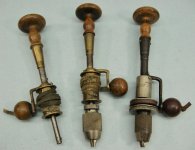
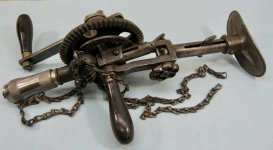
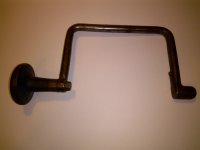
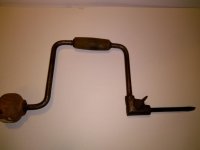
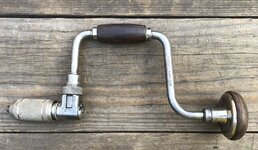
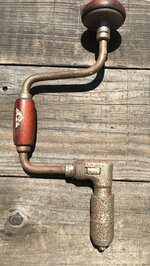
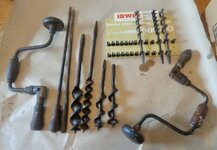
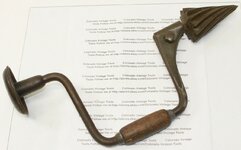
I've been trying to figure out how to store and display my braces in my new shop. I got rid of a few dozen when we moved and I'm trying to organize them better. These are high enough to be mostly out of the way yet low enough to reach them if I want to use one.
I use a version of that system, with the horizontal bar spanning joists in the basement (my workshop is down there). But I have just 11 braces, so there's only two bars, and I put spacer blocks on top of the bars to keep them from snagging each other. Whatever works is good.
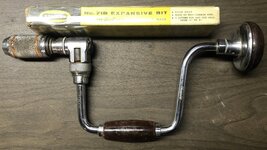
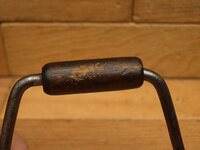
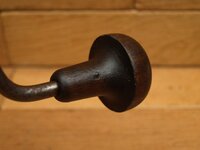
My "collection" began with a 10-inch Peck, Stow, & Wilcox model 102. I got it from my mother's father who worked as a handyman in boatyards along the coast north of Boston in the years after the First World War. He must have bought it second hand because it was made around the time he was born (late 1880s); the patent date on the pin-selector ratchet is December 30, 1884.
I bought a second 102 because I found in use that it helped to have more than one brace if a project involves more than just boring a hole. For example, driving a screw or countersinking or just making more than holes in one size.
In the photo, the five across the top are all 10-inch PSWs: models 102, 102, 152, 1002, and 8120; my grandfather's is at top left. The 8120 (with the fat chuck) is a Samson which I disassembled the chuck and replaced all its ball bearings. (Despite an 1895 patent date, that chuck can lock tight onto round-shank drill bits and hex-shank drivers as well as traditional four-sided tapered tangs.)
The three on the right are by Fray: a 7-inch all-metal Spofford style, an 8-inch ratchetless 508, and a 10-inch 106 with pewter rings on the rosewood wrist, plus a rosewood palm pad. At bottom are a 10-inch Worth (made by PSW), a 10-inch Bell System North/Stanley, and finally a 12-inch Stanley 921.
While I've gone a bit overboard in aquisitions, I don't see these as collector's pieces. All are in the lineup to be used for projects as needed, and all have been used by me at one time or another. To that end I have cleaned off rust as needed, cleaned and lubed chucks and ball-bearing palm pads, and sanded the wooden parts down to clean wood then applied shellac and wax.
The brace from my grandfather is, I think, the oldest tool I own and I always get a kick out of using it on a project. Despite being 130+ years old, it works perfectly. Collecting old tools for the sake of oldness doesn't interest me much, but when they can be used to meet a need in the shop, I'm delighted to work with them.