KMScott
Well-known member
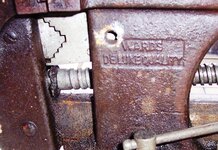
Fred Knox already posted this vise for the Spreadsheet. Thanks though and keep them coming.Wards Deluxe Quality V111 adn V112


Fred Knox already posted this vise for the Spreadsheet. Thanks though and keep them coming.Wards Deluxe Quality V111 adn V112
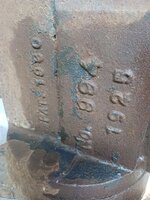
Free is good but that’s going to be quite a project for you.My Brother was given this Chas Parker yesterday, it is a 4 inch No. 994. It’s frozen and the spindle might be bent. It is under load right now. It has been outside for a very long time. Dynamic jaw is missing. He gave it to me.
That jaw is what has me worried.Free is good but that’s going to be quite a project for you.
What is your plan?
As you know, Parker vise jaws are the most difficult to fabricate. The rust can be overcome with Evaporust or electrolysis. That will probably free things up too.


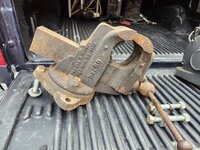
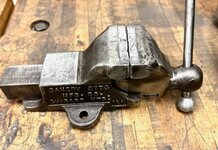
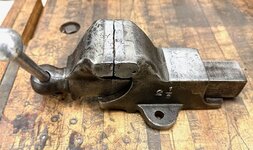
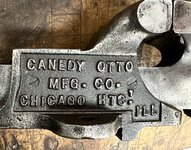
It's neet the way they got the Chas. Parker. Co. to fit on the vise.Cross-posted from the Garage Sale thread...my $40 find in Connecticut, a Chas. Parker No 88.
Missing one of the pipe jaws. I'm also guessing that's a homemade handle on the swivel lock screw. It otherwise appears to be in good shape, given its age. I like the deep jaw, but have no vise-less workbenches. I'll probably squirrel it away for the woodshop I'm going to build next year as it has a lot of character.
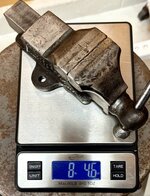
Is this actually cast steel, since it's meant as an anvil? Or just regular cast iron?I picked up a "Wards Deluxe Quality" Anvil vise this am; Homeowner's construction for the main screw and slide, the slide is riveted in place which is a first for me. 3-1/2" jaws, flat replaceable jaw plates, (Phillips head screws interestingly) 5" opening, the 3 pipe jaws (all present) are removable/replaceable, so like a combination vise that way. 17-3/4 lbs.
I'd class it a couple of cuts above the average exposed screw Homeowners vise. Of course the anvil is really an "Anvil shaped object" but for light hobby use (soft metals, thin bits of iron/steel, brass rivets, and the like, its fine. I'm thinking I'l clean it up mount it to a foot or 16" or 2X6, and C-clamp it when I need it for portable use. We do a lit of lantern/stove work on the Coleman camp outs. This would be a good one for that. $15 was more than I've paid for any homeowner's vise, but I don't think I got stung.
Casting marks are V111 adn V112 - Anyone know who made these for Wards adn When?
@KMScott - is this one for the Spreadsheet?
My Brother was given this Chas Parker yesterday, it is a 4 inch No. 994. Its frozen and the spindle might be bent. It is under load right now. It has been outside for a very long time. Dynamic jaw is missing. He gave it to me.

Amazing find at that price. Well played!Cross-posted from the Garage Sale thread...my $40 find in Connecticut, a Chas. Parker No 88.
Missing one of the pipe jaws. I'm also guessing that's a homemade handle on the swivel lock screw. It otherwise appears to be in good shape, given its age. I like the deep jaw, but have no vise-less workbenches. I'll probably squirrel it away for the woodshop I'm going to build next year as it has a lot of character.

Is this actually cast steel, since it's meant as an anvil? Or just regular cast iron?
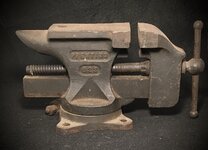
That’s a beauty Shift, it looks like it’s been lightly used. Prentiss called this vise the Triple Ser-vise. It was billed as a machinist vise, a pipe vise and an anvil all rolled into one.I second all of the things Outlaw said.
The only anvil vise I have is this Prentiss 622 shown here for comparison.
 www.garagejournal.com
This post with original specs say “Unbreakable Malleable Iron” for the Wards Deluxe Anvil vise.Wards Master Quality vice
I am restoring a 3 1/2 " Wards Master Quality vice with pipe jaws. Anyone have any information about it ?

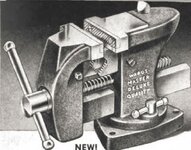
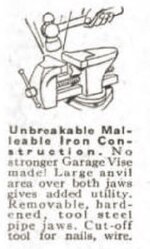
I think I recall a forum post, maybe here, that mentioned this vise model as having been a standard item used in one of the WWII Army repair kits issues for some vehicle, maybe a truck.
Nothing like your combo anvil, machinists', and pipe vise is included in the SNL J-5 (all clamps, vises, etc) or SNL G-27 (tool-sets), which includes various anvils and vises (DP, pipe, and machinists') for 2nd through 4th echelon repair depots. I also don't recall ever seeing anything like it in any vehicle manuals I have had a reason to go through. That would include 1/4-ton to 2.5 tons. To be objective, there were a lot of vehicles in WWII with manuals I have never looked through. And Signal Corps and Engineers had all kinds of kits, too. It doesn't seem like the kind of thing the Army would buy, to me, and if they did, it wouldn't come from WARD's, obviously, but I know you already know that. I'll poke around.@Private Lugnutz - Lugs what say yopu? Posibly war time?
I have no idea, and I'm still clueless who made it - If Colombian, likely ductile rather than gray iron.
The anvil surface does have some chisel marks and dents, so it seems to have some give. It may be the anvil surface was a separate piece of steel or iron like they sometimes did for jaws, but no obvious indication of such.
At not over 18 lbs for the entire vise, its not an anvil anyway, so anything more than soft/thin metals is beyond it. you are not going to use it for even light forging, not even small knives for instance. Brass/copper rivets and grommets, flattening a small kink in thin sheet metal; that's its role.
I could see this in a leather workers shop, or a home hobbyist that works with sheet brass/copper, that sort of user. My daughter does copper and brass wire artwork so she would be a good candidate, but I've already given her a small 1 lb anvil (My dads) and a small Stanley clamp on vise.
The heaviest "Anvil" use would be to have one of those cutters that fit in the "hardie hole" (actually a pritchel hole, but its used as a Hardy in this case) and cut flat bar, and not very thick stuff either.

It was his ex Wife's Dads. He passed away about 4 years ago and her Mother in 22 and they are clearing everything out now. The vise was just sitting in the backyard. Nobody wanted it.Hopeless case! send it to me for proper disposal!
I'll give a double **** since you and your brother both got it for free.
What's your source for this, Shifty?For some of the newer readers of this thread, let me insert here that tons of baby bullet vises and larger models were procured from Wilton for the war effort.

I have purchased more than one vise that was just sitting in the dirt in the backyard. The most notable one that I remember was a Reed 4C.It was his ex Wife's Dads. He passed away about 4 years ago and her Mother in 22 and they are clearing everything out now. The vise was just sitting in the backyard. Nobody wanted it.
Glad to help!Thanks for the extra information relating to vises sold to the military.
I don't know about that - I have certainly done my share of research.You are the expert on things relating to wartime tools.
Please point me to it. I have not seen that.I was only relaying information I have read here showing those little baby bullets with the separate raised anvil pieces as being included in specialized tool kits for the US military, (Army if I remember correctly)
It's true that none of the Wilton's made between 1941 and late 1945 have a date stamp on the keyway, but I have never seen anything showing military sales without a guarantee as the reason. The date stamps were manufacturing dates, not guarantee expiration dates, and the GUAR EXP dates only appeared later for a short period of time. Wilton was clearly selling vises to private companies during WWII and ads in commercial trade mags during WWII state the guarantee, 1 year at first, then 5 years. Whether they were using a receipt or what, we don't know. But there is no evidence that they sold any vises to the government, let alone that they only sold vises to the government, and there is no evidence that the lack of a date stamp means a former government customer vise.I also recall reading about the earliest 4 inch Wilton bullet machinist vises having no date stamped into the keyway because they were sold to the military without any warrantee.
No reason to apologize for anything. I wasn't challenging you. Just curious for the source of your statement for the reasons I stated - no Wilton WPB contracts with any military service or gov't agency on record.I will certainly defer to any written evidence to the contrary and I apologize in advance if I have posted misinformation.
pretty sure teh handle on the swivel lock is original. My Parker is identical in design. it was convenient for restoring, since you can polish up the knob and the bar separateCross-posted from the Garage Sale thread...my $40 find in Connecticut, a Chas. Parker No 88.
Missing one of the pipe jaws. I'm also guessing that's a homemade handle on the swivel lock screw. It otherwise appears to be in good shape, given its age. I like the deep jaw, but have no vise-less workbenches. I'll probably squirrel it away for the woodshop I'm going to build next year as it has a lot of character.
Private Lugnutz said:"...the history section of the Wilton website states that sales were "government only" during WWII, but there are no records of direct contracts between Wilton and any services or agencies in the War Production Board (WPB) contract books and the period ads themselves never mention any gov't agency, only companies, such as International Harvester and Buick. That has led me to infer that Wilton was supplying vises to other companies who were using them in their manufacturing plants. Part of the war effort, but an interesting nuance that often gets missed or mischaracterized, and much different than supplying "tons" of vises to the government, which is much more true of several other vise makers."
OoH, I want one of them one of these days. Tough to find.I have purchased more than one vise that was just sitting in the dirt in the backyard. The most notable one that I remember was a Reed 4C.
Nope, those are original. I use to make and sell them. They fit inside a pocket on the swivel body so it will miss the Static body.Cross-posted from the Garage Sale thread...my $40 find in Connecticut, a Chas. Parker No 88.
Missing one of the pipe jaws. I'm also guessing that's a homemade handle on the swivel lock screw. It otherwise appears to be in good shape, given its age. I like the deep jaw, but have no vise-less workbenches. I'll probably squirrel it away for the woodshop I'm going to build next year as it has a lot of character.
That's what I was referring to here...One line from the Wilton tool.com website history page stuck in my mind so I quote it here:
”From 1941 through 1945, the new Wilton 40S machinist vise was manufactured in Chicago and sold solely to the US Government. Most vises were used in munitions factories or in manufacturing of equipment used during WWII.”
Again, there is no record of Wilton having sold vises under contract to the US Government during WWII, the way there is a record of the other vise mfgrs selling vises under contracts to the US Government during WWII, and the second part of their own statement contradicts the first part. Conversely, the second part of that statement is in agreement with ads they were running in trade mags at the time. If they were used in munitions factories, they were most likely purchased by the companies making the munitions and vehicles and other equipment. Making their "solely to the US Government" claim awfully misleading....and the history section of the Wilton website states that sales were "government only" during WWII...
Vises that were part of tool-sets being deployed to the ETO and PTO would've been purchased by technical services, i.e., ORD, QMC, Corps of Engineers, etc, just as they were purchasing them from Birtman, Columbian, Morgan, etc., as I summarized above.Maybe only a fraction of those vises manufactured during that time period went into tool kits issued to enlisted men or otherwise put to use outside of factories.
They are hard to find. I sold mine to a guy who owned and managed a shop fabricating custom diesel exhaust systems. He told me that the “gorillas” who worked for him have broken just about every vise he has had in his shop and wanted something that would hold up to hard use.OoH, I want one of them one of these days. Tough to find.