To avoid these ads, REGISTER NOW!

knob & tube wiring

To avoid these ads, REGISTER NOW!

Zeke

Well-known member
Joined
Aug 13, 2009
Messages
17,176
Location
Long Beach CA, the sewer by the sea.
Fascinating.

We had cellulose insulation blown into our walls in that same 1948 house that I mentioned in my previous reply. No write-offs or certifications were requested or required (that I know of). This was in 1986 in California, it was offered by (PG&E), at no cost, to qualifying homeowners.
That was then. The 80's favored anything energy saving. Rebates and tax credits for appliances, sun rooms, insulation and they were getting ready for dual pane windows which hit the U.S. in the early 80's on the Eastern side of the country. By the mid 80's we had them here. I know, I installed some of the first ones.
 

Jeff Ivers

Well-known member
Joined
Apr 9, 2010
Messages
2,557
Location
Oklahoma
YES! you win the GJ prize for "what's my post."

i'm a model builder and for a myriad of reasons am jumping up to 1:12 scale. basically 4x the volume of a 1:24 scale model car. so a 24' x 32' cape cod house will scale down to 24" x 32".

one of the - no The - predominant reason i am going into this endeavor is the sheer amount of detail that can be incorporated.

like the guts of a fuse box and the knob & tube wiring exposed And capable of lighting a tiny led lamp at the end of its run.
I am so relieved that you are building a model and not contemplating an acquisition! With that I am not concerned about your safety. I have read some of the posts on here with regards to safety that talk about the design of K&T being safe and that statement is true from a limited perspective - what the statement doesn't take into account is the amperage loads that modern life will throw on the system and when the system was built.

What I mean by that and what might help you is a more detailed description of what I encountered in that house. Keep in mind this was one of the earliest houses built in Kirksville MO with electrical wiring, built in the early 1900's, 3200 sq ft on the two living floors, with a full basement and an attic tall enough that it could have been converted to living space. There was a single ceramic fuse block with 2 screw-in buss fuses installed on the wall of the enclosed back porch. The feed from the power pole on the street came to this box. Each fuse fed a single circuit - one upstairs and one downstairs. All downstairs wiring ran in the basement and all upstairs wiring ran in the attic. All transitions between floors went straight up and down through the walls between a pair of studs. Most of the wiring in the attic and basement ran diagonally - whatever was the shortest distance between needed connection points. Each room had a single electrical outlet and a single ceiling light fixture controlled by a wall switch (push button, if I recall correctly). None of the wiring in the house was larger than 14 gauge. I am sure houses built in later years had more circuits and some used the blade fuses, etc. So one of your issues will be determining the time period you wish to emulate. Good luck with your project!
 

Bert_

Well-known member
Joined
Dec 24, 2016
Messages
9,750
Location
NW Iowa
I will rewire outlets, especially kitchen and bathroom since that's where the higher loads are. Rarely do I suggest people tear open ceilings to rewire lights. Knob and tube powering lights is fine in my opinion

My house has quite a few lights running on knob and tube, I don't loose any sleep. I know where the original service was for the knob and tube. I kind of want to put the fuse blocks back there and have it power the lighting circuit and maybe wire up a couple things in the basement to it. Would be neat to see
 

nadogail

Well-known member
Joined
Jan 23, 2009
Messages
31,979
Location
Coronado, CA
When that house was built the electrical system was probably designed to provide lighting and very few convenience outlets.

Electric Irons were common and Toasters were being introduced.

Industrial electrical systems were in their infancy.
 
OP
S

southpier

Well-known member
Joined
Jun 28, 2009
Messages
552
i remember when micro wave ovens were emerging and we would go house to house adding a dedicated circuit for same. right after holidays and birthdays were the busiest times.
 
OP
S

southpier

Well-known member
Joined
Jun 28, 2009
Messages
552
I am so relieved that you are building a model and not contemplating an acquisition! With that I am not concerned about your safety. I have read some of the posts on here with regards to safety that talk about the design of K&T being safe and that statement is true from a limited perspective - what the statement doesn't take into account is the amperage loads that modern life will throw on the system and when the system was built.

What I mean by that and what might help you is a more detailed description of what I encountered in that house. Keep in mind this was one of the earliest houses built in Kirksville MO with electrical wiring, built in the early 1900's, 3200 sq ft on the two living floors, with a full basement and an attic tall enough that it could have been converted to living space. There was a single ceramic fuse block with 2 screw-in buss fuses installed on the wall of the enclosed back porch. The feed from the power pole on the street came to this box. Each fuse fed a single circuit - one upstairs and one downstairs. All downstairs wiring ran in the basement and all upstairs wiring ran in the attic. All transitions between floors went straight up and down through the walls between a pair of studs. Most of the wiring in the attic and basement ran diagonally - whatever was the shortest distance between needed connection points. Each room had a single electrical outlet and a single ceiling light fixture controlled by a wall switch (push button, if I recall correctly). None of the wiring in the house was larger than 14 gauge. I am sure houses built in later years had more circuits and some used the blade fuses, etc. So one of your issues will be determining the time period you wish to emulate. Good luck with your project!
thank you for the concern. worst thing in my garage apartment is a fluorescent light (downstairs) which is using a bare ground wire for a neutral . . . . . . i just never turn it on.

on another note . . anyone ever see a "south county three way" switch? of course you have, and some of the luckier guys may even have one in their basement or attic.

take (1) a porcelain pull chain fixture complete with 100 watt incandescent bulb, a handful of screw eyes, and a ball of string.

get the picture?
 

TomC750

Well-known member
Joined
Nov 12, 2017
Messages
151
Location
Upstate NY and TN
Very interesting thread, especially since the first house my wife and bought in 1964 was knob and tube all the way. The house was built by an electrician for himself in the late 1800's. When I remodeled a room I rewired it, hard to do as it was, as the wiring was so well done. The insulation was perfect, fresh like it was done last week. All connections soldered. 60 amp service. I ran a 110A subfeed to the garage so I could run a heavy welder. Never even dimmed the lights. When we sided it, the electric company gleefully salvaged the lines from the pole, and stated that they had never seen such heavy gauge wire on a house. The only problem I had was when I bumped a light in the shed out back and blew a fuse. I figured I would fix it then and there as the other light went out too, and obviously blew a fuse. Well, it blew the fuse on the neutral, as I soon discovered when I got a healthy shock. I don't recall the theory of why both sides of the line were fused.
 

Zeke

Well-known member
Joined
Aug 13, 2009
Messages
17,176
Location
Long Beach CA, the sewer by the sea.
In 2017 we rewired a '20's home that had a gang knife switch on the neutral side. It was at least a dozen contacts but IIRC more like 18. Big house.

I had a CA licensed C-20 electrical contractor on that job as it was a big job. I'm sorry I let him take the switch.
 

nadogail

Well-known member
Joined
Jan 23, 2009
Messages
31,979
Location
Coronado, CA
Electrical practices have evolved over the years. What was “good enough” in the very early years might be unacceptable today.

When many electrical installations were first built everything was DC. In a DC ungrounded system opening both the Positive and Negative supply lines would ensure the highest degree of Safety.

When I was teaching Electrical Wiring I stressed to my students that Neutral conductors are almost never never switched or fused, an exception would be the Gasoline Dispensing Pumps at a Service Station.
 
OP
S

southpier

Well-known member
Joined
Jun 28, 2009
Messages
552
i worked for a guy whose father was a weekend handyman. their summer house started as a garage with apartment above and subsequent additions sprawled here and there as time and funds permitted.

all of the switching was done with relays and low voltage wiring. i have no idea why.

this was a guy who put a seat belt on his john deere yard tractor. unfortunately, when it toppled over an embankment, he ended up underneath.
 

Jim greengo

Well-known member
Joined
Sep 3, 2018
Messages
7,415
Location
Behind my house
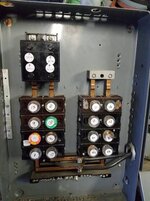
Here a couple good examples of original service equipment. The bigger one is a lot of circuits for a house at the time.

The small one on a board was just nailed to the basement ceiling, I think this was much more common.
I came across a lot of the old wood/asbestos service panels back in the day around omaha.
 
To avoid these ads, REGISTER NOW!

Jim greengo

Well-known member
Joined
Sep 3, 2018
Messages
7,415
Location
Behind my house
Electrical practices have evolved over the years. What was “good enough” in the very early years might be unacceptable today.

When many electrical installations were first built everything was DC. In a DC ungrounded system opening both the Positive and Negative supply lines would ensure the highest degree of Safety.

When I was teaching Electrical Wiring I stressed to my students that Neutral conductors are almost never never switched or fused, an exception would be the Gasoline Dispensing Pumps at a Service Station.
Fused neutrals were common on house services around here back in the day also.
Not very safe,but common. Hahaha
 

AK 99

Active member
Joined
Apr 30, 2022
Messages
26
Location
Washington Courthouse, OH
About a year ago, I bought a house that still has a couple runs of knob and tube in use. I don't believe it to be original? The house was supposedly built in 1900 and from what I've researched, there was not electric service in the area until the late 30's. There used to be a Delco house that housed the Delco generator, I'm guessing the knob and tube wiring is leftover from that. There's actually a lot of knob and tube remaining in the house, but almost all of it is inactive. There's a run of it up in the attic that powers three light fixtures and there's a run of it that I haven't found exactly where in goes yet, but I "think" it powers some light fixtures above the fireplace mantle. The rest of the wiring is all from a later date. The fuse panel has several cartridge fuses and 12 or 14 Edison fuses. Besides the Edison fuses being commonly available still (I guess a lot of folks are surprised by that) I recently discovered that there are resetable breakers available to replace the fuses.

Oddly, all the barns and outbuildings got 'modern' breaker panels and electric installed in 1971. Even the little guest house received a 100 amp breaker panel at that time. But they chose not to update the main house at that time.
 

wyliesdiesels

Well-known member
Joined
Aug 14, 2012
Messages
20,031
Location
Modesto, CA
In 2017 we rewired a '20's home that had a gang knife switch on the neutral side. It was at least a dozen contacts but IIRC more like 18. Big house.

I had a CA licensed C-20 electrical contractor on that job as it was a big job. I'm sorry I let him take the switch.
C-20 is HVAC....

c-10 is electrical
 

mike93lx

ALLIANCE MEMBER
Joined
Dec 9, 2013
Messages
37,642
Location
Richmond, VA
i worked for a guy whose father was a weekend handyman. their summer house started as a garage with apartment above and subsequent additions sprawled here and there as time and funds permitted.

all of the switching was done with relays and low voltage wiring. i have no idea why.

this was a guy who put a seat belt on his john deere yard tractor. unfortunately, when it toppled over an embankment, he ended up underneath.
My folks own a house that has low voltage switching for all the lighting. Place was built by an EE in the 50's (so I am told). There were three dials in the house (front door, back door and master bedroom) with a switch that would allow you to turn on or off 9 lights in the house. It was kind of convenient, but the switches were an annoying style that sometimes required pressing them hard and/or twice.
 

Chukster

Well-known member
Joined
Jan 25, 2012
Messages
2,595
Location
Cary, NC
We toured the Darwin Martin house in Buffalo last year, it's one of Frank Lloyd Wright's designs. No light switches on the upstairs living floor, they were all downstairs, and the Martin's just asked their servants to switch things on & off. There's also an auxiliary house in back, with switches on the main floors, but all the 2-pushbutton kind with brass faceplates.
 

WisJim

Well-known member
Joined
Dec 20, 2010
Messages
2,286
Location
Menomonie, WI
I have a 1897 electrical supply catalog and it's amazing the variety of light fixtures, heaters,coffee and tea pots, etc that were available over 125 years ago. No 2 prong plugs, though. Appliances had Edison thread plugs on the cords.
 

Grb89

New member
Joined
Apr 3, 2023
Messages
2
Just know that knob and tube follows it's own laws. Pretty sure it was used before Ohms Law was discovered:LOL:. I'm joking of course, I like to use that one at work if I'm around the right people, lol. I work with the stuff all the time, it's horrible. the insulation usually just falls right off pretty much. A lot of the time it's hard to tell black from white, 3-ways have no red usually, no wire nuts, instead it's solder with what I think is electrical tape. This means there is usually no choice except to cut it off and most likely the wires are short to begin with. I suggest staying away from it unless you are looking to get some side work. if you need to remove a knob for any reason just bust it with a hammer but have safety glasses on or what i do is look away or close my eyes, lol. Good luck if you need to take out a metal box in the wall, if you do I suggest a grinder and grind what you can then drill holes in the bracket until you can wiggle it out. They are nailed to the front of the stud then drywalled (or sheetRocked) over, cant be very frustrating. If you can find the sweet spot (the top and bottom corners in the center opposite of the stud ) and drill a hole into it, the side will come off if you need to fish a wire into it. The walls are full of what seems to be random obstacles. Back then it was a single gang. the sides come off so they can be connected together to form 2,3,4 or whatever size they wanted.

This is my first post here. I just discovered these forums while looking up a why to loosen up some brand new Vampliers (VT-003-85) linesmen with wire shears.......Spoiler Alert, they are amazing, lol. If only I can loosen them up though. Trying to break them in naturally only seems to make them worse.
 

Grb89

New member
Joined
Apr 3, 2023
Messages
2
I have a 1897 electrical supply catalog and it's amazing the variety of light fixtures, heaters,coffee and tea pots, etc that were available over 125 years ago. No 2 prong plugs, though. Appliances had Edison thread plugs on the cords.
I could spend hours looking at.
 

pbon

Well-known member
Joined
May 14, 2017
Messages
3,498
I have a little bit left to remove in one house. I am pretty sure it is one run that does 3 ceiling lights. I think I have figured out how to get romex to those lights without too much cutting.

At another house, we think we have it all but I need to double check the attic. About 15 years ago we did some renovations and quite a spaghetti cam down the the 1st floor ceiling.

At a house we sold 5 years ago, we had to pay about $8k to have a fair amount removed in order for the buyer to get financing. I had to patch about 8 holes that were cut in walls and ceilings for access.
 
OP
S

southpier

Well-known member
Joined
Jun 28, 2009
Messages
552
....the switches were an annoying style that sometimes required pressing them hard and/or twice.
yes! those are the ones my boss's house had. of course subsequent wiring was line voltage so there were conventional toggle switches and some time later the decora style made its appearance. widely known a "the house that Jack built".
 
OP
S

southpier

Well-known member
Joined
Jun 28, 2009
Messages
552
Q: does new knob & tube wiring have color coded insulation?

everything i've ever seen is so old & dirty i can't remember any color differential.

thanks
 

SlappyWhite

Well-known member
Joined
Oct 3, 2012
Messages
1,819
Location
Upper Canada
I am well acquainted with K&T and a few years ago also rewired my current (1941) house top to bottom.

One question above in the thread, yes there is a white and black wire.

Wires were often tinned for their entire length as the sulphur in the insulation used at the time attacks copper. Not all are this way, depends on the brand...

As for dangers, there are a few:
  • Overheated ceiling light fixtures damaging insulation. The insulation has a much lower temperature rating than modern NMSC and it is common to find the insulation has failed at ceiling light fixtures from people putting multiple high wattage incandescent bulbs in the past (and for decades, insulation eventually fails after decades of this, not right away...). Kitchen is one of the worst locations for this.
  • The panel will be old, corrosion and overheating can be a problem. Not K&T specific but goes hand in hand.
  • Old switches and outlets worn out/failing, again not K&T specific just age.
  • It has been there for 70+ years, odds are it has been messed with. (I found aluminum spliced to K&T, buried splice in no box of course last time around).
  • Three prong outlets installed with no ground. Happens because the outlet needed replacement and big box does not sell two-prong outlets or more often for convenience. Even worse when someone in their infinite wisdom ties neutral and ground together at the outlet to get a "ground". Three prong can be done safely, using a GFCI outlet.
  • With no ground if the hot shorts to the box (box is not grounded) making a switch hot. Won't trip the breaker but touching the screws will make you hot... (rare but still a problem).
  • Not enough circuits/outlets so too much load per circuit.
  • As others noted, not entirely K&T specific but oversized fuses installed by homeowners "solving" the above problem. A breaker could also be replaced the same way but most novice homeowners are not changing breakers.
  • On really old houses there may not be boxes at outlets or switches. My guess is these were wired long after they were constructed...
  • Insurance companies do not like it so expect to pay more OR not get insurance at all....
 
To avoid these ads, REGISTER NOW!
Top Bottom