
You are using an out of date browser. It may not display this or other websites correctly.
You should upgrade or use an alternative browser.
You should upgrade or use an alternative browser.
The Weird Old Ratchet Contest...Show Me What You Got!
- Thread starter BigTexasYardSale
- Start date


Drill Sergeant Arc
Well-known member
One image shows the gear like part removed. What holds that part in place? Is it held stationary against rotation and/or laterally on the shaft? I’m guessing some type of machinery table. You can pull it completely out and move it from one location position to another. Or, with that extra long square drive section, slide it in further to get it out of the way. Can you show a pic of just the gear from the top or bottom?Here's my entry. No maker's mark and I have no idea why you would make such a thing.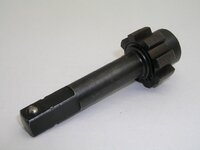
isb cornbinder
Well-known member
A few of my many ratchets.
Attachments


Oldtuleguy
Well-known member
- Joined
- Nov 4, 2017
- Messages
- 10,483
That one is pretty weird bigtex, I think you may have us all beat!
3baygarage
Well-known member
Here's my entry. No maker's mark and I have no idea why you would make such a thing.
That is an interesting one. They used to show up for sale on Ebay a bit in years past. Not sure where they came from.
Indexmill
Well-known member
I don't think it is a ratchet. I don't think it is for sockets... Maybe used to index something attached to the square drive.
Provincial
Well-known member
Similar to some spare tire winches. I think the "driver" may engage the "gear," instead of the square.
d42jeep
Well-known member
Here is a very early S-K ratchet followed by it’s AA write up.


-Don
-Don
Marvin Berry
Well-known member

OP
BigTexasYardSale
Active member
The gear slides on from the square drive end and is held in place by the snap ring you see in the first photo. The gear has tiny teeth on the inside, similar to what you see inside of a ratchet handle. I think I counted 45 teeth. The photo without the gear shows the pawl mechanism, which looks just like a ratchet to me. You turn the top button one way and turning the gear it turns the drive in one direction and ratchets in the other direction. Flip the button on the top and it changes direction, just like a ratchet handle would. Beside the extra long drive shaft the "gear" is an odd design feature. Why not just knurling? It does suggest that maybe something even bigger went over it to turn it, or that it was part of some larger mechanism? The other weird thing is there is no obvious way to take the cartridge apart. The pin that holds the pawl has to come in from the top and is covered by the change direction button but there's no obvious way to release the button.
One image shows the gear like part removed. What holds that part in place? Is it held stationary against rotation and/or laterally on the shaft? I’m guessing some type of machinery table. You can pull it completely out and move it from one location position to another. Or, with that extra long square drive section, slide it in further to get it out of the way. Can you show a pic of just the gear from the top or bottom?
One image shows the gear like part removed. What holds that part in place? Is it held stationary against rotation and/or laterally on the shaft? I’m guessing some type of machinery table. You can pull it completely out and move it from one location position to another. Or, with that extra long square drive section, slide it in further to get it out of the way. Can you show a pic of just the gear from the top or bottom?
OP
BigTexasYardSale
Active member
The t-handle spinner one is an odd one!A few of my many ratchets.
d42jeep
Well-known member
I like some Walden tools. Here are a few I’ve accumulated. 


-Don
-Don
d42jeep
Well-known member
A few more
-Don


-Don
Private Lugnutz
Well-known member
Not sure how OLD it is, but definitely hits the WEIRD mark!That one is pretty weird bigtex,
How many "teeth" are there on the external gear-sleeve? Nine (9)? If so, it's a ratio of one external gear-sleeve tooth for every five (5) fine ratcheting teeth. It articulates finer control, whether fingertip or the something else you and others have suggested.I think I counted 45 teeth.
four.cycle
Well-known member

d42jeep
Well-known member
I’ll have to take another look at it. It doesn’t seem likely that it would be held together with just one rivet. I was outbid recently on one of those cool Walden ratchets.Don, that old S-K 40170 is a pressed-flange design?

-Don
FrankLee
Well-known member
Radian Drive L1 gearless, friction ratchet. Push-thru F/R 1/4" drive.

US4603606A - Unidirectional drive tool cartridge and method of manufacture - Google Patents
A unidirectional drive tool cartridge for use as a torque transmitting device which includes a housing within which is mounted a unidirectional continuous clutch and drive shaft assembly. The drive shaft is carried within a bearing member located within a clutch. The bearing member has a central...
patents.google.com
Attachments


Last edited:

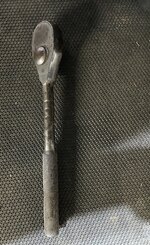
four.cycle
Well-known member
@FrankLee
^ speaking of which, there is a Radian push-through 1/4" drive PALM RATCHET on ebay right now crazy cheap that I would have already snagged but I'm trying to minimize my tool purchases until I get stuff sorted out here.
@RTM - I just remembered why I remembered this one - look at that patent number - not at DATAMP.org and I can't get a copy of the patent from USPTO - what's up with this one?
(* these are the images from the ebay listing so this doesn't get lost. *)
^ speaking of which, there is a Radian push-through 1/4" drive PALM RATCHET on ebay right now crazy cheap that I would have already snagged but I'm trying to minimize my tool purchases until I get stuff sorted out here.
@RTM - I just remembered why I remembered this one - look at that patent number - not at DATAMP.org and I can't get a copy of the patent from USPTO - what's up with this one?
(* these are the images from the ebay listing so this doesn't get lost. *)
Attachments
-
 Radian 1.4 dr palm ratchet (patent 4603606)(ebay 304864906353 01).jpg125 KB · Views: 54
 -
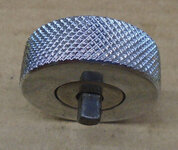 Radian 1.4 dr palm ratchet (patent 4603606)(ebay 304864906353 02).jpg194 KB · Views: 53
 -
 Radian 1.4 dr palm ratchet (patent 4603606)(ebay 304864906353 03).jpg223.4 KB · Views: 49
 -
 Radian 1.4 dr palm ratchet (patent 4603606)(ebay 304864906353 04).jpg220.7 KB · Views: 52
Drill Sergeant Arc
Well-known member
I searched the web and found one on eBay that said it was government surplus but had no other details as to it’s use. Square cut gears are not a particular advantage in most situations and especially in a manually operated sense would be obviously undesirable. My guess is it is to set valve clearances or the like on some type of machine or engine. A cap or cover over an access port is removed and the tool’s square end is inserted to engage a receiver on a gear or shaft end, while the gear bottoms out at the edge of the access opening and aligns with a fulcrum point adjacent to the gear where a screwdriver or pry bar can nudge it back and forth as needed, but then why would you need the ratchet feature? It doesn’t make any sense. The torque capability of the large square cut gear is so much beyond what you would expect the ratchet gearing could withstand, it’s a complete mismatch.Here's my entry. No maker's mark and I have no idea why you would make such a thing.
Private Lugnutz
Well-known member
Okay, you did say Weird and Old, right? 


1. Ca. 1923 Spezial Werkzeugefabrik Feuerbach (SWF) ratchet (5/8-inch male hex drive) head pivots in five positions.
 www.garagejournal.com
2. Early (1921) 1/2-inch square drive ratchet adaptor with an external cam-pin, Allen Manufacturing (yes, THAT Allen), Hartford, CT
www.garagejournal.com
3. Another early (1921) ratchet adaptor (Eastern Machine Screw Corp, New Haven, CT), 5/8-inch male hex drive.
www.garagejournal.com
4. The “Onli-1” – an early (1924) close-quarter (no swing) offset ratchet (King Tools, Asbury Park, NJ), 7/16-inch hex drive.
www.garagejournal.com
5. Another early (1907) ratchet adaptor (5/8-inch square drive) from Charles Miller, Syracuse, NY
www.garagejournal.com
6. Hudgins close-quarter (no swing) ratchet, 3/8-inch square drive. This one is only weird, not old (1982).
www.garagejournal.com
7. Beall “SPEEDEE-RATCH” close-quarter (no swing) ratchet, 1/2-inch square drive.
www.garagejournal.com
8. The Pickop “Pickup” ratchet (1907), 1/2-inch square drive
www.garagejournal.com
9. Very early (1911) ratchet adaptor (Eames Mfg, Boston, MA), 1/2-inch square drive.
www.garagejournal.com
10. Will B. Lane c. 1910 open gear ratchet, 5/8-inch square drive
www.garagejournal.com
11. Early (1913, maybe first) gearless “Friction” ratchet (Allen Wrench & Tool Co., Providence, RI) (this is a different Allen), 1/2-inch square drive
www.garagejournal.com
12. Early (1917) “Universal” (captive swiveling) ratchet (Allen W&T), 1/2-inch square drive
www.garagejournal.com
1. Ca. 1923 Spezial Werkzeugefabrik Feuerbach (SWF) ratchet (5/8-inch male hex drive) head pivots in five positions.
Spezial Werkzeugfabrik Feuerbach D.R.P. Socket Sets
As first reported on the 2018 Garage Sale thread, one of the regular house liquidators at my early bird flea market showed up with a large trailer load of vintage garage tools and equipment this morning. I came home with a bunch of stuff, including a few socket sets. This one, closer to antique...
www.garagejournal.com
2. Early (1921) 1/2-inch square drive ratchet adaptor with an external cam-pin, Allen Manufacturing (yes, THAT Allen), Hartford, CT
c. 1920's Allen "Bay State" Set No. 19
The “Allen” in this Allen "Bay State" Set No. 19… …is Allen Manufacturing in Hartford, Conn., the company most famous for its eponymous hex keys or “Allen wrenches” used in conjunction with set or safety screws, patented (960,244) by W.G. Allen in 1910. The "Bay State" in the name is the...
www.garagejournal.com
3. Another early (1921) ratchet adaptor (Eastern Machine Screw Corp, New Haven, CT), 5/8-inch male hex drive.
c. 1921 Eastern Machine Screw Socket & Ratchet-Wrench Set
I am supposed to be packing for a trip, but Ole Slewfoot and Otg gave me one more excuse to further procrastinate when they tacked on to the end (posts #17 and #18) of my Early Roaring 20’s thread, linked here. According to the 1914 edition of the Special Acts & Resolutions of the State of...
www.garagejournal.com
4. The “Onli-1” – an early (1924) close-quarter (no swing) offset ratchet (King Tools, Asbury Park, NJ), 7/16-inch hex drive.
Onli-1 Socket Set
Onli-1 Socket Set Guy wanted $50 for this set at the flea market today and would not come down! Granted, it’s unique, and probably very rare (might be the “Onli-1” - literally and figuratively) - the only reference I can find to King Tool Company is a pair of patents (1,385,214, and...
www.garagejournal.com
5. Another early (1907) ratchet adaptor (5/8-inch square drive) from Charles Miller, Syracuse, NY
World's First Ever Detachable Crowfoot Wrenches?
I recently acquired this set of primitive detachable crowfoot wrenches from a gent in New Jersey who found them at an estate sale. I have no way of knowing if they originally came from the factory with this little coffin-shaped rack, but I suspect homemade on that. Either way it is easily as...
www.garagejournal.com
6. Hudgins close-quarter (no swing) ratchet, 3/8-inch square drive. This one is only weird, not old (1982).
c. 1982 Hudgins two-way ratchet
I just picked this up at the flea market this morning. It is not quite vintage by classic standards (minus 50 years, nothing later than 1969), but it's certainly not contemporary, and will be more appreciated down here than on the General Discussion forum. The name refers to James L. Hudgins...
www.garagejournal.com
7. Beall “SPEEDEE-RATCH” close-quarter (no swing) ratchet, 1/2-inch square drive.
The "You Must Be Yanking My Chain!" Ratchet, c.1933-1942
As a collector who admires the odd and obscure, I was elated to pick up this “SPEEDEE-RATCH” at the flea market this morning. It’s probably obvious that the spring-steel knob at the end of the handle is meant to be grabbed and pulled, but it might not be so obvious to what purpose...
www.garagejournal.com
8. The Pickop “Pickup” ratchet (1907), 1/2-inch square drive
The Pickop "Pick-up" pick-up
Yes, you read that right. I recently picked up a Pickop "Pick-Up" ratchet-wrench, and one would be hard-pressed to make up a story more eponymous than the story behind this tool, even if you tried!
www.garagejournal.com
9. Very early (1911) ratchet adaptor (Eames Mfg, Boston, MA), 1/2-inch square drive.
c. 1909 Eames Socket Wrenches Automobile Set
Post 1 of 10 I recently splurged for this splendid socket set… …made in 1909 by a pair of brothers, both of them graduates of the Massachusetts Institute of Technology (we’ll get to that later….), and advertised like mad in several trade mags, including Automobile Trade Journal, The...
www.garagejournal.com
10. Will B. Lane c. 1910 open gear ratchet, 5/8-inch square drive
Who made it
Right angle ratcheting, reversible screwdriver. Picked it up at the scrapyard for $.50. Only says “patent applied for” on it Cool little piece and seems well-made
www.garagejournal.com
11. Early (1913, maybe first) gearless “Friction” ratchet (Allen Wrench & Tool Co., Providence, RI) (this is a different Allen), 1/2-inch square drive
Allen Universal Wrench Set No. 51
The Allen "Universal" Wrench Set No. 51 has a uniquely functioning ratchet wrench... ...which gives the wrench and the entire set… …its name. Mr. F.R. Allen (this is not the same Allen as the eponymous hex keys or wrenches), who founded the company with two partners in 1913, was...
www.garagejournal.com
12. Early (1917) “Universal” (captive swiveling) ratchet (Allen W&T), 1/2-inch square drive
Allen Universal Wrench Set No. 51
The Allen "Universal" Wrench Set No. 51 has a uniquely functioning ratchet wrench... ...which gives the wrench and the entire set… …its name. Mr. F.R. Allen (this is not the same Allen as the eponymous hex keys or wrenches), who founded the company with two partners in 1913, was...
www.garagejournal.com
Last edited:
Marvin Berry
Well-known member
Radian Drive L1 gearless, friction ratchet. Push-thru F/R 1/4" drive.
US4603606A - Unidirectional drive tool cartridge and method of manufacture - Google Patents
A unidirectional drive tool cartridge for use as a torque transmitting device which includes a housing within which is mounted a unidirectional continuous clutch and drive shaft assembly. The drive shaft is carried within a bearing member located within a clutch. The bearing member has a central...patents.google.com
I have that ratchet in my drawer, I'll put a few pics up later.@FrankLee
^ speaking of which, there is a Radian push-through 1/4" drive PALM RATCHET on ebay right now crazy cheap that I would have already snagged but I'm trying to minimize my tool purchases until I get stuff sorted out here.
@RTM - I just remembered why I remembered this one - look at that patent number - not at DATAMP.org and I can't get a copy of the patent from USPTO - what's up with this one?
(* these are the images from the ebay listing so this doesn't get lost. *)
four.cycle
Well-known member
^ thanks. now I'm wondering why I couldn't get there. 
Marvin Berry
Well-known member
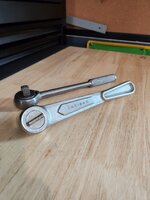
Oh, no, I've had mine for awhile. I just meant I had the palm version. Here it is with a 3/8 Walden and a Palm grip.
Have to say, I'm not a fan of the radian drive ratchet. The action is stiff, and I'm just not a fan of push through ratchet designs.

Have to say, I'm not a fan of the radian drive ratchet. The action is stiff, and I'm just not a fan of push through ratchet designs.
Marvin Berry
Well-known member
And here's an SK Artisan 1/2:

isb cornbinder
Well-known member
I forgot about this SK ratchet. It is made in Germany. Rather than a cog drive system, it uses a frictionless, reversing sprag clutch. I was caught up in the moment and I paid $156,00 for this SK. The extensions are also adapters from metric at the handle to 1/4".
This is one of a bunch of SK stickers. I have them on fridge-magnets.
This is one of a bunch of SK stickers. I have them on fridge-magnets.
Attachments


OP
BigTexasYardSale
Active member
I like the last ratchet, kind of 50's sputnik looking.A few more
-Don
OP
BigTexasYardSale
Active member
Radian Drive L1 gearless, friction ratchet. Push-thru F/R 1/4" drive.
US4603606A - Unidirectional drive tool cartridge and method of manufacture - Google Patents
A unidirectional drive tool cartridge for use as a torque transmitting device which includes a housing within which is mounted a unidirectional continuous clutch and drive shaft assembly. The drive shaft is carried within a bearing member located within a clutch. The bearing member has a central...patents.google.com
OP
BigTexasYardSale
Active member
Now that is cool. I'm not sure I could resist the temptation to take it apart to have a look inside. I looked at the patent drawings and it appears that the rollers roll up on ramps and that is what locks it. What does it feel like when you turn it? I assume there is no clicking like a regular ratchet.
OP
BigTexasYardSale
Active member
WOW! It's interesting that in the early days manufacturers were trying different drive sizes prior to settling on 1/4, 3/8, 1/2, etc.Okay, you did say Weird and Old, right?
1. Ca. 1923 Spezial Werkzeugefabrik Feuerbach (SWF) ratchet (5/8-inch male hex drive) head pivots in five positions.
Spezial Werkzeugfabrik Feuerbach D.R.P. Socket Sets
As first reported on the 2018 Garage Sale thread, one of the regular house liquidators at my early bird flea market showed up with a large trailer load of vintage garage tools and equipment this morning. I came home with a bunch of stuff, including a few socket sets. This one, closer to antique...
2. Early (1921) 1/2-inch square drive ratchet adaptor with an external cam-pin, Allen Manufacturing (yes, THAT Allen), Hartford, CT
c. 1920's Allen "Bay State" Set No. 19
The “Allen” in this Allen "Bay State" Set No. 19… …is Allen Manufacturing in Hartford, Conn., the company most famous for its eponymous hex keys or “Allen wrenches” used in conjunction with set or safety screws, patented (960,244) by W.G. Allen in 1910. The "Bay State" in the name is the...
3. Another early (1921) ratchet adaptor (Eastern Machine Screw Corp, New Haven, CT), 5/8-inch male hex drive.
c. 1921 Eastern Machine Screw Socket & Ratchet-Wrench Set
I am supposed to be packing for a trip, but Ole Slewfoot and Otg gave me one more excuse to further procrastinate when they tacked on to the end (posts #17 and #18) of my Early Roaring 20’s thread, linked here. According to the 1914 edition of the Special Acts & Resolutions of the State of...
4. The “Onli-1” – an early (1924) close-quarter (no swing) offset ratchet (King Tools, Asbury Park, NJ), 7/16-inch hex drive.
Onli-1 Socket Set
Onli-1 Socket Set Guy wanted $50 for this set at the flea market today and would not come down! Granted, it’s unique, and probably very rare (might be the “Onli-1” - literally and figuratively) - the only reference I can find to King Tool Company is a pair of patents (1,385,214, and...
5. Another early ratchet adaptor (5/8-inch square drive) from Charles Miller, Syracuse, NY
World's First Ever Detachable Crowfoot Wrenches?
I recently acquired this set of primitive detachable crowfoot wrenches from a gent in New Jersey who found them at an estate sale. I have no way of knowing if they originally came from the factory with this little coffin-shaped rack, but I suspect homemade on that. Either way it is easily as...
6. Hudgins close-quarter (no swing) ratchet, 3/8-inch square drive. This one is only weird, not old (1982).
c. 1982 Hudgins two-way ratchet
I just picked this up at the flea market this morning. It is not quite vintage by classic standards (minus 50 years, nothing later than 1969), but it's certainly not contemporary, and will be more appreciated down here than on the General Discussion forum. The name refers to James L. Hudgins...
7. Beall “SPEEDEE-RATCH” close-quarter (no swing) ratchet, 1/2-inch square drive.
The "You Must Be Yanking My Chain!" Ratchet, c.1933-1942
As a collector who admires the odd and obscure, I was elated to pick up this “SPEEDEE-RATCH” at the flea market this morning. It’s probably obvious that the spring-steel knob at the end of the handle is meant to be grabbed and pulled, but it might not be so obvious to what purpose...
8. The Pickop “Pickup” ratchet (1907), 1/2-inch square drive
The Pickop "Pick-up" pick-up
Yes, you read that right. I recently picked up a Pickop "Pick-Up" ratchet-wrench, and one would be hard-pressed to make up a story more eponymous than the story behind this tool, even if you tried!
9. Very early (1909) ratchet adaptor (Eames Mfg, Boston, MA), 1/2-inch square drive.
c. 1909 Eames Socket Wrenches Automobile Set
Post 1 of 10 I recently splurged for this splendid socket set… …made in 1909 by a pair of brothers, both of them graduates of the Massachusetts Institute of Technology (we’ll get to that later….), and advertised like mad in several trade mags, including Automobile Trade Journal, The...
10. Will B. Lane c. 1910 open gear ratchet, 5/8-inch square drive
Who made it
Right angle ratcheting, reversible screwdriver. Picked it up at the scrapyard for $.50. Only says “patent applied for” on it Cool little piece and seems well-made
11. Early (1913, maybe first) gearless “Friction” ratchet (Allen Wrench & Tool Co., Providence, RI) (this is a different Allen), 1/2-inch square drive
Allen Universal Wrench Set No. 51
The Allen "Universal" Wrench Set No. 51 has a uniquely functioning ratchet wrench... ...which gives the wrench and the entire set… …its name. Mr. F.R. Allen (this is not the same Allen as the eponymous hex keys or wrenches), who founded the company with two partners in 1913, was...
12. Early (1917) “Universal” (captive swiveling) ratchet (Allen W&T), 1/2-inch square drive
Allen Universal Wrench Set No. 51
The Allen "Universal" Wrench Set No. 51 has a uniquely functioning ratchet wrench... ...which gives the wrench and the entire set… …its name. Mr. F.R. Allen (this is not the same Allen as the eponymous hex keys or wrenches), who founded the company with two partners in 1913, was...
FrankLee
Well-known member
I'm not sure how those come apart... press maybe? I dunno.Now that is cool. I'm not sure I could resist the temptation to take it apart to have a look inside. I looked at the patent drawings and it appears that the rollers roll up on ramps and that is what locks it. What does it feel like when you turn it? I assume there is no clicking like a regular ratchet.
Correct, no clicking. There may be just a bit more drag during reversing non-ratcheting.
OP
BigTexasYardSale
Active member
That is such an interesting concept. With manufacturers engaged in "teeth wars" I wonder why no one has latched on to this just so they could advertise "infinite teeth"? Is there a lot of backlash when you switch directions?I'm not sure how those come apart... press maybe? I dunno.
Correct, no clicking. There may be just a bit more drag during reversing non-ratcheting.
FrankLee
Well-known member
Because it’s push-thru, forward is the same feel as reverse.
I think that’s what you’re asking.
I think that’s what you’re asking.
I've got one like that myself. A 1/2" drive.A few more
-Don
The handle was twisted (owner must have used one heck of a cheater bar!) so I got it cheap. Managed to straighten it and put some heat shrink tubing on it as the knurling was worn. One heck of a paperweight!
Attachments


OP
BigTexasYardSale
Active member
No, sorry, hard to describe. I'll try again. When you switch from backing up (free wheeling, ratcheting, not sure how to put this) to driving how many degrees of handle movement does it take for the mechanism to "lock up" and drive? I'm thinking that it its a 'lot' (what ever that means) that might explain why this type of design is not present commercially. It just doesn't work as good as a super fine tooth ratchet with teeth on teeth.Because it’s push-thru, forward is the same feel as reverse.
I think that’s what you’re asking.
FrankLee
Well-known member
I think you're referring to the same thing when I said "reversing non-ratcheting". Yeah, there seems to be more drag free wheeling.No, sorry, hard to describe. I'll try again. When you switch from backing up (free wheeling, ratcheting, not sure how to put this) to driving how many degrees of handle movement does it take for the mechanism to "lock up" and drive? I'm thinking that it its a 'lot' (what ever that means) that might explain why this type of design is not present commercially. It just doesn't work as good as a super fine tooth ratchet with teeth on teeth.
I wouldn’t say it has infinite "teeth", but it would rival the finest tooth ratchet.
Last edited:
S-K Tool Fanatic!
Well-known member
This old New Britain “Husky“ is a bit goofy.
-Tommy
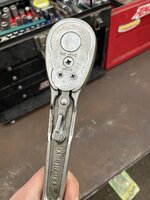
-Tommy


Private Lugnutz
Well-known member
I know you're asking Frank about his Radian, but this is NOT the case with the Allen gearless "Friction" ratchet, which I posted above, or the Blackhawk Freewheeler I have, which uses a series of rollers, and which I have not posted, not considering it terribly old or weird. They grab immediately, release just as quickly, but rotate very smoothly on backswing in my experience. If you're curious, follow the link I posted for the Allen thread above where I posted closeups of the guts....how many degrees of handle movement does it take for the mechanism to "lock up" and drive? I'm thinking that it its a 'lot' (what ever that means) that might explain why this type of design is not present commercially.
OP
BigTexasYardSale
Active member
Definitely. Why have all the extra parts instead of the change lever directly moving the pawl (rhetorical question).This old New Britain “Husky“ is a bit goofy.
-Tommy