Private Lugnutz
Well-known member
"Rothweiler, the Wrench with a Grip" would've had endless possibilities using the likeness of a certain German working dog breed with a strong bite.


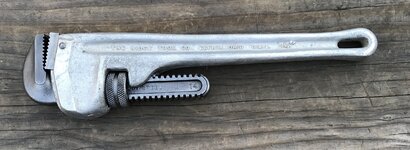
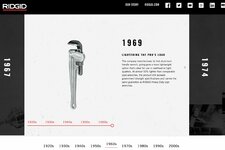
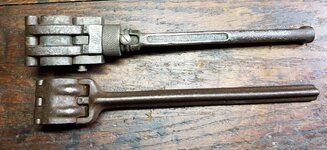
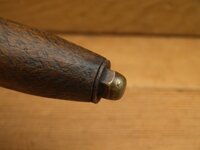
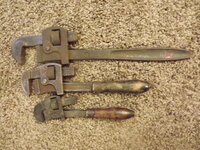
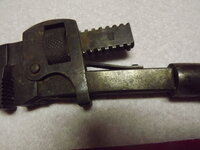
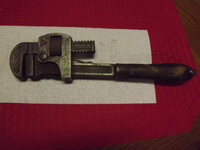
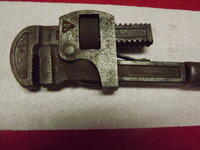
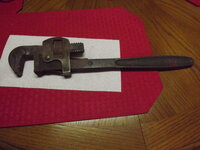
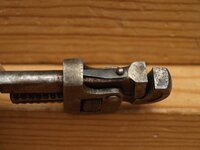
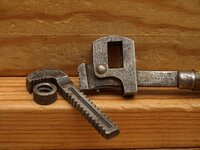
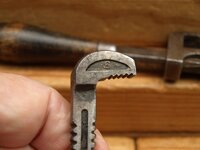
Crescent Forging Co., got this sweet baby in todays mail.
DSCF4200 by wvwheaties, on Flickr
DSCF4199 by wvwheaties, on Flickr
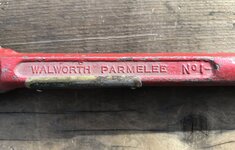
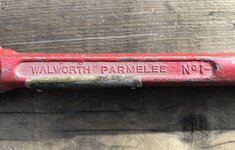
DSCF4197 (2) by wvwheaties, on Flickr
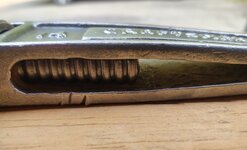
Haven't tried it but it does have some play like in the Stilsons. I'll give it a try tomorrow.That is a cool design! Does the moveable jaw have any play in it, the way Stillsons and others do?
Have you tried it on a pipe or round rod to see how it works?
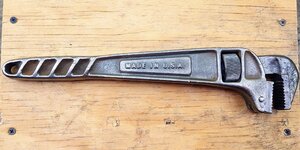
I used these in an old Oilfield in Alaska. We called them "rod wrenches". They clamped onto compressor rods to spin them into the crosshead, so you wouldn't scratch or gouge the polished surface. The engines were Clark, and the compressors were Dresser-Rand. Really neat tools, haven't ever seen them anywhere else.Picked up this unusual pipe wrench this morning at the flea market. Parmelee was making them in Chicago from 1907 to 1913, when they started showing up as a Walworth product branded Walworth-Parmelee. Not sure if they bought them out, licensed it, or what. I'll research that later. The concept is pretty straight forward, and the pictures tell the story, but once you grab the pipe (in this case, 3/4"), and have it hooked, you twist that collar, which locks it into place.
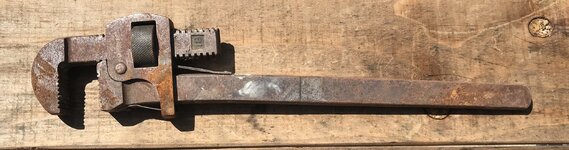


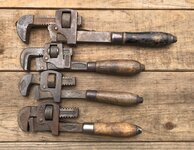
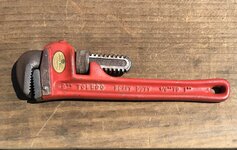
I found this rusty 18” Stillson pipe at a Berkeley sidewalk sale yesterday. It spent a fairly short time in evaporust but responded well. The pieces of the wrench look to me like they are original to the wrench but the hook jaw is marked Pexto and the body of the wrench has Walworth markings. Since Walworth was the inventor of the Stillson wrench I suppose that Pexto could have been using Walworth’s patent on their wrenches but it’s also possible that someone simply put a Pexto jaw on a Walworth wrench.
-Don
After the rust removal.

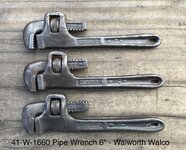









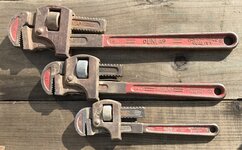

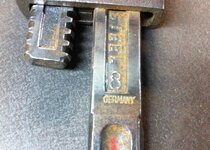
Thanks. I was thinking that Germany was a different brand. So mine would have come from Sears also? Thanks.Just one Dunlap sold by Sears but many different suppliers and styles. 1960 was the last year for Dunlap.
-Don
This is crazy. https://www.ebay.com/itm/2663129014...DetALnUDXW7Bo2lRyFFe4iPcCzINh1ehj6bEidiAaiFUhI would like to find one of those at a sale. They go for WAY too much on eBay.
-Don

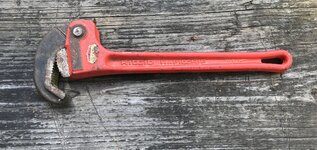
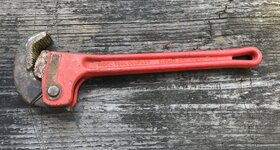

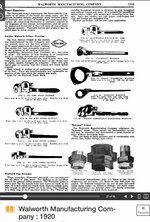
Lugz discusses his upthread.Happy to have found another Parmelee - my second, at the flea yesterday. For 1/2" diameter pipe.
This one is an example of his very first patent (590,853 / March 6, 1888), when he was still making a go of it himself, where the grip was maintained by keeping pressure on the pipe and a cam. My other Parmelee is an example of his fourth and last patent (871,436 / Nov 19, 1907), when he was licensing the design and name to Walworth, and the grip could be secured with a screw-down collar. So, I have his bookends, with two intermediate improvements - 590,853 and 648,706 - in between yet to find.
DATAMP has an interesting biographical tidbit of the kind @woody 73 would appreciate. Homer Parmelee, a Philly man, was 69 years old when he received the first patent!
More pics of the later wrench, more info, and cool period ads in posts #47-51 on page 2. And HeelSpur posted one in post #106 on page 3.
More pics of both wrenches together in thumbnails below.
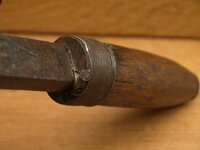
The more significant part of that gubbmint tag is the name on the bottom. I'm not too familiar with the Kaiser Company after WWII. Before it, they were part of a consortium that built three of the big famous western dams. During it, their shipyards famously built 1,000s of ships, mainly, but not exclusively, transports or so called Liberty ships.the government label





 DSCF0777 by wvwheaties, on Flickr
 DSCF1874 (2) by wvwheaties, on Flickr