To avoid these ads, REGISTER NOW!

Metal building 400 ft from house

Ladder26

Member
Joined
Oct 30, 2017
Messages
8
Location
Waterford MI
Hello! First post for me!

We just had our house built, and 400+- feet behind it I had a 28 x 80 metal building built. I'd like to install a 100 amp service to the metal building from the house.

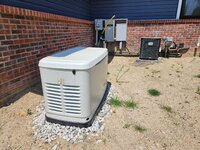
I had a distribution panel(?) Installed after the transfer switch, on the back on the house, next to meter. (then the house has two sub panels, one to run the house and one to run the garage) and the A/C compressor is wired directly off the distribution panel

Here are my questions.

Can I run 400+- feet of "wake forest" 4/0 4/0 4/0 2/0 from the large lugs in the bottom of the distribution panel, through the 3 inch PVC to some kind of junction box or disconnect(?) (suggestions welcome) mounted on the outside of the metal building?

Should I run MHF from the (junction? Disconnect?) box on the side of the barn to the panel inside the building (and should it be 3/0 copper or stick with 4/0 aluminum)

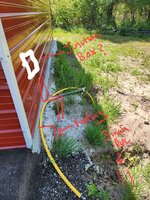
Suggestions on how to transition from the PVC underground, over the footing and to the side of thr building (since I can not go directly up, from the earth, flush with the side of the metal barn.

Is there a particular type of breaker panel I should or should not use for this project?

Will I need expansion joints below either or both panels (on house and barn)

Should or could i use swedge reducer and go down to 2 inch PVC to enter either or both junction boxes (house and barn)?

I am aware that any pvc above the earth needs to be schedule 80, and I will swap out on the house end. I will relocate where it surfaces at that time as well.

Any other suggestions, information and opinions are welcomed

Thanks in advance!

Shane
20230526_121116.jpg20230526_121422.jpg
 
Last edited:
To avoid these ads, REGISTER NOW!

alfredeneuman

Well-known member
Joined
Mar 3, 2011
Messages
4,580
Location
Fullerton, CA
It looks like it doesn't have enough room between the transfer switch and the PVC.
(36" deep clear space without obstruction from the floor up)
 
OP
L

Ladder26

Member
Joined
Oct 30, 2017
Messages
8
Location
Waterford MI
Wow, I'm a little shocked that all I could get for responses to these questions, were two guys who were completely focused on a piece of PVC pipe that won't even exist once this project begins. I know there has to be a few folks on here that have good information to share with me to help me dial this project in!

Shane
 

mm08822

Well-known member
Joined
Jan 13, 2012
Messages
5,925
Location
NJ
Hello! First post for me!

We just had our house built, and 400+- feet behind it I had a 28 x 80 metal building built. I'd like to install a 100 amp service to the metal building from the house. If it is 80' wide, you probably want a second sub-panel on opposite corner. Why 100A? What do you plan to do in there? What are the simultaneous loads?

I had a distribution panel(?) Installed after the transfer switch, on the back on the house, next to meter. (then the house has two sub panels, one to run the house and one to run the garage) and the A/C compressor is wired directly off the distribution panel This is a distribution panel? There are CB's in it? What size CB's? Will/can the barn have a cb in this panel? Need a pic with cover removed.

Here are my questions.

Can I run 400+- feet of "wake forest" 4/0 4/0 4/0 2/0 from the large lugs in the bottom of the distribution panel, through the 3 inch PVC to some kind of junction box or disconnect(?) Is this electrical pvc or drainage pipe? (suggestions welcome) mounted on the outside of the metal building? If you truly will hit 100A load, 250 mcm would be the better choice. You really need to establish the load so you aren't wasting lot's of $$ even for AL. Assuming 100A is your #, 2 - 250 mcm, 1 - 3/0, 1 - #1 XHHW AL would be needed. You don't need a full neutral as you originally suggested.

Should I run MHF from the (junction? Disconnect?) Need the pic w/cover off. box on the side of the barn to the panel inside the building (and should it be 3/0 copper or stick with 4/0 aluminum) At this distance, the last thing I would want is a bundled cable. Stick with individual, straight conductors. Stay away from Cu = $$$$. Try using 2 45's coming out of the ground, maybe chip off some of that footing corner. Bring the conduit up the wall to an LB that enters into the back of the panel. Once you answer what is at the house, it can be determined what is needed on the outside of the barn.

Suggestions on how to transition from the PVC underground, over the footing and to the side of thr building (since I can not go directly up, from the earth, flush with the side of the metal barn. Too late now, but you could have boxed out a 4 " wide space in the footer to get the conduit tighter to the wall or came up inside under the panel.

Is there a particular type of breaker panel I should or should not use for this project? Not really, what doe you currently have?

Will I need expansion joints below either or both panels (on house and barn) For Michigan, I would suggest it.

Should or could i use swedge reducer and go down to 2 inch PVC to enter either or both junction boxes (house and barn)? Let's figure the load and conductor sizes first.

I am aware that any pvc above the earth needs to be schedule 80, and I will swap out on the house end. I will relocate where it surfaces at that time as well. Yup, just plan it out so it isn't fitting city.

Any other suggestions, information and opinions are welcomed What size is the gas line to the gen? What fuel and pressure? Distance to gen from xfer switch? gen size?
What will be the gas pressure out to the barn and loads?

Thanks in advance!

Shane
Wow, I'm a little shocked that all I could get for responses to these questions, were two guys who were completely focused on a piece of PVC pipe that won't even exist once this project begins. You post at Friday midnight of a 3 day weekend! How much traffic did you expect? Most contractors generally install hardware one time and don't rip it out. Everybody hates digging especially around known obstructions. The place to have located that 3" would be to the right to the jbox/dist panel, far enough away to use an LB or LR.

I know there has to be a few folks on here that have good information to share with me to help me dial this project in! There are many, including the 3 who commented about the 3".

Shane
 

LXCam

ALLIANCE MEMBER
Joined
Apr 23, 2013
Messages
19,132
Location
AZ
Well for the building you could go with a LB / close ****** / and a LR or LL to keep it tight.
 

loganb

ALLIANCE MEMBER
Joined
Dec 29, 2011
Messages
5,532
Location
Omaha, NE
Play with a voltage drop calculator/sizing calc like Southwire to get an idea of your options for wire type:


Quick glance at and you'll need to stick with 3/0 copper to stay below 3% drop on a 400' run assuming 100 amp at building and 240v
 

Metal-Marc

Well-known member
Joined
Aug 31, 2009
Messages
7,175
Location
Foothills of the Adirondacks
Wow, I'm a little shocked that all I could get for responses to these questions, were two guys who were completely focused on a piece of PVC pipe that won't even exist once this project begins. I know there has to be a few folks on here that have good information to share with me to help me dial this project in!

Shane
You get what you pay for on the interwebz.
 

Norcal

Well-known member
Joined
Mar 16, 2008
Messages
13,754
Pull direct bury wire and you can put in any kind of pipe you want
I have a really bad & ugly attitude towards electrical cables in water pipe underground ever since I cut a sprinkler line to get it outta my way to repair another only to find I had cut a UF cable inside. The color of the pipe underground sometimes is the only clue as to it's purpose if someone had good sense installing it.
 
OP
L

Ladder26

Member
Joined
Oct 30, 2017
Messages
8
Location
Waterford MI
Hello! First post for me!

We just had our house built, and 400+- feet behind it I had a 28 x 80 metal building built. I'd like to install a 100 amp service to the metal building from the house. If it is 80' wide, you probably want a second sub-panel on opposite corner. Why 100A? What do you plan to do in there? What are the simultaneous loads?
I only want/need one panel, the "shop" section is in the center section of the barn. The other two sections only need 20A plugs and lighting circuits. (far right is for the tractor and 4 doors on left are for car storage)

As for 100 Amps, I landed on this number, because the other panels in my house are 100A and I thought this would be a suitable amount to cover me for anything I plan to do in the future. MIG and TIG welder (Synchrowave 250 and Millermatic 175) probably a 5hp air compressor, hopefully a 3hp bridgeport or similar. along with tyical 1hp and less bench grinder, drill press, etc etc. I'm open to amperage opinion, and would the 4/0 4/0 aluminum hot leads cover me here?

I had a distribution panel(?) Installed after the transfer switch, on the back on the house, next to meter. (then the house has two sub panels, one to run the house and one to run the garage) and the A/C compressor is wired directly off the distribution panel This is a distribution panel? There are CB's in it? What size CB's? Will/can the barn have a cb in this panel? Need a pic with cover removed.

Here are my questions.

Can I run 400+- feet of "wake forest" 4/0 4/0 4/0 2/0 from the large lugs in the bottom of the distribution panel, through the 3 inch PVC to some kind of junction box or disconnect(?) Is this electrical pvc or drainage pipe? (suggestions welcome) mounted on the outside of the metal building? If you truly will hit 100A load, 250 mcm would be the better choice. You really need to establish the load so you aren't wasting lot's of $$ even for AL. Assuming 100A is your #, 2 - 250 mcm, 1 - 3/0, 1 - #1 XHHW AL would be needed. You don't need a full neutral as you originally suggested.
PVC pipe is schedule 40 (drain pipe?) as stated, I will use schedule 80 to replace what is above ground and move where it exits the ground to line up with the panel on the right.


Should I run MHF from the (junction? Disconnect?) Need the pic w/cover off. box on the side of the barn to the panel inside the building (and should it be 3/0 copper or stick with 4/0 aluminum) At this distance, the last thing I would want is a bundled cable. Stick with individual, straight conductors. Stay away from Cu = $$$$. Try using 2 45's coming out of the ground, maybe chip off some of that footing corner. Bring the conduit up the wall to an LB that enters into the back of the panel. Once you answer what is at the house, it can be determined what is needed on the outside of the barn.
Explain why you would suggest single wires vs a bundle wire? it appears that the cost would be the same (for the 4/0 quadruplex vs two 4/0 and smaller neutral and ground) it would seem to me that a single spool of bundled wire would be easier to manage, but again, I'm *not* speaking from experience.

pic of panel below. I was wanting to use the large lugs at the bottom of the bus bar(s) to connect the wire to the barn

Suggestions on how to transition from the PVC underground, over the footing and to the side of thr building (since I can not go directly up, from the earth, flush with the side of the metal barn. Too late now, but you could have boxed out a 4 " wide space in the footer to get the conduit tighter to the wall or came up inside under the panel.

Is there a particular type of breaker panel I should or should not use for this project? Not really, what doe you currently have?
I don't currently have any panel
Will I need expansion joints below either or both panels (on house and barn) For Michigan, I would suggest it.
Noted
Should or could i use swedge reducer and go down to 2 inch PVC to enter either or both junction boxes (house and barn)? Let's figure the load and conductor sizes first.

I am aware that any pvc above the earth needs to be schedule 80, and I will swap out on the house end. I will relocate where it surfaces at that time as well. Yup, just plan it out so it isn't fitting city.

Any other suggestions, information and opinions are welcomed What size is the gas line to the gen? What fuel and pressure? Distance to gen from xfer switch? gen size?
Generator is 18k but I understand the limitations during a power outage and dont need to weld and run machines etc.
gas line to the generator is 1 inch (no idea what the gas pressure to it, is) distance from generator to switch is under 10 feet.
What will be the gas pressure out to the barn and loads?

THANK YOU for the reply and information!

Shane
 

Attachments

  • 20230530_133841.jpg
    20230530_133841.jpg
    1.4 MB · Views: 17
  • 20230530_134048.jpg
    20230530_134048.jpg
    788.5 KB · Views: 22
  • 20230530_134256.jpg
    20230530_134256.jpg
    802.6 KB · Views: 22

Bert_

Well-known member
Joined
Dec 24, 2016
Messages
9,729
Location
NW Iowa
Single conductor do tend to pull easier than twisted cable intended for direct bury.

A junction box or terminal box on the outside of the building is not a bad idea. It would give you a place to reduce the wire size to something that would fit in a 100A panel. I might try to do something similar at the house because neither a 3" pipe or 4/0 wire is going to be much fun in that panel. A underground box like a quazite would be a good choice there.
 
To avoid these ads, REGISTER NOW!

mm08822

Well-known member
Joined
Jan 13, 2012
Messages
5,925
Location
NJ
I only want/need one panel, the "shop" section is in the center section of the barn. The other two sections only need 20A plugs and lighting circuits. (far right is for the tractor and 4 doors on left are for car storage) Ok, might have been better in the center back wall.

As for 100 Amps, I landed on this number, because the other panels in my house are 100A and I thought this would be a suitable amount to cover me for anything I plan to do in the future. MIG and TIG welder (Synchrowave 250 and Millermatic 175) probably a 5hp air compressor, hopefully a 3hp bridgeport or similar. along with tyical 1hp and less bench grinder, drill press, etc etc. I'm open to amperage opinion, and would the 4/0 4/0 aluminum hot leads cover me here? 4/0 could cover it. It all depends on the simultaneous loads. 4/0 AL would be good for 80A at a respectable voltage drop, which is a lot of power.

PVC pipe is schedule 40 (drain pipe?) as stated, I will use schedule 80 to replace what is above ground and move where it exits the ground to line up with the panel on the right. Drain pipe changes a few details. How straight is the drain pipe? Any drain pipe elbows?
How deep is the drain pipe? Now you can't use XHHW but can use USE-2 or URD as Bert suggested. Any chance the drain pipe got crushed during construction?


Use sched 80 electrical conduit (the grey sh*t) to come out of the ground on both ends. Use all electrical fittings and include the exp sleeves. Putting a disconnect on the garage exterior will give you a place to transition the wire sizes and protect the 4/0 feeder much lower than 200A (in the xfer panel @house). Come into the garage panel back-back from the disconnect.

Explain why you would suggest single wires vs a bundle wire? it appears that the cost would be the same (for the 4/0 quadruplex vs two 4/0 and smaller neutral and ground) it would seem to me that a single spool of bundled wire would be easier to manage, but again, I'm *not* speaking from experience. Had nothing to do with cost but ease in pulling. Laying out 4 reels/coils of single conductor is no big deal.

pic of panel below. I was wanting to use the large lugs at the bottom of the bus bar(s) to connect the wire to the barn You can. Those conductors are still short circuit protected by the 200 A cb in the xfer switch. The bonding screw is still present in the outside distribution panel. It needs to be completely removed. A pic of inside the xfer switch would be good to have. Is the neutral bar in it bonded to ground?

I don't currently have any panel I meant what is used in the house.

Noted


Generator is 18k but I understand the limitations during a power outage and dont need to weld and run machines etc.
gas line to the generator is 1 inch (no idea what the gas pressure to it, is) distance from generator to switch is under 10 feet. Take a pic of the gas meter tags. I'm asking b/c 400' is a long distance and I see the tubing out at the barn.
What will be the gas pressure out to the barn and loads?

THANK YOU for the reply and information!

Shane
 

Norcal

Well-known member
Joined
Mar 16, 2008
Messages
13,754
That BR breaker has no business in a Siemens panel, the only non Siemens breaker UL classified for Siemens panels is Eaton CL.
 

dave*99

Well-known member
Joined
May 5, 2009
Messages
4,268
Location
Coastal NJ
How did all that service equipment get located so close together? I see a gas meter, A/C condenser, intake and (2)exhaust for a heater, a window and maybe a dryer vent. When I built my house, I had loads or clearances to observe on those items. I thought I was going to need a bigger house to have enough wall space to make it all work.

1685550149214.jpeg
 
OP
L

Ladder26

Member
Joined
Oct 30, 2017
Messages
8
Location
Waterford MI
How did all that service equipment get located so close together? I see a gas meter, A/C condenser, intake and (2)exhaust for a heater, a window and maybe a dryer vent. When I built my house, I had loads or clearances to observe on those items. I thought I was going to need a bigger house to have enough wall space to make it all work.

1685550149214.jpeg
Possibly codes are different here? There was never any discussion about clearance or proximity to one another. I was actually happy to get all the mechanicals in one corner, together. (You see two intakes and two exhaust... for furnace and water heater. Then you see a dryer vent and a central vacuum vent)
 

dave*99

Well-known member
Joined
May 5, 2009
Messages
4,268
Location
Coastal NJ
Possibly codes are different here? There was never any discussion about clearance or proximity to one another. I was actually happy to get all the mechanicals in one corner, together. (You see two intakes and two exhaust... for furnace and water heater. Then you see a dryer vent and a central vacuum vent)
How high does snow get there? I see the furnace and water heater intakes are low.

Most of the requirements I dealt with were invoked by the AHJ via the owners manuals of the equipment.

Exhausts had to be away from windows by a certain distance (Gas appliance rules that are similar in most owners manuals)

Gas meter (particularly the regulator) had to be away from everything by some distance. The gas utility had their own set of diagrams and rules.

Stuff like this:

1685558539831.png
 
OP
L

Ladder26

Member
Joined
Oct 30, 2017
Messages
8
Location
Waterford MI
How high does snow get there? I see the furnace and water heater intakes are low.

Most of the requirements I dealt with were invoked by the AHJ via the owners manuals of the equipment.

Exhausts had to be away from windows by a certain distance (Gas appliance rules that are similar in most owners manuals)

Gas meter (particularly the regulator) had to be away from everything by some distance. The gas utility had their own set of diagrams and rules.

Stuff like this:

1685558539831.png
I'm 40 Miles north west of Detroit, we certainly have the potential for snow. I was/am aware of the intakes for both the water heater and furnace. The overhangs and the fact that the mechanical area is sort of inset and surrounded on 3 sides by walls may have helped keep the snow from being an issue. But I will certainly keep an eye on that!
 
OP
L

Ladder26

Member
Joined
Oct 30, 2017
Messages
8
Location
Waterford MI
I only want/need one panel, the "shop" section is in the center section of the barn. The other two sections only need 20A plugs and lighting circuits. (far right is for the tractor and 4 doors on left are for car storage) Ok, might have been better in the center back wall.

As for 100 Amps, I landed on this number, because the other panels in my house are 100A and I thought this would be a suitable amount to cover me for anything I plan to do in the future. MIG and TIG welder (Synchrowave 250 and Millermatic 175) probably a 5hp air compressor, hopefully a 3hp bridgeport or similar. along with tyical 1hp and less bench grinder, drill press, etc etc. I'm open to amperage opinion, and would the 4/0 4/0 aluminum hot leads cover me here? 4/0 could cover it. It all depends on the simultaneous loads. 4/0 AL would be good for 80A at a respectable voltage drop, which is a lot of power.
If I go with aluminum 4/0 4/0 for L1 and L2, what size should the neutral and ground be?


PVC pipe is schedule 40 (drain pipe?) as stated, I will use schedule 80 to replace what is above ground and move where it exits the ground to line up with the panel on the right. Drain pipe changes a few details. How straight is the drain pipe? Any drain pipe elbows?
How deep is the drain pipe? Now you can't use XHHW but can use USE-2 or URD as Bert suggested. Any chance the drain pipe got crushed during construction?
its a straight shot to the barn from the house with no bends (other than to naturally arch) the only elbows will be a sweeping 90s that Ill install to get above ground at the house and barn side. depth will range from 4+ feet near the house to around 2 feet near the barn (Ill have to measure to be sure)
and I certainly hope the pipe didn't get crushed or that will really make things difficult haha!


Use sched 80 electrical conduit (the grey sh*t) to come out of the ground on both ends. Use all electrical fittings and include the exp sleeves. Putting a disconnect on the garage exterior will give you a place to transition the wire sizes and protect the 4/0 feeder much lower than 200A (in the xfer panel @house). Come into the garage panel back-back from the disconnect.
any suggestions on a disconnect? and then what size wire should I transition to, that I can run 30ish feet through the building?
Explain why you would suggest single wires vs a bundle wire? it appears that the cost would be the same (for the 4/0 quadruplex vs two 4/0 and smaller neutral and ground) it would seem to me that a single spool of bundled wire would be easier to manage, but again, I'm *not* speaking from experience. Had nothing to do with cost but ease in pulling. Laying out 4 reels/coils of single conductor is no big deal.

pic of panel below. I was wanting to use the large lugs at the bottom of the bus bar(s) to connect the wire to the barn You can. Those conductors are still short circuit protected by the 200 A cb in the xfer switch. The bonding screw is still present in the outside distribution panel. It needs to be completely removed. A pic of inside the xfer switch would be good to have. Is the neutral bar in it bonded to ground?

I don't currently have any panel I meant what is used in the house.

Noted


Generator is 18k but I understand the limitations during a power outage and dont need to weld and run machines etc.
gas line to the generator is 1 inch (no idea what the gas pressure to it, is) distance from generator to switch is under 10 feet. Take a pic of the gas meter tags. I'm asking b/c 400' is a long distance and I see the tubing out at the barn.
What will be the gas pressure out to the barn and loads?
The gas meter has to be changed. I didn't realize there would be an issue once the generator was installed. Unfortunately I'm on a waiting list, as Consumers Energy says they will not have any till late 2023.
There is approximately 400 feet of 1 inch gas line to the barn. The plan is to run a 50k BTU unit heater, or radiant tube heater.

Shane
 

Bert_

Well-known member
Joined
Dec 24, 2016
Messages
9,729
Location
NW Iowa
How high does snow get there? I see the furnace and water heater intakes are low.

Most of the requirements I dealt with were invoked by the AHJ via the owners manuals of the equipment.

Exhausts had to be away from windows by a certain distance (Gas appliance rules that are similar in most owners manuals)

Gas meter (particularly the regulator) had to be away from everything by some distance. The gas utility had their own set of diagrams and rules.

Stuff like this:

1685558539831.png
The gas company has distance requirements, until they themselves break them. I've had two times where they have brought the riser up and set a gas meter directly in front of the electrical service.

When I mentioned it to the service man he just said "we'll put a non venting regulator". If I had made the screw up they probably would have made me move it
 

wyliesdiesels

Well-known member
Joined
Aug 14, 2012
Messages
20,014
Location
Modesto, CA
Play with a voltage drop calculator/sizing calc like Southwire to get an idea of your options for wire type:


Quick glance at and you'll need to stick with 3/0 copper to stay below 3% drop on a 400' run assuming 100 amp at building and 240v
i would not use that calculator as it oversizes wire some times. the formula for wire calcs is in the electrical FAQ sticky
 

wyliesdiesels

Well-known member
Joined
Aug 14, 2012
Messages
20,014
Location
Modesto, CA
I wonder what the electrician that did the install would say if I called him out on this?
youd be surprised how many electricians have no clue about using non-listed breakers in a panel. happens all the time. or he'll say thats the only one i had the store was out and it fits....
 

rickpaulos

Well-known member
Joined
Mar 4, 2019
Messages
85
Location
Iowa
I'm 40 Miles north west of Detroit, we certainly have the potential for snow. I was/am aware of the intakes for both the water heater and furnace. The overhangs and the fact that the mechanical area is sort of inset and surrounded on 3 sides by walls may have helped keep the snow from being an issue. But I will certainly keep an eye on that!
Its not just snow. Leaves can get sucked in, mice and insects, wasps build mud nests inside the pipes. Most furnaces have air pressure differential shut offs. If those detect any air resistance in the pipes, it shuts off the gas flow. IMO, our shop furnace installation had too many 90 degree corners in the pipes. You could not fish them to clear out the golf balls size mud wasp nests. We had to cut the pipes to remove them to clean them out. We used pvc union joints to reinstall for future cleaning.

Putting screens on the intake is a problem. A too fine screen will restrict the air flow so the gas gets shut off. Any larger mesh screen (1/4") may keep leaves & mice out but won't keep bugs out. Some mfds recommend no screens in the winter when the furnace is running most.

Gas pressure. On the house side of the meter, the pressure is about 0.5 psi for natural gas although it's not normally measured in psi. 7 inches of water column is normal. Company owned distribution lines can be any where from 200 to 1500 psi. For a 400 foot run you may need the utility to run a separate supply line to the building and then have a second meter there. Gas meters are also pressure regulators that convert city pressure to the much lower (and safer) house pressure. Electric heat pumps or mini splits might be an easier install.

Some installers will put brightly colored warning tape in the ground above the lines so those get seen by any one with an excavator before they hit the lines. Utilities are color coded so different tape for electric vs gas, etc.
 
To avoid these ads, REGISTER NOW!
Top Bottom