
You are using an out of date browser. It may not display this or other websites correctly.
You should upgrade or use an alternative browser.
You should upgrade or use an alternative browser.
SnapOn socket chroming...
- Thread starter CoThG
- Start date
Boogerman
Well-known member
Several years ago, this covered several threads, you might search "SK sockets painted inside". Got to the point where guys were trying to warranty their socket sets because they weren't chromed inside, and they were hoping the replacements were.
Gist of it is; sockets not chromed inside, or chromed to less extent. Many just dipped in silver paint.
Just use them, don't worry about it. Unless you just tool collector; in that case, wax the inside and it will keep unsightly rust stains away.
Here's some thread links from my quick search:
 www.garagejournal.com
www.garagejournal.com
www.garagejournal.com
www.garagejournal.com
www.garagejournal.com
www.garagejournal.com
www.garagejournal.com
www.garagejournal.com
www.garagejournal.com
Gist of it is; sockets not chromed inside, or chromed to less extent. Many just dipped in silver paint.
Just use them, don't worry about it. Unless you just tool collector; in that case, wax the inside and it will keep unsightly rust stains away.
Here's some thread links from my quick search:
SK sockets randomly chromed inside
This has been posted about before, at least as far back as 2012. But sadly, I didn't do a search before ordering these for Christmas. Maybe chrome or not inside doesn't make any difference... but the randomness of this doesn't give me confidence the tolerances will be right or the heat...
www.garagejournal.com
SK socket interior finish question. (pics)
Look at post 4423 Tools from the old world Thanks for that interesting exchange. Here it is for posterity, with the non relevant parts redacted but in order. Hi guys I have a funny one with Facom's customer service, I wrote them an e-mail because from the size 18 and up the inside of their...
www.garagejournal.com
sk chrome on the inside of sockets?
So I'm still deciding on what sockets to get. I keep looking at SK but always find pictures of sockets without chrome as in the picture below. Has anyone bought a set in the last 6 months that can verify if any of them are like this? Notice some of them are satin inside?
www.garagejournal.com
SK sockets
All my metrics are Stahlwille, I don't use SAE very often but would like build a new set. I've already got a near complete set of SK combination wrenches so I'm leaning toward their socket sets. I've heard a few folks complaining about SK sockets, is there something I don't know? They look...
www.garagejournal.com
SK Sockets
I just want to make a comment about SK sockets. I've read several posts on here about the satin finish inside some SK sockets and not others. When looking at my sets, sizes about 3/8" and up have the satin like "paint" It seems it is paint over the chrome for a small layer of added protection...
www.garagejournal.com
I believe for all chrome plated tools, this is done as the last step after forging/broaching/stamping/polishing. Otherwise the chrome would crack/peel from the other processes.Are SnapOn sockets chromed after they are broached or before? I've watched some videos where it's claimed that Tekton sockets are not chromed on the inside. That would make them susceptible to corrosion.
Sockets not being chromed on the inside or not to the same extent or not polished is extremely common and will not affect the durability of the tool on its own.
Chrome isn't going to be maintained inside the socket over time anyhow. Every time it's used it's an act of mild abrasion, which is why sockets wear out over time too or anything else metal on metal, so just oil them occasionally and rust won't be an issue.
seber
Well-known member
My opinion is that chrome on the inside is a bad idea. Stress from use will make it crack and peel, messing up the fit.
Garcky
Well-known member
Who cares if the inside of a socket is chrome plated? I don't get it.
It reminds me of a sales pitch I saw at a state fair booth for some "miracle" knife or another. The pitchman, somewhere in the pitch said, very quickly, "Never needs sharpening - never take it out of the box." All in the flat, uninflected tone that pitchmen use so nobody will listen to it.
All of those sockets you never use will stay shiny and bright for decades, too.
It reminds me of a sales pitch I saw at a state fair booth for some "miracle" knife or another. The pitchman, somewhere in the pitch said, very quickly, "Never needs sharpening - never take it out of the box." All in the flat, uninflected tone that pitchmen use so nobody will listen to it.
All of those sockets you never use will stay shiny and bright for decades, too.
rooster59
Well-known member
Maybe here:
Ricky Joe
Well-known member
If anything, it will add to the durability of the socket. Chrome takes up space, and when it chips or wears, the socket may no longer fit well. I prefer unchromed sockets and wrenches for that reason.I believe for all chrome plated tools, this is done as the last step after forging/broaching/stamping/polishing. Otherwise the chrome would crack/peel from the other processes.
Sockets not being chromed on the inside or not to the same extent or not polished is extremely common and will not affect the durability of the tool on its own.
purplezr2
Well-known member
Guessing these are plated on the inside, but it more of a satin finish, no high polished like the outside.
finn
Well-known member
Chrome is the last step, except for possibly polishing.
Chroming the inside of a socket is a sign of bad in house process. Chrome will develop micro cracks in use, and those micro cracks eventually migrate into the base metal and can cause a catastrophic failure.
Back when chrome plating was common on piston rings, the vendors developed a high crack content chrome plating to alleviate this. Lots of tiny micro racks wouldn’t propagate, so ring breakage was reduced.
Some fuel injection parts, like wave washers, have a high crack content chrome for the same reason. Low crack chrome eventually develops large cracks, which propagate into the base, then the washer breaks.
Sockets don’t really go through a lot of cycles in their lifetime, on a comparative scale, but, in any event, they do see relatively large compressive and tensile loads, and I wouldn’t be surprised if the same crack generation and propagation scenario exists. I suspect this failure mode is one reason impact sockets are never chromed.
Given a choice, I would stay away from sockets that are internally chromed, all other things being equal.
Chroming the inside of a socket is a sign of bad in house process. Chrome will develop micro cracks in use, and those micro cracks eventually migrate into the base metal and can cause a catastrophic failure.
Back when chrome plating was common on piston rings, the vendors developed a high crack content chrome plating to alleviate this. Lots of tiny micro racks wouldn’t propagate, so ring breakage was reduced.
Some fuel injection parts, like wave washers, have a high crack content chrome for the same reason. Low crack chrome eventually develops large cracks, which propagate into the base, then the washer breaks.
Sockets don’t really go through a lot of cycles in their lifetime, on a comparative scale, but, in any event, they do see relatively large compressive and tensile loads, and I wouldn’t be surprised if the same crack generation and propagation scenario exists. I suspect this failure mode is one reason impact sockets are never chromed.
Given a choice, I would stay away from sockets that are internally chromed, all other things being equal.
finn
Well-known member
Duplicate because of bad internet connection in the shop
Bubba Fett
Well-known member
I figure chroming the inside would alter the dimensions.
Insides typically aren't highly plated because nickel and chrome usually doesn't "throw" well into recesses; especially on large depths and small diameters; like a one inch diameter hole thru a 6" thick part. You tend to get a mess; some call it *************.
It also changes dimensions as said. And it's just not necessary.
It also changes dimensions as said. And it's just not necessary.
Draftpick1
Well-known member
- Joined
- Mar 22, 2018
- Messages
- 326
Walkers
Well-known member
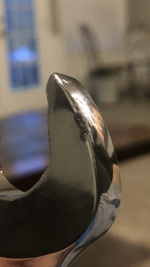
That is usually what they look like when dropped on a battery!Not a socket but Snap On chrome related I have a new Snap On wrench that has some sort of factory defect in either the forging or chrome brand new out of the box 3/4 reverse ratcheting wrench 1/4 long spot with some pitting
Hit it with a buffer, or live with it, or trade it back in. For the price of them today they should be damn near perfect!
Draftpick1
Well-known member
- Joined
- Mar 22, 2018
- Messages
- 326
I sent a picture to Snap on, they sent me the wrenches directly waiting to see what they say about it.That is usually what they look like when dropped on a battery!
Hit it with a buffer, or live with it, or trade it back in. For the price of them today they should be damn near perfect!
That’s a defect and it’s structural. You need a replacement wrench.
That doesn’t look chrome related. Looks like the underlying material is defective. If customer service gives you any ****, I’d ask to speak to engineering. No engineer will say that’s ok, or you can just ”buff it out”.
That doesn’t look chrome related. Looks like the underlying material is defective. If customer service gives you any ****, I’d ask to speak to engineering. No engineer will say that’s ok, or you can just ”buff it out”.