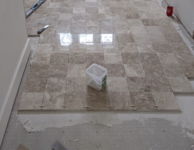
Subfloor - cement board - isolation membrane - tile
All bonded and installed CORRECTLY with the appropriate and sufficient fasteners and adhesives (aka thinset).
All over a properly installed sub structure (the floor joists). With the subfloor glued and screwed to the floor joists, with appropriate blocking/bracing between the floor joists (not always done or done correctly by a LOT of framers/builders, especially on older homes or during building booms when the contractors are subbing out work to the fastest and lowest bidder subs).
OSB subfloor on 19.2" OC I-joist is generally NOT sufficiently stiff for a successful tile installation. As evidenced by your existing cracked 4" floor tiles.
btw, minimum Code requirements are just that. The bare(ly) acceptable MINIMUM. Done to the minimum Code requirements, I usually find most floor structures too bouncy. Generally, those floors are 'strong' enough structurally. But they may or may not be stiff enough for successful tile installation. Hence the cement board AND isolation membrane (aka Ditra) for use under a tiled floor.
You stated you have/had 4" floor tiles, and some of those cracked. Installed properly and installed over a proper subfloor, tiles should NEVER crack IMNSHO unless damaged from impact. You are proposing to use 12 x 24 floor tiles now. Make SURE that your floor system is stiff enough for the large format tile.
You indicated that your existing tile floor was installed over cement backer board that was NOT bonded to the OSB subfloor with thinset. That is not really the correct method. The CBB is supposed to be bonded with thinset to the wooden subfloor AND screwed to the subfloor. So that it is not going anywhere and forms one solid support for the tiles that is not flexing and bending in between layers. And the seams taped with glass mesh tape embedded in thinset which dries/cures before you then get to put the thinset used to bond the tiles to the floor in place.
And remember that the tile must be fully back buttered with thinset and not just "spot bonded" with a couple of dollops of thinset. The floor must have full coverage with thinset as well, and the tile and the floor must be bonded to one another with full thinset coverage with no voids or hollows between the tile and the substrate.