To avoid these ads, REGISTER NOW!

Cement Board or Uncoupling Membrane for Tile Floor in Bathroom

Kilgore Trout

Well-known member
Joined
Dec 30, 2013
Messages
153
Location
Northern Virginia
I am getting ready to re-tile my bathroom floor with 12x24 tile. The old floor was osb/cement board/tile. Some of the exisiting 4x4 tiles are cracked. No many, but a few. That said, they are 20+ years old, so it can happen.

So my question is should I get new cement board or go with something like DITRA XL? I used Kerdi-board to redo my shower and it worked really well, but that was really just because I did the shower early in the pandemic and I could get it delivered to my house.

So, any opinions on what is better? My time is worth money, so I don't mind paying a bit more in materials if it will save me time now and/or in the future.
 
To avoid these ads, REGISTER NOW!

cgrutt

Well-known member
Joined
Mar 4, 2016
Messages
8,351
I've used Ditra over hardibacker on several projects with good results. If you use Ditra make sure you read instructions for whatever tile you are using. Generally I believe you want to use non-modified thinset mortar between (most) tiles and the Ditra. Modified thinset won't cure properly. To adhere Ditra to subfloor use non modified thinset over concrete or concrete backer and modified thinset over OSB or plywood. I believe some tiles require epoxy modified adhesive for proper adhesion. Ditra is good stuff. Good luck.
 

duneslider

Well-known member
Joined
Jan 20, 2013
Messages
2,267
Location
Riverton, Utah
What is your reasoning for wanting to use Ditra-XL?

I personally like ditra much more better than any backerboard, however, done right they both will be just fine. Ditra is a little more expensive but it is easier to use so it gets my money.

Modified thinset will cure just fine under and over ditra but it may take longer to cure. Some areas it can be hard to find a quality non-modified thinset to use with ditra. I have regularly used CBP Versabond as well as Laticrete Gold above and below Ditra. I also use those same ones under and over backerboard.
 

dcg9381

Well-known member
Joined
Jun 20, 2018
Messages
11,883
Location
Austin, TX
Here, I build my own shower pans out of fiberglass over OSB (or pay someone to do it). We leak test the whole pan. On one bathroom I did, outside of the pan, I basically coated the entire bathroom in polyester resin. No glass mat, but did 2 coats of resin on the entire floor and tiled over that. It's stinky for a while when drying - maybe so much so that it's a bad idea on a remodel that you have to live in?
 

rlitman

Well-known member
Joined
Oct 18, 2010
Messages
24,650
Location
Long Island
I too am wondering why Ditra XL. FYI, Ditra Heat is halfway in the middle of thickness between original Ditra and Ditra XL. I just did my bathroom using Laticrete Strata Heat mat, which is functionally equivalent to Ditra Heat, except that the Laticrete product is translucent, so you can see through it enough to know you have no voids beneath it.

Anyway, if this is over wood joists, do you know what the calculated span deflection is for expected loads?
 

mike93lx

ALLIANCE MEMBER
Joined
Dec 9, 2013
Messages
37,844
Location
Richmond, VA
I like ditra a lot and did use heat in a bathroom remodel.

They have a great installation guide that tells you what the subfloor needs to be. I'd read through it and carefully think about thickness and level compared to neighboring rooms
 

Shiftless

Well-known member
Joined
Mar 9, 2014
Messages
14,562
Location
East Bay SFO
It is for the span deflection reason that I used cement board over the sub floor on the floor of our master bath when I remodeled. 12x12 porcelain tiles on the floor…no cracking 10 years later.
 
OP
K

Kilgore Trout

Well-known member
Joined
Dec 30, 2013
Messages
153
Location
Northern Virginia
The current installation was 1/2 cement board over osb with no mortar between. Joists are 19 inches apart. My thought on using DITRA XL was the thought that it would allow a better transition to the hardwoods outside the bathroom. Don't know the deflection calculation, but in terms of loads, the only loads will be people and the bathroom vanity (about 300lbs over a 72 inch span).
 
OP
K

Kilgore Trout

Well-known member
Joined
Dec 30, 2013
Messages
153
Location
Northern Virginia
I suppose I could get a bit fancy and go 1/4 cement board and normal DITRA.

Edit: I plan to use Schluter All Set regardless. I used it for the shower and it worked great and I still have an unopened 50lb bag ready to go. Schluter says it is good for any of their products.
 
OP
K

Kilgore Trout

Well-known member
Joined
Dec 30, 2013
Messages
153
Location
Northern Virginia
If I believe their website, OSB subfloor is fine for DITRA straight on it. You are supposed to use DTRA XL if the joists are 24 inches. Mine are 19 (with 3/4 inch OSB) so I think in theory I can go right over the floor.
 

gsmith22

Well-known member
Joined
Jul 14, 2015
Messages
337
Location
Central NJ
I skimmed the prior responses and didn't see a discussion on it so I thought I would add what Ditra's (or any uncoupling membrane's) purpose is: physically seperate the tile from the floor structure so movement in the floor doesn't translate to movement in the tile and resultant tile/mortar joint cracking.

Think of the floor surface as having several layers - like several sheets of paper stacked on top of each other. Now hold the ends of the paper, push down in the middle and you will see that the sheets of paper vertically deflect, the paper faces slide horizontally along the interface planes showing how vertical deflection in the paper (ie the floor) induces horizontal movement between the layers of the paper (floor). If the tile is physically attaced to the floor (ie tile thinsetted directly to wood sheathing or cement board), vertical movement in the floor translates to horizontal movement between the layers and will tend to cause thinset/tile/grout cracks. If you "uncouple" the tile from the floor framing, the floor structure slides horizontally below the thinset/tile/grout layer eliminating movement and cracking.

The bottom of Ditra's orange plastic sheet is physically bonded to the underlying framing with thinset via the fleece backing. So the dimpled plastic sheet is attached to and moves with the floor framing. The tile and thinset placed over top of the plastic dimpled sheet is not physically bonded to the plastic (because thinset doesn't bond to plastic surfaces). However, the thinset between the sheet and tiles is locked into the plastic sheet via the dovetail geometery of the dimples (which causes a mathcing profile to be created in the cured thinset). If you want no cracks, make the floor structure as vertically stiff as possible (I would add layers of wood sheathing not cement board) and then use an uncompling membrane.
 
To avoid these ads, REGISTER NOW!

rlitman

Well-known member
Joined
Oct 18, 2010
Messages
24,650
Location
Long Island
I bet that Schulter will say to add 5/8 or 3/4 ply on the osb, then ditra right on it.

I'd use advantech
Advantech makes a great subfloor. In my most recent bathroom project, I removed all of the plywood and pine subfloor and replaced it with a single layer of Advantech 1-1/8" subfloor (glued and screwed down) with Laticrete Strata Heat over it.

While a thicker wood subfloor is a good thing, more layers of wood can be bad, particularly when they're not well bonded to each other.
 

Walkers

Well-known member
Joined
May 17, 2021
Messages
3,912
Location
Cave Creek Az
Having recently pulled up a room full of slate that had the fabric decoupling stuff under some areas where the slate was going over cracks in the concrete, I can tell you that those areas were vastly stronger and more crack resistant that the areas without. It easily took triple the effort to remove those tiles. This product was fabric, self stick, anti-crack membrane.
 

duneslider

Well-known member
Joined
Jan 20, 2013
Messages
2,267
Location
Riverton, Utah
Ditra-xl should match up to your 3/4" wood floor better than regular ditra.

The schluter all set is a great product. What is funny...is it IS a modified thinset and can be used under and over ditra and kerdi. If that is available to you then use it, it is a fantastic thinset. It isn't well stocked in my area, so I don't use it often.

When people were asking you the span, they were talking about the joist span. What type of joists are in this area and what is their length from bearing point to bearing point.

If you had tile down before and it was fine then it will likely be fine again but its always nice to double check the details.
 

dcg9381

Well-known member
Joined
Jun 20, 2018
Messages
11,883
Location
Austin, TX
I skimmed the prior responses and didn't see a discussion on it so I thought I would add what Ditra's (or any uncoupling membrane's) purpose is: physically seperate the tile from the floor structure so movement in the floor doesn't translate to movement in the tile and resultant tile/mortar joint cracking.
Ahh.. I didn't know that, I just assumed it was waterproofing. That product makes sense.

Advantech makes a great subfloor. In my most recent bathroom project, I removed all of the plywood and pine subfloor and replaced it with a single layer of Advantech 1-1/8" subfloor
This is what our subfloor was done in. This stuff is heavy and notches together. Our tile is laid straight over this in the master bath (not the shower), we've had no issues with any cracking in 3 years.. Course have the right stucture below the flooring helps.
 

duneslider

Well-known member
Joined
Jan 20, 2013
Messages
2,267
Location
Riverton, Utah
This is what our subfloor was done in. This stuff is heavy and notches together. Our tile is laid straight over this in the master bath (not the shower), we've had no issues with any cracking in 3 years.. Course have the right stucture below the flooring helps.
I really hope this works out for you long term, that is not an approved method. Huber wood even says not to do it. Here is a link to their pdf about it. Huber Wood
 

MoonRise

Well-known member
Joined
Nov 5, 2010
Messages
4,031
Location
NJ
Subfloor - cement board - isolation membrane - tile

All bonded and installed CORRECTLY with the appropriate and sufficient fasteners and adhesives (aka thinset).

All over a properly installed sub structure (the floor joists). With the subfloor glued and screwed to the floor joists, with appropriate blocking/bracing between the floor joists (not always done or done correctly by a LOT of framers/builders, especially on older homes or during building booms when the contractors are subbing out work to the fastest and lowest bidder subs).

OSB subfloor on 19.2" OC I-joist is generally NOT sufficiently stiff for a successful tile installation. As evidenced by your existing cracked 4" floor tiles.

btw, minimum Code requirements are just that. The bare(ly) acceptable MINIMUM. Done to the minimum Code requirements, I usually find most floor structures too bouncy. Generally, those floors are 'strong' enough structurally. But they may or may not be stiff enough for successful tile installation. Hence the cement board AND isolation membrane (aka Ditra) for use under a tiled floor.

You stated you have/had 4" floor tiles, and some of those cracked. Installed properly and installed over a proper subfloor, tiles should NEVER crack IMNSHO unless damaged from impact. You are proposing to use 12 x 24 floor tiles now. Make SURE that your floor system is stiff enough for the large format tile.

You indicated that your existing tile floor was installed over cement backer board that was NOT bonded to the OSB subfloor with thinset. That is not really the correct method. The CBB is supposed to be bonded with thinset to the wooden subfloor AND screwed to the subfloor. So that it is not going anywhere and forms one solid support for the tiles that is not flexing and bending in between layers. And the seams taped with glass mesh tape embedded in thinset which dries/cures before you then get to put the thinset used to bond the tiles to the floor in place.

And remember that the tile must be fully back buttered with thinset and not just "spot bonded" with a couple of dollops of thinset. The floor must have full coverage with thinset as well, and the tile and the floor must be bonded to one another with full thinset coverage with no voids or hollows between the tile and the substrate.
 

dogdog

Well-known member
Joined
Nov 15, 2011
Messages
12,711
^^^
what post 22 says, I used hardierbacker boards / fiber cement boards, not cement boards, from HD or Lowes. but you will have to make sure that the subfloor it lays on does not flex otherwise it will crack.. and only reason it will crack, not because it ages. but vibration or flexing from the sub-floor.

some will give you a square grid patterns. and on the pattern you will notice round circles size of a screw heads... those are ment as a guide for you to make sure a screw is in it. also thinset there as well. I believe it's every 6" or 3" needed... I just remember I skipped a few on my earlier installation and those tile cracked after some time. pretty sure it;s not age... other area that have sufficnent screws and not flexing is fine.
 

rlitman

Well-known member
Joined
Oct 18, 2010
Messages
24,650
Location
Long Island
Subfloor - cement board - isolation membrane - tile...
Except that the isolation membrane folks will tell you that their product should go right onto the subfloor. There's zero advantage to having cement board under Ditra or another structured isolation product. Now if you're planning on just using RedGard or another liquid applied rubber isolation, then yeah, I get your drift. If you're using Ditra or Stratamat or whatever, just thinset down a strip of waterproof membrane (Kerdi band, etc.) under seams in your mat and use REAL corners (no folding BS).

In the end, cement board offers very little additional stiffness to your floor, and isn't great at isolating movement. If your subfloor is good enough for this, then great. If you've got any doubts about your joist deflection, go with the Ditra.

As for Hardi, I won't touch that stuff. It is NOT waterproof. I'll stick to Wonderboard, Durock etc. Yes, there's a newer generation of fibercement boards that has a waterproof coating, and yes, fibercement cuts a little easier if you like sawing, but it's still full of wood fibers that are known to rot over time.
 

duneslider

Well-known member
Joined
Jan 20, 2013
Messages
2,267
Location
Riverton, Utah
Fiber cement will last just as long, or longer than cement board. I would pick it over cement board all day. BUT I have zero desire to touch fiber cement board or cement board. I can carry a roll of ditra on each shoulder and that will cover 650sqft. It installs easier, faster, and works better. Even as cheap as I am the extra cost for ditra or strata is worth it all day every day.
 

dcg9381

Well-known member
Joined
Jun 20, 2018
Messages
11,883
Location
Austin, TX
The floor above has existed for about 2 years now, no cracks. Our grout is epoxy (I'll never use anything else) and most of the bathroom is not a "wet area". I dunno if small tiles help or not. The shower pans - we do those differently here in the south, but even the ones that I did (I pulled out some of the GCs work) - we leak test for weeks. Apparently there are about 10 ways to skin the bathroom tile cat.
 
OP
K

Kilgore Trout

Well-known member
Joined
Dec 30, 2013
Messages
153
Location
Northern Virginia
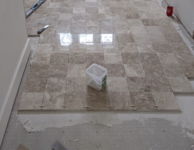
Well, install is now done. I went with 1/4 inch hardibacker over the OSB and DITRA over that. With the hardibacker I couldn't feel any bounce to the floor and certainly not after I had adhered the DITRA. The tile adheres absurdly well to the DITRA. I had one tile that only had wet all-set on about 25% (it was a tile that was going to be a tight fit so I had to test fit it) and it was nigh impossible to pull it up to finish putting all set on the DITRA and tile. I had to get out a pry bar...

In retrospect I can see why people put DITRA straight on the subfloor - it was stupidly easy to cut it to the right shape. It was certainly a lot less work than cutting all of the hardibacker. The hardibacker was probably overkill, but fingers crossed will lead to a long lived install.

The other side benefit of the DITRA was that the grid lines made it really easy to line up the tiles.

On a related note, I used a bosch bulldog extreme SDS to knock out the old floor and bust up the old vanity top (to make it light enough to carry down stairs). What an awesome tool. Made both jobs really easy.
 

duneslider

Well-known member
Joined
Jan 20, 2013
Messages
2,267
Location
Riverton, Utah
The time and effort saved using ditra far outways the extra cost. The hardibacker won't necessarily make the floor better but it does make the floor system denser which sort of does make the whole assembly better. Less vibration, less noise transmission, etc. So, it was extra cost and effort but I wouldn't normally recommend anyone do it but nothing wrong with doing if you want to.
 
To avoid these ads, REGISTER NOW!
Top Bottom