cherokee
Well-known member
I have been slowly installing a home made (home made means I am doing it not just cutting a check to someone to do it all) solar power setup for the house. There is just a ton of things that go into this, aside from the basic "house" wire for power type things, you need to learn about solar systems and the different panels, as well as charge controllers, batteries all that stuff.
My system is fairly small, currently at 400w of solar panels, and 400Ah of battery power. Plans are to setup a wind turbine, and double the solar panels. I already have this stuff, but just not got it installed yet. So many things to do.
I will really not go into too much on the different things, if anyone has questions just ask. I don't want the opening post to be too wordy.
When you go down this road you need a basic understanding of Ohm's Law as you will use it more then you ever have in the past. The panels all have max DC voltages and current, the charge controllers also have limits. You want to make sure you size everything correctly (unlike me) so you don't have to do everything twice.
I would also suggest you stick with a "name brand" charge controller. It is not that the amazon "cheapie" don't work, they do work, or I have not had any issues yet, but the support is just not there. Working with the Renogy (solar company) controller helped me figure out the "chinese" controllers.
There are really just three things you need to get started. A battery, a solar panel, and an inverter. I will do a quick 101 on each.
The battery, a deep cycle battery of any kind will do just fine. You don't need Lipo batteries, or more exact lifepo4 batteries. This is the type that is most popular today, but that old deep cycle battery from your boat will do just fine for starters. You will just need to watch it. One thing the "new" batteries give you are controllers in the battery that will not let you over charge or discharge them too much. Some even have Blutooth in them to talk to your phone and see all the stats on the battery, cycles, discharge rates....all kinds of things.
Solar Panels. Again there are a great many kinds, some work better in the cold, others work better in the hot like the south west US. They all heat up, and with that they loose some of their ability to make little electrical pixies from the sun. The panels I am using are a mix of Renogy and Harbor Freight panels. The HF panels are actually quite good, on par with the most expensive panels. They don't use the "standard" connector, but that means little if you are starting out, you just need everything the same. If you have over one panel you can hook them up in series or parallel. This is where Ohm's law comes in handy, you will double something voltage or current, your charge controller needs to be able to take what you are sending it. There are also goods and bads around both ways of connection. The shade on a panel will effect the array in different ways, if you hook it up and crank up the current, you need wire to handle that, and we all know copper is expensive. And on wire know that CCA is the devils own device. You want real copper....all coper.
The charge controller is the device that takes your solar voltage and puts it into the batteries. They are all "smart" now and will not over charge your batteries, but some will let you discharge them too much, this can depend on many things, batteries, controller....you. If you want it "automatic" you will pay more for that. Mine is all manual.
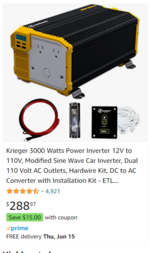
Inverters are the gizmo that takes the DC from the batteries and turns it into AC. There are again two types, pure sign and...well not, modified. Just like it suggests one is a "real" sign wave, the modified you will see the "steps" in the wave form if you hook up an O-scope. Some things will not have as great an issue with modified, other things will. Motors will be more "happy" with pure sign. And again you will pay more for the pure sign wave inverter. Most inverters have "outlets" on them, so you can turn the thing on and go. You really don't "need" more then that. Now if you want to hook it to your house, then you do need that transfer panel.
The transfer panel can be manual or automatic. Mine is manual and does 6 different circuits. The panel I bought was for 220, but I only have 110 "things plugged" into it.
Yesterday was the first day I did a real "test" of the system. It rained all day long so there was no sun, so no charging was going on. In three hours of running everything in the shop but the 220 stuff and the welder I ran that system for 3 hours and took 1/4 out of the batteries. I also used the sander, bench grinder, and a 15a Chop saw that I had actually forgot I was still on solar when I was working. The compressor also kicked on a time or two as I was using a 220 plasma cutter. I am pretty happy with that. I think I could make it all day. Today we are still overcast so not sure how much sun I will get today, I don't know how long it will take to get the batteries charged up.
On to the pics:
These are of my transfer panel. Mine is setup for 220, but my inverter is not. So I could not, or did not want to use the 220 "outlet" that came with the panel. A standard 30a, outlet is what I installed in the panel. It is not pretty but it works. In the first photo you can see everything is on line. This is from "the grid" and you can see the meters are dead. The second photo is everything switched to "gen" this is my battery bank/inverter. In the second photo you can see the meters moved showing they are pulling out of the battery.
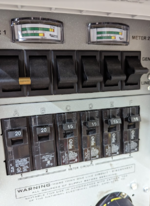

This photo is of the "main" panel. you will see the bits of tape on the breakers. This will tell me what circuit is on the transfer panel, they are labeled A-F So you know what is running when you flip the switch.

This is the cart I have everything on but the solar panels. I did this so I could bring it to the house and run things like the furnace blower, lights and fridge as well as freezers. The blue inverter is very old and a modified sign, the black is a pure sign. They are usually sized by what watts they can support. Again Ohm's law will tell you ball park what you are going to be pulling from it, and with that have an idea on how long it will run on battery. I did this as we have been out of power for 14 days straight in the past. If I can shut down my propane gen for just over night and power off this, I will save on propane. I should be able to run over night depending on how much the furnace needs to run.

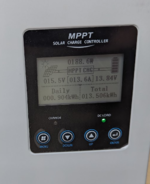
Forgive the wire mess, still a work in progress. The big green thing is a "dump load" for the wind turbine that is not installed. With wind you need a dump load for someplace for the power to go if your batteries are fully charged. My wind turbine is not setup yet, sorry no photos. The little blue guy is a cheapo chinese charge controller. It is not really "good" but it does work. When you go to "good" controllers, as well as inverters you find they take less power to run. The charge controller as well as inverters need power to work. The "better" the device the less parasitic draw they will have.....and that is that much more for your batteries or power going to run your AC devices. Every drop helps.

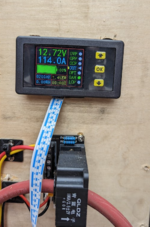
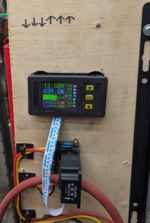
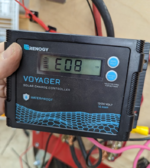
My "good" controller I bought too small. Here is a pic of it with an error code. You want some "wiggle room" when sizing your devices. I had 10 amps so I bought a 10 amp controller, well when it was a clear blue day the panels actually make more then they are rated for. So the charge controller will shut down rather then kill itself. Is that good or bad, well it is making more then the panel is rated for, but I can't use it.....So now I am looking at other charge controllers. The little blue one in the above photo is a 30A and costs nothing from Amazon, the Renogy controller costs roughly the same money but is a much more efficient device. I will use this for another project to power some DC things that are waiting in the wings.
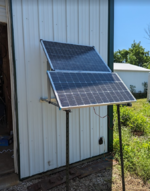
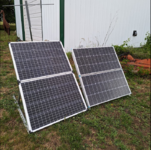
The setup of the 4 panels at the moment. I am going to build them to hang on the side of the building. I don't want them on the roof. Why you ask, well it is a 24' side wall shop and I don't like climbing up there. I will only loose about an hour of sun if I hang them on that side of the building, they will also be real easy to work on should the need come along. You can see the two different kinds of panels, two are Renogy and two are HF. I don't remember what is what, but on that sunny day both made more power then they are rated for.
That is it in a nutshell, as I said this is a real quick over view of my system. It is still very much a work in progress, as you can tell by some of the mess and the panels sitting on the ground.
If you have questions I will do my best to answer them, if there seems to be interest I will update the thread as I get more things done. Currently I am taking a bit of a rest from it, need to fix a mower and hang some more lights in the shop, as well as get a "good" charge controller, thinking 60A may do me depending on the input voltage of the unit. I bought too small. So hopefully my mistake will help you avoid making the same.
My system is fairly small, currently at 400w of solar panels, and 400Ah of battery power. Plans are to setup a wind turbine, and double the solar panels. I already have this stuff, but just not got it installed yet. So many things to do.
I will really not go into too much on the different things, if anyone has questions just ask. I don't want the opening post to be too wordy.
When you go down this road you need a basic understanding of Ohm's Law as you will use it more then you ever have in the past. The panels all have max DC voltages and current, the charge controllers also have limits. You want to make sure you size everything correctly (unlike me) so you don't have to do everything twice.
I would also suggest you stick with a "name brand" charge controller. It is not that the amazon "cheapie" don't work, they do work, or I have not had any issues yet, but the support is just not there. Working with the Renogy (solar company) controller helped me figure out the "chinese" controllers.
There are really just three things you need to get started. A battery, a solar panel, and an inverter. I will do a quick 101 on each.
The battery, a deep cycle battery of any kind will do just fine. You don't need Lipo batteries, or more exact lifepo4 batteries. This is the type that is most popular today, but that old deep cycle battery from your boat will do just fine for starters. You will just need to watch it. One thing the "new" batteries give you are controllers in the battery that will not let you over charge or discharge them too much. Some even have Blutooth in them to talk to your phone and see all the stats on the battery, cycles, discharge rates....all kinds of things.
Solar Panels. Again there are a great many kinds, some work better in the cold, others work better in the hot like the south west US. They all heat up, and with that they loose some of their ability to make little electrical pixies from the sun. The panels I am using are a mix of Renogy and Harbor Freight panels. The HF panels are actually quite good, on par with the most expensive panels. They don't use the "standard" connector, but that means little if you are starting out, you just need everything the same. If you have over one panel you can hook them up in series or parallel. This is where Ohm's law comes in handy, you will double something voltage or current, your charge controller needs to be able to take what you are sending it. There are also goods and bads around both ways of connection. The shade on a panel will effect the array in different ways, if you hook it up and crank up the current, you need wire to handle that, and we all know copper is expensive. And on wire know that CCA is the devils own device. You want real copper....all coper.
The charge controller is the device that takes your solar voltage and puts it into the batteries. They are all "smart" now and will not over charge your batteries, but some will let you discharge them too much, this can depend on many things, batteries, controller....you. If you want it "automatic" you will pay more for that. Mine is all manual.
Inverters are the gizmo that takes the DC from the batteries and turns it into AC. There are again two types, pure sign and...well not, modified. Just like it suggests one is a "real" sign wave, the modified you will see the "steps" in the wave form if you hook up an O-scope. Some things will not have as great an issue with modified, other things will. Motors will be more "happy" with pure sign. And again you will pay more for the pure sign wave inverter. Most inverters have "outlets" on them, so you can turn the thing on and go. You really don't "need" more then that. Now if you want to hook it to your house, then you do need that transfer panel.
The transfer panel can be manual or automatic. Mine is manual and does 6 different circuits. The panel I bought was for 220, but I only have 110 "things plugged" into it.
Yesterday was the first day I did a real "test" of the system. It rained all day long so there was no sun, so no charging was going on. In three hours of running everything in the shop but the 220 stuff and the welder I ran that system for 3 hours and took 1/4 out of the batteries. I also used the sander, bench grinder, and a 15a Chop saw that I had actually forgot I was still on solar when I was working. The compressor also kicked on a time or two as I was using a 220 plasma cutter. I am pretty happy with that. I think I could make it all day. Today we are still overcast so not sure how much sun I will get today, I don't know how long it will take to get the batteries charged up.
On to the pics:
These are of my transfer panel. Mine is setup for 220, but my inverter is not. So I could not, or did not want to use the 220 "outlet" that came with the panel. A standard 30a, outlet is what I installed in the panel. It is not pretty but it works. In the first photo you can see everything is on line. This is from "the grid" and you can see the meters are dead. The second photo is everything switched to "gen" this is my battery bank/inverter. In the second photo you can see the meters moved showing they are pulling out of the battery.
This photo is of the "main" panel. you will see the bits of tape on the breakers. This will tell me what circuit is on the transfer panel, they are labeled A-F So you know what is running when you flip the switch.
This is the cart I have everything on but the solar panels. I did this so I could bring it to the house and run things like the furnace blower, lights and fridge as well as freezers. The blue inverter is very old and a modified sign, the black is a pure sign. They are usually sized by what watts they can support. Again Ohm's law will tell you ball park what you are going to be pulling from it, and with that have an idea on how long it will run on battery. I did this as we have been out of power for 14 days straight in the past. If I can shut down my propane gen for just over night and power off this, I will save on propane. I should be able to run over night depending on how much the furnace needs to run.
Forgive the wire mess, still a work in progress. The big green thing is a "dump load" for the wind turbine that is not installed. With wind you need a dump load for someplace for the power to go if your batteries are fully charged. My wind turbine is not setup yet, sorry no photos. The little blue guy is a cheapo chinese charge controller. It is not really "good" but it does work. When you go to "good" controllers, as well as inverters you find they take less power to run. The charge controller as well as inverters need power to work. The "better" the device the less parasitic draw they will have.....and that is that much more for your batteries or power going to run your AC devices. Every drop helps.
My "good" controller I bought too small. Here is a pic of it with an error code. You want some "wiggle room" when sizing your devices. I had 10 amps so I bought a 10 amp controller, well when it was a clear blue day the panels actually make more then they are rated for. So the charge controller will shut down rather then kill itself. Is that good or bad, well it is making more then the panel is rated for, but I can't use it.....So now I am looking at other charge controllers. The little blue one in the above photo is a 30A and costs nothing from Amazon, the Renogy controller costs roughly the same money but is a much more efficient device. I will use this for another project to power some DC things that are waiting in the wings.
The setup of the 4 panels at the moment. I am going to build them to hang on the side of the building. I don't want them on the roof. Why you ask, well it is a 24' side wall shop and I don't like climbing up there. I will only loose about an hour of sun if I hang them on that side of the building, they will also be real easy to work on should the need come along. You can see the two different kinds of panels, two are Renogy and two are HF. I don't remember what is what, but on that sunny day both made more power then they are rated for.
That is it in a nutshell, as I said this is a real quick over view of my system. It is still very much a work in progress, as you can tell by some of the mess and the panels sitting on the ground.
If you have questions I will do my best to answer them, if there seems to be interest I will update the thread as I get more things done. Currently I am taking a bit of a rest from it, need to fix a mower and hang some more lights in the shop, as well as get a "good" charge controller, thinking 60A may do me depending on the input voltage of the unit. I bought too small. So hopefully my mistake will help you avoid making the same.