To avoid these ads, REGISTER NOW!

Solar Power for Cherokee's shop.

cherokee

Well-known member
Joined
Mar 2, 2010
Messages
980
Location
Kansas City MO
I have been slowly installing a home made (home made means I am doing it not just cutting a check to someone to do it all) solar power setup for the house. There is just a ton of things that go into this, aside from the basic "house" wire for power type things, you need to learn about solar systems and the different panels, as well as charge controllers, batteries all that stuff.

My system is fairly small, currently at 400w of solar panels, and 400Ah of battery power. Plans are to setup a wind turbine, and double the solar panels. I already have this stuff, but just not got it installed yet. So many things to do.

I will really not go into too much on the different things, if anyone has questions just ask. I don't want the opening post to be too wordy.

When you go down this road you need a basic understanding of Ohm's Law as you will use it more then you ever have in the past. The panels all have max DC voltages and current, the charge controllers also have limits. You want to make sure you size everything correctly (unlike me) so you don't have to do everything twice.

I would also suggest you stick with a "name brand" charge controller. It is not that the amazon "cheapie" don't work, they do work, or I have not had any issues yet, but the support is just not there. Working with the Renogy (solar company) controller helped me figure out the "chinese" controllers.

There are really just three things you need to get started. A battery, a solar panel, and an inverter. I will do a quick 101 on each.

The battery, a deep cycle battery of any kind will do just fine. You don't need Lipo batteries, or more exact lifepo4 batteries. This is the type that is most popular today, but that old deep cycle battery from your boat will do just fine for starters. You will just need to watch it. One thing the "new" batteries give you are controllers in the battery that will not let you over charge or discharge them too much. Some even have Blutooth in them to talk to your phone and see all the stats on the battery, cycles, discharge rates....all kinds of things.

Solar Panels. Again there are a great many kinds, some work better in the cold, others work better in the hot like the south west US. They all heat up, and with that they loose some of their ability to make little electrical pixies from the sun. The panels I am using are a mix of Renogy and Harbor Freight panels. The HF panels are actually quite good, on par with the most expensive panels. They don't use the "standard" connector, but that means little if you are starting out, you just need everything the same. If you have over one panel you can hook them up in series or parallel. This is where Ohm's law comes in handy, you will double something voltage or current, your charge controller needs to be able to take what you are sending it. There are also goods and bads around both ways of connection. The shade on a panel will effect the array in different ways, if you hook it up and crank up the current, you need wire to handle that, and we all know copper is expensive. And on wire know that CCA is the devils own device. You want real copper....all coper.

The charge controller is the device that takes your solar voltage and puts it into the batteries. They are all "smart" now and will not over charge your batteries, but some will let you discharge them too much, this can depend on many things, batteries, controller....you. If you want it "automatic" you will pay more for that. Mine is all manual.

Inverters are the gizmo that takes the DC from the batteries and turns it into AC. There are again two types, pure sign and...well not, modified. Just like it suggests one is a "real" sign wave, the modified you will see the "steps" in the wave form if you hook up an O-scope. Some things will not have as great an issue with modified, other things will. Motors will be more "happy" with pure sign. And again you will pay more for the pure sign wave inverter. Most inverters have "outlets" on them, so you can turn the thing on and go. You really don't "need" more then that. Now if you want to hook it to your house, then you do need that transfer panel.

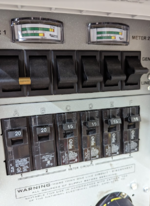
The transfer panel can be manual or automatic. Mine is manual and does 6 different circuits. The panel I bought was for 220, but I only have 110 "things plugged" into it.

Yesterday was the first day I did a real "test" of the system. It rained all day long so there was no sun, so no charging was going on. In three hours of running everything in the shop but the 220 stuff and the welder I ran that system for 3 hours and took 1/4 out of the batteries. I also used the sander, bench grinder, and a 15a Chop saw that I had actually forgot I was still on solar when I was working. The compressor also kicked on a time or two as I was using a 220 plasma cutter. I am pretty happy with that. I think I could make it all day. Today we are still overcast so not sure how much sun I will get today, I don't know how long it will take to get the batteries charged up.

On to the pics:

These are of my transfer panel. Mine is setup for 220, but my inverter is not. So I could not, or did not want to use the 220 "outlet" that came with the panel. A standard 30a, outlet is what I installed in the panel. It is not pretty but it works. In the first photo you can see everything is on line. This is from "the grid" and you can see the meters are dead. The second photo is everything switched to "gen" this is my battery bank/inverter. In the second photo you can see the meters moved showing they are pulling out of the battery.
1686571413166.png
1686571435033.png

This photo is of the "main" panel. you will see the bits of tape on the breakers. This will tell me what circuit is on the transfer panel, they are labeled A-F So you know what is running when you flip the switch.

1686571852953.png

This is the cart I have everything on but the solar panels. I did this so I could bring it to the house and run things like the furnace blower, lights and fridge as well as freezers. The blue inverter is very old and a modified sign, the black is a pure sign. They are usually sized by what watts they can support. Again Ohm's law will tell you ball park what you are going to be pulling from it, and with that have an idea on how long it will run on battery. I did this as we have been out of power for 14 days straight in the past. If I can shut down my propane gen for just over night and power off this, I will save on propane. I should be able to run over night depending on how much the furnace needs to run.

1686572077395.png

Forgive the wire mess, still a work in progress. The big green thing is a "dump load" for the wind turbine that is not installed. With wind you need a dump load for someplace for the power to go if your batteries are fully charged. My wind turbine is not setup yet, sorry no photos. The little blue guy is a cheapo chinese charge controller. It is not really "good" but it does work. When you go to "good" controllers, as well as inverters you find they take less power to run. The charge controller as well as inverters need power to work. The "better" the device the less parasitic draw they will have.....and that is that much more for your batteries or power going to run your AC devices. Every drop helps.

1686572299852.png

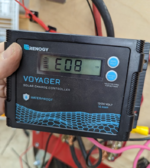
My "good" controller I bought too small. Here is a pic of it with an error code. You want some "wiggle room" when sizing your devices. I had 10 amps so I bought a 10 amp controller, well when it was a clear blue day the panels actually make more then they are rated for. So the charge controller will shut down rather then kill itself. Is that good or bad, well it is making more then the panel is rated for, but I can't use it.....So now I am looking at other charge controllers. The little blue one in the above photo is a 30A and costs nothing from Amazon, the Renogy controller costs roughly the same money but is a much more efficient device. I will use this for another project to power some DC things that are waiting in the wings.
1686572397713.png

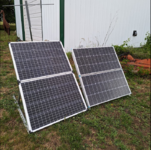
The setup of the 4 panels at the moment. I am going to build them to hang on the side of the building. I don't want them on the roof. Why you ask, well it is a 24' side wall shop and I don't like climbing up there. I will only loose about an hour of sun if I hang them on that side of the building, they will also be real easy to work on should the need come along. You can see the two different kinds of panels, two are Renogy and two are HF. I don't remember what is what, but on that sunny day both made more power then they are rated for.
1686572596687.png

That is it in a nutshell, as I said this is a real quick over view of my system. It is still very much a work in progress, as you can tell by some of the mess and the panels sitting on the ground.

If you have questions I will do my best to answer them, if there seems to be interest I will update the thread as I get more things done. Currently I am taking a bit of a rest from it, need to fix a mower and hang some more lights in the shop, as well as get a "good" charge controller, thinking 60A may do me depending on the input voltage of the unit. I bought too small. So hopefully my mistake will help you avoid making the same.
 
To avoid these ads, REGISTER NOW!

Monza Harry

Well-known member
Joined
Dec 29, 2018
Messages
1,433
Location
Windsor ON
Interesting! Now for a quick thought can a π filter be built/sourced for the modified sine wave invertors? Or are the power level making this cost prohibitive? Now will your cart promote cooling by convection loops (thermo siphon) or will this need a fan? That wire wound resistor will need some cooling help and likely some thermo blocking to the wooden box. Thanx for sharing! Harry
 
OP
C

cherokee

Well-known member
Joined
Mar 2, 2010
Messages
980
Location
Kansas City MO
Interesting! Now for a quick thought can a π filter be built/sourced for the modified sine wave invertors? Or are the power level making this cost prohibitive? Now will your cart promote cooling by convection loops (thermo siphon) or will this need a fan? That wire wound resistor will need some cooling help and likely some thermo blocking to the wooden box. Thanx for sharing! Harry
I don't think it would be "worth it" to build your own inverter. It would be a fun project I would think, but for me there comes a time when you say, this is just not worth the time and research.

As too cooling, we have had some pretty wacko weather here lately, mornings in the low 50's, and afternoons in the mid 80's, fairly cool. I have not had any heating issues during my one long run. The inverter itself will have its fans kick on from time to time, but everything was cool to the touch. When it gets "HOT" out there later this summer, I will need to see if everything will breathe like it needs to.

Depending on how much the mower fights me I might get to it this weekend, taking a few days off next week. I need to fish or cut bait and get the new controller on order. I imagine it would not be difficult to make this as well yourself. I would love to get things hung on the building. Put up two more lights last night.

Even with the temps in the mid 70's, the top of the shop was hot as hell. Yet another project. Need to get all this "big stuff" done before I retire and the income will be reduced.
 

Monza Harry

Well-known member
Joined
Dec 29, 2018
Messages
1,433
Location
Windsor ON
A π filter is to clean the steps out of the modified invertors output wave form. The filter is a capacitor across the leads then a single inductance inline on one leed then another capacitor across the leeds so it physically looks like the π symbol. Exceptional for DC but I'm not sure how well this would work for AC. I was thinking of a way to enable the use of some lower priced invertors for at least some of the power creation. Harry
 
OP
C

cherokee

Well-known member
Joined
Mar 2, 2010
Messages
980
Location
Kansas City MO
A π filter is to clean the steps out of the modified invertors output wave form. The filter is a capacitor across the leads then a single inductance inline on one leed then another capacitor across the leeds so it physically looks like the π symbol. Exceptional for DC but I'm not sure how well this would work for AC. I was thinking of a way to enable the use of some lower priced invertors for at least some of the power creation. Harry

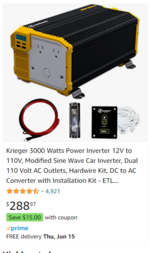
I am not sure it would be worth it. Here are two that are in the same basic "quality" area. And roughly the same features.

1686664198597.png1686664215296.png

Now yes you can get cheaper versions of both, but you loose how efficient they are.

IMHO when dealing with this stuff, getting the units that take the least power to do their job is pretty high on the list.

I am just not sure that just buying the pure sign would be money better spent. The modified are also not all equal, some are "cleaner" then others, and again you pay for that as well. It is all a plus and minus.

I did just order a new MPPT controller, to cover for my mistake, I could hook up the panels so I could use the existing controller, but I really don't want to do that, I have decided a series/parallel setup is what I want, some panels in series, then those hooked in banks in parallel. I don't want the current to get too high as wire is expensive. The mounts, really just angle iron should be here before the weekend, as well as the mounts to hang all this junk on the side of my building. Last night when adding the last two lights, I had everything running off the inverters again, It ran for about 4 hours and still had a ways to go before low voltage cutoff, but LED's don't pull all that much and I did not use any other tools that hit it hard.

If the interest is there I will update the thread as I go forward with it.
 
OP
C

cherokee

Well-known member
Joined
Mar 2, 2010
Messages
980
Location
Kansas City MO
This thread is not getting a great deal of traction, so I guess after this update I will let it die and not post any more updates, I will answer questions if there are any. We will see.

I got the new controller installed Wed evening. Went really smooth. Below is a photo of the main display on the main page.

What this is telling you is that it is charging the batteries. The lines in the battery icon are animated showing charge going in, the little "tubes" that run from "MPPT CHG" to the picture of the battery and grid that is the solar cells is animated as well, the little dot moves from the solar to the battery.

14.7 is showing you how much voltage is coming in from the array, the 17.0 is tells you how many amps, the 12.97 is current battery voltage. The Daily and Total numbers are the Kwh of how much has come in from the last time it was cleared. The Charge light will blink when it is charging, and the DC load light tells if the DC output on the solar charge controller is active. You can have it off, or on a timer, or all all the time. I have use for DC down the road so it will be on all the time.

1686918581878.png
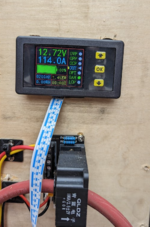
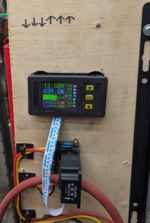
This little gizmo will tell me a few things as well, the top is battery voltage, the bottom is how many amps I am pulling out of the batteries. The "OUT" will blink red if I am taking out of the batteries and green if I am putting "into" the batteries, charge or discharge. The other numbers only the 1.45 kw is for how much I have taken out from this things last reset.

1686918694357.png

I had "most" everything in the shop on it for four hours last night. 12.7 was the lowest the battery bank ever got. I did find I can't run a "boost" battery charger on it, pulled too much and kicked me over the edge and everything went dark....oh well good to know. After that I switched from battery to grid power the bank of outlets I had the boost battery charger on.

Again so far pretty happy with how it is going. It has been fun building this.

I am taking some time off work next week, I have hopes on getting the solar panels mounted on the building during that time....however there are just a ton of other things I need to do as well. We will see.
 

Skyman

Well-known member
Joined
Nov 9, 2021
Messages
1,174
Location
Central Maryland
I hope this won't be the last update you'll post. I doubt I'm the only one who's interested. Good stuff here.

Had you given any thought to mounting your panels on a post?
 
OP
C

cherokee

Well-known member
Joined
Mar 2, 2010
Messages
980
Location
Kansas City MO
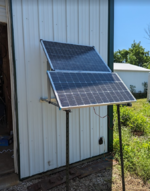
Small update from the weekend. I have mounted two panels on the side of the shop. Yes it is all done on the cheap, who cares it will hold and it will keep rocks from the mower from hitting the panels.

1687776676266.png

This is on the West-ish, side of the building. West? Yup. My building is roughly east west with perhaps a little tilt to the south on the "door" end, and thus a little north on the back end.

After roughly 4pm my south facing panels would fall off to almost nothing, 13v and perhaps one amp. If the batteries are above 13v that does nothing. Putting these two on the west side I get sun till (this time of year) roughly 730-800. These two will give me a few amps, and 20v on their own.

Check your sun when doing something like this, you want to make sure to get every drop you can.

For example. I had just a fan running on solar, one of those large floor mounted jobbies. Pulls roughly 10a in high speed, and if the wind is blowing against the fan it will jump a bit. With my current setup it was about a wash power wise. I was taking out running just that one fan about what I was putting in.

You can also see the penetration for going inside the building. All wires are still temp till I get everything on the sides, then it will be enclosed.
 
OP
C

cherokee

Well-known member
Joined
Mar 2, 2010
Messages
980
Location
Kansas City MO
Here is a fairly new video on the batteries that I am using. They are "budget" batteries, but they do review very well.

I have 4 of these guys. This past weekend I ran everything but the welder and band saw on battery power for 4 hours before I flipped the switch.

IIRC I cut the batteries at 13v. This is above the cutoff for the batteries but it was lunch time.


Michigan Mike

Well-known member
Joined
Sep 12, 2012
Messages
449
Location
Kalamazoo Mi.
I don't post much and don't have enough of an electrical background to ask intelligent questions. Having said that my first house was built with solar in mind. It had large south facing windows for solar heat gain and the south facing roof was a 16/ 12 pitch which was the correct pitch here in southern Michigan for solar collectors. I never did hang collectors on the roof as it was not feasible at the time. I am following this thread closely your approach and methods seem very doable for me. So even though I don't post much I do appreciate the work you are doing and will try to at least put likes on your thread.
 
  • Like
Reactions: RPH

niget2002

Well-known member
Joined
Oct 2, 2012
Messages
11,133
Location
Josephine, TX
I have a few small projects running on solar. The door for our chicken coop is automated and opens/closes at preset times each day. The door uses a small 12v actuator that I have running off of a battery that is kept charged using a solar panel. I'm using one of the little cheap solar chargers that you show in your pictures.

It's worked well for about 3 years now. I have had to replace the little 12v battery almost every year. I attribute it to the huge temperature swings that the battery is being forced to work in.
 

Ak Jim

Well-known member
Joined
Jan 5, 2012
Messages
532
Location
Interior AK
I have a friend who has a house out in the wilds of Alaska. He has solar and a diesel generator. His solar is on a pole and you can move the array to point at the sun. This is important in AK because of the low sun angles and path the sun follows. Makes a big difference when the array is pointing directly to the sun.
 

Skyman

Well-known member
Joined
Nov 9, 2021
Messages
1,174
Location
Central Maryland
Looks plenty functional, Cherokee.

niget2002, the temp swings might be contributing to the short battery life, but does you set-up have a decent charge controller on it? Might the system be overcharging the battery?
 

WisJim

Well-known member
Joined
Dec 20, 2010
Messages
2,283
Location
Menomonie, WI
I installed my first wind turbine in 1977 or 78, to power our off grid house. The basic rule of thumb for a wind turbine is to get it at least 30 feet (50 feet is better) above anything within 500 feet. Otherwise turbulence will greatly reduce your energy output and the life of the machine. Mounting it on a roof is not a good idea.
We installed our first PV panels in 1981 or so. The quality of the panels and the associated electronics (controllers, inverters, etc.) is worlds better today than what we used back then.
The main thing with a lead-acid battery system is to not discharge below 80% on a regular basis, and never discharge below 50% charge. And if fluid level can be checked, always keep the plates covered with electrolyte.
 

theoldwizard1

Well-known member
Joined
Feb 22, 2011
Messages
43,196
Location
SE MI
The battery, a deep cycle battery of any kind will do just fine. You don't need Lipo batteries, or more exact lifepo4 batteries. This is the type that is most popular today, but that old deep cycle battery from your boat will do just fine for starters.ke will help you avoid making the same.
The only TRUE deep cycle lead acid batteries that are readily available are golf cart batteries (size GC2). Marine/RV batteries are a compromise.

Despite the recommendation to stay with "name brand" components, I will disagree. There are some decent quality LiFePO4 batteries from brands you have never heard of. The "best bang for the buck" is to buy individual cells directly from China.

Any one interested in a DIY solar system needs to spend many hours on Will Prowse's YouTube channel.
 

theoldwizard1

Well-known member
Joined
Feb 22, 2011
Messages
43,196
Location
SE MI
Interesting! Now for a quick thought can a π filter be built/sourced for the modified sine wave invertors? Or are the power level making this cost prohibitive?
π filters have too much "parasitic" loss to be effective.

In the past 5 years or so there have been major new ICs that actually make the cost difference between modified sine wave and pure sine wave inverters almost zero. The big difference seems to be between "high frequency" vs "low frequency" inverters. High frequency are less expensive (easier/cheaper to wind multiple smaller E-core transformers compared to larger toroidal transformers), but don't seems to last as long.
 

theoldwizard1

Well-known member
Joined
Feb 22, 2011
Messages
43,196
Location
SE MI
I don't think it would be "worth it" to build your own inverter. It would be a fun project I would think, but for me there comes a time when you say, this is just not worth the time and research.
I have been kicking this around for a couple of years !

The biggest problem is finding a source for silicon "electrical/transformer" steel to wind the transformer.
 

theoldwizard1

Well-known member
Joined
Feb 22, 2011
Messages
43,196
Location
SE MI
A π filter is to clean the steps out of the modified invertors output wave form. The filter is a capacitor across the leads then a single inductance inline on one leed then another capacitor across the leeds so it physically looks like the π symbol. Exceptional for DC but I'm not sure how well this would work for AC.
You need to use a capacitor that can handle both positive and negative voltages. The most common electrolytic capacitors can not.
 
To avoid these ads, REGISTER NOW!

theoldwizard1

Well-known member
Joined
Feb 22, 2011
Messages
43,196
Location
SE MI
I installed my first wind turbine in 1977 or 78, to power our off grid house. The basic rule of thumb for a wind turbine is to get it at least 30 feet (50 feet is better) above anything within 500 feet. Otherwise turbulence will greatly reduce your energy output and the life of the machine. Mounting it on a roof is not a good idea.
All solar equipment prices have been dropping quickly over the past 5 years.
 
OP
C

cherokee

Well-known member
Joined
Mar 2, 2010
Messages
980
Location
Kansas City MO
I have a few small projects running on solar. The door for our chicken coop is automated and opens/closes at preset times each day. The door uses a small 12v actuator that I have running off of a battery that is kept charged using a solar panel. I'm using one of the little cheap solar chargers that you show in your pictures.

It's worked well for about 3 years now. I have had to replace the little 12v battery almost every year. I attribute it to the huge temperature swings that the battery is being forced to work in.

I guest you could say my first "solar" project was an electric fence. Basically a box with a battery with solar cells on top. You then run a single wire around your fence line, and when the cow, or anything else touches it ZAP. It does not "really" hurt, I would call it high uncomfortable. The animals are now long gone but I still had that for around my chickens before they burned their house down. (I will tell that story later).

If you can keep the battery a little warm in the winter it will help it. If the coop is heated and mine was it will go a long way to making your battery last.
 
OP
C

cherokee

Well-known member
Joined
Mar 2, 2010
Messages
980
Location
Kansas City MO
I installed my first wind turbine in 1977 or 78, to power our off grid house. The basic rule of thumb for a wind turbine is to get it at least 30 feet (50 feet is better) above anything within 500 feet. Otherwise turbulence will greatly reduce your energy output and the life of the machine. Mounting it on a roof is not a good idea.
We installed our first PV panels in 1981 or so. The quality of the panels and the associated electronics (controllers, inverters, etc.) is worlds better today than what we used back then.
The main thing with a lead-acid battery system is to not discharge below 80% on a regular basis, and never discharge below 50% charge. And if fluid level can be checked, always keep the plates covered with electrolyte.

I have a wind turbine, I had hoped to get it up this year, but June is already over basically. I am thinking it will be next years project. I underestimate how slowly I work now.
 
OP
C

cherokee

Well-known member
Joined
Mar 2, 2010
Messages
980
Location
Kansas City MO
The only TRUE deep cycle lead acid batteries that are readily available are golf cart batteries (size GC2). Marine/RV batteries are a compromise.

Despite the recommendation to stay with "name brand" components, I will disagree. There are some decent quality LiFePO4 batteries from brands you have never heard of. The "best bang for the buck" is to buy individual cells directly from China.

Any one interested in a DIY solar system needs to spend many hours on Will Prowse's YouTube channel.

If you watch that video I posted you will see the guy tear down a "budget" lifepo4 battery. He gets the names of the cells and checks their price. I am far too lazy to dig through the video and get exact numbers so this will be ball park. That "budget" Power Queen battery can be held for sub $350. When the guy dug out the individual cells and found out who made them he then went to the site and found the costs on the cells. For you to buy the cells IIRC it would cost you roughly $700 for those same cells, and then you need the bars, wire, BMS. They must get one heck of a volume discount is all I can guess.

I know they are selling them, after they became "internet darlings" the stock has been low on them. I had to wait roughly 3 months after order to get my second pair. I have 4 100ah batteries.
 
OP
C

cherokee

Well-known member
Joined
Mar 2, 2010
Messages
980
Location
Kansas City MO
A mini update,

Last night I did a little work in the shop, I wanted to post up something I found very interesting.

First off this gizmo:

This thing is a doohicky that will tell me state of charge and draw, or input from the battery bank.

What this is telling you is the bank is at 13.58V and the total current out is 39amps. Where the little "OUT" is and how the arrow points to the left says "power" is coming out of the battery bank. If it was going in that little arrow would point to the right.

1687862289379.png

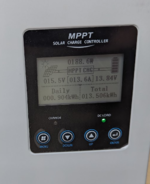
This thing is the charge controller, again it shows what the battery bank voltage is as well as the voltage and amperage coming in from the solar array. In this case 15.5v and 13.6a.

1687862706951.png

What you need to do is a little math to see what you are drawing. The total "output" I am taking out from the batteries is going to be 39 + 13.6. So I am really pulling about 52.6 amps.

If you only have a few things running off the battery you will see that little arrow next to the "OUT" bounce back and forth, right and left. Sometimes putting power in sometimes taking power out.

You are thinking yea....that kinda figures.

Now think of what you use that pulls roughly 13 amps. It is not a great deal of stuff. I currently have 8 100W solar panels in a parallel/series hookup. Those panels cost roughly $100 a pop. Now think of what it would take to run your house....in the summer....with the AC and TV on.

A great many people think I am anti "clean energy", well no. I want to learn more about it, so I ask questions, and when the questions don't get answers that ring true if I can I will just do it myself. I am just setup that way, my little peanut brain works this way. So I just do it. Yes there are bigger batteries and bigger panels, and they also come with bigger price tags. Personally I think every house should have "some" kind of power setup on them. Why not, the roof is already there, and it will help your electric use. Down side it is still expensive, and really expensive if you just wright a check.

Made two more "legs" for the panels that go on the side in my typical redneck way, T-posts and scrap metal. Hopefully get at least one mounted this week, but I have a brush hog to move and some "weeding" to do. I just know there is a snake under that brush hog.
 

wandrur

ALLIANCE MEMBER
Joined
Dec 13, 2021
Messages
1,212
Location
Fredericksburg, VA
Good thread! Thanks for posting this.

I have something very similar that I will be putting in my motorcycle garage shed. Renogy 40A MPPT, 4x100 panels, and a Lossigy 200AH LiFePo battery. All the pieces are together and just waiting for me to finish the interior walls so I can mount the setup on the wall. In the meantime, I'll figure out how to mount the four panels.
 
OP
C

cherokee

Well-known member
Joined
Mar 2, 2010
Messages
980
Location
Kansas City MO
Good thread! Thanks for posting this.

I have something very similar that I will be putting in my motorcycle garage shed. Renogy 40A MPPT, 4x100 panels, and a Lossigy 200AH LiFePo battery. All the pieces are together and just waiting for me to finish the interior walls so I can mount the setup on the wall. In the meantime, I'll figure out how to mount the four panels.

The angle is a big thing, bigger then I figured.
 

theoldwizard1

Well-known member
Joined
Feb 22, 2011
Messages
43,196
Location
SE MI
For anyone who thinks this is easy and/or not expensive you need to watch a few episodes from the YouTube channel Ambition Strikes
.

The reason the went so huge is because they have a shop that includes a large plasma cutter table and welder. Likely they will add a lathe and mill.
 

theoldwizard1

Well-known member
Joined
Feb 22, 2011
Messages
43,196
Location
SE MI
I have been slowly installing a home made (home made means I am doing it not just cutting a check to someone to do it all) solar power setup for the house. There is just a ton of things that go into this, aside from the basic "house" wire for power type things, you need to learn about solar systems and the different panels, as well as charge controllers, batteries all that stuff.
If you are serious about "growing" your system to power a house or shop that has loads of more than some lighting and small electric hand tools, you will eventually need to go to a 48V battery bank and a split phase inverter. These are both big $,$$$ !!

This is very worth the time to read ! 48V Off Grid Solar Power

Another worthwhile read Raw LiFePO4 Cells

Lots of REAL WORLD feedback in this forum DIY Solar Forum
 
Last edited:
OP
C

cherokee

Well-known member
Joined
Mar 2, 2010
Messages
980
Location
Kansas City MO
If you are serious about "growing" your system to power a house or shop that has loads of more than some lighting and small electric hand tools, you will eventually need to go to a 48V battery bank and a split phase inverter. These are both big $,$$$ !!

This is very worth the time to read ! 48V Off Grid Solar Power

Another worthwhile read Raw LiFePO4 Cells

Lots of REAL WORLD feedback in this forum DIY Solar Forum

I agree, but there are some things 12v give you. Aside from "cheaper" they are everywhere. Need an inverter in a pinch, Harbor Freight has them along with about every "outdoor" type place, campers, motor homes...... What I gain by going 12v is more then what I loose by moving up.

I am a member on the DIY forum, under a different name, my new name. My name here is from an account years ago. You will see a huge hole in the posting history if you look.

Really this thing was done for a couple reasons. One I just wanted to play with it. Two I wanted a way to have some power without running on the house generator. I have a propane gen on the house. If I am out for an extended time, 14 days was the longest. If I can power off that generator and run the deep freezes, fridge and furnace blower/other stuff to make heat on the furnace. I will be miles ahead. This is why it is all on the cart. I can just roll it into the house and power up the circuits needed, say over night. Then when the sun comes out I can recharge (hopefully) and get by on using less propane.
 

theoldwizard1

Well-known member
Joined
Feb 22, 2011
Messages
43,196
Location
SE MI
Really this thing was done for a couple reasons. One I just wanted to play with it. Two I wanted a way to have some power without running on the house generator. I have a propane gen on the house. If I am out for an extended time, 14 days was the longest. If I can power off that generator and run the deep freezes, fridge and furnace blower/other stuff to make heat on the furnace. I will be miles ahead. This is why it is all on the cart. I can just roll it into the house and power up the circuits needed, say over night. Then when the sun comes out I can recharge (hopefully) and get by on using less propane.
I apologize if I came across as critical ! You have a good "starting point" ! You can grow a 12V system pretty large. I would still use GC2 lead acid batteries.

There is another thread here where I stated you CAN run 2 independent (non-synchronize) 120VAC power sources (yes, common neutral) into your house as long as you are not trying to run any 240VAC loads. So you can double your capacity without having to upgrade to a split phase inverter !
 

niget2002

Well-known member
Joined
Oct 2, 2012
Messages
11,133
Location
Josephine, TX
Looks plenty functional, Cherokee.

niget2002, the temp swings might be contributing to the short battery life, but does you set-up have a decent charge controller on it? Might the system be overcharging the battery?
That's possible. I do have a better charge controller sitting in the shop. I could swap them out and see if the battery lasts longer. The better charge controller was for another project that I haven't gotten around to yet.
 
OP
C

cherokee

Well-known member
Joined
Mar 2, 2010
Messages
980
Location
Kansas City MO
I apologize if I came across as critical ! You have a good "starting point" ! You can grow a 12V system pretty large. I would still use GC2 lead acid batteries.

There is another thread here where I stated you CAN run 2 independent (non-synchronize) 120VAC power sources (yes, common neutral) into your house as long as you are not trying to run any 240VAC loads. So you can double your capacity without having to upgrade to a split phase inverter !
No you did not come across that way. I just wanted to make clear why I did what I did and the reasons behind it. I freely admit there is some tin foil hat thinking in there as well.
 

dcg9381

Well-known member
Joined
Jun 20, 2018
Messages
11,773
Location
Austin, TX
If you are serious about "growing" your system to power a house or shop that has loads of more than some lighting and small electric hand tools, you will eventually need to go to a 48V battery bank and a split phase inverter. These are both big $,$$$ !!

This is very worth the time to read ! 48V Off Grid Solar Power
I have several of those inverters that you mention. 4 of them, actually... And 6 of their latest generation of 48V batteries. They are absolutely the cheapest around that aren't sold direct off a boat from China. Worth mentioning that they are off a boat from China and are branded here by a company in Texas. I have them up and working, but there is no real support of these (EG-4) from the reseller - they're business is overrun with support calls. Firmware updates have no change logs and we've been on the tail end of hardware changes without notification.

That being said, they work... But these in particular have an idle draw of 120watts per inverter.

sol-ark is the altnernative that I'd recommend as there is real engineering support. They're also substantially more expensive.
 

sleek98

Well-known member
Joined
Aug 9, 2016
Messages
687
Location
Kansas City, MO
I am following along. I have been debating putting some solar on our boat dock to run the lifts and keep the boat/ski battery charged.
 

dcg9381

Well-known member
Joined
Jun 20, 2018
Messages
11,773
Location
Austin, TX
I am following along. I have been debating putting some solar on our boat dock to run the lifts and keep the boat/ski battery charged.
These are common up north... I'd do it all day long, simple 12V systems with simple chargers and 12V motor. Make sure you get charge controllers that have low voltage protection (on the source battery).
 

slik560

Well-known member
Joined
Oct 5, 2009
Messages
787
Location
Kansas, USA
I just took delivery of a basic Renogy 200W panel kit. Now I\m sizing a system for temporary backup due to the frequent power outages in our older neighborhood. All the lines are overhead, so all it takes is some wind or one of the power company's ancient transformers to blow in the summer heat. I'll go back through this entire topic before I buy anything else; namely an inverter and the batteries. Thanks for laying all this out. Since I'm in the same genral area I'm curious about how everything performs.
 

slik560

Well-known member
Joined
Oct 5, 2009
Messages
787
Location
Kansas, USA
So if you're using four 100ah batteries, is the 3000w inverter good enough? Are the batteries in parallel? Sorry - I'm a beginner - back to basics. I'll hit Will Prowse's YouTube channel to keep questions to a minimun. :)
 

dcg9381

Well-known member
Joined
Jun 20, 2018
Messages
11,773
Location
Austin, TX
So if you're using four 100ah batteries, is the 3000w inverter good enough? :)
Batteries are spec'd with maximum draw. I usually target no more than 80%.

3000 watts / 12V batteries = 250A draw. Those batteries better be in parallel. :)
 
To avoid these ads, REGISTER NOW!
Top Bottom