The tub spout at the bottom of the shower is a toe tester, test the water temp with your foot before turning on the head.Use to watch Holmes on homes and found it interesting how Canada code runs water lines. A central manifold with direct runs to each location. Also weird how they install the tub spigot at the bottom of shower stalls.


You are using an out of date browser. It may not display this or other websites correctly.
You should upgrade or use an alternative browser.
You should upgrade or use an alternative browser.
Plumbing Project - Re-Pipe the House
- Thread starter DGersic
- Start date
Years ago I had a rental property with clay outside and trees on the sidewalk. We tried sleeving and a tenant flushed a toilet during the process despite everyone being informed not to. We then spent $15k digging. But probably a “buy time” fix to consider since I could control things better in my house.
PolishX
Active member
We have sleeved and lined mains and laterals for years, even some old wood stave lines. It's help up since the mid 90's here in Alaska no issuesFor your sewer, look in to having it sleeved or lined. We had ours done about 20 years ago and it’s holding up well. I have cast iron above ground, but it’s clay tile after it exits the foundation. It had moved and separate, leading to blockages. Getting the liner in was a lot of work, but a lot less than digging and runnning a whole new 150’ sewer line would have been.
Chance
Well-known member
Are they high enough for filling a bucket? That would be handy. I wonder if code would let me put one of those in a shower in the U.S?The tub spout at the bottom of the shower is a toe tester, test the water temp with your foot before turning on the head.
Drained the water heater today.
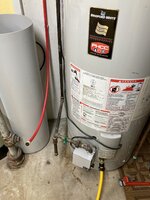
Then spent some quality time with my torch building this extension.
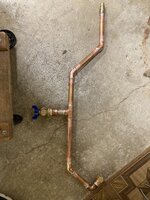
Connected the former drain to the PEX line.

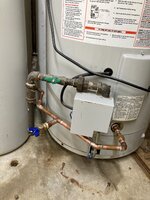

This, hopefully, completes the passive return loop. Leak testing now. If it holds, I’ll heat it up again, and we’ll see how it works.
Then spent some quality time with my torch building this extension.
Connected the former drain to the PEX line.
This, hopefully, completes the passive return loop. Leak testing now. If it holds, I’ll heat it up again, and we’ll see how it works.
larry4406
Well-known member
I thought passive return loops normally include a one way swing check valve enabling flow in the direction towards the WH drain? It least the one I did at a former house of mine had one per the details I followed then.
I thought passive return loops normally include a one way swing check valve enabling flow in the direction towards the WH drain? It least the one I did at a former house of mine had one per the details I followed then.
Yep. That’s further up-circuit in the PEX before it comes down the wall.
HoosierBuddy
Well-known member
Very nice work.
This project needs to go on my "to do once I retire" list. Our 105 year old house has a mi ter plumbing mix of every material ever used for piping in the last 100 years. The galvanized section (like you mentioned) is the most trouble. I used to have a pinhole leak open up in every once in a while requiring a repair. The town switched their water supply about 15 years ago from the town wells to a lake fed by the local watershed and all those leaks quit happening. Anyway...back then I was repairing it by taking out sections of cold water piping and using PVC or hot water piping and using CPVC. Times have changed. Your PEX looks really good.
This project needs to go on my "to do once I retire" list. Our 105 year old house has a mi
ter plumbing mix of every material ever used for piping in the last 100 years. The galvanized section (like you mentioned) is the most trouble. I used to have a pinhole leak open up in every once in a while requiring a repair. The town switched their water supply about 15 years ago from the town wells to a lake fed by the local watershed and all those leaks quit happening. Anyway...back then I was repairing it by taking out sections of cold water piping and using PVC or hot water piping and using CPVC. Times have changed. Your PEX looks really good.Very nice work.
This project needs to go on my "to do once I retire" list. Our 105 year old house has a mi
I can highly recommend retirement. It still feels weird to be able,to just do something without having to plan how it’ll impact going to work. And being able to just go to the store, too.
larry4406
Well-known member
At my father in law's house, every time he encountered a pin hole leak in his copper, he installed a valve at the repair location vs a new section and couplings. There had to be 15+ valves in the basement ceiling! No idea why he did that.Very nice work.
This project needs to go on my "to do once I retire" list. Our 105 year old house has a mi
Chance
Well-known member
mix master ?mi
Bruce 993 SEA
Well-known member
When I saw the title of this thread, I was hoping you went for the expansion tool. Great job on this project!!!
HoosierBuddy
Well-known member
yes. I have no idea how that changed to mi"emoji"ter.mix master ?
x-mas without the dash.
Good gravy!
75gmck25
Well-known member
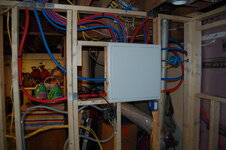
Just in case someone is considering using a pex manifold, I'll post a picture of my setup, taken during installation a few years ago. Its located in a recess in the wall of the basement bathroom. This is a view of the back side and the front of the access panel in the bathroom.
The manifold I used has 3/4" in and 3/4" out because water passes through the manifold and up to a bathroom two floors above. Everything in the basement and in the kitchen on the floor above is connected to individual 1/2" shutoffs on the manifold.
The manifold I used has 3/4" in and 3/4" out because water passes through the manifold and up to a bathroom two floors above. Everything in the basement and in the kitchen on the floor above is connected to individual 1/2" shutoffs on the manifold.
Attachments

SweetD
Well-known member
I just want to say thank you for sharing and documenting. Very interesting! Job well done.
After some delays for things like cleaning the basement after blowing diatomaceous earth all over everything, and a major reduction in “stuff” we’ve been storing but don’t need, I finally finished the last part of this project.
After lots of measuring and head scratching, I pulled the fridge out and cut the wall for the ice maker box.

I previously modified the box to mount “old work” style, but ran in to a problem because I didn’t know that I have two layers of 5/8“ drywall. There wasn't room for the PEX fitting. So the box got a second modification to move the fitting back for clearance. It’s not as pretty now, but it’s not something anybody will see any time soon.
Because I’m in an outside wall here, drilling straight down doesn’t lead to basement air space. I had planned to use the 1” Speed Bore to go down, then hit it from the basement side coming up on an angle. Can’t get my drill in the hole, so using a 90* adapter. I thought this would work, and it might have, if I hadn’t found a nail with the Speed Bore. Hitting that just about broke my wrists, there is a lot of torque in the DeWalt 18V drill. The abrupt stop did snap the drive shaft of the 90* adapter.
With the HF borescope, I could see that the nail was in the middle of the hole. I switched to a 1” hole saw. No power way to drive it, so I put a 3/8” socket on it, and spun it that way. Left hand pushing down, right hand cranking the ratchet handle. I now have two nice blisters on my left palm, but I was able to cut down past the nail, chip out the hole center with a chisel, and shop vac out the debris.
From the basement side, some careful measurements and a 1 1/2” hole saw going up on an angle hit the bottom of my 1” hole.
I dropped a short piece of 3/4” PEX in the hole to act as a sleeve, probably not needed, but I did it anyway. A piece of 1/2” went through the 3/4”, and met up with the line and ball valve in the basement.

So, it’s done. Tomorrow I can contact the inspector to finish out the permit.
After lots of measuring and head scratching, I pulled the fridge out and cut the wall for the ice maker box.
I previously modified the box to mount “old work” style, but ran in to a problem because I didn’t know that I have two layers of 5/8“ drywall. There wasn't room for the PEX fitting. So the box got a second modification to move the fitting back for clearance. It’s not as pretty now, but it’s not something anybody will see any time soon.
Because I’m in an outside wall here, drilling straight down doesn’t lead to basement air space. I had planned to use the 1” Speed Bore to go down, then hit it from the basement side coming up on an angle. Can’t get my drill in the hole, so using a 90* adapter. I thought this would work, and it might have, if I hadn’t found a nail with the Speed Bore. Hitting that just about broke my wrists, there is a lot of torque in the DeWalt 18V drill. The abrupt stop did snap the drive shaft of the 90* adapter.
With the HF borescope, I could see that the nail was in the middle of the hole. I switched to a 1” hole saw. No power way to drive it, so I put a 3/8” socket on it, and spun it that way. Left hand pushing down, right hand cranking the ratchet handle. I now have two nice blisters on my left palm, but I was able to cut down past the nail, chip out the hole center with a chisel, and shop vac out the debris.
From the basement side, some careful measurements and a 1 1/2” hole saw going up on an angle hit the bottom of my 1” hole.
I dropped a short piece of 3/4” PEX in the hole to act as a sleeve, probably not needed, but I did it anyway. A piece of 1/2” went through the 3/4”, and met up with the line and ball valve in the basement.
So, it’s done. Tomorrow I can contact the inspector to finish out the permit.
nadogail
Well-known member
Your finished job looks good from here.
Jobs always look easy before you start them, Breaking a tool during a weekend can ruin your day.
Jobs always look easy before you start them, Breaking a tool during a weekend can ruin your day.
gsmith22
Well-known member
I first saw this thread this morning. I briefly skipped through the thread. Your work looks amazing and hats off to you.
Edit - on using coiled piping vs straight sticks. To get the coiled pex piping to become straight, pull it through a slightly larger diameter schedule 40 pvc pipe. I was using uponor and I think I used 1/2" pex with 3/4" pvc, 3/4" pex wiht 1" pvc, and 1" pex with 1.25" pvc. mount the pvc to something (i mounted to some wall studs in the basement) and pull the pex through - comes out straight on the otherside.
One thing did pop into my head - did you use uponor piping (I know I saw expansion rings)? I ask because there is a brewing class action against their blue and red colored piping that develops splits and eventually leaks at the expanded ends. Takes a relatively long time (5 to 10 yrs) and occurs first on the hot water side. Its suspected that Uponor's process to color the pipe combined with the level of chlorination in city water when in use determines how quickly/bad of a problem it becomes. You actually can't buy red and blue pipe from uponor anymore - they switched out to all clear piping with printed red and blue lettering specifically because of this. Here is one thread that goes through it: https://terrylove.com/forums/index....onths-house-built-in-2015-need-advice.101926/ but there are many others on that forum. If you still got the walls open, have chlorinated city water, now would be the time to get that stuff out. Hoping none of this applies to you....
Edit 2: here is another one of those pex threads: https://terrylove.com/forums/index.php?threads/cracks-forming-next-to-plastic-uponor-fittings.90520/
Edit - on using coiled piping vs straight sticks. To get the coiled pex piping to become straight, pull it through a slightly larger diameter schedule 40 pvc pipe. I was using uponor and I think I used 1/2" pex with 3/4" pvc, 3/4" pex wiht 1" pvc, and 1" pex with 1.25" pvc. mount the pvc to something (i mounted to some wall studs in the basement) and pull the pex through - comes out straight on the otherside.
One thing did pop into my head - did you use uponor piping (I know I saw expansion rings)? I ask because there is a brewing class action against their blue and red colored piping that develops splits and eventually leaks at the expanded ends. Takes a relatively long time (5 to 10 yrs) and occurs first on the hot water side. Its suspected that Uponor's process to color the pipe combined with the level of chlorination in city water when in use determines how quickly/bad of a problem it becomes. You actually can't buy red and blue pipe from uponor anymore - they switched out to all clear piping with printed red and blue lettering specifically because of this. Here is one thread that goes through it: https://terrylove.com/forums/index....onths-house-built-in-2015-need-advice.101926/ but there are many others on that forum. If you still got the walls open, have chlorinated city water, now would be the time to get that stuff out. Hoping none of this applies to you....
Edit 2: here is another one of those pex threads: https://terrylove.com/forums/index.php?threads/cracks-forming-next-to-plastic-uponor-fittings.90520/
Last edited:
I first saw this thread this morning. I briefly skipped through the thread. Your work looks amazing and hats off to you.
One thing did pop into my head - did you use uponor piping (I know I saw expansion rings)? I ask because there is a brewing class action against their blue and red colored piping that develops splits and eventually leaks at the expanded ends. Takes a relatively long time (5 to 10 yrs) and occurs first on the hot water side. It’s suspected that Uponor's process to color the pipe combined with the level of chlorination in city water when in use determines how quickly/bad of a problem it becomes. You actually can't buy red and blue pipe from uponor anymore - they switched out to all clear piping with printed red and blue lettering. Here is one thread that goes through it: https://terrylove.com/forums/index....onths-house-built-in-2015-need-advice.101926/ but there are many others on that forum. If you still got the walls open, have chlorinated city water, now would be the time to get that stuff out. Hoping none of this applies to you....
I did not use Upanor. I did a bunch of research on PEX before starting, and there is a guy on YouTube posting as Integrity Repipe that had a lot of info and experience on the Upanor problems that convinced me not to use Upanor.
I was going to go with his recommended Zurn pipe and fittings, but that didn't work out. They only sell through distributors, and the two distributors that they recommended I talk to were both pushing Upanor. They might be able to special order Zurn, but it’s not in stock, special order prices apply, and wait for shipping time.
I decided that I wanted to buy as much of the supplies as possible locally. I assumed there would be things that I missed, mid work changes, and a need to buy something I missed in the first pass. I did not want to have to wait for shipping to finish because I miscounted the number of T fittings or something stupid like that.
I spent more time down the rabbit hole of PEX A vs. B and crimp vs. expansion. There’s a lot of information out there that equates A with expansion and B with crimp. This isn’t actually true. Some of the companies making B pipe are making expansion fittings for it. You have to read the pipe specs, look for F.1960. If it says F.1960, it can be used with expansion rings and fittings.
Locally, I have Lowes and Menards. There is a Home Depot a few towns away, figure 45 minutes drive each way. So HD is out. Lowes has a Chinese brand PEX B pipe, and either crimp or SharkBite fittings. Not what I want. Menards has Sioux Chief, made in USA PEX B pipe with a good selection of crimp and expansion fittings. Sioux Chief has a decent warranty, at least on paper, and doesn’t restrict it to only using their rings and fittings, which I thought was a nice touch. So I went with Sioux Chief for most of the supplies.
I did order ball valves and hammer arrestors from Supply House. Good service, nice parts, and they had what Menards didn’t. I wanted drop ear ball valves I could mount, and F.1960 hammer arrestors.
Lowes did supply a few things, primarily the steel 90* bend supports for 3/4” that I welded mounting tabs to.
captain14
Well-known member
Saving this for later to read the entire thread.
gsmith22
Well-known member
good to hear. I saw the red and blue and expansion fittings (F1960) and wasn't sure.I did not use Upanor. I did a bunch of research on PEX before starting, and there is a guy on YouTube posting as Integrity Repipe that had a lot of info and experience on the Upanor problems that convinced me not to use Upanor.
I was going to go with his recommended Zurn pipe and fittings, but that didn't work out. They only sell through distributors, and the two distributors that they recommended I talk to were both pushing Upanor. They might be able to special order Zurn, but it’s not in stock, special order prices apply, and wait for shipping time.
I decided that I wanted to buy as much of the supplies as possible locally. I assumed there would be things that I missed, mid work changes, and a need to buy something I missed in the first pass. I did not want to have to wait for shipping to finish because I miscounted the number of T fittings or something stupid like that.
I spent more time down the rabbit hole of PEX A vs. B and crimp vs. expansion. There’s a lot of information out there that equates A with expansion and B with crimp. This isn’t actually true. Some of the companies making B pipe are making expansion fittings for it. You have to read the pipe specs, look for F.1960. If it says F.1960, it can be used with expansion rings and fittings.
Locally, I have Lowes and Menards. There is a Home Depot a few towns away, figure 45 minutes drive each way. So HD is out. Lowes has a Chinese brand PEX B pipe, and either crimp or SharkBite fittings. Not what I want. Menards has Sioux Chief, made in USA PEX B pipe with a good selection of crimp and expansion fittings. Sioux Chief has a decent warranty, at least on paper, and doesn’t restrict it to only using their rings and fittings, which I thought was a nice touch. So I went with Sioux Chief for most of the supplies.
I did order ball valves and hammer arrestors from Supply House. Good service, nice parts, and they had what Menards didn’t. I wanted drop ear ball valves I could mount, and F.1960 hammer arrestors.
Lowes did supply a few things, primarily the steel 90* bend supports for 3/4” that I welded mounting tabs to.
Some background for anyone following: The pex A/B designation refers to how the pipe is made - Uponor does A (Engle method of crosslinking; they might be the only one or one of the few) most others do B (Silane process). From what I have gathered, for Uponor to color the pipe for A method, they manufacture a clear pipe (what you get from the Engle method) that they then reheat in some manner to apply the outer colored coating and some part of that process is where it all went wrong. I have seen no complaints on their clear piping (ie it wasn't reheated/colored). Most commerical plumbers only use clear for both hot and cold so it tended to be a residential issue (where the colored piping is more popular). If Sioux Chief is a "B" pex, then there shouldn't be any issue because its an entirely different manufactuing process to get the red and blue (I think the color may be enfused in the pex for B). There is a "C" type pex but not widely use or available made with a different process.
Innovate1
Well-known member
Nice work and write up. I think your utility bills will go up with the passive recirc loop. Maybe not terrible with PEX but keeping the line hot all the time will have a lot more heat loss. I put a small recirc pump and push button timer for when I want hot water but then I have copper piping so continuous recirc losses would be huge.
good to hear. I saw the red and blue and expansion fittings (F1960) and wasn't sure.
Some background for anyone following: The pex A/B designation refers to how the pipe is made - Uponor does A (Engle method of crosslinking; they might be the only one or one of the few) most others do B (Silane process). From what I have gathered, for Uponor to color the pipe for A method, they manufacture a clear pipe (what you get from the Engle method) that they then reheat in some manner to apply the outer colored coating and some part of that process is where it all went wrong. I have seen no complaints on their clear piping (ie it wasn't reheated/colored). Most commerical plumbers only use clear for both hot and cold so it tended to be a residential issue (where the colored piping is more popular). If Sioux Chief is a "B" pex, then there shouldn't be any issue because its an entirely different manufactuing process to get the red and blue (I think the color may be enfused in the pex for B). There is a "C" type pex but not widely use or available made with a different process.
The Integrity Repipe guy is not impressed with the “new” Upanor pipe either.
Sioux Chief is PEX B.
Nice work and write up. I think your utility bills will go up with the passive recirc loop. Maybe not terrible with PEX but keeping the line hot all the time will have a lot more heat loss. I put a small recirc pump and push button timer for when I want hot water but then I have copper piping so continuous recirc losses would be huge.
Maybe, yes. I did go back and add insulation to the hot line to try to minimize this.
gsmith22
Well-known member
its a combo of heat loss from always warm hot water pipe trying to cool, whatever the heating source is using energy, and the pump always on recirculating water. you want a way to turn on and off the hot water return system. whether that is a switch, motion sensor, timer, etc. pick one but otherwise your power bills go way up to have always hot water.Maybe, yes. I did go back and add insulation to the hot line to try to minimize this.
Innovate1
Well-known member
It's a passive loop - no pump.its a combo of heat loss from always warm hot water pipe trying to cool, whatever the heating source is using energy, and the pump always on recirculating water. you want a way to turn on and off the hot water return system. whether that is a switch, motion sensor, timer, etc. pick one but otherwise your power bills go way up to have always hot water.
gsmith22
Well-known member
sorry missed that part - okay so no pump electricity. But this may actually be worse becuase then you can't turn the system "off". your hot water heater will be constantly having water below setpoint added to it via the passive loop and thus using energy to maintain setpoint. effectively the system is always onIt's a passive loop - no pump.
I assume the purpse of this is to have hot water to a fixture quickly. with a pump and some way to manage that pump, you get hot water quickly when you want it and aren't paying for energy use inbetween when you turn the pump off (via the switch, moton sensor, timer, etc.). bascially a radiant heat system via the passive looop was added to the house by extending the hot water heater volume through the piping. even if the pipe is well insulated (it won't be relative to the hot water heater tank), the dramatic increase in surface area of the piping over just the exterior surface of the water heater means alot of enegy gets lost along the length of the pipe.
its a combo of heat loss from always warm hot water pipe trying to cool, whatever the heating source is using energy, and the pump always on recirculating water. you want a way to turn on and off the hot water return system. whether that is a switch, motion sensor, timer, etc. pick one but otherwise your power bills go way up to have always hot water.
It’s a trade off. Without the recirculated water, there’s a couple gallons of cold water going down the drain while the entire pipe is filled with hot. Also then a couple gallons of cold water being dumped in to the water heater tank, so the heater cycles more often anyway.
This uses less water, possibly uses more gas. It’s a trade off.
Being passive, it’s not full hot at the fixture immediately, which is actually kinda nice. Warm water without having to even use the cold tap is about perfect.
I can turn it off. There’s a ball valve in the recirculating circuit. I probably will for the summer, where “cold” water isn’t all that cold. It’s really for the winter, where the cold water is cold enough to make my hands cramp painfully. If it costs me a few bucks in gas bills, it’s worth it.
karoc
Well-known member
Awesome post, very detailed with pics. I’m at dirty water thread so far.
Sou
Sounds like a recipe for waiting on hot water at the faucet.
I ran a 3/8 soft copper 30' to my kitchen sink and the wait for hot water is 1/2 what it was before. I have no reduction in flow.
I don't run much 3/4" for hot water, usually there just isn't a need
my current code calls for no more than 10 feet of 3/8 upstream of the fixture
then 1/2 is allowed for the next 10 feet
then at least 3/4 is required for the rest
Sounds like a recipe for waiting on hot water at the faucet.
I ran a 3/8 soft copper 30' to my kitchen sink and the wait for hot water is 1/2 what it was before. I have no reduction in flow.
I don't run much 3/4" for hot water, usually there just isn't a need
my current code calls for no more than 10 feet of 3/8 upstream of the fixture
then 1/2 is allowed for the next 10 feet
then at least 3/4 is required for the rest
yes, that's crazy .Sou
Sounds like a recipe for waiting on hot water at the faucet.
I ran a 3/8 soft copper 30' to my kitchen sink and the wait for hot water is 1/2 what it was before. I have no reduction in flow.
I don't run much 3/4" for hot water, usually there just isn't a need
I am going to replace my kitchen HW with 3/8 od copper at some point. When I relocated the HW heater to a better location it added about 20' to the length of my run and it takes forever to get HW to the kitchen. bathroom is fine as it's very close. I experimented with a 1/4 air hose and determined that there is no restriction because of the reduced pipe size . the aerator has more restriction that the 1/4 does.and 3/8 od is larger than 1/4 ID
karoc
Well-known member
When time comes for me to do my plumbing I be asking about 3/8 vs 1/2 pex with tankless that be about 20’ away. Never seen 3/8 line ran for HW before to cut down on delivery time
Think about the volume of cold water in the 1/2" vs the 3/8"When time comes for me to do my plumbing I be asking about 3/8 vs 1/2 pex with tankless that be about 20’ away. Never seen 3/8 line ran for HW before to cut down on delivery time
gsmith22
Well-known member
be carefull with the 3/8. its not a commonly stocked size so local availability will definately vary and you might be subject to online ordering only. Also, I had looked into it before and the vast majority of plumbing fixtures have 1/2" connections. I'm sure you can make up a size conversion assembly to get from 3/8 pex to 1/2 connection but its just another thing to deal with. If it was me, I would just use the 1/2" piping for availability and ease of assembly. I can't imagine the additional wait time with 1/2 is a deal breaker over 3/8.
I also do think you want a 3/8 pipe longer than several feet as the water pressure losses from friction in that small pipe will really start to build up. The aerator loss is a single location restriction that is probably equivalent to several feet of pipe. But 20' of pipe at 3/8 is asking for trouble.
I also do think you want a 3/8 pipe longer than several feet as the water pressure losses from friction in that small pipe will really start to build up. The aerator loss is a single location restriction that is probably equivalent to several feet of pipe. But 20' of pipe at 3/8 is asking for trouble.
I have 30' of 3/8 feeding my kitchen faucet. Even with the aerator removed it flows the same as the cold side which is fed with a standard supply hose right off a 3/4" pipe.
I wouldn't feed a bathtub with 3/8 but any faucet will be better off with it.
I wouldn't feed a bathtub with 3/8 but any faucet will be better off with it.
housewolf
Well-known member
How is the flow when the dishwasher is filling?I have 30' of 3/8 feeding my kitchen faucet. Even with the aerator removed it flows the same as the cold side which is fed with a standard supply hose right off a 3/4" pipe.
I wouldn't feed a bathtub with 3/8 but any faucet will be better off with it.
Don't have one.How is the flow when the dishwasher is filling?
a lot of " I thinks"... don't knock it till you've tried it , and if it's not for you, so be it.be carefull with the 3/8. its not a commonly stocked size so local availability will definately vary and you might be subject to online ordering only. Also, I had looked into it before and the vast majority of plumbing fixtures have 1/2" connections. I'm sure you can make up a size conversion assembly to get from 3/8 pex to 1/2 connection but its just another thing to deal with. If it was me, I would just use the 1/2" piping for availability and ease of assembly. I can't imagine the additional wait time with 1/2 is a deal breaker over 3/8.
I also do think you want a 3/8 pipe longer than several feet as the water pressure losses from friction in that small pipe will really start to build up. The aerator loss is a single location restriction that is probably equivalent to several feet of pipe. But 20' of pipe at 3/8 is asking for trouble.