To avoid these ads, REGISTER NOW!

Room Over Garage Cooling Problems

housewolf

Well-known member
Joined
Feb 3, 2021
Messages
1,144
Location
East Texas
Thanks in advance for any good advice I may get here.

My garage is 24’x32’ with an 8’x12’ corner of it framed out for an office. The office is insulated and has a mini split on the wall. No insulation anywhere else in the garage. There is a finished room over the garage that is spray foam insulated. 5-1/2” on the roof and 3-1/2” on the gable walls. There is no insulation on the (2”x10”) floor. The floor is 7/16” plywood with a layer of 7/16” OSB on top & LVP on top of the OSB. When the outdoor temps are 95*+ I can’t keep the room below 80* running an 18K BTU mini split on the bottom of a wall. We live on a lake and have guest pretty regularly that we’d like to offer the room to but I can’t consistently keep it comfortable. My shop is an 18’x36’ metal building with foam insulation and the same size unit, I could hang meat in there.

The window on one gable end is double pane and it’s not practical to do anything beyond tint there. The door on the other end is poorly sealed but I’m thinking the floor being uninsulated is the main issue. The bottom of the floor is ~90* in the heat of the day. Of course the flooring is about the same temp as whatever the room happens to be.

I can just “throw money at it” and get the spray foam guys out to do the floor but it would be invasive and cost less if I (DIY) attached foam board to the plywood below. Is the floor even the problem ?? How important is it to seal every single crack/gap in the foam board?

FWIW; the building is what’s left from our old lake weekend cabin after a tornado. We built a new house next door and live here full time now. In other words; it’s not what I would have built “from scratch”, I just kind of played the hand I was dealt. The whole project is a DIY, reclaimed material, shoot from the hip sort of thing.

Pics for reference -
5FEA771B-23F0-4B4D-91BD-65B5C6FD4BA9.jpeg

CCCC3DBC-F403-4D34-887A-C7C9F5744DC8.jpeg
 
To avoid these ads, REGISTER NOW!

eegger

Well-known member
Joined
May 31, 2020
Messages
137
Location
WI
You could get someone with a Flir camera and that would confirm the heat is coming up from the garage floor. The heat is radiating up.

Your (2”x10”) floor has lots of space for the insulation, you could do 2-3 layers of foam and or finish with a faced insulation.


R30 batts would work too, I'd probably go with that if it was me.
 
OP
H

housewolf

Well-known member
Joined
Feb 3, 2021
Messages
1,144
Location
East Texas
You could get someone with a Flir camera and that would confirm the heat is coming up from the garage floor. The heat is radiating up.

Your (2”x10”) floor has lots of space for the insulation, you could do 2-3 layers of foam and or finish with a faced insulation.


R30 batts would work too, I'd probably go with that if it was me.
Thank you. I haven’t really considered batt/fiberglass insulation because I don’t have plans to ever cover the walls or ceiling. I hadn’t considered adding layers of the foam board, I could keep adding layers until problem solved. The Flir camera is a great suggestion and the guy that did the foam for me previously probably has one. I’ll give him a call.
 

PoorUB

Well-known member
Joined
Mar 29, 2021
Messages
11,692
Location
Fargo, ND
Update:
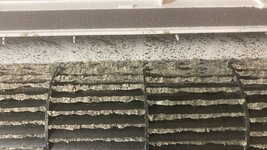
Before I called the insulator, I needed to check one more thing…

Working fine now 🤦‍♂️
Yikes! That will cause a problem!

Dirty blower wheels just kill air flow to a greater extent that most people realize.

Years ago I an into a 3 ton AC that wasn't keeping up. It was an engineered system so I assumed it was correct at one time. I pulled the blower and washed the blower wheel. It had been painted, but all the paint was gone and now it had a smooth rust layer covering everything. I also washed the indoor coil. The air handler was belt drive. The motor pulley was adjusted as fast as it would go and the motor was running full amps. It still would not cooled the space.

I got a hold of some air balancing tools and measured the air flow. I was low. You need 400 CFM per tom and I was getting just under 1,000 on the threes ton system. I decided the only problem I could see was the blower wheel and ordered a new one and replaced it. When I got done I had to slow the blower speed down as it was moving too much air. Also slowing the blower speed lowered motor amps so there was a slight savings there too. After that the unit cooled the space just fine.

I showed other people in the HVAC trade that blower wheel and everyone said they would not have replaced it and were shocked to hear the story behind it. So just as fine layer of dust on a blower wheel will kill air flow. A dirty wheel like in the OP's pics simply destroy air flow.
 
Last edited:
OP
H

housewolf

Well-known member
Joined
Feb 3, 2021
Messages
1,144
Location
East Texas
Yikes! That will cause a problem!

Dirty blower wheels just kill air flow to a greater extent that most people realize.

Years ago O an into a 3 ton AC that wasn't keeping up. It was an engineered system so I assumed it was correct at one time. I pulled the blower and washed the blower wheel. It had been painted, but all the paint was gone and now it had a smooth rust layer covering everything. I also washed the indoor coil. The air handler was belt drive. The motor pulley was adjusted as fast as it would go and the motor was running full amps. It still would not cooled the space.

I got a hold of some air balancing tools and measured the air flow. I was low. You need 400 CFM per tom and I was getting just under 1,000 on the threes ton system. I decided the only problem I could see was the blower wheel and ordered a new one and replaced it. When I got done I had to slow the blower speed down as it was moving too much air. Also slowing the blower speed lowered motor amps so there was a slight savings there too. After that the unit cooled the space just fine.

I showed other people in the HVAC trade that blower wheel and everyone said they would not have replaced it and were shocked to hear the story behind it. So just as fine layer of dust on a blower wheel will kill air flow. A dirty wheel like in the OP's pics simply destroy air flow.
The room was 72* (setpoint) with the unit idling along almost silently when I came up here this morning.

The unit is only 18 mos old but I did install it before I completely finished construction. I didn’t do any cutting in there and very little sanding, the room isn’t occupied but maybe 4 days a month. The filters that came with the unit have never been very dirty but I suppose I should have put some temp filter media over them until I was completely finished with construction.

Yeah, you take the cross section between the blades on the blower and reduce that by ~40% it only stands to reason your airflow will be reduced by as much. I don’t go up there much so never noticed it wasn’t moving as much air. I did check the discharge air DT but still feel like a ******* for not thoroughly checking the unit.

That’s not to say the floor doesn’t still need insulation. I think I’m just going to buy a couple of 2” boards every trip to the box store until I have it completed.

ETA; I did talk to the spray foam guy and he said he’d try and get the minimum trip charge waived to spray under the floor for around $800. I’d be all over that! Could probably see mid 60s in 100+ weather fully encased in foam insulation. 😎
 
Last edited:
To avoid these ads, REGISTER NOW!

PoorUB

Well-known member
Joined
Mar 29, 2021
Messages
11,692
Location
Fargo, ND
Yeah, you take the cross section between the blades on the blower and reduce that by ~40% it only stands to reason your airflow will be reduced by as much. I don’t go up there much so never noticed it wasn’t moving as much air. I did check the discharge air DT but still feel like a ******* for not thoroughly checking the unit.
It isn't the restricted cross section of the fan blades, it it the dirt on the blades that disrupts the air flow across the blades and the efficiency drops of incredibly.
 

thammel

Well-known member
Joined
Oct 3, 2005
Messages
2,245
Location
Maryland
Your uninsulated floor adds greatly to the heat loss. If you insulate the floor you will find it a lot easier to keep the attic room cool. Three modes of heat transfer are conduction, convection and radiation. What you have going on here is conduction through the flooring and then convection below in the air spaces. So when the bottom of the floor(top of the ceiling joist cavities I think) gets to 90 degrees via convection then you have conduction through the floor to the top surface of the floor then convection off the floor. What you want to do is reduce the thermal conductivity of the floor system (via insulation) so the temperature difference between the top of the floor and the bottom of the floor is increased. It's really a system problem. Insulation will make a huge improvement.
 
OP
H

housewolf

Well-known member
Joined
Feb 3, 2021
Messages
1,144
Location
East Texas
Your uninsulated floor adds greatly to the heat loss. If you insulate the floor you will find it a lot easier to keep the attic room cool. Three modes of heat transfer are conduction, convection and radiation. What you have going on here is conduction through the flooring and then convection below in the air spaces. So when the bottom of the floor(top of the ceiling joist cavities I think) gets to 90 degrees via convection then you have conduction through the floor to the top surface of the floor then convection off the floor. What you want to do is reduce the thermal conductivity of the floor system (via insulation) so the temperature difference between the top of the floor and the bottom of the floor is increased. It's really a system problem. Insulation will make a huge improvement.
Thank you. Even though I’m comfortable sitting up here now, I’ve pretty much decided to either spray foam the underside or DIY 2” foam boards. The spray foam guy wasn’t able to waive the entire difference between what the work is worth and the minimum trip charge but he did split it with me. The boards are an R10 and he said 5-1/2” of open cell is R21. In short, it’s +$500 to do spray foam.

Even though the room isn’t constantly occupied, it is important to me to have the ability to keep it comfortable. We offer it to guest that would maybe prefer that over sleeping in the house and it’s our “Plan B” should we have an extended power outage. Four times we’ve gone 2+ weeks, that’s over 50 years so it’s not like a regular event but we do have to keep it in mind. I can run everything (not at once) with an efficient/quiet generator.
 

fitter30

Well-known member
Joined
Jun 23, 2019
Messages
2,992
Location
Peace Valley,mo
Have a combo thermometer/ RH ? Amazon has them for $15. Think your getting infiltration through the floor. RH travels high to low just like temp. Space under 50% RH is good but lower is better. Did you happen to clean the coils with evap cleaner and water?
 
OP
H

housewolf

Well-known member
Joined
Feb 3, 2021
Messages
1,144
Location
East Texas
Have a combo thermometer/ RH ? Amazon has them for $15. Think your getting infiltration through the floor. RH travels high to low just like temp. Space under 50% RH is good but lower is better. Did you happen to clean the coils with evap cleaner and water?
The coils were pretty clean. When I saw how dirty the blower was I expected the coils to be in bad shape too. I did spray them with simple green and rinsed with water. It’s brutally hot here now, Temps have been high 90s to 102, humidity 60-70% with dew points in the high 70s. The RH indoors has stayed below 50 so even at 80*, it’s not that uncomfortable, but I knew it was off. I’m leaning toward biting the bullet and having them spray 5-1/2” of open cell under the floor and turn it into an ice box. My house and shop are both spray foam, have small units in both that just idle through these hot days keeping the indoors dry and cool.
 
To avoid these ads, REGISTER NOW!
Top Bottom