To avoid these ads, REGISTER NOW!

Bad connection in meter box? General installer woes...

Framton Nuttel

Well-known member
Joined
Jun 1, 2021
Messages
82
Location
Montreal
I'm relating a recent experience here, as I am still trying to help a family member advocate for themselves with the contractors involved and also because the situation highlights a number of things that can go wrong with an electrical job. I work on high voltage systems in an industrial setting, but am not an electrician and don't pretend to be one.

The prelude to the saga below is that the family member had a new electric furnace installed and other HVAC work performed. The HVAC contractor was supposed to have their electrician add a second service panel, as well as a second service drop to add sufficient capacity. The homeowner apparently had some questions as to whether the work was fully completed, but the system was more or less functional and the contractor took the money and moved on. This all happened about a year ago and everything seemed to be working ok.

Last week, the family member had a number of circuits stop working in their house. We quickly established that voltage on the L1 leg of their 240V service was much lower than nominal, and all branch circuits on the L1 leg (as well as all 240V circuits) stopped working (everything on L2 was fine). We've have recently had some very stormy weather, so it seemed possible that the existing service drop lines got yanked by blowing branches or that there was water ingress somewhere.

Checking outside, it quickly became apparent that the outdoor work was never completed:
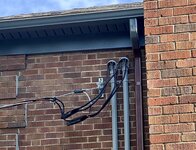
  • there are two service drop conduits above the meter box, but one of them just has the two wires hanging out not connected to anything
  • there is no electric meter in the socket, just a meter jumper
  • on the customer side below the meter box, I can see two separate conduits: a rigid PVC conduit that runs to original service panel, plus a second flexible conduit added by the HVAC contractor
  • presumably, the two customer side circuits have somehow been wired in parallel inside the meter box using the lugs from the meter socket [edit: it turns out this meter box is designed to support two service panels using an accessory lug]
  • tapping on the outside of the glass faceplate covering the meter socket caused visible arcing inside the box and caused the L1 fault to come and go (tapping was done with a 1000V insulated screwdriver fwiw)
Based on these observations, I urged my relative to make an emergency call to an electrician as the situation seemed potentially dangerous (in addition to being inconvenient).

So next day (apparently after calling seven places) they get an electrician to come out and he confirms the L1 leg is bad. He goes outdoor and checks the meter box, and quickly realizes the installation was unfinished. I would have thought he could have pulled the jumper and at least checked for loose lugs or something inside the box, but he didn't want to touch it and (understandably) urged them to get the original contractor to come out and take responsibility.

They called the original contractor, who "promised to call back" but has been basically ghosting them. We are at the start of a two week "construction holiday" here, where pretty much everyone in construction and trades takes their vacation. I am urging them to get whatever electrician they can find to come back on an emergency call and do whatever it takes to at least address the arcing connection in the meter box and get them a stable 240V service until they can get the whole mess cleaned up (maybe take the original contractor to small claims court or whatever).

I will post some photos later, but the whole thing is pretty scary. If anyone has advice or comments I'd be grateful for whatever support.

Thanks!

FN
 
Last edited:
To avoid these ads, REGISTER NOW!
OP
F

Framton Nuttel

Well-known member
Joined
Jun 1, 2021
Messages
82
Location
Montreal
Here's the meter box - note heat pump partially blocking access to the box. Who installs stuff like this!?

26552502-B5F7-4140-8B64-275B6CFC4B9E_1_102_a.jpeg

Apparently, the HVAC contractor's electrician gently angled the heat pump away to allow access during installation of the box and conduits. This outdoor unit has four copper lines - it seems like taking a big chance if one of these gets kinked or busted...
 
Last edited:
OP
F

Framton Nuttel

Well-known member
Joined
Jun 1, 2021
Messages
82
Location
Montreal
Single meter socket with meter jumper, a year after installation. The seal has been broken with the wire stuck back into the plastic tab.

tempImageZckZB5.png
 
OP
F

Framton Nuttel

Well-known member
Joined
Jun 1, 2021
Messages
82
Location
Montreal
Two panels with conduits running back to meter box - presumably jumpered in parallel inside the meter box (upper panel cover removed to check L1 and L2 bus voltages).

The lower box with flexible conduit was installed last year by the HVAC contractor.

tempImageKUlh86.png
 
OP
F

Framton Nuttel

Well-known member
Joined
Jun 1, 2021
Messages
82
Location
Montreal
I guess this obviously was not inspected :( Did they even pull a permit ?

In our metro area, permits are only required to make sure that visible changes comply with local aesthetic standards or for renovations where the city might be able to increase your property taxes.

There is no provision for getting permits and inspection of work done by a homeowner. Basically everything has to be done by a licensed tradesperson, and as such can be done without a permit, but nothing is ever inspected by a third party.

The unfortunate result is that trades here have a monopoly on the jobs, and complete impunity with regards to the quality of work. They are certainly not all bad, but stuff like this is far too common.

I've lived in jurisdictions in the US and Canada where a homeowner can get a permit and you actually get a constructive inspection from a knowledgable inspector. Sadly it's kind of a "Wild West" situation here.
 
Last edited:
OP
F

Framton Nuttel

Well-known member
Joined
Jun 1, 2021
Messages
82
Location
Montreal
I guess this obviously was not inspected :( Did they even pull a permit ?

The closest thing to a permit would have been that the contractor would have been responsible for requesting the second service drop from the electric utility, who would have had to approve the request as well as register the installation of a second meter. Normally the utility should sign off on the finished job, and place seals on the installed meters. Clearly this never happened (the old seal, which was broken, was threaded back through the meter ring and made to look intact).

So far as I can tell, there is no evidence the contractor approached the utility company at all. The second service drop was never completed and there's only the single meter socket (nobody knows what happened to the original meter).

The homeowner is still getting electric bills, maybe based on some average of past consumption? It seems odd that the utility has never looked into why they are not receiving any metering data for almost a year.
 

Snip's

Well-known member
Joined
Apr 29, 2017
Messages
1,857
Location
Ohio
Seems like Canadian home insurance companies would find fault with payout for property loss if the work wasn't inspected???
 
OP
F

Framton Nuttel

Well-known member
Joined
Jun 1, 2021
Messages
82
Location
Montreal
Seems like Canadian home insurance companies would find fault with payout for property loss if the work wasn't inspected???

If you can produce a receipt showing the work was done by duly licensed contractors, you are basically covered. However, if the work was badly done then the homeowner's insurance company might try to go after the electrician's insurance company if the damages were caused by errors or omissions on their part.

For new policies, the insurance company might send their own inspector and demand that any faulty electrical work be corrected before coverage is issued.

If you do your own electrical work, unlicensed, and your work leads to a fire or other damages, then you are pretty much screwed in terms of any insurance payout. As I mentioned above, there is no legal provision here for a homeowner to obtain permit and inspection on DIY electrical work (or work performed by a licensed contractor for that matter). A permitted project might be followed by a visit from a city inspector, but their only job is to make sure you followed zoning rules and that any changes impacting property taxes (eg adding rooms or square footage) have been registered.

Apparently, there were efforts years ago to block Home Depot and other stores in Quebec from selling pretty much any hardware that might be used for DIY electrical work (similar to restrictions on sale of some HVAC refrigerants). It didn't happen.
 
Last edited:

Snip's

Well-known member
Joined
Apr 29, 2017
Messages
1,857
Location
Ohio
A year or so ago, I had a whole house generator installed by a licensed contractor who was responsible with pulling a permit...
The system was installed but not operable until approved by the inspector... I held final payment until after the inspection was made and proof that the system would work when the main power was disconnected....

I assume that was not the case with your family member...

Time to get legal involved?
 
OP
F

Framton Nuttel

Well-known member
Joined
Jun 1, 2021
Messages
82
Location
Montreal
A year or so ago, I had a whole house generator installed by a licensed contractor who was responsible with pulling a permit...
The system was installed but not operable until approved by the inspector... I held final payment until after the inspection was made and proof that the system would work when the main power was disconnected....

I assume that was not the case with your family member...

Time to get legal involved?

I used to live in the US and agree the inspection system in many states (and some provinces here) is much better than the mess in my province.

The construction industry in Quebec, especially for residential, is pretty badly broken in a lot of ways.

One recourse is to lodge a complaint with the RBQ, who issue construction licenses in Quebec, although they are kind of toothless and already overwhelmed by contractor horror stories.

At this point I'd be inclined to send a demand letter to the original HVAC outfit stating that if they don't complete the work stipulated in the contract then we [the homeowner] will have the work done by another electrician on an emergency basis and will take legal action to recover costs.
 
OP
F

Framton Nuttel

Well-known member
Joined
Jun 1, 2021
Messages
82
Location
Montreal
Looks like a lot went wrong here.

Whose does service drops in the area, the power company or a private electrician?

I'm baffled that any of this required a second service and meter.

I believe the power company is responsible for connecting and disconnecting the service drop so the homeowner's contractor can manage everything on the customer side.

Looking at the actual circuits involved in the two panels, I agree that the second service drop seems unnecessary.

The original service panel has the usual 200A master breaker, while the newer panel has a 100A master breaker. They were short a few slots on the original panel, but it seems like the second panel could easily have been wired as a sub panel.

As it stands, they are only running off the single 200A service drop anyway and it was never an issue in terms of capacity. The problem seems to stem from how the two customer side conduits have been spliced inside the meter box.

It would not be uncommon here for a contractor to upsell the need for a second service drop, only to realize it wasn't needed but take the money anyway. The right thing to do - at least in the short term - would probably be to just rewire the new panel as a sub and clean up the wiring in the meter box.

Does anyone know if the meter jumper can be pulled without removing the front cover of the meter box? I would personally not do this myself, but am curious as to whether an electrician would really need to move that heat pump in order to make a basic inspection of connections inside the meter box.
 

PCustoms

Well-known member
Joined
Jul 23, 2011
Messages
23,124
Location
VT
It would not be uncommon here for a contractor to upsell the need for a second service drop, only to realize it wasn't needed but take the money anyway. The right thing to do - at least in the short term - would probably be to just rewire the new panel as a sub and clean up the wiring in the meter box.

I'm assuming upsell/ignorance from the contractor, when the PoCo came to do the hookup and saw the issues (blocked meter, existing meter, panel layout) they told the contractor to fix it and left. Then the contractor jumpered everything to get paid.

Is there any (good, don't want to get red tagged) way to involve PoCo?
 
OP
F

Framton Nuttel

Well-known member
Joined
Jun 1, 2021
Messages
82
Location
Montreal
I'm assuming upsell/ignorance from the contractor, when the PoCo came to do the hookup and saw the issues (blocked meter, existing meter, panel layout) they told the contractor to fix it and left. Then the contractor jumpered everything to get paid.

Is there any (good, don't want to get red tagged) way to involve PoCo?

That sounds imminently plausible. It's a good point about risks with involving the PoCo, who might just disconnect the residence until the mess is fixed.

They're going to try to contact the original contractor on Monday, hopefully being more forceful now that they know the full extent of the mess.

Problem is it's the Quebec construction holiday so it might be impossible to reach anyone for the next two weeks. They can't really live like this for that long, so plan B might be to hire another electrician to mitigate the most urgent stuff and then attempt to recover costs through an RBQ complaint or filing in small claims court (which sane person wants to get into).
 
OP
F

Framton Nuttel

Well-known member
Joined
Jun 1, 2021
Messages
82
Location
Montreal
I checked with a few people in my area who had second service drops added for Level 2 EV chargers.

Apparently now they can merge the two legs on each side inside the residence, and use a single meter that is also located indoors.

So it no longer seems to be the case that two service drops require two outdoor meters. It still does not seem right to leave an outdoor meter jumper as a permanent connection or to have the two panel conduits spliced inside the meter box.
 
OP
F

Framton Nuttel

Well-known member
Joined
Jun 1, 2021
Messages
82
Location
Montreal
It's possible their outdoor box has lugs that allow merging two service drops, which are bridged to the customer side via the meter or jumper. Maybe the customer side also allows two sets of feeder lines to be hooked up in parallel, and something is just loose.
 

2Fast

Well-known member
Joined
Mar 20, 2020
Messages
248
Location
Southwest
Side note - I recently had a new water heater installed by a licensed contractor, which included all permits, fees, etc. The day they completed installation, I went ahead and paid, charged to my credit card. But for some reason, they kept dragging their feet on getting the final inspection. I notified them several times, if the final was doesn't done and approved within 90 days of the payment date, I am going to dispute the charge with my credit card.

90 days roles around, still no final - so I dispute the charge and .... the credit card company give me a full refund! I email the company letting them know I received the full refund, and as soon as the system gets inspected I will pay them, again. About one week later it was inspected
 

FredWanaker

Well-known member
Joined
Mar 27, 2021
Messages
1,470
Location
NorCal
I think you should stay out of it because you are guessing on a lot of things. Personally I would suggest they contact the power company to take a look to be sure everything on the POCO side is done properly. They may shut the power off if they see something they do not like. Based on what I have seen on TV of similar in Montreal, I believe that Hydro-Quebec is responsible for things like this, and they can pull the license of the contractor involved.
 
To avoid these ads, REGISTER NOW!

wyliesdiesels

Well-known member
Joined
Aug 14, 2012
Messages
20,031
Location
Modesto, CA
Wow what a mess :wtf: … definitely make them come back and fix it. Or file claim with their insurance
In the US, 2 services (meaning 2 drops) to one building is generally not allowed…. And why go through all that trouble to install a second service instead of just upgrading the existing service??

:wtf::headscrat:poop:
 
OP
F

Framton Nuttel

Well-known member
Joined
Jun 1, 2021
Messages
82
Location
Montreal
I think you should stay out of it because you are guessing on a lot of things. Personally I would suggest they contact the power company to take a look to be sure everything on the POCO side is done properly. They may shut the power off if they see something they do not like. Based on what I have seen on TV of similar in Montreal, I believe that Hydro-Quebec is responsible for things like this, and they can pull the license of the contractor involved.

Yes I agree - I don't want to get involved, although I will follow from a distance and am interested in what the actual explanation and resolution will be. My only real input has been to say that this should urgently be looked at by an electrician and they shouldn't assume it's ok if the 240V service comes back on (plus noting the obvious that the HVAC contractor left the place in a rather sorry state).

The meter box they have is marketed in Canada as a solution for upgrading residential 200A service to 320A. It's not clear if a second service drop is required, or why they left that one service mast with wires hanging. The box is designed to support two distribution panels with a 2-port connector kit. In the end, the only thing the contractor definitely hasn't done is replace the temporary jumper plate with a meter.

Who knows why the box is arcing or the feeder is glitching - obviously only a licensed electrician with appropriate PPE should be digging into the meter box. There are a lot of unknowns and guessing is pointless.

My questions here are mainly to achieve a better understanding of how this kind of job should be done as it's helpful to know when interpreting quotes and proposals.

Thanks for the tips,

FN
 

PCustoms

Well-known member
Joined
Jul 23, 2011
Messages
23,124
Location
VT
The only reason I can see for adding the 2nd service is if the electric furnace was meant to operate on some sort of on demand or reduced rate electric schedule.
 
OP
F

Framton Nuttel

Well-known member
Joined
Jun 1, 2021
Messages
82
Location
Montreal
Wow what a mess :wtf: … definitely make them come back and fix it. Or file claim with their insurance

In the US, 2 services (meaning 2 drops) to one building is generally not allowed…. And why go through all that trouble to install a second service instead of just upgrading the existing service??

:wtf::headscrat:poop:

A lot of people in my area are getting this, mainly to support EV charging. A Level 2 home charger works best on a dedicated 60A circuit, and many larger homes can't support this on the original 200A service.

The houses will have two service masts, but the feeders running back to the pole are still the two hot lines plus neutral. Each hot line from the pole is split into two lines that enter the respective weather heads and masts.

My understanding is that two meters were required in the old days, but these modern meter boxes can manage with a single meter socket.

I am interested in better understanding how this is currently implemented, but as was pointed out guessing is kind of pointless. If someone has a good understanding of this I'd love to hear.
 

u3b3rg33k

Well-known member
Joined
Dec 18, 2017
Messages
4,048
The only reason I can see for adding the 2nd service is if the electric furnace was meant to operate on some sort of on demand or reduced rate electric schedule.
I've seen 2nd meters in VT for exactly that (water heater on a metered timer), but still one service drop.
 
OP
F

Framton Nuttel

Well-known member
Joined
Jun 1, 2021
Messages
82
Location
Montreal
The only reason I can see for adding the 2nd service is if the electric furnace was meant to operate on some sort of on demand or reduced rate electric schedule.

It may not have been accurate to call it a second service, but it's weird that they have the two masts with one set of wires dangling.

As I mentioned above, a number of houses in my region are adding a second service mast but they are still getting power from a single pair of wires back to the pole.

Many of us have dual energy gas/heat pump systems and we get discounted electricity for the heat pump down to a certain minimum temperature. Below this, the system is supposed to switch to natural gas heat.
 
OP
F

Framton Nuttel

Well-known member
Joined
Jun 1, 2021
Messages
82
Location
Montreal
This is pretty common in my area. Not sure what terminology you would use to describe it. Second service drop is maybe not correct (a lot of construction work here takes place in French).

IMG_6928.jpeg IMG_6930.jpeg
 

pizza

Well-known member
Joined
Dec 4, 2019
Messages
1,739
Location
Midwest, USA
There is no provision for getting permits and inspection of work done by a homeowner. Basically everything has to be done by a licensed tradesperson, and as such can be done without a permit, but nothing is ever inspected by a third party.

I've lived in jurisdictions in the US and Canada where a homeowner can get a permit and you actually get a constructive inspection from a knowledgable inspector. Sadly it's kind of a "Wild West" situation here.

in my town, permits are required, but they are only issued to licensed contractors/tradesmen, lol. this means that homeowners are not allowed to work on their own houses!

similar problem
 
OP
F

Framton Nuttel

Well-known member
Joined
Jun 1, 2021
Messages
82
Location
Montreal
in my town, permits are required, but they are only issued to licensed contractors/tradesmen, lol. this means that homeowners are not allowed to work on their own houses!

similar problem

In Quebec, homeowners in single family dwellings (houses) can do their own plumbing and framing etc. It's illegal here to do your own electrical work though, or any plumbing related to natural gas.

As I mentioned earlier, the trade body for electricians tried years ago to ban the sale of any electrical hardware beyond light bulbs in consumer retail outlets. Maybe this is an urban legend, but there are endless online admonishments against homeowners doing any unlicensed electrical work here.
 

u3b3rg33k

Well-known member
Joined
Dec 18, 2017
Messages
4,048
In Quebec, homeowners in single family dwellings (houses) can do their own plumbing and framing etc. It's illegal here to do your own electrical work though, or any plumbing related to natural gas.

As I mentioned earlier, the trade body for electricians tried years ago to ban the sale of any electrical hardware beyond light bulbs in consumer retail outlets. Maybe this is an urban legend, but there are endless online admonishments against homeowners doing any unlicensed electrical work here.
wow, a master electrician to swap a thermostat!

I'm all for not having idiots do electrical work but that's a new one for me.
 
OP
F

Framton Nuttel

Well-known member
Joined
Jun 1, 2021
Messages
82
Location
Montreal
wow, a master electrician to swap a thermostat!

I'm all for not having idiots do electrical work but that's a new one for me.

Yep - needless to say, a lot of homeowners ignore this and the electric aisle at Home Depot remains a busy place.

We all take risks in life and the important thing is to be honest about our own limits and risk tolerance.

The industry is kind of broken here, with perpetual shortages of skilled and competent labour. As a result, shoddy work by (or under the lax supervision of) licensed pros is far too common (with all due respect to the many good tradespeople whose image is tarnished by this).
 
OP
F

Framton Nuttel

Well-known member
Joined
Jun 1, 2021
Messages
82
Location
Montreal
Hoping to get in touch today with the original contractor and/or the Hydro company. Failing that, hopefully can find an electrician in the area who's not off for construction holiday.

Another troubling scenario is that the two dangling lines from the second service mast were in fact hooked up, but have been yanked out by one of our recent storms. In this case, those lines could be energized since they are on common lugs with the other (still-connected) feeder lines at the meter socket. This would also mean that the full 320A service was being pulled on the single intact conduit rated for 200A. If one or the other dangling mast wires comes into intermittent contact with wet branches, then this could impact the affected leg if the other end of the line is in fact on a common lug at the meter socket.

I know it's pointless to speculate, other than for helping appreciate that this is a potentially dangerous situation that needs to be looked at by a pro asap. The patently unfinished job makes it difficult to know what work was and wasn't done when the contractor left the job site for good.

My understanding is that this type of service upgrade (200A to 320/400A) typically involves the use of two service masts. I believe this to avoid the use of excessively large gauge wires and the bigger conduits this would require. What I usually see is a pair of 2" conduits, respectively occupied by wiring rated for 200A, for a total of 400A capacity. By that logic, the second set of feeder lines would have been essential in providing the upgraded capacity in this job.
 

dave*99

Well-known member
Joined
May 5, 2009
Messages
4,269
Location
Coastal NJ
As mentioned, this is likely a terminology difference when calling this a second service drop. I'm in NJ and a house by mine is fed by underground cable from overhead distribution at the street.

There are 2 conduits running down the utility pole and going to the meter pan at the house. Each conduit has 3 large conductors. They tap the overhead lines individually. There are 3 taps on the overhead about a foot North and 3 more taps about a foot South along the overhead conductors.

All these cables terminate on busses on the utility side of the meter in a very large meter pan on the house. Inside the house are (2) separate 200A service panels. Each panel has a 200A main. Those 2 mains are the only disconnects

In summary, a single meter, single service, probably 320/400A and 2 paralleled sets of service conductors between the utility pole and the meter pan.

1690207641316.jpeg
 
Last edited:
OP
F

Framton Nuttel

Well-known member
Joined
Jun 1, 2021
Messages
82
Location
Montreal
Here the arrangement usually seems to be that a single trio of wires (2 hot + neutral) run from the utility pole wires to the residence, at which point each of the three lines may be split to run down two separate conduits (in my area virtually everything is overhead).

Recently it seems to have become popular to use "standalone meter sockets" like this one in 320A upgrades (it's what my family member has). It can use accessory lugs to accept two feeders in parallel and also run two distribution panels in parallel. Apparently with a smart meter they can be installed indoors, which some people find more aesthetic.

I would have naively thought that it would be necessary to upsize the wires all the way back to the pole to double their current carrying capacity. However, it may be that the wires that are inside conduits are subject to tighter constraints in regards to heat dissipation etc.

To be clear, I would never attempt to touch any of this wiring myself. However, thinking through this is a helpful way to learn which in turn helps planning projects and understanding bids.
 
OP
F

Framton Nuttel

Well-known member
Joined
Jun 1, 2021
Messages
82
Location
Montreal
Update:

They got in touch with the original electrician who did the partially-completed wiring upgrades for the HVAC contractor.

The second service mast was never connected, because this has to be done by the utility company and the electrician never contacted them to arrange it. Presumably the same thing applies for the missing meter.

In our jurisdiction, it has to be a licensed electrician making the request to the utility company for a service upgrade. The utility won't talk to a non-electrician homeowner regarding service upgrades. For some reason this was never done despite the work having been largely completed ten months ago.

He's coming out this afternoon - expect some finger-pointing and covering of hindquarters...
 
OP
F

Framton Nuttel

Well-known member
Joined
Jun 1, 2021
Messages
82
Location
Montreal
What's weird about this is that they were told they needed to upgrade their electrical capacity from 200A to 400A to handle the new heating installation, but apparently they've been running everything for the last year on the original feeder wires rated at 200A.

Was it dangerous that they were running everything off of the original service mast for almost a year? Did they really need the 400A upgrade for the HVAC work?
 

dave*99

Well-known member
Joined
May 5, 2009
Messages
4,269
Location
Coastal NJ
I would have naively thought that it would be necessary to upsize the wires all the way back to the pole to double their current carrying capacity. However, it may be that the wires that are inside conduits are subject to tighter constraints in regards to heat dissipation etc.
There are a couple things going on here.

The utility owns the overhead service wires. They are in free air. They are sized based on the utilities understanding of the typical load for a house that size. They often uses much smaller wire than the service entrance wire.

Rest assured that if there are 4 houses connected to a transformer and each house has 200A service-------- there is no way the utility sizes the overhead wire or transformer to deliver 800A.

Wires in conduit will need to be sized for the heating of the wire as you mentioned. If you transition from overhead to underground as shown in my photo, the the wires in conduit will be sized for the full capacity of the service, but connected to smaller overhead wire at the poles.

In my area, the utility provides overhead service up to the side of the house. The customer owns everything from the weather head down. Sometimes the utility will provide the meter pan, sometimes they just give you a list of approved pans and you buy one.
 
OP
F

Framton Nuttel

Well-known member
Joined
Jun 1, 2021
Messages
82
Location
Montreal
Thanks Dave*99 - that makes sense.

The other week a neighbour was getting their service upgraded to 400A and I asked the linesman if there was any risk that other houses might not be able to do this kind of upgrade if the local grid capacity was exceeded.

He was pretty clear in his opinion that this wasn't likely to be an issue. He said in the worst case, they might have to come and upgrade the nearest transformer but he hasn't seen it happen yet.

I suppose that when the electrician makes the request to the utility company for a service upgrade, they are required to present a load analysis and this will help the utility determine what upgrades, if any, are required on their side.
 
OP
F

Framton Nuttel

Well-known member
Joined
Jun 1, 2021
Messages
82
Location
Montreal
So in the end here's the deal - apparently the utility company came to the premises last year to install the new meter and connect the second set of feeder wires.

The guy (utility company) who came didn't have a 320A meter, so he just took the old one and left without arranging any followup. So they have been running off the original feeder through a meter jumper plate for the last ten months.

As suspected, the meter jumper plate was not fully seated. Although it was working for the last ten months, something caused it to creep further out of position which led to the intermittent L2 fluctuations and arcing. We've had some extreme temperature fluctuations and high winds but who knows...

The electrician (HVAC contractor's sub) opened the meter ring and fully seated the jumper plate, which solved the issue for now. That meter box also has a "bypass" switch which allows current to flow uninterrupted when the meter is pulled out.

According to the electrician, their current load would never have exceeded the capacity of the original feeders so there was never any issue (other than the meter jumper not being seated). Of course this suggests that the service upgrade was a blatant upsell by the HVAC contractor, but at least they'll have it for EV charging etc.

The electrician contacted the utility company, who will send someone in the next couple of weeks to install the meter and connect the second set of feeders.

You'd think someone from the HVAC contractor would have followed up to make sure everything was finished and working properly, but that's residential construction here...
 
Last edited:
To avoid these ads, REGISTER NOW!
Top Bottom