Hi-Lock Aircraft Fasteners - A Short Lesson
Hi-Locks are basically bolts used in aircraft structure assembly. They are used in the place of rivets in many places in the aircraft as they are stronger and easier to install, Boeing used automated machinery to install these fasteners.
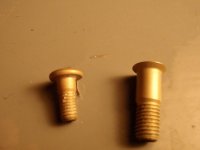
The fasteners are available in many different diameters, lengths, and head styles. There are two basic head styles, protruding and flush. The protruding head is available in two types, the larger one, as in the pic, is a tension head, while there is a smaller, thinner head that may be used if the fastener is only loaded in shear. The fasteners may be manufactured from steel, or titanium and will have many different finishes, such as cadmium plate and they are generally lubed with a alcohol finish that leaves a whitish residue on them.
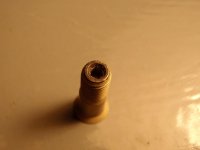
In normal installations, the fasteners are installed in holes that are a one or two thousands interference fit. The fastener has to be driven into the hole, and it does not try to turn when the collar is installed. Smaller sizes are prone to turning even if interference fit, and all have an Allen recess in the end of the fastener.
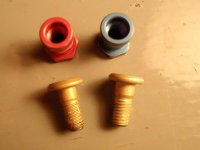
The collars are made of different materials, steel, aluminum, and titanium, and have a recess in them for the shank of the fastener to protrude into. The red collar is for a fastener of standard shank size, and on the right is a blue collar with a larger recess to accept fasteners with a 1/64" or 1/32" oversize shanks. Shown is a 1/64" OS shank on the right fastener. These red and blue collars are anodized aluminum.
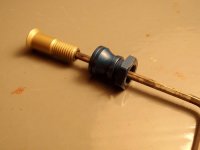
Just under the hex of the collar is a weak point. When you run the collar down (and it is pinched out of round to make it self locking) the collar will tighten up and then the hex will shear off, indicating correct torque has been achieved.
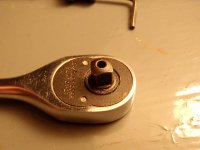
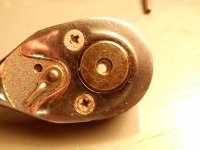
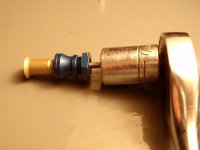
This Proto ratchet has a hole all the way thru it, for the Allen wrench, but does not have a socket retention ring or ball.
The remaining pics are in the next post.
Charles