To avoid these ads, REGISTER NOW!

Some Mini Split Questions

pfettig77

Well-known member
Joined
Jun 20, 2023
Messages
86
Before I get scolded: yes, I've read the other threads on this topic. I've done tons of reading and I think I'm ready to buy something but I have a few questions first. I'm just finishing up a 24x30 detached garage with a bonus room above.

1) Anyone have one of the less expensive brands with hyper heat (Pioneer, Senville, etc.)? They all claim to work down to -22. Any experience with that? We occasionally get that cold around here in NW Wisconsin - maybe a couple days a year. I was told I may be able to have this be my only source of heat?? I'm going to do an experiment and see if that's true this winter. I'll probably leave them on "freeze protection" mode - about 46-50 degrees - most of the time unless I'm working or playing in there. Any other brands I should look at? Can't afford a Fujitsu or Mitsubishi.

2) With multi-zone units they divide the air handler size differently. The one I'm looking at is a 28k condenser with two 12k handlers or a 18k and a 9k handler. Although they have the same square footage, the garage is 7200 cubic feet and the bonus room is 4080 cubic feet. Should I do the 18k (garage) and 9k (bonus room) split? Sounds obvious, but the bonus room may be a living (or hanging out) space some day, so I want to make sure it stays cool/warm.

3) I've heard a few times that it's better to get 2 separate units than one multi-zone unit. I can get 2 separate 12k Pioneers for $2500 or a Senville with two 12k heads for $2300. Is it worth the extra money/install process?

4) At what point does the efficiency get so low that it would be cheaper to have a back-up source? Would it be so much less efficient at, say 0 degrees that it would be worth the expense to install an LP backup? What about other electric heat?
 
Last edited:
To avoid these ads, REGISTER NOW!

jack stand

Well-known member
Joined
Feb 29, 2012
Messages
3,346
Location
Lakes Region Maine
I'm a cheap *******, but when it comes to a product that keeps me warm or cool AND that;
I don't fully understand
Am concerned about being able to have it serviced locally
Have heard of factory support issues
Have heard about parts availability

What if any one of these is true, how cheap really was it.
Now in an "auxiliary" building such as yours (vs. your house) where you don't have to be in it, it might be a little harder to pry open my wallet for one of the industry's proven leading brands, it still could be a disapointing costly failure that needs more money thrown at it to stay warm or cool in your new building.
Could you wait a year (budget) to have a "better" unit?
 

jjrbus

Well-known member
Joined
Dec 8, 2018
Messages
619
Location
Florida
Having a unit serviced is a legitimate concern, here in FL honest mini service techs are very difficult to find. I am sure they are around but likely busy and not looking for new customers.
 

mike93lx

ALLIANCE MEMBER
Joined
Dec 9, 2013
Messages
37,723
Location
Richmond, VA
Being able to generate heat and being able to generate enough heat are very different. I bet if you do the load calcs, you'll need a good amount more heat than it can provide, assuming you size the cooling appropriately.
 

428PI

Well-known member
Joined
Jul 14, 2018
Messages
1,976
Location
Peabody, KS
The real question is do you absolutely have to heat it in the dead of winter? Is there plumbing that will freeze up. I'm running the Pioneer 9k and 18k combo on the bottom floor of my house. Will keep it above 65 until it gets really cold (in Kansas not Wisconsin). Kept it cool (75) in the dead of summer when it was above 100 for a week. Where you're at I'd definitely have a backup heater unless you really want to oversize it and could live with it not working at times.
 
Last edited:

jack stand

Well-known member
Joined
Feb 29, 2012
Messages
3,346
Location
Lakes Region Maine
The guy installing it is a friend of mine. He’s a very talented HVAC guy.
Does he have access to "name brand" equipment with all of the manufacturers support and warranties?
In my very limited experience the areas of the country where m/splits have not really caught on with the local builders and hvac contractors or the public, the mini splits are unfamiliar and therefore puts the contractor out of his comfort zone of familiarity and experience. This adds to his estimate.
I'd expect that your proposed 2 head m/s system would be a 1 day install for 2 guys. That's simply impossible for what he's been doing for his entire career. Heck there's more time than that fabbing and installing the tin work.
My similar 2 head system with probably a little more difficult lineset path to the upstairs unit (retrofit vs. new construction) was done by 2 guy in a day.
With your friends labor advantage, cry once buy once, even if you have to wait a year. 👍
 
OP
P

pfettig77

Well-known member
Joined
Jun 20, 2023
Messages
86
Being able to generate heat and being able to generate enough heat are very different. I bet if you do the load calcs, you'll need a good amount more heat than it can provide, assuming you size the cooling appropriately.
That’s what I was wondering. Not sure how to do the load calculations though.
 

American Locomotive

Well-known member
Joined
Jan 8, 2017
Messages
10,987
Location
Rhode Island
Pay very careful attention to the cheap units "hyperheat" claims. Open up their datasheets and look at the data.

Mitsubishi hyperheat units will generate their rated nameplate heating capacity down to -5F, and usually retain 75-80% down to -13F.

I've seen some cheap "hyperheat" units that are down to less than 50% of nameplate capacity by -5, and by -20F the're generating so little heat you might as well plug in an electric heater - it'd be just as efficient. So check datasheets carefully.
 

pcmeiners

Well-known member
Joined
Aug 13, 2009
Messages
7,937
Location
In the only town in Pennsylvania, Bloomsburg.
"So check datasheets carefully."

Yes check the data, and from multiple source if possible.
This is a big issue with minisplits. Manufacturers supply the data but NO ONE checks that the data is correct, it an honor system; not the AHRI, the states or the federal government properly oversees the data claims. It is a free for all, if manufactures want to falsify or manipulate data, it is up to them.....and they do.
So do you want a little known unit or the cheapest unit available? or a unit with low SEER and HSPF.
 
Last edited:

Jackfre

Well-known member
Joined
Dec 26, 2010
Messages
4,411
Location
N CA
How much difference is there in the pricing? Your experienced HVAC guy likely has a relationship with distribution that he can buy the unit for you at a better price than you can. I would exhaust all avenues to get the Fujitsu/Mitsu first. Support is key as time goes by.
 
OP
P

pfettig77

Well-known member
Joined
Jun 20, 2023
Messages
86
How much difference is there in the pricing? Your experienced HVAC guy likely has a relationship with distribution that he can buy the unit for you at a better price than you can. I would exhaust all avenues to get the Fujitsu/Mitsu first. Support is key as time goes by.
He does large scale commercial stuff nowadays - so probably no deals on the Japanese splits.
 

Jackfre

Well-known member
Joined
Dec 26, 2010
Messages
4,411
Location
N CA
IF he is a hand, and from your description he is, when he walks into a wholesale house he will be acknowledged. Even if he doesn’t have an open account distribution will be happy to sell him. Just ask him! If he is uncomfortable he will tell you and you are no worse off.
 
OP
P

pfettig77

Well-known member
Joined
Jun 20, 2023
Messages
86
If anyone wants to look at the numbers for me, I wouldn't be offended. I'm definitely in over my head when it comes to that kind of stuff.
I realize they can say anything they want, but here is a chart from Pioneer (Pioneer, Senville, Cooper and Hunter, etc. all appear to be the same):


Here are some claims from their sites:
"allows our mini split systems to provide cooling and heating at up to -22F/-30C, with up to 75% efficiency"
"Hyperformance™ retains up to an impressive 88% of its heating capacity, even in low single-digit weather"

Also, can anyone tell me why it might be better to get multiple systems rather than one multi-zone system?
 
Last edited:

housewolf

Well-known member
Joined
Feb 3, 2021
Messages
1,144
Location
East Texas
He does large scale commercial stuff nowadays - so probably no deals on the Japanese splits.
Mitsubishi is probably the biggest player in that arena, at least they were 4 years ago when I left the business. Even the largest projects usually have a few MSs in them
 

American Locomotive

Well-known member
Joined
Jan 8, 2017
Messages
10,987
Location
Rhode Island
If anyone wants to look at the numbers for me, I wouldn't be offended. I'm definitely in over my head when it comes to that kind of stuff.
I realize they can say anything they want, but here is a chart from Pioneer (Pioneer, Senville, Cooper and Hunter, etc. all appear to be the same):


Here are some claims from their sites:
"allows our mini split systems to provide cooling and heating at up to -22F/-30C, with up to 75% efficiency"
"Hyperformance™ retains up to an impressive 88% of its heating capacity, even in low single-digit weather"
Those performance numbers aren't great. Fujitsu, Mitsubishi, LG and others will typically provide full rated heat down to -5F or colder on hyperheat models. Those units you posted are barely hitting rated capacity at 17F. A Mitusbishi hyperheat will typically be 20% above nameplate heating capacity by 17F.
 
OP
P

pfettig77

Well-known member
Joined
Jun 20, 2023
Messages
86
Those performance numbers aren't great. Fujitsu, Mitsubishi, LG and others will typically provide full rated heat down to -5F or colder on hyperheat models. Those units you posted are barely hitting rated capacity at 17F. A Mitusbishi hyperheat will typically be 20% above nameplate heating capacity by 17F.
Thanks. I wonder how that translates into dollars and cents. A single 12k "generic" unit is about $1200 and a Mitsubishi is about $2500 once you buy the install kit and base pan heater. How long would it take to recoup that money? I realize reliability should be factored in.
Would you buy two single zones or one multi-zone?
 

American Locomotive

Well-known member
Joined
Jan 8, 2017
Messages
10,987
Location
Rhode Island
It's not "how long it would take to recoup the money?" it's "will this unit actually provide enough heat at low temperatures?".

In terms of efficiency, the cheap units tend to use inflated efficiency numbers that don't really reflect reality. You will notice a lot of the cheap units have dramatically lower SEER2 units than they did SEER1, while the premium Japanese brands hardly changed.
 
OP
P

pfettig77

Well-known member
Joined
Jun 20, 2023
Messages
86
It's not "how long it would take to recoup the money?" it's "will this unit actually provide enough heat at low temperatures?".

In terms of efficiency, the cheap units tend to use inflated efficiency numbers that don't really reflect reality. You will notice a lot of the cheap units have dramatically lower SEER2 units than they did SEER1, while the premium Japanese brands hardly changed.
Thanks. Do you think sizing matters? Would it make a difference, in terms of winter heating, if I got a bigger unit?
I came across the below post yesterday and this chap seems to be doing pretty well and he's in a colder climate than me. He does have better insulation than I'll have though.
SUB-ZERO Mini Split + Spray Foam Report | The Garage Journal
 
To avoid these ads, REGISTER NOW!

rlitman

Well-known member
Joined
Oct 18, 2010
Messages
24,632
Location
Long Island
Pay very careful attention to the cheap units "hyperheat" claims. Open up their datasheets and look at the data.

Mitsubishi hyperheat units will generate their rated nameplate heating capacity down to -5F, and usually retain 75-80% down to -13F.

I've seen some cheap "hyperheat" units that are down to less than 50% of nameplate capacity by -5, and by -20F the're generating so little heat you might as well plug in an electric heater - it'd be just as efficient. So check datasheets carefully.
There's another big gotcha with mini-split heating. Condensation.

Over the past two winters, I've heated by basement with my LG dual-head mini-split, and in the coldest weather it's been great (admittedly, the coldest weather for me would be 0F). I saw no performance issues when run for long periods under 15F, but when it's close to freezing outside, say 29F and up, there may be enough humidity in the air to freeze up the outdoor coil, which forces the unit into defrost mode. And defrost mode works by running the unit as an air conditioner, blowing COLD air indoors until the coil melts.

So, paradoxically, I'm at the biggest risk of freezing indoors when it's warmest outside. Even so, I don't think I'd be comfortable relying on this as my sole source of protection from freeze damage.

Another thing to consider is price. Two separate systems will often price out the same as a two-head system. Multi-head systems have the advantage of less compressors to place outside, but they also have the disadvantage of reliability, because a single problem can now disable every head.
 
OP
P

pfettig77

Well-known member
Joined
Jun 20, 2023
Messages
86
There's another big gotcha with mini-split heating. Condensation.

Over the past two winters, I've heated by basement with my LG dual-head mini-split, and in the coldest weather it's been great (admittedly, the coldest weather for me would be 0F). I saw no performance issues when run for long periods under 15F, but when it's close to freezing outside, say 29F and up, there may be enough humidity in the air to freeze up the outdoor coil, which forces the unit into defrost mode. And defrost mode works by running the unit as an air conditioner, blowing COLD air indoors until the coil melts.

So, paradoxically, I'm at the biggest risk of freezing indoors when it's warmest outside. Even so, I don't think I'd be comfortable relying on this as my sole source of protection from freeze damage.

Another thing to consider is price. Two separate systems will often price out the same as a two-head system. Multi-head systems have the advantage of less compressors to place outside, but they also have the disadvantage of reliability, because a single problem can now disable every head.
My Mr. Cool defrosts quite a bit in the winter, but I've never had it blow cold air.

If a mini split has a pan heater, does that help with the problem of frosting up, or is that something different?
 

American Locomotive

Well-known member
Joined
Jan 8, 2017
Messages
10,987
Location
Rhode Island
A bigger unit would help close the heating gap, as you'd have more capacity overall. I can't tell you how long the payoff would be from a more efficient unit, and a larger, cheaper, less efficient unit. Depends on how big the efficiency disparity is, how much heating you need, and how much your electricity costs.

The only purpose of a pan heater is to stop ice from building up in the bottom of the unit and possibly damaging the coil or getting stuck in the fan.

I only really have experience with Mitsubishi minisplits, but they certainly do not blow cold air during defrost. The indoor fan switches off, the outdoor unit ramps up and quickly melts the ice off the coil, then it switches back to heat mode and doesn't turn the indoor fan on until the coil is hot again. I'm sure the indoor coil gets very cold during a defrost. Takes maybe 4-5 minutes for a defrost cycle?
 

pcmeiners

Well-known member
Joined
Aug 13, 2009
Messages
7,937
Location
In the only town in Pennsylvania, Bloomsburg.
"Multi-head systems have the advantage of less compressors to place outside, but they also have the disadvantage of reliability, because a single problem can now disable every head."


Multi head/zone units have a much lower efficiency than single zone units (SEER, HSPF). Also the higher the BTU capacity rating, the lower the efficiency, even within single zone units .
 

fitter30

Well-known member
Joined
Jun 23, 2019
Messages
2,988
Location
Peace Valley,mo
Any hyper heat units need to know what your load is at the coldest temp. Most units even hyper heat lose capacity in cold temps. Need to talk with the manufacturer ask what is the output at x temp. And with any equipment if freezing temps is a problem.
Water freezing ,can't live in this environment need backup.
 
OP
P

pfettig77

Well-known member
Joined
Jun 20, 2023
Messages
86
"Multi-head systems have the advantage of less compressors to place outside, but they also have the disadvantage of reliability, because a single problem can now disable every head."


Multi head/zone units have a much lower efficiency than single zone units (SEER, HSPF). Also the higher the BTU capacity rating, the lower the efficiency, even within single zone units.
I am a little torn between two 12k units and one 28k unit with two heads. My only hesitation is the extra install time and cost and then having two kinda ugly boxes next to my garage instead of 1. How much of a real world difference will it make in terms of efficiency and money?
 
Last edited:

Jackfre

Well-known member
Joined
Dec 26, 2010
Messages
4,411
Location
N CA
Two ugly boxes? Compared to central units they are quite compact and good looking. Check out the alternatives. 12k units require a 15A circuit. Depending upon manuf the 28 will require a 20 or 30. The advantage to singles is substantially higher efficiency as pointed out and you have redundancy. You will also likely find that depending upon lay-out, in the majority of the seasons you can run only one unit. Given you location and clippers rolling out of Ontario and Manitoba I think you should go with the best supported leading brands as advised.
 

pcmeiners

Well-known member
Joined
Aug 13, 2009
Messages
7,937
Location
In the only town in Pennsylvania, Bloomsburg.
How much of a difference depends on the models you choose, primarily dependant on SEER and HSPF rating and initial costs. Also SEER (cooling) means little if you live in cooler climates, HSPF heating) is more important in cooler region, the reverse if you live primarily warmer areas, where SEER is most important. If I lived in Texas or Florida I would not give HSPF rating any importance

Below are 3 calculators for cost comparison of minisplits, with the ability to see what different SEER ,HSPF and fuel costs variables affect running costs.....

Personally I ran with the highest efficiency, low temp, Fujitsu units (33 SEER, HSPF 13.8). I choose to pay up front, then pay very low utility costs over years .

Two boxes are not bad, I have 5 single zone boxes, 3 in one area in the rear of the house; I need a few bushes to hide the three. I figure I can heat AC and supply hot water (water heater heat pump) for a total of $1300. presently per year for a 1350sqft ranch home and an 1080sqft garage with a $.11/kw cost. Figure I can easily live with the boxes, once I plant a few bushes.

The first two calculators linked are simple, the third is more complicated.


This is more complicated, you need to replace variables in the spreadsheet, such as fuel costs, and efficiency ( Approx. Efficiency (% ) . As to efficiency average minisplits get 300% COP 3, high efficiency get 400% (average), which is a COP of 4


Have installed four so far. All my unit lineset are run on the inside of house walls which is a lot of work, but looks much better than surface installs.

As a last note manufacturers of multi zone units avoid stating efficiency ratings, one because they are lower, the other reason is the difficulty in testing and standards for multi zone units.
 
Last edited:

428PI

Well-known member
Joined
Jul 14, 2018
Messages
1,976
Location
Peabody, KS
The biggest benefit to the single unit is one electrical line, disconnect, and one unit outside of course. I purchased the available surge protector too just in case. No regrets so far.
 
OP
P

pfettig77

Well-known member
Joined
Jun 20, 2023
Messages
86
How much of a difference depends on the models you choose, primarily dependant on SEER and HSPF rating and initial costs. Also SEER (cooling) means little if you live in cooler climates, HSPF heating) is more important in cooler region, the reverse if you live primarily warmer areas, where SEER is most important. If I lived in Texas or Florida I would not give HSPF rating any importance

Below are 3 calculators for cost comparison of minisplits, with the ability to see what different SEER ,HSPF and fuel costs variables affect running costs.....

Personally I ran with the highest efficiency, low temp, Fujitsu units (33 SEER, HSPF 13.8). I choose to pay up front, then pay very low utility costs over years .

Two boxes are not bad, I have 5 single zone boxes, 3 in one area in the rear of the house; I need a few bushes to hide the three. I figure I can heat AC and supply hot water (water heater heat pump) for a total of $1300. presently per year for a 1350sqft ranch home and an 1080sqft garage with a $.11/kw cost. Figure I can easily live with the boxes, once I plant a few bushes.

The first two calculators linked are simple, the third is more complicated.


This is more complicated, you need to replace variables in the spreadsheet, such as fuel costs, and efficiency ( Approx. Efficiency (% ) . As to efficiency average minisplits get 300% COP 3, high efficiency get 400% (average), which is a COP of 4


Have installed four so far. All my unit lineset are run on the inside of house walls which is a lot of work, but looks much better than surface installs.

As a last note manufacturers of multi zone units avoid stating efficiency ratings, one because they are lower, the other reason is the difficulty in testing and standards for multi zone units.
Thanks for the link. I played around with them for a while. Barring any major breakdowns, I don't think the more expensive units would pay for themselves in their lifetimes (and I just don't think I can justify $5000 vs $2300 when it's just a garage). You do have me leaning more towards doing two 12k units (is that enough)? It should be the world's easiest install as the heads will be directly above the condensers and there's no insulation or drywall yet.
 
OP
P

pfettig77

Well-known member
Joined
Jun 20, 2023
Messages
86
12k is plenty , I am doing a slightly larger garage and a house (temporally) with a 12k.

Don't forget the federal tax credit.
Thanks. Just looked into that. That could potentially be a big chunk of change. Do they check the work or are people on their honor?
 
Last edited:

pcmeiners

Well-known member
Joined
Aug 13, 2009
Messages
7,937
Location
In the only town in Pennsylvania, Bloomsburg.
Your local utility might check, to avoid it send pictures of the outside inside install plus pictures of the serial number plate with the rebate forms . As to the feds include a photo copy of the receipts if you want, they will not come to your garage to check, if your ever audited, have the receipts handy. Personally I will send a copy with the return. This year I will get $1600 in rebates, and $3200 in tax credits.
 

American Locomotive

Well-known member
Joined
Jan 8, 2017
Messages
10,987
Location
Rhode Island
Are you planning to do a DIY install, or have a contractor?

During COVID, it was sweet because you could DIY a ton of stuff and still get the Fed/State/POCO rebates. They were even doing instant rebates at the cash register for Hybrid water heaters at one point. I got a Rheem Hybrid Water Heater for $300 after rebates and I put it in myself.

...however things have changed now. I helped a friend install some minisplits, and the POCO denied him the minisplit rebates because the system wasn't installed by a contractor on their approved list. You had to pick a contractor from their approved list (and there were a lot of reputable local companies NOT on that list, including ones I know are Mitsubishi certified), and go through this ordeal of a process. Needing to go through their list of approved contractors drives the cost up so much, it's basically a wash compared to going with a non-approved contractor that isn't eligible for the rebate.
 
OP
P

pfettig77

Well-known member
Joined
Jun 20, 2023
Messages
86
Are you planning to do a DIY install, or have a contractor?

During COVID, it was sweet because you could DIY a ton of stuff and still get the Fed/State/POCO rebates. They were even doing instant rebates at the cash register for Hybrid water heaters at one point. I got a Rheem Hybrid Water Heater for $300 after rebates and I put it in myself.

...however things have changed now. I helped a friend install some minisplits, and the POCO denied him the minisplit rebates because the system wasn't installed by a contractor on their approved list. You had to pick a contractor from their approved list (and there were a lot of reputable local companies NOT on that list, including ones I know are Mitsubishi certified), and go through this ordeal of a process. Needing to go through their list of approved contractors drives the cost up so much, it's basically a wash compared to going with a non-approved contractor that isn't eligible for the rebate.
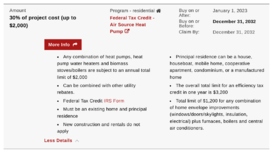
Here are the federal and state guidelines for the rebate. I followed the link to the federal site to read the fine print but didn't see any restrictions about who installs it. I'll skip the state one. I doubt he's a "trade ally contractor." He strictly does giant commercial stuff.
Fed rebate.png
WI rebate.png
 

Highbeam

Well-known member
Joined
Feb 15, 2011
Messages
2,292
Location
Mt Rainier foothills, WA
Those performance numbers aren't great. Fujitsu, Mitsubishi, LG and others will typically provide full rated heat down to -5F or colder on hyperheat models. Those units you posted are barely hitting rated capacity at 17F. A Mitusbishi hyperheat will typically be 20% above nameplate heating capacity by 17F.
This just tells me that Mitsu underrates their equipment. They still lose capacity as the ambient temperature drops. The solution is to simply upsize your equipment so that at very low temperatures you are still making sufficient heat.

If there is no oversight for the data sheets that knife cuts both ways. Meaning we can't trust any of them.
 

pcmeiners

Well-known member
Joined
Aug 13, 2009
Messages
7,937
Location
In the only town in Pennsylvania, Bloomsburg.
"This just tells me that Mitsu underrates their equipment. They still lose capacity as the ambient temperature drops."

There is and never was a heat pump that does not loose capacity when he temperature drops, add to the thread, please tell us something we do not already know.

If you want guaranteed performance at low temps go with ....


"...however things have changed now. "

In 2024, the Fed credit will require an energy audit. Another play by the Feds to feed "professionals". Wonder if the homeowner get stuck paying for it or will the utilities pay for the audit.

As to the rebate requiring a real life contractor, guess it varies by the utility company
I have already gotten 2 rebates from my electric company. No contractors license is required in Bloomsburg, I just used my EPA 608 universal cert number .
 
Last edited:

dcg9381

Well-known member
Joined
Jun 20, 2018
Messages
11,796
Location
Austin, TX
There is and never was a heat pump that does not loose capacity when he temperature drops, add to the thread, tell us something we do not already know.
I didn't know how much capacity they lose.. Well, I didn't realize how much it was going to hurt until we had "serious freezes" in 2021. It's just odd-ball (to me) that they are rating units to "100% output" at -20C, but normal output is actually 300% "rated" output. It's marketing spin.
 
To avoid these ads, REGISTER NOW!
Top Bottom