To avoid these ads, REGISTER NOW!

15a run in attic

strobes

Active member
Joined
Oct 27, 2023
Messages
43
Hi, all, first post here. I can't find answer to some questions. And looking for directions to appropriate articles in the NEC and or other resources.
I need to run about 65 feet of wire (15 a breaker) from panel in garage to outside for a mini split. Mini splits in capacity I want available in 115V or 220V.
My house is slab on grade. So one option to run wire in attic. And these are the questions.
1. Can my home insurance cancel policy if they find that work was not done by unlicensed person? ( I plan to do it)
2. Should I go with 115v or 220v? I understand difference from equipment's performance view. And I have place for 100v or 220V 15A breaker in the panel. But it may depends on question #1 ?
3. I don't mind to run conduit above joist (run is perpendicular) but what type of wire/temperature rating needed per code in TX? Attics are hot and wires are enclosed.
4. Part of the wiring from attic to panel will be outside conduit.
 
To avoid these ads, REGISTER NOW!

rd65

Well-known member
Joined
Sep 29, 2017
Messages
2,841
Location
Granite Falls, WA
I just ran romex in my attic using staples to keep up off any areas that it could get crushed. NEC codes are different state to state as far as which year code they go by. No romex in conduit. I'm western WA, we dont have the kind of heat concerns. No experience with mini splits. 220 will cost more for wire. I did all the wiring from the panel in my shop with a permit so I figure I am covered that way.
 

Galaxywide

Well-known member
Joined
Jun 24, 2019
Messages
74
Location
Twin Cities, MN
220 will cost more for wire.

Yes but also no. You'll need another conductor, but can very likely use smaller gauge due to lower ampacity requirements.

Edit: I was assuming a unit running off 220 would also require 120 and therefore a neutral, which may not be the case. If neutral is not needed, running 220 will be strictly cheaper than 120 due to halving the current required for a given wattage.
 
Last edited:

mm08822

Well-known member
Joined
Jan 13, 2012
Messages
6,053
Location
NJ
Hi, all, first post here. I can't find answer to some questions. And looking for directions to appropriate articles in the NEC and or other resources.
I need to run about 65 feet of wire (15 a breaker) from panel in garage to outside for a mini split. Mini splits in capacity I want available in 115V or 220V.
My house is slab on grade. So one option to run wire in attic. And these are the questions.
1. Can my home insurance cancel policy if they find that work was not done by unlicensed person? ( I plan to do it)
2. Should I go with 115v or 220v? I understand difference from equipment's performance view. And I have place for 100v or 220V 15A breaker in the panel. But it may depends on question #1 ?
3. I don't mind to run conduit above joist (run is perpendicular) but what type of wire/temperature rating needed per code in TX? Attics are hot and wires are enclosed.
4. Part of the wiring from attic to panel will be outside conduit.
1) You need to read the unit's MCA value from the nameplate to determine the minimum wire size. Running in attic is fine.
Typically no - ask your ins co for their answer. No one else's answer matters. Most localities require permit and inspection regardless of who does the work. Generally once the work is inspected, there is no further discussion about properly done or not.
2) My preferance is always 240v if I have the option. Read the unit's nameplate for the maximum cb size permitted - MOP value.
15A may not be correct. Check the MCA and MOP values first.
3) Conduit gives you the choice of which wire to use as different insulation provides for different ampacity values. Ampacity can be lowered for the ambient temp wire is exposed to. Need mca, mop and attic temps to determine min size.
4) Conduit would probably be the better choice to eliminate an unnecessary splice. Otherwise you would need UF cable for the exterior. UF could be run the entire way but could also transition to NM-B once inside.
 

Steve W.

Well-known member
Joined
Mar 27, 2019
Messages
1,263
Location
Southwest oHIo
For any mini split you are likely to use in Texas, a 120-volt unit will NOT be enough.

I am about to install a couple minis at my place. They run on 240v, draw about 20 amp max, so they are getting their required 30 amp breakers on 240v. You will need 10 gauge wire for that. 10/2 with ground will work.

.
 

mm08822

Well-known member
Joined
Jan 13, 2012
Messages
6,053
Location
NJ
I just ran romex in my attic using staples to keep up off any areas that it could get crushed. NEC codes are different state to state as far as which year code they go by. No romex in conduit. I'm western WA, we dont have the kind of heat concerns. No experience with mini splits. 220 will cost more for wire. I did all the wiring from the panel in my shop with a permit so I figure I am covered that way.
Romex can go in conduit in dry locations, but can be a b***h to pull. Avoid it whenever possible.
Actually running at 240v gives the possibility to reduce wire size due to halving the current. The wire insulation rating is typically 600v so the same wire or cable is good for either 120 or 240v.
 

mm08822

Well-known member
Joined
Jan 13, 2012
Messages
6,053
Location
NJ
For any mini split you are likely to use in Texas, a 120-volt unit will NOT be enough.

I am about to install a couple minis at my place. They run on 240v, draw about 20 amp max, so they are getting their required 30 amp breakers on 240v. You will need 10 gauge wire for that. 10/2 with ground will work.

.
What worked for you make not work for the OP or could be overkill. OP needs to read his unit's nameplate for it's requirements.
 

wyliesdiesels

Well-known member
Joined
Aug 14, 2012
Messages
20,074
Location
Modesto, CA
Hi, all, first post here. I can't find answer to some questions. And looking for directions to appropriate articles in the NEC and or other resources.
I need to run about 65 feet of wire (15 a breaker) from panel in garage to outside for a mini split. Mini splits in capacity I want available in 115V or 220V.
My house is slab on grade. So one option to run wire in attic. And these are the questions.
1. Can my home insurance cancel policy if they find that work was not done by unlicensed person? ( I plan to do it)
2. Should I go with 115v or 220v? I understand difference from equipment's performance view. And I have place for 100v or 220V 15A breaker in the panel. But it may depends on question #1 ?
3. I don't mind to run conduit above joist (run is perpendicular) but what type of wire/temperature rating needed per code in TX? Attics are hot and wires are enclosed.
4. Part of the wiring from attic to panel will be outside conduit.
need to backup here.

before sizing the circuit you need to pick a unit because wiring is sized based on the MCA- minimum circuit amps, rating of the unit.
 

wyliesdiesels

Well-known member
Joined
Aug 14, 2012
Messages
20,074
Location
Modesto, CA
I just ran romex in my attic using staples to keep up off any areas that it could get crushed. NEC codes are different state to state as far as which year code they go by. No romex in conduit.
this is incorrect for indoor conduit.
I'm western WA, we dont have the kind of heat concerns. No experience with mini splits. 220 will cost more for wire. I did all the wiring from the panel in my shop with a permit so I figure I am covered that way.
huh? why? and its 240v not 220v
 
OP
S

strobes

Active member
Joined
Oct 27, 2023
Messages
43
Everyone, thank you for comments!
@mm08822, I'll ask my city what take to get a permit. In this case I expect that city will send an inspector.
The mini split calls for 14ga wire 15A beaker. I plan to bump to 12ga. ( this is 9000 btu unit for one room to be use as AUX. The house has 5 ton central AC) And 9000btu available in 115V. If I run 230V in conduit, any idea where to find temperature rating for wires running in conduit for TX attic, if you may know?
With 115V, can I connect it to 15A branch circuit? There is an outlet in the room where compressor will be but outside. So I can remove outlet and pick the power from that drop.
 

75gmck25

Well-known member
Joined
Jul 21, 2014
Messages
1,328
Location
Alexandria, VA
Also give your city permit office a call, and ask whether you can pull the permit and do all the work as a homeowner.

In my city I can pull a permit and install all the electrical wiring and devices I want because it's my home. However, I can't do electrical work for someone else's home, and I can't do permitted work on any multi-family dwelling.

In my case, they will inspect my work and must approve it after it's installed, but I don't need to involve a licensed electrician. Inspectors have been very friendly during inspections. I think they assume I don't want to burn down my own house.

General guidance - If you don't understand the code and rules well enough to be confident you can pass inspection, it's best to pay someone qualified to do the work.
 
OP
S

strobes

Active member
Joined
Oct 27, 2023
Messages
43
Also give your city permit office a call, and ask whether you can pull the permit and do all the work as a homeowner.

In my city I can pull a permit and install all the electrical wiring and devices I want because it's my home. However, I can't do electrical work for someone else's home, and I can't do permitted work on any multi-family dwelling.

In my case, they will inspect my work and must approve it after it's installed, but I don't need to involve a licensed electrician. Inspectors have been very friendly during inspections. I think they assume I don't want to burn down my own house.

General guidance - If you don't understand the code and rules well enough to be confident you can pass inspection, it's best to pay someone qualified to do the work.
Good advice, thank you.
I understand what to look for. I dont know where to find it. For exaple what type of wires can be used in conduit and the same time run without conduit so I can avoid splicing. Or I can figure out temperature rating for wire insulation that is in conduit based on NEC but dont know if it needs to adjusted for attic in TX?
 

rmanrman

Well-known member
Joined
Nov 2, 2012
Messages
387
Electrical voltage in the USA has a standard from 1970,s is 120 volts and 240 volts. Why bcuse the street transformer voltage is 240. Volts to your house circuit breaker panel. Then in the panel you choose 120 or 240 volts as per circuit or appliance is required.
 

mm08822

Well-known member
Joined
Jan 13, 2012
Messages
6,053
Location
NJ
Everyone, thank you for comments!
@mm08822, I'll ask my city what take to get a permit. In this case I expect that city will send an inspector.
The mini split calls for 14ga wire 15A beaker. I plan to bump to 12ga. ( this is 9000 btu unit for one room to be use as AUX. The house has 5 ton central AC) And 9000btu available in 115V. If I run 230V in conduit, any idea where to find temperature rating for wires running in conduit for TX attic, if you may know?
With 115V, can I connect it to 15A branch circuit? There is an outlet in the room where compressor will be but outside. So I can remove outlet and pick the power from that drop.
THHN insulation is rated for 90C/194F. I'm guessing 130F in the attic.🤷‍♂️ A 15% reduction in 90C ampacity from 30A for #12 Copper allows for 25A without other considerations. Since the unit's MOP is 15A, #12 THHN copper works. (And so does #14.) Blue and Orange big box stores carry THHN copper.
NM-B is only rated for 60C. At 130F, its derate is 50%. You would need #10. (30a x 0.5 =15a)

The max single load on a 15a general purpose circuit is 50% of the circuit rating - 7.5A. So, no you can't do that. Also the circuit could have other loads maxing out the 15A causing random trips. You may not like the dimming/flickering on that circuit when the mini-split is running.

Maybe I missed something, but the link you provided shows the 9K unit @208/230vac only in the specs table.
 
OP
S

strobes

Active member
Joined
Oct 27, 2023
Messages
43
THHN insulation is rated for 90C/194F. I'm guessing 130F in the attic.🤷‍♂️ A 15% reduction in 90C ampacity from 30A for #12 Copper allows for 25A without other considerations. Since the unit's MOP is 15A, #12 THHN copper works. (And so does #14.) Blue and Orange big box stores carry THHN copper.
NM-B is only rated for 60C. At 130F, its derate is 50%. You would need #10. (30a x 0.5 =15a)

The max single load on a 15a general purpose circuit is 50% of the circuit rating - 7.5A. So, no you can't do that. Also the circuit could have other loads maxing out the 15A causing random trips. You may not like the dimming/flickering on that circuit when the mini-split is running.

Maybe I missed something, but the link you provided shows the 9K unit @208/230vac only in the specs table.
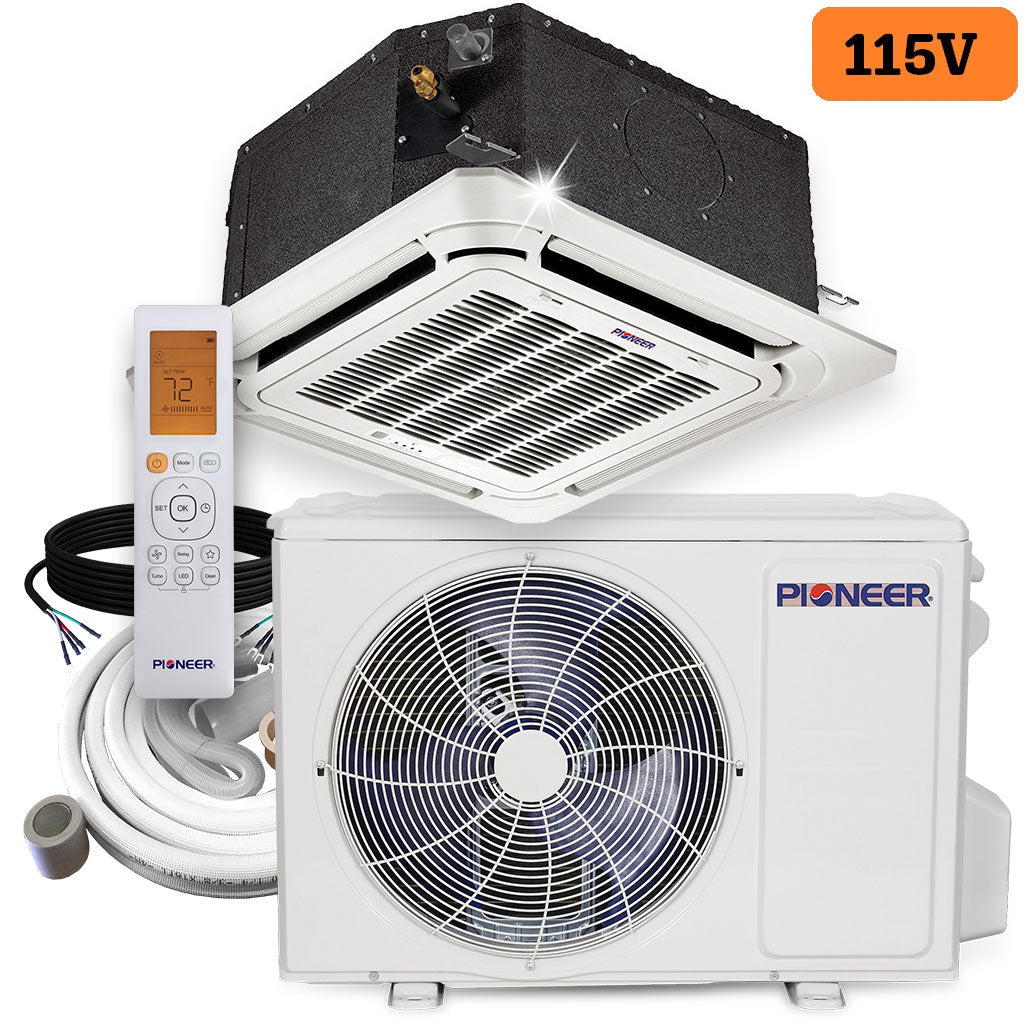
yes. you are correct, published docs show no rating for 115v unit, just for information, here is the link to 115v unit. But considering all comments, it will be 230V.

I have a plan now. Speak with city, ask for permit and follow up inspection. If granted use THHN 12ga (red, black,green). Vertical run from panel to attic without conduit. Use conduit in attic and outside to disconnect.
If the mini split is only one appliance on the circuit do I need disconnect with breaker or 15A breaker in panel is sufficient?
Thank you every one for help!
 
To avoid these ads, REGISTER NOW!

wyliesdiesels

Well-known member
Joined
Aug 14, 2012
Messages
20,074
Location
Modesto, CA
If the unit calls for “max fuse” then you will need a fused disconnect with appropriate sized fuses. If not then will just need a disconnect since the panel is not nearby.

Also you will need a receptacle within 20’ for servicing equipment.
 

Shiftless

Well-known member
Joined
Mar 9, 2014
Messages
14,595
Location
East Bay SFO
Vertical run from panel to attic without conduit. Use conduit in attic and outside to disconnect.
AFAIK, you’re not allowed to run individual wires through free space like inside a stud cavity. Use conduit for the whole run. Or start with ”Romex” through the wall cavity and transition to individual wires in conduit with a junction box in the attic.
 

walta

Well-known member
Joined
Jan 13, 2017
Messages
2,313
Location
Dutzow Missouri
If the unit calls for “max fuse” then you will need a fused disconnect with appropriate sized fuses. If not then will just need a disconnect since the panel is not nearby.

Also you will need a receptacle within 20’ for servicing equipment.

I just want to repeat that it is very likely your code will require you to pull a second cable for the GFIC service outlet required to be installed near the AC unit.

Walta
 

sparky 1971

Well-known member
Joined
Oct 9, 2018
Messages
8,015
Location
Central Iowa
If the unit calls for “max fuse” then you will need a fused disconnect with appropriate sized fuses. If not then will just need a disconnect since the panel is not nearby.

Also you will need a receptacle within 20’ for servicing equipment.
It's 25 feet. 210.63. Not much of a change, but could make the difference between adding a receptacle and not.
 

mm08822

Well-known member
Joined
Jan 13, 2012
Messages
6,053
Location
NJ
I have a plan now. Speak with city, ask for permit and follow up inspection. If granted use THHN 12ga (red, black,green). Vertical run from panel to attic without conduit. Use conduit in attic and outside to disconnect.
If the mini split is only one appliance on the circuit do I need disconnect with breaker or 15A breaker in panel is sufficient?
Thank you every one for help!
You can run 2 blacks or 2 reds. That will cut down on one spool to buy.
 

mm08822

Well-known member
Joined
Jan 13, 2012
Messages
6,053
Location
NJ
I just want to repeat that it is very likely your code will require you to pull a second cable for the GFIC service outlet required to be installed near the AC unit.

Walta
As long as the recept is gfci protected, it can be fed from an existing general purpose circuit.
 
OP
S

strobes

Active member
Joined
Oct 27, 2023
Messages
43
Everyone, Thank you for help! Create community. I'm so happy that I found this forum.
Yes I got gfci near by already. But was not aware that one is required.
 

75gmck25

Well-known member
Joined
Jul 21, 2014
Messages
1,328
Location
Alexandria, VA
In my San Antonio, Texas house I had all kinds of NM cable (120 volt, 240 volt, 15, 20, 30 and 50 amp circuits, etc.) running through my attic, including power for two attic central A/C units. None of the wire was run in conduit anywhere in the attic. Don't overcomplicate things for your work. Only use conduit where the wire needs physical protection, or if you are running individual wires instead of NM cable.
 
OP
S

strobes

Active member
Joined
Oct 27, 2023
Messages
43
In my San Antonio, Texas house I had all kinds of NM cable (120 volt, 240 volt, 15, 20, 30 and 50 amp circuits, etc.) running through my attic, including power for two attic central A/C units. None of the wire was run in conduit anywhere in the attic. Don't overcomplicate things for your work. Only use conduit where the wire needs physical protection, or if you are running individual wires instead of NM cable.
Yes, that is the same in my house, 30 years old. I was not sure if code has changes. Given all the help and education I got here in the last few days in this forum my plan is to speak with city inspector tomorrow to see what he'll say. Hope NM-8 will be OK.
 
OP
S

strobes

Active member
Joined
Oct 27, 2023
Messages
43
Ok, here is the update, I got permit. Speaking with inspector NM-B will be fine with transition to THHN or UF wire in conduit for outside. Looks like twist nuts are ok to use for the transition.
Next challenge is to run wires from panel / wall cavity to the attic. There is no room for my romex in the hole drilled by builder. And i need to drill one. So I did cut a hole in sheet rock to verify that no wires there. But drilling from the top is not an option because of the roof plywood. It's about 4" above the top plate where I need to drill.
Do I need special tool? How professionals would take care of this problem?
 

75gmck25

Well-known member
Joined
Jul 21, 2014
Messages
1,328
Location
Alexandria, VA
I assume that wherever you removed the sheetrock does not give you clearance to drill up through the top plate? Also remember a top plate may be doubled up, depending on how it was framed.

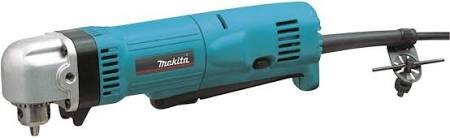
4" is pretty tight from above. However, a right angle drill and very short wood drill bits will get you started, and then switch to a longer bit to get all the way through. You can also drill at an angle from the left or right side and you might get a little more clearance. The hole has to hit the stud bay, but it doesn't need to be straight up and down.

Start out with an oversized short bit at (like using 1" bit for a 5/8" hole) and drill out the hole in the top of the plate at an angle. Then switch to a regular bit and gradually work it into the hole until it's vertical.
 

dave*99

Well-known member
Joined
May 5, 2009
Messages
4,286
Location
Coastal NJ
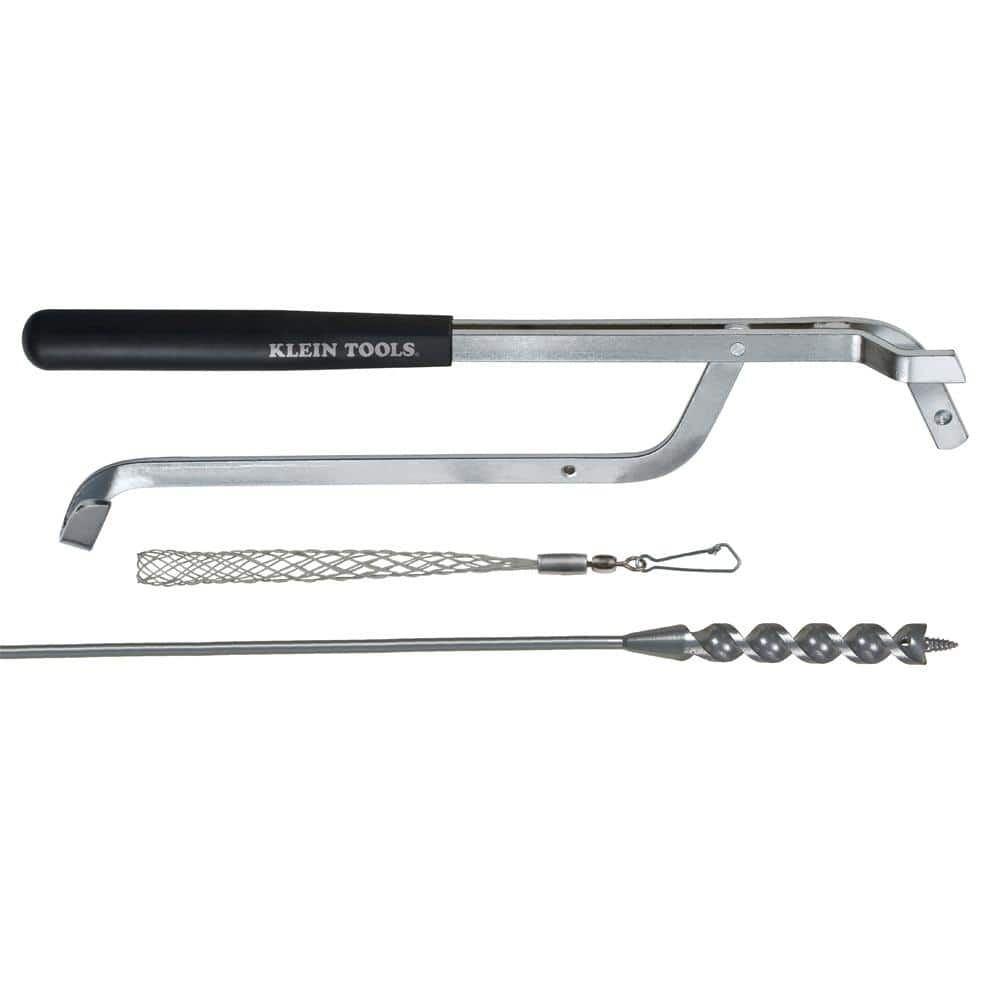
You can use a long flexible bit and drill from the wall up
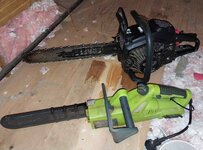
If you want fancy tools they exist.


walta

Well-known member
Joined
Jan 13, 2017
Messages
2,313
Location
Dutzow Missouri

Attachments

  • 2023-10-31_15-36-46.jpg
    2023-10-31_15-36-46.jpg
    18.4 KB · Views: 4
  • 2023-10-31_15-35-35.jpg
    2023-10-31_15-35-35.jpg
    24.4 KB · Views: 1
OP
S

strobes

Active member
Joined
Oct 27, 2023
Messages
43
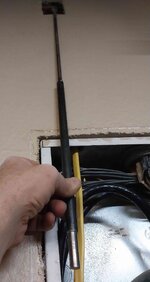
while selecting between these two I opted to machine and tack weld 12" extension to the drill in hand. Yellow romex you seen in the picture is the new run. Thank you, guys!
 

Attachments

  • 20231031_192739.jpg
    20231031_192739.jpg
    675 KB · Views: 15
  • 20231031_193222.jpg
    20231031_193222.jpg
    290.9 KB · Views: 15
OP
S

strobes

Active member
Joined
Oct 27, 2023
Messages
43
I'm planning to transition from NM-B 12/2 to THHN or UF for conduit in attic. I'm sure regular junction box mounted to a rafter near by exit to outside will work fine. Regarding THHN vs. UF Is one better then other in my case?
And from disconnect to mini split compressor my plan to use flex conduit. Do I need it watertight?
 

sparky 1971

Well-known member
Joined
Oct 9, 2018
Messages
8,015
Location
Central Iowa
I'm planning to transition from NM-B 12/2 to THHN or UF for conduit in attic. I'm sure regular junction box mounted to a rafter near by exit to outside will work fine. Regarding THHN vs. UF Is one better then other in my case?
And from disconnect to mini split compressor my plan to use flex conduit. Do I need it watertight?
If it's THHN, it's also going to have to be THWN and be in some sort of conduit. How are you planning on getting from the attic to the disconnect? If you're fishing down the wall, leave it in NM the entire distance and poke through the exterior wall into the back of the disconnect.

You need watertight flex conduit. The box stores carry a 6' pre made whip with the wires already installed and the ends on it. The price has gone up, here one used to be $11 and now are $31. I now make my own since I have everything in bulk, but you can't make one for less than that.
 
OP
S

strobes

Active member
Joined
Oct 27, 2023
Messages
43
How are you planning on getting from the attic to the disconnect? If you're fishing down the wall, leave it in NM the entire distance and poke through the exterior wall into the back of the disconnect.
THWN - Thank you. I was not thinking about this.
I have to use sofit. Planning shape conduit so one part is parallel to a rafter, other part parallel to exterior wall and sneak it through a hole in soffit. I have a sofit vent near by so I can see and drive conduit using it. The part of the conduit that is parallel to the rafter will be secured by hangers and terminated with junction box. Hope this is compliant to the code?
Looks like disconnect operating handle should be below 6'7", correct?
 
To avoid these ads, REGISTER NOW!
Top Bottom