To avoid these ads, REGISTER NOW!

Single post lift not lifting. Questions with pics.

Joined
Jan 10, 2020
Messages
15
Location
backyard
Hi all, I did some searching on the forum and learned some things but not enough to fix my issue. I'm part owner of a 2500sq' former automotive shop than has an in ground single post lift. The lift wasn't used for several months and now it doesn't seem to want to do much of anything when air pressure is applied. The first pic is the controls of our actual lift. Pic 2 is a scan from the "Rotary Service Manual for Air Operated Automobile Lifts" that I found in this on the forum here:
( https://www.garagejournal.com/forum/threads/have-some-questions-on-a-single-post-floor-lift.371556/ ).

All of the vertical lines travel into the concrete floor, there is no above ground hydraulic tank. The controls make it appear to be a hybrid of Types A and B from the manual. I'm not even sure how to check the fluid level in this thing. There hasn't been any recent changes to the lift and if any fluid was added it would've been at least 10 years since then. I believe the shop was built in 1974 and assume the lift was installed then.
 

Attachments

  • lift.jpeg
    lift.jpeg
    395 KB · Views: 121
  • scan0002.jpg
    scan0002.jpg
    130.1 KB · Views: 127
To avoid these ads, REGISTER NOW!

Mike65

Well-known member
Joined
Mar 7, 2007
Messages
3,099
Location
Horse Pasture, Va.
Those are the type of lifts that all the new car dealerships had when I worked at them in the 70's-90's. There has to be a way to check the fluid level in the tank. In the link you posted someone suggested looking near the single in floor piston for a plug which is where the hydraulic tank would be, unless the floor has been repaired & it was covered over. Then in that case the floor would have to busted up to find the hydraulic tank.
 

Jarwop

Well-known member
Joined
Jul 13, 2015
Messages
112
Location
Tulsa, OKLA
Would appear the blue hose is supplying air to operate the lift. I would verify there is air pressure available there. If so, I would break the union apart below the control valve and verify the valve works, or connect a temporary air hose coupling to the pipe going down into the concrete (to ram) to see if the lift moves.
 
OP
F
Joined
Jan 10, 2020
Messages
15
Location
backyard
"There has to be a way to check the fluid level in the tank. In the link you posted someone suggested looking near the single in floor piston for a plug which is where the hydraulic tank would be..."
Yeah, I finally got the yahoos to move the inop vehicle parked over the lift. I did find an infloor square bung hiding under one of the lift arms, it was pretty close to the piston so it was easy to miss.

I read through that other thread again. Considering that it doesn't even sound like air is flowing, how do you think I should approach the bung to troubleshoot my problem?

Would appear the blue hose is supplying air to operate the lift. I would verify there is air pressure available there. If so, I would break the union apart below the control valve and verify the valve works, or connect a temporary air hose coupling to the pipe going down into the concrete (to ram) to see if the lift moves.
You are correct about the airflow through the valve. I did remove the air control valve. It seems to operate as it should. No airflow with handle in middle position, airflow from supply side to the line leading to lift in the left position, airflow from lift to muffled output of of valve in the right position. Like you said, I'm going to run the air supply to directly to the line to simplify things until everything gets sorted out.

Unfortunately, the power is off for now so I'll have to use top off my portable compressor at the house and haul it down there to troubleshoot.
 

bigdog12

Member
Joined
Oct 31, 2015
Messages
16
Location
converted corn crib
The safety leg might be rusted and/or stuck in its tube. Easy way to tell is just remove the bolt that attaches to the lift platform and see if the lift will go up. If it does then you have to figure out how to get the safety leg out so you can clean it up. When I worked at a dealership back in the 70s' and 80s' we would have to do this occasionally even on lifts that were used daily. there were a few times we had to rig up a jack to get the leg out of the floor. Then drop the end of a hose down to the bottom of the tube and flush the crud out the top. wire brush the dirt and rust off the leg and reassemble. I'm not saying this is the best or right way to do it, but it worked. If I was doing it now and not getting paid flat rate like I was then I would treat everything with some rust converter to try to eliminate future problems.
 
OP
F
Joined
Jan 10, 2020
Messages
15
Location
backyard
Update...

The safety leg might be rusted and/or stuck in its tube. Easy way to tell is just remove the bolt that attaches to the lift platform and see if the lift will go up.
Good idea, I'm working with limited resources so I left the house today with my best guess at what tools I'd need and left to see what I could accomplish. I took my 1/2" dive socket set and breaker thinking it would be what I need to remove the safety leg bolt. Turns out I need a 1-3/4" socket.

I didn't have that with me but I'll return with the right tools and hopefully enough muscle. Even if it isn't the problem I wan to remove i from the equation until I know for sure what all is wrong.

Additionally,
I took my low capacity Ridgid 18v compressor as well. I ran the supply directly into the vertical line that goes to the lift as suggested (bypassing the valve and direction selector assembly). After letting it run for several minutes I couldn't develop any pressure.

Does anyone know what this seems indicative of?

Also,
I took my cordless shop vac with the intent of sucking out the crud under the top of the cover plate so I could maybe access dipstick like found in the type A lift. Turns out the crud is actually a piston/plunger full of sand.

I guess I know for sure it's a Type B lift.
So after re-reviewing some of the info offered and links I already provided, am I correct to think that the in floor bung that I found is the hydraulic reservoir? I think I misinterpreted the the old Rotary manual I originally posted in thinking the "Air Vent" shown in the floor of both types was the in floor square-drive bung mentioned elsewhere. I did measure the drive and it's 3/4". I have an appropriate 3/4" drive set that I can get a hold of so I will return with that.

Future plan:
Return to try again and...
1) remove square drive bung and hopefully access dipstick
2) remove bolt from safety pole so to make troubleshooting more straightforward
3) use floor jack to see if I can raise the whole assembly manually
4) charge batteries and return with compressor to see if lift operates after safety leg is unbolted (but the inability to build pressure makes this seem unlikely I think).

Any additional thoughts?
 
OP
F
Joined
Jan 10, 2020
Messages
15
Location
backyard
Take a bigger Compressor, engine driven if required.
Prior to the power issue in the shop there was a larger volume compressor available. The problem was first demonstrated to me with this compressor. I know a small compressor isn't ideal but I don't think it's the main issue.

Evan a small compressor should be able to build some pressure even if it takes practically forever, no?
 
OP
F
Joined
Jan 10, 2020
Messages
15
Location
backyard
Update:

Reservoir bung:
Couldn't locate a 3/4" breaker bar or 1-3/4" socket on a Saturday. Tried my 1/2" drive breaker w/ a 3/4" drive adapter on the in floor reservoir bung. That bung LOOKS tight and it didn't budge while using my jack handle w/ a cheater. Didn't want to break my breaker so I'll have to try again w/ an actual 3/4" drive. Might have to resort to adding some heat too.

Safety leg:
No 1-3/4" socket no progress made.
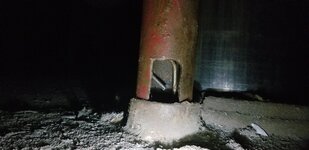
I did get my floor jack under the head enough to lift it up. If the safety leg is an issue then I can't tell. I did get the leg out of the floor far enough to see this dipstick handle thing through the cutout.

Does anyone know what it goes to?

Future plan:
Return to try again and...
1) still need to remove remove square drive bung and hopefully access dipstick
2) still need to remove bolt from safety pole so to make troubleshooting more straightforward (don't think that's the problem though.

I don't know if nay of this can explain why I can't build pressure though
 

Attachments

  • lift.jpg
    lift.jpg
    381.1 KB · Views: 76
To avoid these ads, REGISTER NOW!

Milton Shaw

Well-known member
Joined
Feb 11, 2011
Messages
4,845
On that lift the air line pressurizes the hydraulic tank and then the pull leaver on the left lets the fluid raise the cylinder. There is some time lapse between pressurizes and the lift will start to move. That setup has a tank and a tube where some of the in ground have them combined into just they lift cylinder that also houses the tank in the cylinder itself. The advantage of your type is that you exact control over the motion of the cylinder as you control the hydraulic fluid movement and can move the cylinder in as little as 1/4 inch movement. The combined tank will continue to move after you have released the controls, with the expansion of the air in the system. To lower the cylinder on yours you exhaust the air and then you can operate the lever to control the fluid and cylinder motion.
 
OP
F
Joined
Jan 10, 2020
Messages
15
Location
backyard
On that lift the air line pressurizes the hydraulic tank and then the pull leaver on the left lets the fluid raise the cylinder. There is some time lapse between pressurizes and the lift will start to move. That setup has a tank and a tube where some of the in ground have them combined into just they lift cylinder that also houses the tank in the cylinder itself. The advantage of your type is that you exact control over the motion of the cylinder as you control the hydraulic fluid movement and can move the cylinder in as little as 1/4 inch movement. The combined tank will continue to move after you have released the controls, with the expansion of the air in the system. To lower the cylinder on yours you exhaust the air and then you can operate the lever to control the fluid and cylinder motion.
You are correct in noting how the lift operates. You explanation also explains why this is laid out differently from most of the diagrams referenced here.

What are your thoughts on why I can't seem to get any pressure to build?

The piston/plunger seems to be free as I can lift it manually with a floor jack so I don't think the safety pole is stuck (not that that would explain the lack of pressure). I've sourced a heavy duty cordless impact and tomorrow I plan on trying again to remove the 3/4 floor bung to see what I can learn about the in ground reservoir.
 
OP
F
Joined
Jan 10, 2020
Messages
15
Location
backyard
Update:

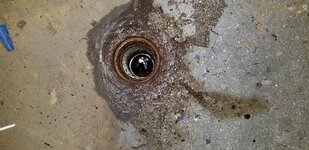
Got the floor bung off finally. Took some penetrating fluid, an 1,100ftlb cordless impact and some patience. No dipstick on the bung but the level is about 35" below the floor level and only approx. 6" deep. I have no idea where the fluid level is supposed to be or what amount of fluid it would take to get it there. Also, the appearance of the fluid doesn't look encouraging but I'm not sure what to expect it to look like after probably 50 years.

Unless anyone has any better ideas, I'll start trying to source several gallons of trans fluid when I get a chance.

I fully realize the outer casing might be rusted through. I figure I'll give the current plan a shot and hope for the best.
 

Attachments

  • 20231127_142728.jpg
    20231127_142728.jpg
    855 KB · Views: 45
  • 20231127_144112.jpg
    20231127_144112.jpg
    651.1 KB · Views: 42
OP
F
Joined
Jan 10, 2020
Messages
15
Location
backyard
Do you hear air leaking when you have air applied to the tank?
It should be hydraulic oil not trans fluid.
I've made an effort to listen for leaks and can't hear anything. I don't have much air available but when I dump my charged one gallon compressor into the line it doesn't dump like there is a wide open leak somewhere, takes maybe 15 seconds to drop back to zero.

I've read elsewhere on the forum where people have used trans fluid in these lifts and that they can take use a fairly substantial amount. I don't know what the hydraulic oil would cost but I'm hoping to get some used trans fluid for nothing. With free fluid it seems worth a shot know if the lift is junk or not
 
OP
F
Joined
Jan 10, 2020
Messages
15
Location
backyard
If the tank rotted out and is leaking yes......................
So I guess the air could be going one of two places. Either through the case and into the ground or past the packing gland. I don't hear a leak past the gland. I'm thinking I could spray around the piston/plunger with soapy water and then apply air to see what happens. I had wondered if the packing gland could become dry due to lack of use.
 

Wrench97

Well-known member
Joined
Jun 23, 2018
Messages
12,145
Location
Southeastern Pa
The packing gland would have oil leaking out of it, providing it was leaking and there was oil in the system.
It's usually the top of the tanks that rot out if they are not sitting in ground water.
 

mike93lx

ALLIANCE MEMBER
Joined
Dec 9, 2013
Messages
37,844
Location
Richmond, VA
I'd at least stick an inspection camera into the tank to try and see what might be going on. I wouldn't pour gallons of transmission fluid into a hole in the ground hoping it isn't just going to leak out
 

Milton Shaw

Well-known member
Joined
Feb 11, 2011
Messages
4,845
If its been in the ground 50 years it probably has tanks/cylinders/pipes rusted through. Those are EPA required now to have double walls to prevent any ground water contamination. Yours is probably soaked the dirt under the lift with oil and would require extensive/expensive cleaning of the soil. You would be better off abandoning the tank/lift and don't let the government know about it.
 

c39er

Well-known member
Joined
Mar 23, 2008
Messages
1,667
Location
Seattle, Washington
A large dozer or track hoe can leak as much fluid as a leaking lift with a stupid operator!
Another oily clean up that happens a lot.
Our poor earth....
 
To avoid these ads, REGISTER NOW!
Top Bottom