To avoid these ads, REGISTER NOW!

Project Farm tests flex-head ratchets (and one roto-head)

AEAdam

Well-known member
Joined
May 27, 2023
Messages
2,806
Location
SE PA
You do realize that the snap on dual 80 has been out for over 20 years now. They came out with ratchets longer than many other companies breaker bars and they are not failing by being used as a breaker bars on rusty autos, heavy equipment, or on industrial equipment..
Many other companies have come out with similar multitooth engagement pawls and caught up.

What was considered excessive torque 30 years ago is no longer relevant with the new class of ratchets.

Breaker bars are irrelevant now days to most mechs and we are not having our ratchets fail.
And all these ratchets' failure torques were WAY more than the fastener's shear capability. I think it would be difficult to break a ratchet without a pipe on it. And if you put a pipe on one, I think you'd rip the head off the fastener. These YouTube testers have to go to lengths to get these tools to fail (like the open end wrench slip testing). They aren't useless, but also aren't "real world" conditions.
 
Last edited:
To avoid these ads, REGISTER NOW!

Mgdoug3

Well-known member
Joined
Mar 2, 2018
Messages
1,391
Location
KY
When my only choice was a 12" Craftsman or a breaker bar, of course I would use the breaker bar and possibly a cheater pipe. I don't get why people are harping so much about using a breaker bar with today's long ratchets. The weak point is the anvil so it doesn't matter if I use a break bar or ratchet. If my 25" Snap-on ratchet can't break a bolt loose then I'll grab my 3/4" Precision Instrument breaker bar that's a ratchet head or my 18" Wright with a cheater pipe.

I have yet to break any high quality ratchets and only use a breaker bar when I need to "wiggle" a rusty bolt or when using a crow foot.
 

liliysdad

Well-known member
Joined
Jul 18, 2008
Messages
5,445
Me either. All my equipment is in good repair with properly torqued fasteners.

Oh hell, I’m always tearing some nasty barn or field find something. The impacts and cheater pipes (on ratchets) get used quite a bit.

We don’t really get rust here in real nasty quantities but old stuff gets funky sometimes.
 

Mgdoug3

Well-known member
Joined
Mar 2, 2018
Messages
1,391
Location
KY
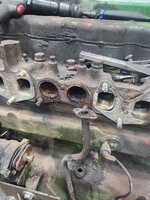
This is what I worked on last week. Someone at some point spent a lot of money at the machine shop and appears that everything was professionally put together. These bolts didn't care they were properly torqued 20 years ago. Aluminum and bolts don't mix well and neither do exhaust manifolds and 1000s of heat cycles. No 1/2" breaker bar was used and no ratchets were broken.
 

Attachments

  • 20231118_213142.jpg
    20231118_213142.jpg
    1.4 MB · Views: 56

richfinn

Well-known member
Joined
Jan 29, 2011
Messages
4,818
Location
Leeds, Yorkshire, England
I can’t remember the last time I used a Breaker for anything. Not entirely sure why I still own them.

The head size is more compact and the pivot point is in a different spot to a regular flexhead ratchet which can be benefit sometimes.

If you need to work a fastener back and forth to free it up no switching required.

You can also use them screwdriver style before final torquing.

I still use mine quite often on some jobs, nice tool to have
 

AEAdam

Well-known member
Joined
May 27, 2023
Messages
2,806
Location
SE PA
The head size is more compact and the pivot point is in a different spot to a regular flexhead ratchet which can be benefit sometimes.

If you need to work a fastener back and forth to free it up no switching required.

You can also use them screwdriver style before final torquing.

I still use mine quite often on some jobs, nice tool to have
Rich, you’ve posted this a couple times when this subject comes up. I do not currently OWN a breaker, but I really appreciate your comments on this.
 

liliysdad

Well-known member
Joined
Jul 18, 2008
Messages
5,445
The head size is more compact and the pivot point is in a different spot to a regular flexhead ratchet which can be benefit sometimes.
I can't argue that, but I also can't recall a single time where this would have mattered.
If you need to work a fastener back and forth to free it up no switching required
You can also use them screwdriver style before final torquing.
If I have room or this nonsense, I have room to put an impact or cordless ratchet on it.
I still use mine quite often on some jobs, nice tool to have
My breakers have been relegated to tool bags and boxes in vehicles for removing lug nuts. That is literally the only use they have had in years.
 

richfinn

Well-known member
Joined
Jan 29, 2011
Messages
4,818
Location
Leeds, Yorkshire, England
I can't argue that, but I also can't recall a single time where this would have mattered.


If I have room or this nonsense, I have room to put an impact or cordless ratchet on it.

My breakers have been relegated to tool bags and boxes in vehicles for removing lug nuts. That is literally the only use they have had in years.
You need to come and work on some front wheel drive Diesel Peugeot/Citroen, they don't leave any room for flex-heads let alone impacts in those engine bays 😅
 

cgrutt

Well-known member
Joined
Mar 4, 2016
Messages
8,375
Bought the 36" 3/4 breaker bar earlier this year used it when I replaced rear wheel bearing on my son's 328ix (spindle nut). Also used it with 1/2 adapter for lower bearing carrier on my Bravo III X outdrive. May or may not have gotten them off with a ratchet but glad I had and used it both times. Recall having to use a jack handle and a 24" 1/2 Snap on breaker bar on a different outdrive and having alot of trouble getting it to break loose. Breaker bars still have their place IMO.
 
Last edited:

Pexto

Well-known member
Joined
May 5, 2018
Messages
640
Not sure if this has been resolved or not but the FACOM S.161BPB 1/2 ratchet looks nearly identical to the USAG ISO 3315, both of which are SBD owned. Is Facom the OEM, or is USAG?

FACOM bought USAG many years ago, and then later SBD bought FACOM. I believe that a lot of the FACOM ratchets have been made at the USAG factory in Italy for quite some time. That USAG factory spits out nearly identical high-quality ratchets under several different brands - USAG, FACOM, and also Proto and perhaps DeWalt, all under the SBD umbrella.

The FACOM/USAG link sometimes works the other way too. I've got some USAG screwdrivers that look identical to FACOM, and were made in France. Clearly they came from a FACOM factory, since AFAIK USAG only had factories in Italy.

There's a short fun video of the USAG Gemonio factory here:
 

VolvoRyan

Well-known member
Joined
Dec 29, 2019
Messages
1,339
Location
Kentuckiana, USA
The head size is more compact and the pivot point is in a different spot to a regular flexhead ratchet which can be benefit sometimes.

Super true. Volvo was really good at hiding the brake caliper fasteners behind the trailing arms on the 240/740/940. A 3/8" breaker bar is the only way you're getting in there. A long zero-offset box wrench will do it, too.... but the breaker bar has more leverage. Break it free and then you're off to the races with a ratcheting box wrench.

I'll admit that the 24" locking-flex Snap-On does get more use than the breaker bars elsewhere.

-Ryan
 

Steve_P

Well-known member
Joined
Sep 15, 2010
Messages
5,188
If you need an impact and can't fit one, then a ratchet is not the appropriate substitute, a breaker bar is.

Not really. If you watched enough of the PF destruction videos, you'd see that all of the better brand non flex head ratchets shear the anvil off before the gears fail; the gears are not the weak point in the design. Therefore, a breaker bar is no stronger than a ratchet, statistically, in the same brand and same drive size. Modern ratchets are as thin, or thinner, at the head than the same size breaker bar. And if they both shear the anvil....

Breaker bars are now mostly obsolete.
 

liliysdad

Well-known member
Joined
Jul 18, 2008
Messages
5,445
If you can't figure it out, I'm not going to try explaining it to you.

Ahh…so because the opinion of professionals all in this thread, which correspond with the rating provided by the manufacturers, don’t jive with your beliefs….an eyeroll is warranted?

As was said earlier, and many times in this thread, the breaker is largely obsolete.
 
To avoid these ads, REGISTER NOW!

VolvoRyan

Well-known member
Joined
Dec 29, 2019
Messages
1,339
Location
Kentuckiana, USA
And all these ratchets' failure torques were WAY more than the fastener's shear capability. I think it would be difficult to break a ratchet without a pipe on it. And if you put a pipe on one, I think you'd rip the head off the fastener. These YouTube testers have to go to lengths to get these tools to fail (like the open end wrench slip testing). They aren't useless, but also aren't "real world" conditions.


Agreed. Pretty easy to twist off even a frozen M14 or M16 fastener with less leverage than the YouTubers are using to break these tools.

Open end wrench testing is also weird. Some of the poorer performing open end wrenches need a serious cheater bar to get them to slip.

-Ryan
 

richfinn

Well-known member
Joined
Jan 29, 2011
Messages
4,818
Location
Leeds, Yorkshire, England
Ahh…so because the opinion of professionals all in this thread, which correspond with the rating provided by the manufacturers, don’t jive with your beliefs….an eyeroll is warranted?

As was said earlier, and many times in this thread, the breaker is largely obsolete.

Obsolescence isn't decided by one guy on the Internet I'm afraid, your confusing your personal opinion with reality.

I still use my breakers fairy regularly despite having air and cordless impacts and a bunch of flexhead ratchets.

It depends on what you work on, Snap-On obviously feels there is still a market for such tools 👍
 

liliysdad

Well-known member
Joined
Jul 18, 2008
Messages
5,445
Obsolescence isn't decided by one guy on the Internet I'm afraid, your confusing your personal opinion with reality.

I still use my breakers fairy regularly despite having air and cordless impacts and a bunch of flexhead ratchets.

It depends on what you work on, Snap-On obviously feels there is still a market for such tools 👍


Look back in just this thread…it’s not “one guy.”

Tool companies will keep making what sells. As long as folks keep buying breakers, they will keep making them. There is near zero cost in them, and. Much like corded and pneumatic tools, there isn almost no R&D investment. That doesn’t make them relevant…simply proof that folks are set in their ways.
 

toyotadriver

Well-known member
Joined
Dec 30, 2010
Messages
1,586
Recently purchased some Gearwrench 90T ratchets. I really like them. Definitely a good purchase.


Nothing in this post should be misunderstood, interpreted, misinterpreted, or construed to be of a political nature.
 

richfinn

Well-known member
Joined
Jan 29, 2011
Messages
4,818
Location
Leeds, Yorkshire, England
Look back in just this thread…it’s not “one guy.”

Tool companies will keep making what sells. As long as folks keep buying breakers, they will keep making them. There is near zero cost in them, and. Much like corded and pneumatic tools, there isn almost no R&D investment. That doesn’t make them relevant…simply proof that folks are set in their ways.

Yes, but then you have another bunch of GJ guys (who are also invested in high end impacts and flexhead ratchets) countering your argument and stating that they are still relevant in some applications.

Problem solved, if you don't need one = don't waste your cash, if you do = get one (preferably a Snap-On)

I would love to debate the finer points of breaker bar ownership, but there isn't much more to say beyond "I still use mine" 😄
 

AEAdam

Well-known member
Joined
May 27, 2023
Messages
2,806
Location
SE PA
If people didn't need them, Snap-On wouldn't sell them 😉
Snap On still makes speed wrenches. They probably make a lot of tools from the past that some folks find essential because it’s what they learned with.

My Dad was a great craftsman. He preferred a handsaw to a circular saw. He drove screws with a yankee screwdriver. Nothing wrong with that.

When I was starting out working on cars, we had breakers because manufacturers couldn’t make ratchet mechanisms strong enough. I had 12pt sockets to help me get my breaker bar into the right spot. I don’t really need either anymore. For their intended purpose, they are “surplus to requirements”.

I view the new big strong ratchets as breakers 2.0. They are just better in every way. I recommend every mechanic, especially shade tree types, have an SHLF80A.

Not saying people should throw away their breaker bars. For people just starting out, my advice is buy the ratchets first.
 

RAS61

Well-known member
Joined
Sep 14, 2012
Messages
538
Location
Low Country, SC
Yes, they will have a **** fit but this chart is worthless anyway. Who the hell torques a 3/8" ratchet to over 270 ft-lb? Also the difference between 295.2 and 292.0 is insignificant particularly when only one ratchet from each was tested. I love Project Farm but a lot of his tests are irrelevant in the real world picture.
I'll go one step further, you'd need to do this test at least 10 times to even make general conclusions. A wrench isn't going to fail at the same point every time, there will be variables, and sometimes there will be a wide difference. The only meaningful measure of a tool is the long term satisfaction of actual users, you could collect that data, but you can't make a video and profit with views off of it
 

M6erfan

Well-known member
Joined
Dec 6, 2014
Messages
10,170
Location
'Merica!
I have a beautiful Ko-ken 4768N-600 1/2" breaker bar. The more I got into cordless impacts the less it got used. I pretty much collects dust these days.
 
Last edited:

richfinn

Well-known member
Joined
Jan 29, 2011
Messages
4,818
Location
Leeds, Yorkshire, England
Snap On still makes speed wrenches. They probably make a lot of tools from the past that some folks find essential because it’s what they learned with.

My Dad was a great craftsman. He preferred a handsaw to a circular saw. He drove screws with a yankee screwdriver. Nothing wrong with that.

When I was starting out working on cars, we had breakers because manufacturers couldn’t make ratchet mechanisms strong enough. I had 12pt sockets to help me get my breaker bar into the right spot. I don’t really need either anymore. For their intended purpose, they are “surplus to requirements”.

I view the new big strong ratchets as breakers 2.0. They are just better in every way. I recommend every mechanic, especially shade tree types, have an SHLF80A.

Not saying people should throw away their breaker bars. For people just starting out, my advice is buy the ratchets first.

Nothing wrong with being a craftsman or using traditional tools.

I do own Snap-On dual 80 flexhead ratchets (great tools), but I still use my breaker bars (a better term is hinged handle) for the reasons listed above as they are more compact and no need to switch direction.

I also own a 3/8" Snap-On speed brace (and I sometimes use that too) I believe they are still popular with aircraft mechanics who aren't allowed to use power tools in some applications.

It's the "obsolescence" thing I'm not agreeing with, I decide when my tools are surplus to requirements, not some random guys on the Internet with opinions which don't relate to the vehicles I work on.

For me personally Imperial/SAE tools are "obsolete", but I'm not going to tell you or anybody else that yours are too (that would just be silly) 👍
 

M635_Guy

Well-known member
Joined
Dec 5, 2019
Messages
4,336
Location
NC
Ahh…so because the opinion of professionals all in this thread, which correspond with the rating provided by the manufacturers, don’t jive with your beliefs….an eyeroll is warranted?
No, you're missing it still, but it's fine. Go ahead and continue your chest-beating. pgNW3y.gif

As was said earlier, and many times in this thread, the breaker is largely obsolete.
It's not "largely obsolete" because people have evolved to mis-using ratchets as breaker bars and using a lifetime warranty to deal with the aftermath (though there are not a few people who think that's fine). They're far less-used because impacts have gotten so smart and capable (in the case of cordless) and small/powerful (for pneumatic).
 
Last edited:
OP
G

General Geoff

Well-known member
Joined
Jan 12, 2013
Messages
3,879
Location
Allentown, Pennsylvania
It's not "largely obsolete" because people have evolved to mis-using ratchets as breaker bars and using a lifetime warranty to deal with the aftermath (though there are not a few people who think that's fine).

When the anvil fails before the ratchet teeth or pawls, and the repair kit for the ratchet costs less than the repair kit for a breaker bar, that's a pretty clear indicator that the breaker bar is effectively obsolete (at least in drive sizes 1/2" and smaller)
 

Etchase

Well-known member
Joined
Nov 10, 2017
Messages
2,027
Location
Hawaii
Interestingly, I find broken and tweaked ratchets where the anvil is intact. I’m not sure these test to failure YouTube videos capture the damage to teeth and pawls from repeated high torque applications. Improper reassembly seems to be a leading cause of failure too. Snapped anvils not so much, but maybe those get thrown away.
 

scooby074

Well-known member
Joined
Oct 26, 2008
Messages
5,260
Location
Nova Scotia
I wouldnt say breaker bars are obsolete but theyre on the ropes. There is a time for them, considerably less now than in the past however. Sometimes you need that little bit of clearance that a breaker bar can give. Most times my breaker bar is used with my ratchet adapter. And now with the long handled 1/2 ratchets like the SLF80A the breaker bar is really on the back burner for most jobs now.

The big torque 1/2" impacts certainly didnt help the breaker bar's future either.
 

VolvoRyan

Well-known member
Joined
Dec 29, 2019
Messages
1,339
Location
Kentuckiana, USA
When the anvil fails before the ratchet teeth or pawls, and the repair kit for the ratchet costs less than the repair kit for a breaker bar, that's a pretty clear indicator that the breaker bar is effectively obsolete (at least in drive sizes 1/2" and smaller)

Snap-On sells rebuild kits for their 1/2" drive Dual 80 for $10. Not sure how anything can be sold for cheaper. Nice to have the kit in the toolbox for a quick fix, then warranty the guts.

I wouldnt say breaker bars are obsolete but theyre on the ropes. There is a time for them, considerably less now than in the past however. Sometimes you need that little bit of clearance that a breaker bar can give. Most times my breaker bar is used with my ratchet adapter. And now with the long handled 1/2 ratchets like the SLF80A the breaker bar is really on the back burner for most jobs now.

The big torque 1/2" impacts certainly didnt help the breaker bar's future either.

All true. I have the locking SLF80A, and it's thicker than all my breaker bars, so it's less "flexy". Breaker bars still win for economy (cost/weight/storage). There's a convenience here.... especially if you just dabble in a drive size. I have very little need to expand into 3/4" drive.... so I just have a long breaker bar, and the two sockets I need it for.


Also worth noting, some wrenches perform "worse" solely due to being more narrow. In many cases those are actually more usable...

Indeed. I picked up a set of Wera Jokers knowing their reputation. I got them because the 12-pt open end looks to be good for adjusting cable tension in tight quarters. I agree that there's a lot not to like about them, but they are surprisingly thin. Thin enough to possibly replace my jam nut wrenches.

-Ryan
 
Last edited:

2ndGearRubber

Well-known member
Joined
Mar 24, 2014
Messages
14,185
Location
Pittsburgh
Breaker bars can still be key in your tool arsenal, but for shape/size/lack of ratcheting reasons, not overall strength.

I was under the impression GJ had collectively understood that putting a 4ft bar on a 3/8 ratchet didn't prove much as a test of ratchet quality, aside from proof that ratchets are very strong in general.

I have Matco, Snap On, SK, and Tekton ratchets in my cart. I walked across the shop to my box to get a HF composite for a specific task a few weeks ago. While it does not have the best feeling mechanism in the world, it was the right tool for the job and it got the job done.
 

M635_Guy

Well-known member
Joined
Dec 5, 2019
Messages
4,336
Location
NC
When the anvil fails before the ratchet teeth or pawls, and the repair kit for the ratchet costs less than the repair kit for a breaker bar, that's a pretty clear indicator that the breaker bar is effectively obsolete (at least in drive sizes 1/2" and smaller)
As much as anything, it's a way to keep warranty costs down in a world where people are using their tools as disposable unnecessarily.

I'm not arguing for breaker bars being a daily thing - since I got my highly-capable and "smart" impacts (that will stop smacking and just spin off the fastener once it's cracked, for example), mine are rarely-used. But there are several situations (mentioned above) where they make complete sense and are better than ratchets in some ways (not the least of which is that they'll handle far more grump than a ratchet is designed for).

I'm rarely working on a deadline, and almost never a short one, so I can count on one hand the situations I've ever been in that required abusing my tools to get something done. My garage is a wreck most of the time, but my tools are clean and stored properly. That works for me - I recognize that how I work/manage my tools would drive some people crazy.

I do sorta get the idea of a Flat Rate tech being more devoted to minimizing time at the expense of their tools (but only sorta in a lot of cases). But non-Flat Rate people, and especially DIY'ers of any level, emulating that behavior and justifying it for the Flat Rate reasons is... hard to accept as reasonable to me (to put the nicest words around it).

If that's what you do in your garage, it's your place and your tools. I just don't get chest-thumping about it at all, or what people think that says about them.
 
Last edited:

Steve_P

Well-known member
Joined
Sep 15, 2010
Messages
5,188
Breaker bars can still be key in your tool arsenal, but for shape/size/lack of ratcheting reasons, not overall strength.

Right, this is the key- there's statistically no strength advantage today between a ratchet and bar in same brand and size. I guess 30+ years ago, back when there were 30 tooth ratchets with a few teeth engaged, bars did have a strength advantage? Or maybe we just thought there was a strength advantage? Is there anyone here that has some real-world experience failing an old Snap On ratchet, and then the SO breaker bar surviving the same task? I used to have a 40+ year old SK 3/4" ratchet with a bent handle. The ratchet showed no sign of being apart, and the mechanism appeared original; meaning it was stronger than the handle. So maybe we just assumed that bars were stronger? Because it does make sense to assume that, but now that we have people blowing stuff up on Youtube for us...

Breaker bars still have some use, and I haven't sold any of mine. But they've long been moved from the easy to access ratchet drawer, to the not so easy access and rarely used drawer with some excess 1/2" ratchets, etc. If you've got a rusty nut and bolt that you're going to use an impact on, a bar and socket would make sense to use opposite of the side being impacted. I have a 1/4" sliding breaker bar that I bought specifically for use with the Lisle tap sockets; a 3/4" SK for the rare task of setting up pinion gears. But otherwise, my breaker bars sit unused, unless needed specifically for the lack of ratcheting feature.
 
To avoid these ads, REGISTER NOW!
Top Bottom