To avoid these ads, REGISTER NOW!

High Electric Bills with new heat pump

mmk412

Member
Joined
Apr 25, 2023
Messages
7
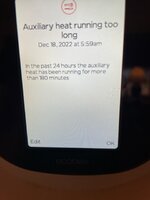
I was wondering if anybody has any experience with heat pumps. I had a new furnace and heat pump installed a little over a year ago. While I noticed that my electric bill went down (a little) in summer, the electric bill doubled in the winter. The ecobee thermostat shows the following error:
"In the past 24 hours the auxilary heat has been running for more than 180 minutes" . This warning shows up every now and then. The installers told me there was nothing to worry about.
My question is if I turn the power off to the heat pump would the furnace still work? I'm thinking that it has to be the heat pump that's drawing so much current so I'm figuring if I disconnect the heat pump it might solve the high electric bills. I'm just trying to figure out if that will effect the furnace operation.
I thought I'd ask this forum before trying this myself.
Tanks for any help.

MK
 

Attachments

  • ECOBEE ERROR 12-18-22.JPG
    ECOBEE ERROR 12-18-22.JPG
    27.1 KB · Views: 57
To avoid these ads, REGISTER NOW!

JbTech

Well-known member
Joined
Mar 16, 2013
Messages
216
Location
Blue Rock, Ohio
What's your auxiliary heat source? What have your overnight lows been?

We have propane, but some have electric heat strips.
 

JeepYJ

Well-known member
Joined
Dec 25, 2015
Messages
9,105
You need to give a lot more info.
What was your previous heat source?
What’s your backup heat source now?
What are your outdoor temperatures?
Are you leaving your thermostat set at a constant temp 24/7?
I have a heat pump and it runs with temps down into the teens. Backup heat is electric and it is expensive when it’s needed, but most winters that not too often.
 

PoorUB

Well-known member
Joined
Mar 29, 2021
Messages
11,692
Location
Fargo, ND
I was wondering if anybody has any experience with heat pumps. I had a new furnace and heat pump installed a little over a year ago. While I noticed that my electric bill went down (a little) in summer, the electric bill doubled in the winter. The ecobee thermostat shows the following error:
"In the past 24 hours the auxilary heat has been running for more than 180 minutes" . This warning shows up every now and then. The installers told me there was nothing to worry about.
My question is if I turn the power off to the heat pump would the furnace still work? I'm thinking that it has to be the heat pump that's drawing so much current so I'm figuring if I disconnect the heat pump it might solve the high electric bills. I'm just trying to figure out if that will effect the furnace operation.
I thought I'd ask this forum before trying this myself.
Tanks for any help.

MK
Did you have a heatpump before? If yes, you electric bill should not go up, and I would assume it would go down slightly. Something is not correct with the installation.

If no, certainly you bill will go up!
 

larry4406

Well-known member
Joined
Jan 27, 2006
Messages
19,502
Location
Northern Virginia
Smart setback thermostat on a heat pump? If so, when you jack the temperature up more than about 2-3 degrees at a time it forces the resistance heat to kick on and there goes your electric bill.
 

FourthQuarter

Well-known member
Joined
Dec 1, 2022
Messages
83
Location
Cape Ann
I've been living with a heat pumps for 30+ years, both in my home and rental properties. The fancy new ones (modulating, e.g. Bosch, makes a great one) are way better than the old ones. I am in New England so my remarks probably don't apply to more southerly installations.

I'll assume you have electric as second stage.

Fist thing with heat pumps is set the thermostat and forget it unless you're going away for more than a couple of days. Playing with the thermostat will bankrupt you.

From time to time I've cheated and turned off the breaker (often on the air handler cabinet) to disable the second stage during cold snaps. Whether that punishes the compressor too much I don't know. I mostly just leave the darn thing alone.

Heat pumps IMHO **** to own and operate. I bet if one were to do a life cycle cost analysis, a gas fired burner would beat the pants off a heat pump. A heat pumps life span is ~15 years, refrigerant leaks, sticky reversing valves, circuit board failures, etc. make them a stupid choice for anyone but a developer. Low first installation cost for both heating and cooling is what drives the choice.
 

toyotadriver

Well-known member
Joined
Dec 30, 2010
Messages
1,586
Heat pumps are great in moderate climates. They aren't nearly as great in very cold climates. I would be checking to see if the heat strips are running all the time.

Also agree we need more info. Location? Temps? What system did you have before the heat pump?


Nothing in this post should be misunderstood, interpreted, misinterpreted, or construed to be of a political nature.
 

danski0224

Well-known member
Joined
Jan 29, 2005
Messages
13,498
Location
Near Naperville, IL
I was wondering if anybody has any experience with heat pumps. I had a new furnace and heat pump installed a little over a year ago. While I noticed that my electric bill went down (a little) in summer, the electric bill doubled in the winter. The ecobee thermostat shows the following error:
"In the past 24 hours the auxilary heat has been running for more than 180 minutes" . This warning shows up every now and then.
So called "smart" thermostats are not normally the best choice. Do NOT try to "save money" with setbacks. It doesn't work. AFIK, Ecobee does not use a dedicated outdoor temperature sensor, so you MUST set up the WiFi so it pulls climate data from the internet.

Or else the changeover temperature will not work.
The installers told me there was nothing to worry about.
********. It was not installed properly.
My question is if I turn the power off to the heat pump would the furnace still work?
It should, the thermostat should go into backup/emergency heat mode.
I'm thinking that it has to be the heat pump that's drawing so much current so I'm figuring if I disconnect the heat pump it might solve the high electric bills.
This is flawed diagnostics. The "air conditioner" and "heat pump" are the same piece of equipment. Both utilize the same circulating blower in the furnace/air handler and the same compressor/condenser.

If the electrical bill "went down" in the summer, then the AC/heat pump isn't the problem*.

*: It shouldn't be the problem, but then you get into whether or not it is sized or matched properly, set up properly (controls), charged with refrigerant properly... so on and so forth. Stuff people in this forum poo poo.

Based upon the information provided, it sounds like you have electric resistance backup heat in the furnace. The more correct term if this is the case is "air handler with electric heat kit".

There isn't enough information to go on.

Is the backup heat sizing and staging the same between the old and new air handler?

Is the AC/heat pump the same size? Evaporator coil?

What is the rated heating capacity of the condenser and evaporator combination at 47* F and 17* F? These are published specifications from the manufacturer. Note that if you have the manufacturer and model numbers, you can go through the AHRI website and get an AHRI Match Certificate that will give you this information. It is a royal PITA to navigate the site. If your equipment is efficient enough, it will qualify for Federal Tax rebate/credit, but you need the AHRI certificate.

What is the calculated heat loss for your home? This info is needed.

What are your utility costs?

The rated capacity and calculated heat loss is needed to figure out the balance point.


The balance point is the point where the equipment capacity matches the structure heat loss.

The economic balance point factors in the cost of electricity (and fossil fuel if dual fuel). The "balance point" and "economic balance point" are not necessarily the same.

One cannot simply slap in a heat pump and guess, then expect it to work properly.

You can obtain the information in bold above and search the web for balance point calculators. Ideally, the HVAC contractor should have done all of this.

The balance point (or economic balance point) is put into the thermostat as the changeover temperature (or, compressor lockout). This is when it switches from heat pump to backup heat. The cost of electricity or fossil fuel needs to be monitored to ensure that the economic balance point remains correct.

It is not normally possible for the heat pump and backup heat to operate at the same time. One would really need to mess up the thermostat wiring for this to happen. Improper menu setup is also possible, but again, it is really hard to make both come on at the same time- I can't really think of a way to intentionally make that happen.

I have a 4 stage dual fuel system, and have installed others.
 
Last edited:

danski0224

Well-known member
Joined
Jan 29, 2005
Messages
13,498
Location
Near Naperville, IL
Heat pumps IMHO **** to own and operate. I bet if one were to do a life cycle cost analysis, a gas fired burner would beat the pants off a heat pump. A heat pumps life span is ~15 years, refrigerant leaks, sticky reversing valves, circuit board failures, etc. make them a stupid choice for anyone but a developer. Low first installation cost for both heating and cooling is what drives the choice.
Have you priced out Bosch stuff? It is anything BUT cheap.

Same holds true for anything other than heat pump stuff marketed and sold to the DIY crowd and touted as "the bomb" in this forum.

Mitsubishi and LG stuff, and domestic inverter split systems are quite expensive. A developer would NEVER choose those unless there were no other options.

An ICP inverter condenser is 2x+ the wholesale cost of a standard mid tier condenser, much less "builder grade".

Bosch is actually less, at least for the condenser, and has more features. Despite being made in China, the Bosch build quality out of the box exceeds just about anything I have installed with respect to residential equipment. The evaporator coils are a work of art.

The other repair issues?

Maybe.

A heat pump is also typically working at least 2x as much as a straight AC.

Leaks can come from faulty installation or ****** manufacturer moves to cut their costs (not your costs)- like mirochannel coils.

I would install a surge protector on any high end piece of HVAC equipment these days- especially something with a $1k inverter control board.
 

jthemmer

Member
Joined
Dec 17, 2023
Messages
9
I do commercial heating, cooling, and refrigeration. Your installers don’t know service. You need to get a tech that knows heat pumps. I’d assume it is an air source heat pump and not geothermal. That heat pump will typically operate down to 20 degrees efficiently. Then “auxiliary heat” kicks in which is your electric heat or natural gas/propane back up. Your issue lies with the auxiliary back up heat. It also shouldn’t be running for 180 min +. Sounds under sized or an issue with a heat strip.
 

danski0224

Well-known member
Joined
Jan 29, 2005
Messages
13,498
Location
Near Naperville, IL
That heat pump will typically operate down to 20 degrees efficiently.
Misleading.

The electrical efficiency does not change. It still takes X amount of kW to run the compressor and indoor fan.

However, the amount of heat that the heat pump can extract as the outdoor temperature drops DOES change. This reflected in the published specifications for heating capacity at 47* and 17* F. The inverter units will have more heating capacity at a lower temperature compared to a non-inverter piece of equipment of the same size.

One can get more heat by installing a larger condenser and/or a larger evaporator, but there are limits here. One must have ductwork capable of supporting the airflow. An inverter split system is the choice in this type of installation. One could install a 5 ton Bosch condenser and coil for heating capacity and only need 2 tons of cooling, but the ductwork has to move the required airflow in heating mode.

Then “auxiliary heat” kicks in which is your electric heat or natural gas/propane back up.

This is determined by the balance point or the economic balance point, not arbitrarily picking some random temperature.

On one extreme, the heat pump will not have the capacity and indoor temperature will drop.

On the other extreme, one is giving up heat pump efficiency compared to resistance heat too soon.

When the balance point is set properly (and if the economic balance point is not used), the heat pump will be on all of the time, and it will maintain the desired setpoint.
 
Last edited:

American Locomotive

Well-known member
Joined
Jan 8, 2017
Messages
11,008
Location
Rhode Island
@mmk412 Please answer these questions:
1) What state/country are you located in. This is important for heat pump operation
2) You say "heat pump & furnace". Are you saying your system has a traditional gas-fired furnace in addition to the heatpump?

Assuming the the answer to number 2 is "yes", read below:
In a combination heat pump/furnace system (also known as "dual fuel"), the heat pump will provide the majority of your heat. As a result, you are basically shifting money from your gas bill, to your electric bill. So your electric bill SHOULD be higher in the winter, but your gas bill should also be lower by a larger amount than the electric bill is higher. The idea behind this, is that the heat pump is so efficient, it's cheaper to use it to heat your home than it is to use gas.

Heat pump systems lose efficiency as the temperature gets colder, however. At some low enough outdoor temperature, it will become more expensive to run the heatpump than it is to run the gas furnace. At that point, your thermostat should be configured to disable the heatpump and switch to the gas furnace. When it warms back up enough outside, it will switch back to the heat pump.

Now, some people don't have a furnace attached to their heatpump. Instead, their system will have something called "auxiliary heat strips" or "emergency heat strips". In these systems, the thermostat monitors the temperature in the house and compares it to the set temperature. If the thermostat sees that the heat pump has been running a very long time and isn't able to achieve the setpoint (because it's too cold out) or the house is drifting too far from the set point, it will kick on the auxiliary heat strips.

What it seems like to me, is that your EcoBee is NOT configured for dual fuel mode, and is instead configured as a standard heatpump with aux heat strips. It's getting too cold outside, your heatpump can't keep up, and the ecobee is turning on the furnace as "backup aux heat". So it's probably running your heatpump at way too cold of an outdoor temp, turning on the furnace to keep up, and then warning you the "aux heat" is running too much. In proper dual-fuel mode, you would not get that warning.
 

jthemmer

Member
Joined
Dec 17, 2023
Messages
9
Misleading.

The electrical efficiency does not change. It still takes X amount of kW to run the compressor and indoor fan.

However, the amount of heat that the heat pump can extract as the outdoor temperature drops DOES change. This reflected in the published specifications for heating capacity at 47* and 17* F. The inverter units will have more heating capacity at a lower temperature compared to a non-inverter piece of equipment of the same size.

One can get more heat by installing a larger condenser and/or a larger evaporator, but there are limits here. One must have ductwork capable of supporting the airflow. An inverter split system is the choice in this type of installation. One could install a 5 ton Bosch condenser and coil for heating capacity and only need 2 tons of cooling, but the ductwork has to move the required airflow in heating mode.


This is determined by the balance point or the economic balance point, not arbitrarily picking some random temperature.

On one extreme, the heat pump will not have the capacity and indoor temperature will drop.

On the other extreme, one is giving up heat pump efficiency compared to resistance heat too soon.

When the balance point is set properly (and if the economic balance point is not used), the heat pump will be on all of the time, and it will maintain the
Misleading.

The electrical efficiency does not change. It still takes X amount of kW to run the compressor and indoor fan.

However, the amount of heat that the heat pump can extract as the outdoor temperature drops DOES change. This reflected in the published specifications for heating capacity at 47* and 17* F. The inverter units will have more heating capacity at a lower temperature compared to a non-inverter piece of equipment of the same size.

One can get more heat by installing a larger condenser and/or a larger evaporator, but there are limits here. One must have ductwork capable of supporting the airflow. An inverter split system is the choice in this type of installation. One could install a 5 ton Bosch condenser and coil for heating capacity and only need 2 tons of cooling, but the ductwork has to move the required airflow in heating mode.


This is determined by the balance point or the economic balance point, not arbitrarily picking some random temperature.

On one extreme, the heat pump will not have the capacity and indoor temperature will drop.

On the other extreme, one is giving up heat pump efficiency compared to resistance heat too soon.

When the balance point is set properly (and if the economic balance point is not used), the heat pump will be on all of the time, and it will maintain the desired setpoint.
You know your stuff! You are the kind of tech the OP needs to contact, unlike his installer. I only have to work on these dang things when a friend of a friends unit isn’t working.
 

theoldwizard1

Well-known member
Joined
Feb 22, 2011
Messages
43,243
Location
SE MI
I was wondering if anybody has any experience with heat pumps. I had a new furnace and heat pump installed a little over a year ago. While I noticed that my electric bill went down (a little) in summer, the electric bill doubled in the winter. The ecobee thermostat shows the following error:
"In the past 24 hours the auxilary heat has been running for more than 180 minutes" . This warning shows up every now and then. The installers told me there was nothing to worry about.
Of course there he would say that, HE IS NOT PAYING YOUR ENERGY BILLS !

First, I have never heard of anyone REPLACING/INSTAALLING a new heat pump and furnace at the same time. You must have deep pockets !

Second, this is a classic case of BUYER BEWARE ! Or maybe just, no one trained you on the most cost efficient way of using your HVAC.

Many heat pumps do not provide sufficient heat below 35F-40F, so the manufacturer augments them with electric resistance heat strips, which are VERY EXPENSIVE to operate. If this is an all new HVAC system, you should be able to turn the heat pump off and run the furnace when the temps are below about 40F.

Conversely, heat pumps are usually MORE cost effective than natural gas or propane in the 40F-70F range.
 

danski0224

Well-known member
Joined
Jan 29, 2005
Messages
13,498
Location
Near Naperville, IL
In a combination heat pump/furnace system (also known as "dual fuel"), the heat pump will provide the majority of your heat. As a result, you are basically shifting money from your gas bill, to your electric bill. So your electric bill SHOULD be higher in the winter, but your gas bill should also be lower by a larger amount than the electric bill is higher. The idea behind this, is that the heat pump is so efficient, it's cheaper to use it to heat your home than it is to use gas.
This is not necessarily true.

This is where the economic balance point comes into play. One can't know this without equipment heating specs, a load calculation and utility costs, and then run the numbers to figure out the economic balance point. Little yet very important details frequently poo pooed on this forum.

Dual fuel substitutes fossil fuel for electricity to run the compressor. Natural gas cost + furnace blower electrical usage may be less than the added compressor electrical cost. The condenser takes power to run.

Propane- yes, it's almost guaranteed to be less to run the heat pump.

Resistance strip heat- yes, much less to run the heat pump. Could be as much as 1/4 the cost.

Then there are added costs from ****** ductwork + high TESP + increased amp draw from that fancy variable speed motor.
 
To avoid these ads, REGISTER NOW!

danski0224

Well-known member
Joined
Jan 29, 2005
Messages
13,498
Location
Near Naperville, IL
For those that have solar power, the economic balance point can become a non issue. Run the heat pump until the balance point is reached, then switch to backup heat.
 

danski0224

Well-known member
Joined
Jan 29, 2005
Messages
13,498
Location
Near Naperville, IL
In these systems, the thermostat monitors the temperature in the house and compares it to the set temperature. If the thermostat sees that the heat pump has been running a very long time and isn't able to achieve the setpoint (because it's too cold out) or the house is drifting too far from the set point, it will kick on the auxiliary heat strips.
Thermostat doesn't care how long the equipment is running. Not one f-ing bit.

There needs to be an outdoor temperature sensor for dual fuel, whether it is fossil fuel or electric backup. The fancy thermostat may pull the temperature from the internet.

In any event, the compressor lockout or changeover temperature needs to be programmed into the thermostat. When this temperature is reached, the thermostat engages backup/emergency heat. Changeover/lockout is based upon balance point or economic balance point. Not a WAG.

If the equipment is operating and the indoor temperature drops (usually by 2 degrees, but may be adjustable), the thermostat will engage emergency/backup heat. There may be further staging if the temperature continues to drop. High winds can cause the indoor temperature to drop, even above the balance point/lockout temperature.

Same thing will happen if someone bumps up the temperature by 2 or 3 degrees- the thermostat will typically engage backup/emergency heat. On multi stage systems, this may be a little different, but the thermostat can kick in the backup heat. This is why it is important to NOT **** WITH THE THERMOSTAT.

I have a multi stage dual fuel system. I know how it works.
 

toyotadriver

Well-known member
Joined
Dec 30, 2010
Messages
1,586
Of course there he would say that, HE IS NOT PAYING YOUR ENERGY BILLS !

First, I have never heard of anyone REPLACING/INSTAALLING a new heat pump and furnace at the same time. You must have deep pockets !

Second, this is a classic case of BUYER BEWARE ! Or maybe just, no one trained you on the most cost efficient way of using your HVAC.

Many heat pumps do not provide sufficient heat below 35F-40F, so the manufacturer augments them with electric resistance heat strips, which are VERY EXPENSIVE to operate. If this is an all new HVAC system, you should be able to turn the heat pump off and run the furnace when the temps are below about 40F.

Conversely, heat pumps are usually MORE cost effective than natural gas or propane in the 40F-70F range.


There is such a thing as a new heat pump and furnace installed together. Actually fairly common. The cost isn't too high. They are typically called a dual fuel system. There is a thermostat outside at the outside unit and the inside thermostat is also used to set the switch over temp. Depending on the electrical rates and the gas/propane rates, you can calculate what temp is the best switch over temp. Once you hit that temp, your heat pump shuts down and the gas/propane takes over heating needs. The dual fuel system uses a fuel burning furnace (propane or natural gas) to supplement the heat pump instead of the electric resistance elements.

The old days of heat pumps only working above 35-40*F are gone. Modern heat pumps work just fine well below 35*F. The best mini splits are still making heat below 0*F. Most modern standard system heat pumps are capable of heating to mid to low 20*s without issue. In my case, based on my electrical rates and propane rates, I have the switch over temp at 29*F. At 30*F, the heat pump is still blowing warm air...not hot air but definitely warm air. I could run it lower but my propane rates are pretty decent. If my propane prices were higher, I'd probably change the switch over temp to 25*F or so.

I might have missed it but I didn't catch if the OP uses gas/propane or electric resistance strips. If his all electric system isn't set up correctly, it could easily cause his bills to be too high.


Nothing in this post should be misunderstood, interpreted, misinterpreted, or construed to be of a political nature.
 

428PI

Well-known member
Joined
Jul 14, 2018
Messages
1,976
Location
Peabody, KS
Heat pumps IMHO **** to own and operate. I bet if one were to do a life cycle cost analysis, a gas fired burner would beat the pants off a heat pump. A heat pumps life span is ~15 years, refrigerant leaks, sticky reversing valves, circuit board failures, etc. make them a stupid choice for anyone but a developer. Low first installation cost for both heating and cooling is what drives the choice.
I love my mini splits. Went from 2k a year on propane (and propane is cheap here) to 400 gallons (at less than 1.50 a gallon) and probably won't even use that. Went from 115k but propane heat to 27k mini split btus. Keeps my house above 65. I use propane to start my wood on fire in my furnace. I plan to burn some wood when it gets below freezing weather to supplement mini splits. Got my solar going this week which will help with half of my kwh in the winter.
 

American Locomotive

Well-known member
Joined
Jan 8, 2017
Messages
11,008
Location
Rhode Island
Thermostat doesn't care how long the equipment is running. Not one f-ing bit.
In its default "auto" configuration, an EcoBee will use an algorithmic heat staging control - not defined by specific "steps" or temperature deltas. Many other modern "smart" thermostats (including Nests) will look to see a change in the room temperature, and if the room temp does not increase enough by a certain amount, in a certain amount of time, it will engage aux heat. More traditional
This is not necessarily true.
This is where the economic balance point comes into play. One can't know this without equipment heating specs, a load calculation and utility costs, and then run the numbers to figure out the economic balance point. Little yet very important details frequently poo pooed on this forum.
I was simply stating the basic logic behind having a dual fuel system, not whether or not OP's system is ideal. If it made no economic sense in his area, it shouldn't have been installed in the first place. But ultimately it's not relevant right now, because OP hasn't replied with any details yet. This thread is just getting filled up with confusing garbage, and we don't even know what system OP has.
 
Last edited:

danski0224

Well-known member
Joined
Jan 29, 2005
Messages
13,498
Location
Near Naperville, IL
Clearly the thermostat indicating the aux heat has been on for 180 minutes proves you are wrong. In its default "auto" configuration, an EcoBee will use algorithmic heat staging. Many other modern "smart" thermostats (including Nests) will look to see a change in the room temperature, and if the room temp does not increase enough by a certain amount, in a certain amount of time, it will engage aux heat.
Yet another reason why these "smart" thermostats ****. I always push people away from them.

Mine will not engage aux heat unless the temperature drops inside, with the equipment running; or if I raise the temperature by 3 degrees manually; or unless the outside temperature drops below the changeover temperature.

If the heat pump is on all day and maintaining temperature, it will not do anything different... but at my changeover temperature, that actually will not happen because it will cycle.
 

theoldwizard1

Well-known member
Joined
Feb 22, 2011
Messages
43,243
Location
SE MI
There is such a thing as a new heat pump and furnace installed together. Actually fairly common. The cost isn't too high. They are typically called a dual fuel system. There is a thermostat outside at the outside unit and the inside thermostat is also used to set the switch over temp.
Then the OP needs to have it adjusted.

The old days of heat pumps only working above 35-40*F are gone. Modern heat pumps work just fine well below 35*F.
Don't bet on that statement !
 

theoldwizard1

Well-known member
Joined
Feb 22, 2011
Messages
43,243
Location
SE MI
Heat pumps IMHO **** to own and operate. I bet if one were to do a life cycle cost analysis, a gas fired burner would beat the pants off a heat pump. A heat pumps life span is ~15 years, refrigerant leaks, sticky reversing valves, circuit board failures, etc. make them a stupid choice for anyone but a developer. Low first installation cost for both heating and cooling is what drives the choice.
Not over the long term and probably not if you are using propane ! And I have never heard anyone say that heat pumps have a low installation cost.

My in-laws had a house built in western NC (foothills of the Smokies) about 25 years ago. The builder recommended a heat pump, plus gas (propane) logs for back up. Several years later, a new house was built next to them with propane and A/C. After a couple of years, that owner was bitching about energy costs. My in-laws just smiled.
 

toyotadriver

Well-known member
Joined
Dec 30, 2010
Messages
1,586
Then the OP needs to have it adjusted.


Don't bet on that statement !


I wouldn't hesitate to bet on that statement. I own one. Works great. With my propane rates, 29*F change over temp is ideal but if propane was more expensive, I'd drop the switch over temp lower. Even at 25*F my heat pump is still putting out warm air....not hot air but warm air.

The heat pumps of years ago didn't work well below 35*F. I remember...we had one when I was a kid. In my case, that was quite a long time ago. Heat pump technology has improved substantially since then. Come join the rest of us in modern times.

If I lived in an area where the winter temps stayed below freezing for much of the time, I wouldn't have a heat pump. For my moderate climate, they are fantastic. And, we do get some very cold temps in the winter for short spurts and when that happens, the propane furnace is great. I've had both all electric heat pumps and dual fuel systems and I absolutely love the dual fuel.

Another advantage of the dual fuel is it takes a very large generator to run a heat pump but a small inverter generator will run the propane furnace with ease.


Nothing in this post should be misunderstood, interpreted, misinterpreted, or construed to be of a political nature.
 

LopezBart

Well-known member
Joined
Oct 13, 2023
Messages
2,564
Location
Lopez Island, WA
We're in the Pacific Northwest; the climate is mild, with low temps typically a bit above freezing. However, occasionally the Fraser River sends us a Northeaster and temps drop to 15-20F. Our heat pump + hydronic heat works well through all of this; it was installed in 2020. We use our wood stoves as backup heat in case of power failure or just for sitting around in the evening; with acres of woods, just taking care of some of the downed trees provides plenty of wood. Power bills are quite reasonable, but separating modern construction (R40 roof, etc) from heat pump efficiency is difficult.
 

pcmeiners

Well-known member
Joined
Aug 13, 2009
Messages
7,949
Location
In the only town in Pennsylvania, Bloomsburg.
"Propane- yes, it's almost guaranteed to be less to run the heat pump."

"

Conversely, heat pumps are usually MORE cost effective than natural gas or propane in the 40F-70F range.
Unknown without figuring out the economic balance point."
, you would know it is true if you did any research


How many times do I have to post the spreadsheet below before people read it at least once, run the numbers, and then post ?????. The cost per million BTUs is the most accurate comparison of fuel heating costs.
.
Propane is NOT cheaper than a somewhat modern heat pump, perhaps one that is 30 years old; a vented propane heater is one of the most expensive fuels to heat with, again on national average cost. A recently purchased heat pump on average is cheaper than natural gas on average cost, not by a wide margin, but it is, considering nationwide averages, as contained in the spreadsheet below.
.
Please post facts NOT what you want to believe. The most likely reason the OPs heat pump is costing so much is most likely he did not want to spend the money on an efficient unit, (not even a high efficiency); a heat pump, that does not require resistance coils ..do not expect miracles otherwise.

1703533940600.png
 
Last edited:
OP
M

mmk412

Member
Joined
Apr 25, 2023
Messages
7
One way to find out. Though I doubt flipping the breaker on the heat pump is going to affect the furnace.
These are the systems I had installed. I let the installer talk me into getting the heat pump instead of an air conditioner. The temp around here has been about 24 degrees at night.
American Standard Heat Pump
SILVER 16 SEER HEAT PUMP
Model #4A6H6030H1000A**

American Standard Furnace
96% 2Stage
Model #S9V2B060U3PSB
WIDTH 17 1/2
BTU 60,000

The heat pump is hooked up to 240V disconnect on the outside of the house and I was wondering if I turned that off would the furnace still work. I'm just going to do it and see what happens but I thought if somebody on this board has some insight I would wait before I did it.
 

u3b3rg33k

Well-known member
Joined
Dec 18, 2017
Messages
4,048
I was wondering if anybody has any experience with heat pumps. I had a new furnace and heat pump installed a little over a year ago. While I noticed that my electric bill went down (a little) in summer, the electric bill doubled in the winter. The ecobee thermostat shows the following error:
"In the past 24 hours the auxilary heat has been running for more than 180 minutes" . This warning shows up every now and then. The installers told me there was nothing to worry about.
My question is if I turn the power off to the heat pump would the furnace still work? I'm thinking that it has to be the heat pump that's drawing so much current so I'm figuring if I disconnect the heat pump it might solve the high electric bills. I'm just trying to figure out if that will effect the furnace operation.
I thought I'd ask this forum before trying this myself.
Tanks for any help.

MK
this depends on a lot of factors you haven't shared with us yet. for example, if they put in a 1 ton heat pump and 20kW strip, and it's -30F, it might make a lot of sense. if you have a high tech inverter system that's generously sized, it likely means your controls are misconfigured.
Smart setback thermostat on a heat pump? If so, when you jack the temperature up more than about 2-3 degrees at a time it forces the resistance heat to kick on and there goes your electric bill.
that depends entirely on thermostat programming.
Thermostat doesn't care how long the equipment is running. Not one f-ing bit.

There needs to be an outdoor temperature sensor for dual fuel, whether it is fossil fuel or electric backup. The fancy thermostat may pull the temperature from the internet.

In any event, the compressor lockout or changeover temperature needs to be programmed into the thermostat. When this temperature is reached, the thermostat engages backup/emergency heat. Changeover/lockout is based upon balance point or economic balance point. Not a WAG.

If the equipment is operating and the indoor temperature drops (usually by 2 degrees, but may be adjustable), the thermostat will engage emergency/backup heat. There may be further staging if the temperature continues to drop. High winds can cause the indoor temperature to drop, even above the balance point/lockout temperature.

Same thing will happen if someone bumps up the temperature by 2 or 3 degrees- the thermostat will typically engage backup/emergency heat. On multi stage systems, this may be a little different, but the thermostat can kick in the backup heat. This is why it is important to NOT **** WITH THE THERMOSTAT.

I have a multi stage dual fuel system. I know how it works.
that depends entirely on the thermostat, and if it's fancy enough, how it's programmed.

Some of the communicating systems will even modulate strip heat to "fill" the discharge temp differential. i.e. if the compressor is making 100F air, it'll PWM the strips to make 120F discharge air (this is preferable to cycling the whole strip on/off based on room temp as this often leads to occupant discomfort with large strips). this can be based on outdoor reset, so the desired discharge air temp may increase as outdoor temp decreases.

Yet another reason why these "smart" thermostats ****. I always push people away from them.

Mine will not engage aux heat unless the temperature drops inside, with the equipment running; or if I raise the temperature by 3 degrees manually; or unless the outside temperature drops below the changeover temperature.

If the heat pump is on all day and maintaining temperature, it will not do anything different... but at my changeover temperature, that actually will not happen because it will cycle.
a properly commissioned smart thermostat should have aux heat locked out above the capacity balance point, and have features like "intelligent recovery" enabled especially if you use setbacks. this lets the thermostat NOT run the aux heat during recovery. and with many thermostats may automatically limit setback based on outdoor temperature.
 

u3b3rg33k

Well-known member
Joined
Dec 18, 2017
Messages
4,048
These are the systems I had installed. I let the installer talk me into getting the heat pump instead of an air conditioner. The temp around here has been about 24 degrees at night.
American Standard Heat Pump
SILVER 16 SEER HEAT PUMP
Model #4A6H6030H1000A**

American Standard Furnace
96% 2Stage
Model #S9V2B060U3PSB
WIDTH 17 1/2
BTU 60,000

The heat pump is hooked up to 240V disconnect on the outside of the house and I was wondering if I turned that off would the furnace still work. I'm just going to do it and see what happens but I thought if somebody on this board has some insight I would wait before I did it.
in your setup, there should be no heat strips and the NG furnace is "aux". long run times would be attributed to running stage 1 (40k BTU) on your furnace - with that information "it's nothing to worry about" may be a very reasonably statement.

When you're burning NG, the heat pump probably CANNOT operate as the coil is after the furnace. if they configured it to allow for simultaneous operation, that would be "not good".

you should see trading of therms for kWh on your bill.

that model number says you have a 2.5ton (30kBTU) single stage heat pump. if it were me, I'd have my thermostat programmed based on the price of natural gas vs kWh * HSPF. for anyone to help you with that we'd need to know your utility rate plans.
 
Last edited:

Matty J

Active member
Joined
Dec 22, 2023
Messages
38
"In the past 24 hours the auxilary heat has been running for more than 180 minutes"

Ive had issues with my heat pumps not being wired correctly causing the emergency/aux heat strips to run wayyyyyyy more than they needed to. So that would be something quick to look in to. Or could also be a setting on your thermostat causing the heat strips to come on. Also, make sure the heat pump is properly charged with refrigerant because that could also cause your heat strip to work overtime.
 

danski0224

Well-known member
Joined
Jan 29, 2005
Messages
13,498
Location
Near Naperville, IL
Some of the communicating systems will even modulate strip heat to "fill" the discharge temp differential. i.e. if the compressor is making 100F air, it'll PWM the strips to make 120F discharge air (this is preferable to cycling the whole strip on/off based on room temp as this often leads to occupant discomfort with large strips). this can be based on outdoor reset, so the desired discharge air temp may increase as outdoor temp decreases.
An example of equipment and thermostat?
 
To avoid these ads, REGISTER NOW!
Top Bottom