To avoid these ads, REGISTER NOW!

How to Install Concrete Expansion Anchors Correctly - or Not

Rusted Nut

Well-known member
Joined
Dec 11, 2022
Messages
1,810
Location
Northern Arizona
So I see a lot folks having issues installing expansion (wedge) anchors, and thought I’d post my thoughts on how to properly install them, or not. I am a 35 year carpenter by trade, been a superintendent running commercial construction projects including a lot of major concrete projects for the last 20 years, and have installed hundreds of these things. Personally I wouldn’t use expansion anchors for anything critical, I use them mostly for temporary bracing and the like. I would never use them on a 2 post lift. Why? Because they are very difficult to install properly.

An expansion or wedge anchor works by wedging action into the side a of a drilled hole. To get to the manufacturer’s rated strength, the hole needs to be drilled accurately, something very difficult to really accomplish. In one certification class I took, even a 1/8” larger hole substantially decreases ultimate tension strength, like 50% reduction. Many roto-hammer bits are bent, and roto-hammer chucks tend to have a lot of run-out; and lets face it – roto-hammers are drill presses; so the hole winds up larger than it should. Also, lets say your slab has large aggregate. As you drill, the aggregate will break, rather than be drilled through, then you have a really large hole where the aggregate broke off and chipped out. Sleeve style anchors will help somewhat with chipped out holes. All these things combined make installing expansion anchors a **** shoot IMO.

So, your installing a lift. If it’s a 4 post, the lift is never going flip over, it may slide around on the shop floor but won’t flip. Expansion anchors are fine here, as you are really only dealing with shear values, not tension or pull-out strength. If you drove a nail into a ceiling joist and hung on it, that’s tension or pull-out strength. If you drove a nail into a vertical stud and stood on the nail, that is mostly shear strength. With a 2 post lift, it is pretty easy to get a vehicle off balance and try to tip the lift forward or backwards; now you’re are dealing mainly with tension or pull-out strength. If you have 4 bolts per post, then most of the pull-out load is on 2 bolts per post or 4 total. You better hope they are installed properly and the concrete is in good shape.

Check out Table #2 on Page 4 in the attached Hilti tech specs for Kwik Bolts. The cured compressive strength of concrete has a huge effect on ultimate tension strength of post installed concrete anchors. A half inch bolt is rated @ 2480# for 2500PSI and 3845# for 6000PSI, with 2” imbedment. With 3 ½” imbedment up that to 7080# with 6000PSI; big difference! Installing expansion anchors in fresh or uncured concrete (less than 28 days under normal conditions) is worthless. And no, once installed they will not increase in strength as the concrete cures; they get weaker as the concrete shrinks. I’ve pulled temporary form aligner anchors out with my hand after a few days (they fine for alignment kickers).

OK, so if I won’t use expansion anchors; how would I install a 2 post loft. My preferred method if pouring a slab would be to use an imbed. An imbed is a steel plate with at least 4 shear studs (nelson studs) welded on (see attached photo). Rebar can be tied to the studs and run into the slab for added development length to spread the load into surrounding concrete. Set the top of the imbed plate to top of slab grade, then weld the post on. This is assuming that the manufacturer is OK with welding on their posts. Another method is build an anchor bolt template and imbed anchors in the slab. You can tie rebar to these, weld terminator plates on etc… Also, plan out your crack control joints/cuts; starting around your post anchors, as you don’t want cracks or control joints near your anchors, then fill in others areas as needed.

If slab is already in place, use epoxy anchors; they’re simple and work really well. Make sure the hole is clean; as in brushed out and blown out with air. A dusty dirty hole substantially reduce epoxy anchor strength. Also remember any anchorage is only as good as the surrounding concrete. Hilti has some very good easy to read tech docs for their products on their website.

Hope this helps.
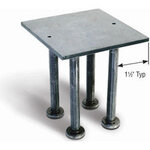
 

Attachments

  • Hilti Kwik Bolt.pdf
    1.8 MB · Views: 12
  • imbed.jpg
    imbed.jpg
    10.2 KB · Views: 16
To avoid these ads, REGISTER NOW!

wssix99

Well-known member
Joined
Mar 2, 2011
Messages
5,161
Location
Chicago, IL
I am a 35 year carpenter by trade, been a superintendent running commercial construction projects including a lot of major concrete projects for the last 20 years, and have installed hundreds of these things.

I'm sure you mean well by posting this, but the advice you are giving and the conclusions you are making is contrary to every single manufacturer's instructions. (Equipment and hardware suppliers.) These companies have legions of skilled and qualified engineers who calculate this stuff out using resources beyond what we have available to us on this site and beyond the simple lookup tables provided on instruction sheets. Do you think there is any possibility that an optimal approach might be to follow best practices given by the OEM's and take different advice to overcome the "difficulty" regarding installing anchors properly? (instead of running away from something that might seem "difficult")

To get to the manufacturer’s rated strength, the hole needs to be drilled accurately, something very difficult to really accomplish.
I have never had a problem drilling holes with the proper tools and serviceable bits, nor have I ever met anyone who has had a different experience. I have met many people who have had problems - but they have used crappy tools, worn-out bits, or the wrong type of bit.

Installing lifts (or any equipment, for that matter) is serious business. Cheeping out on tools is doesn't pay off. Its a great opportunity to buy a new bit, rent a proper drill (if one needs to) and use a good fool-proof expansion anchor.

The cured compressive strength of concrete has a huge effect on ultimate tension strength of post installed concrete anchors.
This effect is the same for epoxy bolts or expansion anchors. Their maximum pull-out strength is both developed at the base of the anchor. Epoxy bolts do not magically discover extra strength in the concrete. (Assuming the anchor is stronger than the concrete.) Its a function of the concrete properties and anchor length and has nothing to do with the anchor type.

My preferred method if pouring a slab would be to use an imbed. An imbed is a steel plate with at least 4 shear studs (nelson studs) welded on (see attached photo). Rebar can be tied to the studs and run into the slab for added development length to spread the load into surrounding concrete.
This may seem like a "good" idea on the surface, but it ignores how rebar works in a slab on grade and what it is designed for. The extra steel to pull this off can also make the concrete crack as it shrinks. There are many reasons why this is not an option in lift manufacturers' instructions aside from all the non-production welding becoming safety-critical to the installation. (This later point should give everyone pause before moving further in thought.)

If slab is already in place, use epoxy anchors; they’re simple and work really well. Make sure the hole is clean; as in brushed out and blown out with air. A dusty dirty hole substantially reduce epoxy anchor strength.
This sounds simple, but is much more difficult to pull off reliably. I'm sure you have seen installers needing certifications in the field when installing epoxy anchors in safety-critical environments.

Yes, epoxy anchors will work on lifts. Some manufacturers hold them as silent backup options for some customers. However; expansion anchors can be installed with greater reliability than epoxy anchors. If an expansion anchor can be torqued down, its good. (If it comes loose - simply re-torque.) Torque is not an indicator for an epoxy anchor's installation. In order to know if an epoxy anchor is going to hold it needs to be load tested, which is a major PITA, expensive, and beyond what most installers would want to get into.
 
OP
R

Rusted Nut

Well-known member
Joined
Dec 11, 2022
Messages
1,810
Location
Northern Arizona
I'm sure you mean well by posting this, but the advice you are giving and the conclusions you are making is contrary to every single manufacturer's instructions. (Equipment and hardware suppliers.) These companies have legions of skilled and qualified engineers who calculate this stuff out using resources beyond what we have available to us on this site and beyond the simple lookup tables provided on instruction sheets. Do you think there is any possibility that an optimal approach might be to follow best practices given by the OEM's and take different advice to overcome the "difficulty" regarding installing anchors properly? (instead of running away from something that might seem "difficult")
Yes, tried to mean well. Most of the "difficulty of proper installation" I am referring to and the resulting failure to meet spec strength; came from manufactures trainings I took.
I have never had a problem drilling holes with the proper tools and serviceable bits, nor have I ever met anyone who has had a different experience. I have met many people who have had problems - but they have used crappy tools, worn-out bits, or the wrong type of bit.

Installing lifts (or any equipment, for that matter) is serious business. Cheeping out on tools is doesn't pay off. Its a great opportunity to buy a new bit, rent a proper drill (if one needs to) and use a good fool-proof expansion anchor.
Having a perfect tool does not eliminate fracturing aggregate in hole, which can be a big issue.
This effect is the same for epoxy bolts or expansion anchors. Their maximum pull-out strength is both developed at the base of the anchor. Epoxy bolts do not magically discover extra strength in the concrete. (Assuming the anchor is stronger than the concrete.) Its a function of the concrete properties and anchor length and has nothing to do with the anchor type.
You are correct, but epoxy doesn't need a perfect hole.
This may seem like a "good" idea on the surface, but it ignores how rebar works in a slab on grade and what it is designed for. The extra steel to pull this off can also make the concrete crack as it shrinks. There are many reasons why this is not an option in lift manufacturers' instructions aside from all the non-production welding becoming safety-critical to the installation. (This later point should give everyone pause before moving further in thought.)
Possibly yes, but we install hundreds of imbeds in commercial building for stair tower anchorage, elevator rails, exterior canopies, decks, etc...; lots of ways to minimize cracking.
This sounds simple, but is much more difficult to pull off reliably. I'm sure you have seen installers needing certifications in the field when installing epoxy anchors in safety-critical environments.
Yup, most jurisdictions require epoxy certifications, and many require full time special inspection. Epoxy anchors are pretty easy; just make sure hole is clean and epoxy is mixed properly (hard to screw this up as it comes out a mixing tube)
Yes, epoxy anchors will work on lifts. Some manufacturers hold them as silent backup options for some customers. However; expansion anchors can be installed with greater reliability than epoxy anchors. If an expansion anchor can be torqued down, its good. (If it comes loose - simply re-torque.) Torque is not an indicator for an epoxy anchor's installation. In order to know if an epoxy anchor is going to hold it needs to be load tested, which is a major PITA, expensive, and beyond what most installers would want to get into.
Torque spec is often given for epoxy anchors; it's in the Hilti tech doc. . I've proof tested many anchors; never had an epoxy anchor fail. We installed some raised access flooring, where the stanchions are glued down; except in an area with some heavier gear which were required to be expansion bolted. We had to proof test 10% of them, they all failed, everyone. We went with bigger bolts, they failed too. Then we epoxied them to the floor; they all passed. We tested a few to failure, they went 300% over original spec until the stanchion broke.

Just my two cents.
 

JohnC1957

Well-known member
Joined
Mar 19, 2022
Messages
84
OP is coming from a commercial construction background. My background is as licensed GC in Chicago and LA, and as a project manager on concrete podium and high rise construction. I have never seen wedge anchors specified for high load applications. It’s generally embeds and if you miss the location, epoxy with special inspections, which are hole size and clean out. I would follow manufacturer instructions also, but nothings beats an imbed.
 
To avoid these ads, REGISTER NOW!

readhead

Well-known member
Joined
Dec 8, 2012
Messages
6,181
Location
Durango, Co.
Nothing beats a properly placed embed. Fixed it for you.
I finally got to the point of having one of my guys on site while the masons were trying to put them in the wrong place. Saved me a lot of work later.
 

1984shovelhead

Active member
Joined
Jan 13, 2019
Messages
42
Location
virginia
As an industrial/commercial electrician got certified for Hilti epoxy anchors.its not rocket science.installed hundreds tested to failure saw some take concrete with them.I’ve installed many types of wedge anchor.i consider the epoxy type easier to use and leaving less room for error.
 

PWC Repair

Well-known member
Joined
Dec 27, 2012
Messages
3,182
Location
Arkansas
When I drilled holes in my slab I built a jig to hold my drill plumb. Then I drilled a pilot hole, THEN enlarged it to size to keep sloppiness at a minumum. As a diy'er I felt like this was common sense. Then I see the "pros" at a new site just squatting down, leaning all willy-nilly on a nice Hilti drill all the meanwhile wollering from somewhat plumb to rocking back and forth 15 degrees or so. Then I was like hmmmm do I go overkill on my own stuff or are most of these guys idiots?
 

wssix99

Well-known member
Joined
Mar 2, 2011
Messages
5,161
Location
Chicago, IL
OP is coming from a commercial construction background. My background is as licensed GC in Chicago and LA, and as a project manager on concrete podium and high rise construction. I have never seen wedge anchors specified for high load applications.
Unless you are the engineer of record, I'm not sure how you would now what applications are high load and which ones are low load. Either way, wedge anchors are a poor choice for permanently installed structures. (I expect this is the greater reason you haven't used them often.)

Wedge anchors require maintenance and checking them for loosening. For some parts of buildings this is a problem. For a piece of machinery installed to a floor, this is typically not a big concern.

It’s generally embeds and if you miss the location, epoxy with special inspections, which are hole size and clean out. I would follow manufacturer instructions also, but nothings beats an imbed.

Imbeds always come with customized design and engineering. (I have some in the structure of my house.) No doubt a 2 post lift could be imbedded and they could be designed for the lift. The challenge is that welding and inspection becomes a critical item for the install, which is beyond the skillset for most installers.
 
OP
R

Rusted Nut

Well-known member
Joined
Dec 11, 2022
Messages
1,810
Location
Northern Arizona
Unless you are the engineer of record, I'm not sure how you would now what applications are high load and which ones are low load. Either way, wedge anchors are a poor choice for permanently installed structures. (I expect this is the greater reason you haven't used them often.)
You don’t need to be an engineer of record to apply common sense.
Wedge anchors require maintenance and checking them for loosening.
If anchors and are loosening, then they are pulling out of the holes and not reaching anywhere near design strength. Which was the original point I was trying to make.
For some parts of buildings this is a problem. For a piece of machinery installed to a floor, this is typically not a big concern.


Imbeds always come with customized design and engineering. (I have some in the structure of my house.) No doubt a 2 post lift could be imbedded and they could be designed for the lift. The challenge is that welding and inspection becomes a critical item for the install, which is beyond the skillset for most installers.
 

wssix99

Well-known member
Joined
Mar 2, 2011
Messages
5,161
Location
Chicago, IL
You don’t need to be an engineer of record to apply common sense.
Wouldn't common sense be to follow manufacturers' instructions, written by technical experts following industry standards and testing the physical equipment?

How does the application of common sense lead one to conclude that there is some other optimal off-label route for installing equipment like auto lifts? Is there a conspiracy amongst all of the lift manufactures? Is ALI a cabal? https://www.autolift.org/
 
To avoid these ads, REGISTER NOW!
Top Bottom