Rusted Nut
Well-known member
So I see a lot folks having issues installing expansion (wedge) anchors, and thought I’d post my thoughts on how to properly install them, or not. I am a 35 year carpenter by trade, been a superintendent running commercial construction projects including a lot of major concrete projects for the last 20 years, and have installed hundreds of these things. Personally I wouldn’t use expansion anchors for anything critical, I use them mostly for temporary bracing and the like. I would never use them on a 2 post lift. Why? Because they are very difficult to install properly.
An expansion or wedge anchor works by wedging action into the side a of a drilled hole. To get to the manufacturer’s rated strength, the hole needs to be drilled accurately, something very difficult to really accomplish. In one certification class I took, even a 1/8” larger hole substantially decreases ultimate tension strength, like 50% reduction. Many roto-hammer bits are bent, and roto-hammer chucks tend to have a lot of run-out; and lets face it – roto-hammers are drill presses; so the hole winds up larger than it should. Also, lets say your slab has large aggregate. As you drill, the aggregate will break, rather than be drilled through, then you have a really large hole where the aggregate broke off and chipped out. Sleeve style anchors will help somewhat with chipped out holes. All these things combined make installing expansion anchors a **** shoot IMO.
So, your installing a lift. If it’s a 4 post, the lift is never going flip over, it may slide around on the shop floor but won’t flip. Expansion anchors are fine here, as you are really only dealing with shear values, not tension or pull-out strength. If you drove a nail into a ceiling joist and hung on it, that’s tension or pull-out strength. If you drove a nail into a vertical stud and stood on the nail, that is mostly shear strength. With a 2 post lift, it is pretty easy to get a vehicle off balance and try to tip the lift forward or backwards; now you’re are dealing mainly with tension or pull-out strength. If you have 4 bolts per post, then most of the pull-out load is on 2 bolts per post or 4 total. You better hope they are installed properly and the concrete is in good shape.
Check out Table #2 on Page 4 in the attached Hilti tech specs for Kwik Bolts. The cured compressive strength of concrete has a huge effect on ultimate tension strength of post installed concrete anchors. A half inch bolt is rated @ 2480# for 2500PSI and 3845# for 6000PSI, with 2” imbedment. With 3 ½” imbedment up that to 7080# with 6000PSI; big difference! Installing expansion anchors in fresh or uncured concrete (less than 28 days under normal conditions) is worthless. And no, once installed they will not increase in strength as the concrete cures; they get weaker as the concrete shrinks. I’ve pulled temporary form aligner anchors out with my hand after a few days (they fine for alignment kickers).
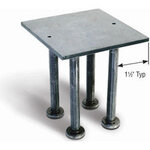
OK, so if I won’t use expansion anchors; how would I install a 2 post loft. My preferred method if pouring a slab would be to use an imbed. An imbed is a steel plate with at least 4 shear studs (nelson studs) welded on (see attached photo). Rebar can be tied to the studs and run into the slab for added development length to spread the load into surrounding concrete. Set the top of the imbed plate to top of slab grade, then weld the post on. This is assuming that the manufacturer is OK with welding on their posts. Another method is build an anchor bolt template and imbed anchors in the slab. You can tie rebar to these, weld terminator plates on etc… Also, plan out your crack control joints/cuts; starting around your post anchors, as you don’t want cracks or control joints near your anchors, then fill in others areas as needed.
If slab is already in place, use epoxy anchors; they’re simple and work really well. Make sure the hole is clean; as in brushed out and blown out with air. A dusty dirty hole substantially reduce epoxy anchor strength. Also remember any anchorage is only as good as the surrounding concrete. Hilti has some very good easy to read tech docs for their products on their website.
Hope this helps.
An expansion or wedge anchor works by wedging action into the side a of a drilled hole. To get to the manufacturer’s rated strength, the hole needs to be drilled accurately, something very difficult to really accomplish. In one certification class I took, even a 1/8” larger hole substantially decreases ultimate tension strength, like 50% reduction. Many roto-hammer bits are bent, and roto-hammer chucks tend to have a lot of run-out; and lets face it – roto-hammers are drill presses; so the hole winds up larger than it should. Also, lets say your slab has large aggregate. As you drill, the aggregate will break, rather than be drilled through, then you have a really large hole where the aggregate broke off and chipped out. Sleeve style anchors will help somewhat with chipped out holes. All these things combined make installing expansion anchors a **** shoot IMO.
So, your installing a lift. If it’s a 4 post, the lift is never going flip over, it may slide around on the shop floor but won’t flip. Expansion anchors are fine here, as you are really only dealing with shear values, not tension or pull-out strength. If you drove a nail into a ceiling joist and hung on it, that’s tension or pull-out strength. If you drove a nail into a vertical stud and stood on the nail, that is mostly shear strength. With a 2 post lift, it is pretty easy to get a vehicle off balance and try to tip the lift forward or backwards; now you’re are dealing mainly with tension or pull-out strength. If you have 4 bolts per post, then most of the pull-out load is on 2 bolts per post or 4 total. You better hope they are installed properly and the concrete is in good shape.
Check out Table #2 on Page 4 in the attached Hilti tech specs for Kwik Bolts. The cured compressive strength of concrete has a huge effect on ultimate tension strength of post installed concrete anchors. A half inch bolt is rated @ 2480# for 2500PSI and 3845# for 6000PSI, with 2” imbedment. With 3 ½” imbedment up that to 7080# with 6000PSI; big difference! Installing expansion anchors in fresh or uncured concrete (less than 28 days under normal conditions) is worthless. And no, once installed they will not increase in strength as the concrete cures; they get weaker as the concrete shrinks. I’ve pulled temporary form aligner anchors out with my hand after a few days (they fine for alignment kickers).
OK, so if I won’t use expansion anchors; how would I install a 2 post loft. My preferred method if pouring a slab would be to use an imbed. An imbed is a steel plate with at least 4 shear studs (nelson studs) welded on (see attached photo). Rebar can be tied to the studs and run into the slab for added development length to spread the load into surrounding concrete. Set the top of the imbed plate to top of slab grade, then weld the post on. This is assuming that the manufacturer is OK with welding on their posts. Another method is build an anchor bolt template and imbed anchors in the slab. You can tie rebar to these, weld terminator plates on etc… Also, plan out your crack control joints/cuts; starting around your post anchors, as you don’t want cracks or control joints near your anchors, then fill in others areas as needed.
If slab is already in place, use epoxy anchors; they’re simple and work really well. Make sure the hole is clean; as in brushed out and blown out with air. A dusty dirty hole substantially reduce epoxy anchor strength. Also remember any anchorage is only as good as the surrounding concrete. Hilti has some very good easy to read tech docs for their products on their website.
Hope this helps.