To avoid these ads, REGISTER NOW!

Split Service to Furnace?

dziskovs

Well-known member
Joined
Dec 6, 2017
Messages
69
Location
Bowling Green, OH
Hi All,

I'm in the process of trying to setup some energy monitoring since I had a geothermal ground source heat pump installed this past summer, and bills are quite a bit higher than what I was planning for, so I'm attempting to determine the actual power being used by heat pump, water pumps etc. Trying to figure out what exactly is going on at my panel before I figure out what kind of monitor to buy.

Where I'm really confused is that it seems like I have a dedicated feed to the furnace circuit breaker/ disconnect that does not go into the main panel at all. My understanding is that this house likely used to be Electric only, and they added natural gas at a later time ( I replaced NG furnace with geothermal Heatpump this summer). The old AC heatpump circuit has a breaker in the main panel (currently off and unused), but furnace does not.

I only have one meter outside, and its an older style CT meter that does not have a disconnect bulb (which I think means the only way to disconnect power to the main legs is at transformer at street).

I don't think this is what is referred to as 400A Split service, but I could be wrong. Trying to find useful info online and haven't narrowed it down yet.

Thoughts? If I monitor the main panel, I don't think it will tell me what the Furnace is doing, but Meter - Main panel will give me total kWh. I may need to get a separate circuit monitor for the Furnace leg.

Panel.png
 
To avoid these ads, REGISTER NOW!

wyliesdiesels

Well-known member
Joined
Aug 14, 2012
Messages
20,031
Location
Modesto, CA
can you post pics of the CT cabinet, meter, etc.

where do the 2 conduits coming out of the bottom of the panels go? to the CT cabinet?

wow that furnace disconnect has a number of issues. looks like white plumbing PVC on top held on with a cable clamp. :eek:
 

Bert_

Well-known member
Joined
Dec 24, 2016
Messages
9,753
Location
NW Iowa
can you post pics of the CT cabinet, meter, etc.

where do the 2 conduits coming out of the bottom of the panels go? to the CT cabinet?

wow that furnace disconnect has a number of issues. looks like white plumbing PVC on top held on with a cable clamp. :eek:
Looks like se cable to me.
 

Bert_

Well-known member
Joined
Dec 24, 2016
Messages
9,753
Location
NW Iowa
Not uncommon to have a separate panel for electric heating. Really common if your electric company offers a second meter that is a reduced rate for electric heat.

From that picture it looks like a good quality older installation.
 

dcg9381

Well-known member
Joined
Jun 20, 2018
Messages
11,778
Location
Austin, TX
Trying to figure out what exactly is going on at my panel before I figure out what kind of monitor to buy.


Thoughts? If I monitor the main panel, I don't think it will tell me what the Furnace is doing, but Meter - Main panel will give me total kWh. I may need to get a separate circuit monitor for the Furnace leg.
There are really two types of monitors, those that monitor the main and use software to make "educated guesses" about loads (you can tag things as they come on/off). Or you do a monitor that inductively monitors the branches individually. You'd need to know exactly what's on the branch (breaker).

The monitors that look at individual induction probes - they don't make guesses, they tell you the draw on that circuit and you and know specifically.

Where this breaks down is if you have multiple sub-panels... If you want accuracy, you have to install a monitor in each sub panel with probes on the branches that you want to know about.
 
OP
D

dziskovs

Well-known member
Joined
Dec 6, 2017
Messages
69
Location
Bowling Green, OH
where do the 2 conduits coming out of the bottom of the panels go? to the CT cabinet?
They go underground from there and go to street to my knowledge.... My only guess is that the CT clamps are underground. This is a "millivolt meter" (Not sure of the proper term), so whatever the meter reads, its multiplied by 40 to get actual kWh's.

Picture below was taken while they were residing the house (and managed to drive a nail through the sub panel feed to basement...)
Back of Electric Panel.jpg
 

nh_yota

Well-known member
Joined
Mar 10, 2015
Messages
4,077
Location
Seacoast New Hampshire
"All-electric" houses became popular during the fuel crises of the 1970's and it was very common for them to have larger than normal services with separate metering for heating. Additionally, it was cheaper installation-wise to run a power hungry appliance like an electric furnace off its own disconnect from the meter/main rather than upgrade the house panel.
 

dave*99

Well-known member
Joined
May 5, 2009
Messages
4,269
Location
Coastal NJ
Musta been a helluva big electric heater. Did they really run those on one big breaker? I would have expected a panel for the old heater somewhere.
 
OP
D

dziskovs

Well-known member
Joined
Dec 6, 2017
Messages
69
Location
Bowling Green, OH
The other thing I'm working out is in the future I want to add either a battery backup or NG powered backup generator in the future, and can't comprehend how they would wire in the transfer switch given that I have power coming in through separate legs to the house.
 

wyliesdiesels

Well-known member
Joined
Aug 14, 2012
Messages
20,031
Location
Modesto, CA
They go underground from there and go to street to my knowledge.... My only guess is that the CT clamps are underground. This is a "millivolt meter" (Not sure of the proper term), so whatever the meter reads, its multiplied by 40 to get actual kWh's.

Picture below was taken while they were residing the house (and managed to drive a nail through the sub panel feed to basement...)
Back of Electric Panel.jpg
so where is the CT cabinet then? on the pole? this is an odd setup
 
OP
D

dziskovs

Well-known member
Joined
Dec 6, 2017
Messages
69
Location
Bowling Green, OH
so where is the CT cabinet then? on the pole? this is an odd setup
From the meter/ panel, power goes underground, and to the street. There is a transformer across the street that supplies this corner of the neighborhood, but beyond that, I'm clueless. Electricians when they were here told me I probably need to call the power company at some point to have them upgrade the meter to a current style with the bulb that can be removed.
 

wssix99

Well-known member
Joined
Mar 2, 2011
Messages
5,161
Location
Chicago, IL
Is this your first season with the geo unit? If so, you might want to hold off until the money starts rolling in during the summer...

Your electric use will go up noticeably compared to the gas unit. In addition to the electricity you were using for the blower before, you now have the heat pump compressor running. (The water pumps should be negligible.) Your increased power use should be equivalent to something like two additional refrigerators in the house. If that's what you are paying for - mystery solved. Your heat pump compressor is taking 40 degree-ish water in from your well and pushing it to 90 degree-ish fluid through your coil. That takes power.

In the summer, the differential is much more favorable and your power bill will be way lower than what you had with your air source heat pump.
 
OP
D

dziskovs

Well-known member
Joined
Dec 6, 2017
Messages
69
Location
Bowling Green, OH
Is this your first season with the geo unit? If so, you might want to hold off until the money starts rolling in during the summer...

Your electric use will go up noticeably compared to the gas unit. In addition to the electricity you were using for the blower before, you now have the heat pump compressor running. (The water pumps should be negligible.) Your increased power use should be equivalent to something like two additional refrigerators in the house. If that's what you are paying for - mystery solved. Your heat pump compressor is taking 40 degree-ish water in from your well and pushing it to 90 degree-ish fluid through your coil. That takes power.

In the summer, the differential is much more favorable and your power bill will be way lower than what you had with your air source heat pump.
Yes, geo was installed in June. I knew winter would be higher cost vs. NG furnace, but I did not expect it to be significantly higher. I'm in 2nd house in this area, and utilities have been very similar between both houses before I upgraded HVAC. Since install, our NG bill has been pretty constant with 2-5 ccf of usage depending on how much cooking and extra hot water we are using (tankless installed in series with DSH tank).

So far in actual heating months, Nov. was 1960 kWh, December was 1720, and I'm 11 days into January, and already at 1400 kWh. Our electric rates shot up 2 months after we installed the geothermal system, so I'm looking at kWh used vs. directly comparing bills. I have a 3 zone system in the house and the upstairs zones run like 18-20 hours a day to maintain 68 deg F. I'm hoping once I add better insulation in attic, and do some air sealing that I can see a quantifiable difference is usage overall.

I've also read that first winter after install is the worst, as the ground is still settling. We did a 4.5T ground loop with directional boring, so I wouldn't expect settling to be as significant as with a trench that was dug and backfilled. I noticed quite a bit of settling around the header pit.
 

wssix99

Well-known member
Joined
Mar 2, 2011
Messages
5,161
Location
Chicago, IL
I have a 5T geo system and my biggest month last year was 2700 kWh. Last month (in Chicago) was 1900.

For perspective, during to dog days of summer, our top bill was 1600 kWh.

We also have a lot of work from home and some occasional EV charging, but the heat pump dominates our usage. We are in an ICF house, but that shouldn't matter for a comparison as our heat pumps are sized for the house they are in. Tonnage should be the best indicator.

So, your electricity usage looks pretty reasonable in my experience.

The BIG thing that has helped us on our bill is our utility's hourly power program. We pay wholesale electric rates. These rates are dirt cheap at night (2 cents per kWh or less) but can spike to 30 cents or more during demand surges. Since our big draws are the heat pump during winter and our EV charging at night, our heaviest usage is when power is cheap. Without this program, we would pay $1-2K more for our power each year.

^You might want to see if you have access to something similar in your area.
 

wssix99

Well-known member
Joined
Mar 2, 2011
Messages
5,161
Location
Chicago, IL
BTW - I think that stuff about ground settling is nonsense. :)

If you can't see what your inlet and outlet water temps are, you'll want to get a scanner for your unit so you can see. Those are key indicators of how hard the system and we'll are working.
 
OP
D

dziskovs

Well-known member
Joined
Dec 6, 2017
Messages
69
Location
Bowling Green, OH
BTW - I think that stuff about ground settling is nonsense. :)

If you can't see what your inlet and outlet water temps are, you'll want to get a scanner for your unit so you can see. Those are key indicators of how hard the system and we'll are working.
I had tech out for the 6 month service, and Water inlet was 35 deg, and water outlet was 31.6 deg, which is a lot lower than I was expecting. Seems like there is not enough dwell time between on off cycles for the system to actually pick up much heat from the ground. Need to check it again here soon. I don't believe I can check on the unit itself, I think I have to probe the ports directly to get water temps (Its a Climatemaster Tranquility 30).
 

Kezorm

Well-known member
Joined
Aug 18, 2021
Messages
174
Location
Twin Cities, MN
Do you have special electricity rate on the GSHP (e.g. dual-fuel)? For me, typical cost to run my GSHP at 3.0 COP is about break-even with natural gas boiler. But this only works out because I have dual-fuel rate on the heat pump. If I had to pay standard rate, cost would likely be closer to 2x vs. the boiler.
 
Last edited:
To avoid these ads, REGISTER NOW!
OP
D

dziskovs

Well-known member
Joined
Dec 6, 2017
Messages
69
Location
Bowling Green, OH
Do you have special electricity rate on the GSHP (e.g. dual-fuel)? For me, typical cost to run my GSHP at 3.0 COP is about break-even with natural gas boiler. But this only works out because I have dual-fuel rate on the heat pump. If I had to pay standard rate, cost would likely be closer to 2x vs. the boiler.
No, just fixed rate 100% of time. Toledo Edison just jacked rates from $.065 to $.12ish. I contracted to buy power from an outside supplier for something like $.08 for 2 years.
 

wssix99

Well-known member
Joined
Mar 2, 2011
Messages
5,161
Location
Chicago, IL
Good luck this month! You guys have some cold weather in Chicago now.
Its nothing like the spell a few years back where we had a deep freeze for 2 weeks and hit -35 during the day. The geo system came through that like a champ. (The electricity use did max that month.)
 

wssix99

Well-known member
Joined
Mar 2, 2011
Messages
5,161
Location
Chicago, IL
I had tech out for the 6 month service, and Water inlet was 35 deg, and water outlet was 31.6 deg, which is a lot lower than I was expecting.
That's not an uncommon inlet temperature and more an indication of how the well is loaded up. The area around the well will get cold as it is used. If you turn off the unit and let it sit for a bit, the temperature will bump up a bit as it absorbs heat from the ground but come down again as it is used. The outlet temperature has a lot to do with how the unit is running and set up.

At that temperature, I assume you are running 50% glycol in the well? You must have the freeze jumper cut on the control board that allows you to go down to that temperature.

I don't believe I can check on the unit itself, I think I have to probe the ports directly to get water temps (Its a Climatemaster Tranquility 30).
I have the same system. (an older unit) Our units use the DXM2 controller, which is a common "brain" for many different brands and types of geo units. You can check these temperatures on the unit.

You need this scan tool: https://files.climatemaster.com/97b...al-geothermal-heating-and-cooling-systems.pdf

^ The tool runs $500 but is worth every penny. You can read all the sensors inside the unit and see all the temperatures. You can also see the error codes when the unit shuts down and either address the problem yourself or call your tech and have them come with what is needed to address the issue. (And save yourself an extra trip and time.)

This site has all the tech manuals and what you need to debug issues: https://www.climatemaster.com/geothermal-dealer/products/tranquility-30-digital-series-te

In addition to having the scan tool, I also highly recommend knowing how long it will take you to get spare parts. My house got hit by lightning and the EMP destroyed by DXM2 board. I had to wait 5 days (without AC) to get a new one. I also lost all the programming and had to figure it all out for myself. (I don't have anyone who can service my unit, so I do it myself.) I now keep a fully-programmed board on the shelf as a sand-by.

If your tech can get a new board same day, that's great. At a minimum, I would get the ACD scan tool and take prints of all the screens in case you ever need to re-program a new board.

The other thing with this unit is that I have found the on-board expansion tank is insufficient. So, its also important to check your well pressures and make sure they are in-spec and your expansion tank is doing the right thing. If not, you'll get pressure-related shut downs or the system will pull a vacuum during the winter.

My unit also eats starting capacitors for the compressor every 5 years-ish. I keep one of those on the shelf also. That is something you'll want to check out on youtube. The service is just like any other AC unit. If you swap it yourself, its a $15 repair. If you have to have your service guy come, it will cost you several hundred and you'll be down for a day or more when it goes.
 
OP
D

dziskovs

Well-known member
Joined
Dec 6, 2017
Messages
69
Location
Bowling Green, OH
At that temperature, I assume you are running 50% glycol in the well? You must have the freeze jumper cut on the control board that allows you to go down to that temperature.
I'm not positive on what the mix is in the well. I'll have to look around and see if I can find the docs from the well installer.

I'll take a look at getting one of those scan tools. We only had one installer in the area that I was comfortable with, but the system we ended up with is a bit of a mix and match with Trane Thermostats, Climatemaster Heatpump, Arzel zoning, and Honeywell humidifier. Trying to get anything any information off the system is a challenge. The HVAC rep offered to install an communicating thermostat from Climate master in parallel so I could see what was going on, but I didn't bite on it yet. Seems like the service tool is probably the better route to go.

I've been looking into the WEL server for tracking and diagnostic purposes, but haven't decided how user friendly it will be yet.
 

P0234

Well-known member
Joined
Aug 6, 2012
Messages
3,241
Location
NoVA
To me it looks like you have the perfect opportunity for a second panel. Pull out the dedicated furnace circuit, throw in a regular panel.
 

wssix99

Well-known member
Joined
Mar 2, 2011
Messages
5,161
Location
Chicago, IL
I'll take a look at getting one of those scan tools. We only had one installer in the area that I was comfortable with, but the system we ended up with is a bit of a mix and match with Trane Thermostats, Climatemaster Heatpump, Arzel zoning, and Honeywell humidifier. Trying to get anything any information off the system is a challenge.
I have a similar setup and had to address what I assume were similar challenges. All of our zoning and thermostats are Honeywell but they aren't plug and play. Everything needed to be manually integrated. After I got in and reviewed everything, I found my installer made errors all over the place. Our geo unit was not configured optimally but fortunately it wasn't overly aggressive like our on-demand water heater. (They put that unit on a setting that could have burned our house down!) We have a Honeywell steam humidifier and also an integrated whole-house HRV.

The HVAC rep offered to install an communicating thermostat from Climate master in parallel so I could see what was going on, but I didn't bite on it yet. Seems like the service tool is probably the better route to go.
Yes, I went with the service tool because the thermostat won't integrate with my other thermostats. If I recall correctly, the thermostat also doesn't have the full functionality of the service tool. (I would be wrong on that.)

The big downside to the service tool is that it can't remain hooked up. There's no safe mode and it stays powered on. One brush up against the wrong button and unwanted things happen. I just keep the cable hooked up all the time and hanging outside my unit. When I need the service tool, I just plug it into the wire. (Instead of opening up the case and plugging the wire into the main board.)

I've been looking into the WEL server for tracking and diagnostic purposes, but haven't decided how user friendly it will be yet.
The DXM2 board is great and has been in use for well over 15 years. (Definitely more than 10 - my unit is 10 years old this year.) The next evolution of this should naturally be network enabled. I'm actually surprised its not on the market yet. The board has a great deal of inputs and monitoring built in - the catch is that we need the service tool to see the data.

No, just fixed rate 100% of time. Toledo Edison just jacked rates from $.065 to $.12ish. I contracted to buy power from an outside supplier for something like $.08 for 2 years.
I checked my bill last month and am paying just over $.04 with the hourly power plan. (Before all the other delivery charges and taxes.) If you have this option, it's probably worth a good look.

For some additional reference, here is my usage this month. You can see the dramatic spike when the temperature dropped. The recent cold snap increased our power usage by 50%. This is all the heat pump.

1705552147227.png


Here's the summer view. You an see how much lighter the power usage is and how the temperature swings have less of an effect at our latitude:

1705552300310.png
 
OP
D

dziskovs

Well-known member
Joined
Dec 6, 2017
Messages
69
Location
Bowling Green, OH
The big downside to the service tool is that it can't remain hooked up. There's no safe mode and it stays powered on. One brush up against the wrong button and unwanted things happen. I just keep the cable hooked up all the time and hanging outside my unit. When I need the service tool, I just plug it into the wire. (Instead of opening up the case and plugging the wire into the main board.)
Thanks for that tidbit. I've got one on order now, so hoping to get it installed in the next week or so.

What are you using to track power usage? That is basically the minimum I'm looking for as far as kW used from Heat pump vs Temp.
 

wssix99

Well-known member
Joined
Mar 2, 2011
Messages
5,161
Location
Chicago, IL
What are you using to track power usage? That is basically the minimum I'm looking for as far as kW used from Heat pump vs Temp.

I have a very sophisticated system called "Nagging Wife." It goes off every morning and doesn't stop until the evening when I go to sleep. The system also proactively turns off lights ("to save energy" - exactly when I need light) like when I'm going to the bathroom or working with power tools in the shop.

I looked at all sorts of add-on monitors when I put in the Geo system but wisely decided to wait. With a year of usage and my utility's smart meter analytics, I have everything I need. I have day-by day usage statistics and know that my base usage is 25 kWh on days when the heat pump is not running. (Max charge on my EV is 13 kWh, so I can also subtract that if I need to..)
Those charts above come from my utility online and include the average temperature overlay. (You may have something similar.) Anything above my base load and EV charging is the variable use of the heat pump.
 
OP
D

dziskovs

Well-known member
Joined
Dec 6, 2017
Messages
69
Location
Bowling Green, OH
(You may have something similar.)
Well what do you know. I can't get daily, but this is at least helpful. June was geo install, so I'll be comparing next summer to see if usage goes down at all.

What I really want to do is plot my EWT and LWT against these plots to see how effective my system is.
1705595848704.png1705595848704.png
 
Last edited:

wyliesdiesels

Well-known member
Joined
Aug 14, 2012
Messages
20,031
Location
Modesto, CA
"a lot" is relative. If one converts the BTUs I would have wasted with gas or oil heat to kW, my energy usage is really low - and a he'll of a lot le$$ expensive.

My neighbors' gas bills dwarf my electricity bill.
out here in cali our electric rates are thru the roof. so gas is way cheaper to heat things
 

wssix99

Well-known member
Joined
Mar 2, 2011
Messages
5,161
Location
Chicago, IL
What I really want to do is plot my EWT and LWT against these plots to see how effective my system is.
This would be interesting to see. With our control board becoming so ubiquitous, I would like to see at least a plug-in data logger in the absence of network enablement, but haven't come across one.

Do you have a smart meter that communicates two ways with your POCO? This is a key enabler for the daily power view. I didn't get it until my area was well into the program for the meter switch-over. I'm sure you'll be getting this view soon. If you already have the meter, your utility has the data and hopefully you'll get to see your historical use when you get the analytics.

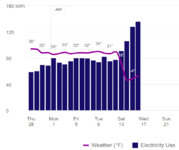
Here's another interesting effect...
1705604581168.png

As this current cold snap has gone on and the power has ticked upward, the power usage still continues to climb. I believe this is the geo well "freezing up" and the EWT dropping. The heat pump becomes less efficient and then needs to work harder. I expect that when the air temperatures return to a 32 degree average, the power usage will still be north of 80 kWh due to the well being cold and needing to "catch-up" on the heat soak from the surrounding earth. If we get a prolonged period of warm weather after this, it should make for a really interesting graph.

...It would indeed be very interesting to overlay my EWT and LWT averages over this, but unfortunately my Nagging Wife system doesn't have the needed bandwidth.
 
OP
D

dziskovs

Well-known member
Joined
Dec 6, 2017
Messages
69
Location
Bowling Green, OH
but unfortunately my Nagging Wife system doesn't have the needed bandwidth.
Haha!

My poco does not have smart meters here yet. Still have someone walk the neighborhood and log it in his tablet. I can go check the meter every day, but thats going to get old really fast.
 

wssix99

Well-known member
Joined
Mar 2, 2011
Messages
5,161
Location
Chicago, IL
out here in cali our electric rates are thru the roof. so gas is way cheaper to heat things
Same thing in the midwest. In this situation, our heat is free. (Our heat is indirectly coming from the residual decay of uranium in the earth's crust and core.) We are only using electricity to take that heat from the ground and move it around our houses. (The electricity to do that is more than a simple furnace blower, but much less than straight electric heat and much less energy than gas or oil.)

If we were to add solar, we could net zero on these systems but solar is another feud with the power company in our area... :(
 

P0234

Well-known member
Joined
Aug 6, 2012
Messages
3,241
Location
NoVA
Haha!

My poco does not have smart meters here yet. Still have someone walk the neighborhood and log it in his tablet. I can go check the meter every day, but thats going to get old really fast.

If your meter is somewhat recent, it might be smart but not look it. A lot of meters talk on 900mhz using the Itron ERT. Mine does this, its just a simple looking meter but using an RTL-SDR dongle I get down to the second power usage for the cost of a $12 usb dongle.

Even if it doesn't, a raspberry PI and some scripting can get you meter readings too:

 
To avoid these ads, REGISTER NOW!
Top Bottom