To avoid these ads, REGISTER NOW!

Split Service to Furnace?

OP
D

dziskovs

Well-known member
Joined
Dec 6, 2017
Messages
69
Location
Bowling Green, OH
Looking into what data I do have given I've been tracking monthly utilities well since I owned this house, I think this data is telling me that in BTU's, I'm using far less energy than what I previously was with NG.

For electric, I used 3412 BTU/ kWh, and for NG, I used 103800 BTU/ ccf. This assumes that 100% of energy use goes to heat in BTU's. Dashed line is average monthly temp for that year, solid lines are kW*3412+ccf*103800 for each month. Geothermal Install was in June of 2023.

I'll have to wait another 2 weeks to see how January works out for NG + electric usage with this cold snap, but October-December of 2023 (Green line) show in BTU's that I'm using much less energy overall than I did in 2022 with similar average temperatures.

Actual Utility Bill wise, I'm paying more ($60 in October, $110 in November, and $90 in December) for less overall energy, but NG is cheap in my area at around $0.50/ ccf +fees. Hoping my annual bill total ends up as a savings overall, but who knows at this point how much I'll save in the summer.

For now, I'll be thankful that the backup resistance heat hasn't kicked on yet, and that the system seems capable of keeping house at setpoint in stage 1 heating (although running almost constantly to do so).

Utilities.png

Getting back to original topic of post, sounds like I should possibly investigate upgrading the furnace circuit breaker/ shutoff into a secondary panel, or try to find a energy monitor that will work on main panel with capability to monitor the furnace circuit as dedicated circuit.

Here is someone who has started to build their own DXM2 data logger. Some assembly (and coding) required... https://jeremylaurenson.wordpress.com/2022/12/09/raspberry-pi-climatemaster-logger/
^This is fantastic. This might be what finally gets to me to buy a rasberry pi and setup some other smart home stuff with Home Assistant that I've been thinking about for a long time.

Thanks All!
 
To avoid these ads, REGISTER NOW!
OP
D

dziskovs

Well-known member
Joined
Dec 6, 2017
Messages
69
Location
Bowling Green, OH
After I just did all of that above, I realized that with a Heatpump, I need to be using a COP of 3-4, so that 3412 BTU's/ kWh maybe doesn't apply.. Need to think about that more and redo my maths.
 

wyliesdiesels

Well-known member
Joined
Aug 14, 2012
Messages
20,032
Location
Modesto, CA
Same thing in the midwest. In this situation, our heat is free. (Our heat is indirectly coming from the residual decay of uranium in the earth's crust and core.) We are only using electricity to take that heat from the ground and move it around our houses. (The electricity to do that is more than a simple furnace blower, but much less than straight electric heat and much less energy than gas or oil.)

If we were to add solar, we could net zero on these systems but solar is another feud with the power company in our area... :(
we must not have enough heat in the ground here to make it worth it as nobody around here has geo thermal systems
 

wssix99

Well-known member
Joined
Mar 2, 2011
Messages
5,161
Location
Chicago, IL
Getting back to original topic of post, sounds like I should possibly investigate upgrading the furnace circuit breaker/ shutoff into a secondary panel, or try to find a energy monitor that will work on main panel with capability to monitor the furnace circuit as dedicated circuit.
Did you check your smart meter schedule to see when you get yours? IMO - These high efficiency appliances are great but when something breaks, they fail spectacularly. Having another meter/device in the system is one more gadget that can break. If you feel that you really need a monitor, you might consider a bypass switch to go with it so you can take it out of the equation for debugging.

Before all, its definitely good to settle on the math and measurements you want to use...

After I just did all of that above, I realized that with a Heatpump, I need to be using a COP of 3-4, so that 3412 BTU's/ kWh maybe doesn't apply.. Need to think about that more and redo my maths.
Your numbers look good to me. Energy is energy and the numbers you are using for gas is the heat content. All good.

Its amazing how much energy is wasted and goes up the chimney, even on an efficient conventional furnace! On top of that, your Climatemaster uses VFD's inside the box, so its also better on the apples-to-apples blower.

Actual Utility Bill wise, I'm paying more ($60 in October, $110 in November, and $90 in December) for less overall energy, but NG is cheap in my area at around $0.50/ ccf +fees. Hoping my annual bill total ends up as a savings overall, but who knows at this point how much I'll save in the summer.
Your electricity rate went up 33% when you signed on to the 3rd party deal, right? There is a lot of smoke and mirrors on our utility bills and we are going to pay what we are going to pay. You might be better off doing your year-over-year on a kWh basis for an honest assessment of where you stand. The money hurts, but everything is going up in price these days - even our utilities. You may not be seeing the dollar savings you expect, but it looks like your utility bills would be going up anyway had you done nothing.

The utilities jam us with fees and are masters at escalating those quietly. For example, only 15% of my gas bill is for the actual gas. The rest is for distribution, customer service, storage, environmental fees, other BS where they hide the legal payments or corrupt executives, and the taxes given to our corrupt politicians. (The politicians in my area don't get sued. They just loose their offices when they get caught and become utility executives...)

For now, I'll be thankful that the backup resistance heat hasn't kicked on yet, and that the system seems capable of keeping house at setpoint in stage 1 heating (although running almost constantly to do so).
Most people I have talked to completely disconnect this or have a switch and manually turn it on when they get into dire straits. I don't know how simple this is on the Climatemaster, though. We ordered ours without. We got through -35 degree weeks just fine, although the geo doesn't have the big quick punch that a conventional furnace does. The unit ran constantly and we needed to throttle our zones as we moved around the house, close our window treatments for extra insulation, etc.
 

wssix99

Well-known member
Joined
Mar 2, 2011
Messages
5,161
Location
Chicago, IL
we must not have enough heat in the ground here to make it worth it as nobody around here has geo thermal systems
No - you have a nice payoff and there are US Department of Energy funded studies that flag Southern California as ripe territory...

It looks like the issue in your area is one of lobbyists. Somebody is getting paid. Maybe the excuse is that geo wells disturb endangered ground worms or something? https://www.californiageo.org/geothermal-heat-pump-installations-in-california/
 

wyliesdiesels

Well-known member
Joined
Aug 14, 2012
Messages
20,032
Location
Modesto, CA
No - you have a nice payoff and there are US Department of Energy funded studies that flag Southern California as ripe territory...

It looks like the issue in your area is one of lobbyists. Somebody is getting paid. Maybe the excuse is that geo wells disturb endangered ground worms or something? https://www.californiageo.org/geothermal-heat-pump-installations-in-california/
but im not in SoCal.

We have a little U in the ground here but nowhere near as much compared to other areas or states. we didnt have any U mines here during the nuclear technology race either
 

wssix99

Well-known member
Joined
Mar 2, 2011
Messages
5,161
Location
Chicago, IL
but im not in SoCal.
Sorry. The article above still explains why you don't see it around you. Modesto still has a good paypack on this stuff. Here is an old model, but the "Economic" view gives a good representation of where this works. (Of course, the climate across the State of CA runs the gamut.)

We have a little U in the ground here but nowhere near as much compared to other areas or states. we didnt have any U mines here during the nuclear technology race either
Its the U in the Earth's core that keeps the entire Earth at a constant temperature everywhere. https://en.wikipedia.org/wiki/Geothermal_gradient

Geothermal heating/cooling works everywhere and there are different ways to do it with varying types of wells. The biggest variables are local adoption (labor, vendors, regulations) and the economic payback of the additional investment required to construct the well.

In the City, where I live, we have a straight 460' vertical well and had to get a permit from the City before we drilled to make sure there were no tunnels, subway lines, etc. underneath us. We also have labor and vendor issues because there are no companies that service residential heat pumps at this latitude/area. (So, I do most of my own service and/or we shell out big time to get commercial HVAC companies to come service us.)

@dziskovs and I have closed-loop systems/wells, which are at the higher end of the spectrum with regard to expense. (These are typically required for denser areas.) Our wells are like a radiator system on a car. Coolant circulates in a closed system and heat exchanges in the earth. I have a friend with a ranch who has an open loop system that draws fresh water out of their domestic water well, transfers heat, and then ejects the water into a pond on the property. (The water then moves back down and re-charges the aquifer.) This later system is a lot less expensive because the well expense is incremental - just to drill a slightly larger water well from what would have been required otherwise.

^ These open loop systems are also more electricity-efficient. They don't have the decay in electrical efficiency like the closed-loop wells do when they freeze or heat up. The open loop wells are always drawing 55 degree fluid.
 
Last edited:
OP
D

dziskovs

Well-known member
Joined
Dec 6, 2017
Messages
69
Location
Bowling Green, OH
Most people I have talked to completely disconnect this or have a switch and manually turn it on when they get into dire straits. I don't know how simple this is on the Climatemaster, though. We ordered ours without. We got through -35 degree weeks just fine, although the geo doesn't have the big quick punch that a conventional furnace does. The unit ran constantly and we needed to throttle our zones as we moved around the house, close our window treatments for extra insulation, etc.
I have a 3 switch breaker panel next to the furnace, one for 1st stage heat, 2nd stage heat, and geo (which I'm assuming is for the pumps themselves). Should be able to turn it off if need be, but wanted to see if it even engaged in the first winter with the system. I've got a ACDU03 Communicating Service Tool on the way, so should be able to get some loop temps off the monitor here soon. Found a guy on FB marketplace getting out of HVAC work, and got it for $150. Almost had 1 off epay for $125, but someone outbid me at the last second.

Did you check your smart meter schedule to see when you get yours? IMO - These high efficiency appliances are great but when something breaks, they fail spectacularly. Having another meter/device in the system is one more gadget that can break. If you feel that you really need a monitor, you might consider a bypass switch to go with it so you can take it out of the equation for debugging.
I'm in the "future update" bucket with no set date yet.

Your electricity rate went up 33% when you signed on to the 3rd party deal, right?
Yeah, it would have gone up by almost 50% if I would have stuck with Toledo Edison providing power vs. the 3rd party based on rate per kWh not including fees. If I look at total bill/ kWh used, I went from $0.12/kWh to $0.14/ kWh which is only about a 17% increase.
 
OP
D

dziskovs

Well-known member
Joined
Dec 6, 2017
Messages
69
Location
Bowling Green, OH
You might be better off doing your year-over-year on a kWh basis for an honest assessment of where you stand.
Once I hit June, that will be a year of Geothermal installed, so I've got my totals setup to look at year over year(from June-May) for Total Utility Cost, as well as kWh and NG usage. It's all sunk cost at this point (and paid off), but I'm a math geek, so I like to run the numbers and see if the payback is anywhere near what I had originally estimated.
 

wssix99

Well-known member
Joined
Mar 2, 2011
Messages
5,161
Location
Chicago, IL
I have a 3 switch breaker panel next to the furnace, one for 1st stage heat, 2nd stage heat, and geo (which I'm assuming is for the pumps themselves).
The geo pumps should be part of the Climatemaster unit and on a single breaker. Maybe your 3rd breaker is for a humidifier? (That would be on a separate circuit from the other stuff.)

Found a guy on FB marketplace getting out of HVAC work, and got it for $150. Almost had 1 off epay for $125, but someone outbid me at the last second.
This is an absolute steal!

BTW - One other thing you can do with this is turn off your unit at the thermostats and then command the pumps to circulate the well. (You may have to be in service mode to do this. I don't remember.) Doing this causes the fluid to equalize and your EWT will get to match your LWT. This gives you a point-in-time measurement of the well's temperature. Looking at this over a period of time will visualize the effect of the well freezing or heating up as its used.

I mentioned that I thought the theory of "well conditioning" is BS. I had some technicians relay the same sentiment to me. With my experience, it definitely doesn't apply to closed loop systems. (You'll see it with your scan tool.) The well temperatures act in a localized area around the well quickly. However, it may be more of "a thing" for open loop systems like my friend has where they are pulling water from a well and ejecting it into a pond. The ground cooling and heating is likely spread over a much larger area between the ejection pond and the well and it may take a long time for the temperatures to swing. (Either way, its still not such a big deal IMO because the open loops are so much more efficient.)

Yeah, it would have gone up by almost 50% if I would have stuck with Toledo Edison providing power vs. the 3rd party based on rate per kWh not including fees. If I look at total bill/ kWh used, I went from $0.12/kWh to $0.14/ kWh which is only about a 17% increase.
You might also check your POCO fees. They have been going up (with "inflation") also and are really hard to see/track.
 
Last edited:

pembol

Well-known member
Joined
Feb 13, 2014
Messages
274
Our geo system uses a Water Furnace heat pump, and they also have a service tool to read out the system performance - it is called the AID tool. However some smart guy has reverse engineered the protocol, and with a $20 raspberry pi, and RS485 adapter you can read out the system performance in real time and stream it what ever application you would like using MQTT: https://github.com/ccutrer/waterfurnace_aurora

Maybe there is a similar hack for your heat pump?

It is pretty amazingly cool - it gives real time energy consumption (watts for heat pump, blower, ground loop pump), all the temperatures, the instantaneous BTU output, the real time COP, the ground loop flow rate etc.

Our system was only turned on a couple of months ago, but so far in the coldest and darkest months we are about 10kWh per day away from net-zero with a 10kW solar system. This gives us pretty good hope that annually averaged we will be well below net zero.
 

wssix99

Well-known member
Joined
Mar 2, 2011
Messages
5,161
Location
Chicago, IL
Maybe there is a similar hack for your heat pump?
Our Service Tool (as far as I have ever found) does not have this info. (They show pump watts, but not power usage for the rest of the unit.)

Our Raspberry Pi guy (link above) also doesn't have this in his data array. It doesn't mean that the data isn't there but I don't see any true metering devices anywhere in the unit. If anything, it would be estimated.
 

pembol

Well-known member
Joined
Feb 13, 2014
Messages
274
Our Service Tool (as far as I have ever found) does not have this info. (They show pump watts, but not power usage for the rest of the unit.)

Our Raspberry Pi guy (link above) also doesn't have this in his data array. It doesn't mean that the data isn't there but I don't see any true metering devices anywhere in the unit. If anything, it would be estimated.

My waterfurnace has the 'advanced controls' which is what provides all the supplemental data, with the basic control I think you loose a lot of the more detailed measurements/ Looking at the MQTT stream, there are something like 100 parameters, I am still not sure what a lot of them mean.
 

wssix99

Well-known member
Joined
Mar 2, 2011
Messages
5,161
Location
Chicago, IL
My waterfurnace has the 'advanced controls' which is what provides all the supplemental data, with the basic control I think you loose a lot of the more detailed measurements/ Looking at the MQTT stream, there are something like 100 parameters, I am still not sure what a lot of them mean.
Yes, the Waterfurnace main board has "Full unit energy monitoring of compressor, fan, and auxiliary heat current and power." https://www.waterfurnace.com/commercial/products/controls/aurora-advanced-controls

The Climatemaster board doesn't call this out.
 
OP
D

dziskovs

Well-known member
Joined
Dec 6, 2017
Messages
69
Location
Bowling Green, OH
ACDU03 service tool showed up today, so I'll play around on a few of the diagnostic screens this weekend! Thanks for the heads up on that wssix99!
 

wssix99

Well-known member
Joined
Mar 2, 2011
Messages
5,161
Location
Chicago, IL
Good luck.

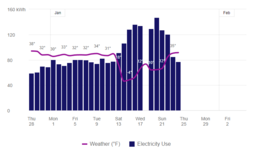
As promised, here is my power graph coming out of the deep thaw. The warm-up of the closed loop well went a lot faster than I thought it would!

... the graph is missing one day of data? Maybe the POCO is giving that one to me as a freebee???

1706325108794.png

The weather is back in the low 30's and our electricity usage is back to what it was at the start of the month. During the two days where the temperature came up, our power usage was still high as the well was still cold, even though demands were down. (Its the inverse of the slow escalation during the drop in temps.)
 
OP
D

dziskovs

Well-known member
Joined
Dec 6, 2017
Messages
69
Location
Bowling Green, OH
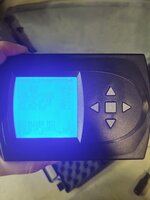
Played with the service tool today. Looks like EWT is 33.9F and LWT is 30.6F

My 2nd floor master bedroom zone is under renovation, and runs 20+ hours a day right now. Once I finish drywall and insulation up there, I am hoping that zone will run less frequently. The supplies in the basement are also in a hidden rim joist parallel to the foundation (the furthest zone from the furnace), and I can feel cold air coming out of that cavity, so the supply air is probably getting cooled as it goes up to the master.

IMG_20240127_083947951.jpg

The connection to the service tool looks to be a little finicky and I'm afraid I'm going to break the pins or connector if I keep attaching and detaching it. If I leave it connected all the time, what are the risks? I'm the only one that does anything in the utility room, so trying to think about how to manage that.
 

wssix99

Well-known member
Joined
Mar 2, 2011
Messages
5,161
Location
Chicago, IL
Played with the service tool today. Looks like EWT is 33.9F and LWT is 30.6F
Having an uninsulated room is almost like having a window open. You'll see and feel (on your electric bill) the effect of this.


The connection to the service tool looks to be a little finicky and I'm afraid I'm going to break the pins or connector if I keep attaching and detaching it. If I leave it connected all the time, what are the risks? I'm the only one that does anything in the utility room, so trying to think about how to manage that.
Indeed. I keep my cable plugged in all of the time to protect the pins on the board and to avoid the PITA from opening the cover and plugging in. (I ran the cable through the side with my other low voltage wires.) I then unplug and plug the cable in at the tool, which is easier and more durable. I haven't had any problems.

Keeping the tool plugged in can cause problems. (I tried that for a bit and ran into them.) I brushed against the unit and it caused the geo unit to go into test mode, which shut things down and caused some of the pumps to run constantly. I'm not sure what else can happen, but I'm sure there are some really bad things...

Looking at the information by the guy with the Raspberry Pi monitor, it seems that only two wires are used by the tool. If so, we could probably put in a DPST switch, hook it up all the time, and then simply turn it on and off.
 
OP
D

dziskovs

Well-known member
Joined
Dec 6, 2017
Messages
69
Location
Bowling Green, OH
Well meter reader just stopped by and electrical usage jumped to 3720 kWh for January vs. 1720 for December, and 1960 for November. Estimating around $500 for January's electric bill. January had much colder days, monthly average temp was 29 deg F vs Nov/Dec were about 42 deg F. I'm still trying to justify how the master bedroom zone (~500 sq ft) ran 442 hours in January vs. the rest of the upstairs (1000 sq ft) on a single zone only ran for 221 hours.

In regards to the renovation, its just the 10x15 master bathroom that is under renovation. All walls are insulated with drywall removed in a few areas. Plan in the spring is to remove the rest of the drywall, reinsulate and air seal. I know there is heat loss from the bathroom to the attic since the bathroom is adjacent to our chimney stack, and those walls are currently open studs with plastic over them for right now. Looks like I'm going to have some motivation to get this addressed pretty quickly. Only other thing I can think of is if Electricians never put the insulation back after adding all of our can lights and rewiring during the master bedroom renovations.

Need to get energy monitor installed soon so I can have data backing up that I think the geothermal is the energy hog. Our habits really haven't changed over the last 6 months for laundry, other electronics etc. I have most of our main energy hogs on smart plugs and only turn on when in use. The funny thing is that we lost power twice to the neighborhood in January for about 8 hours each time, so our electrical usage actually would have been higher without losing power...
 

wssix99

Well-known member
Joined
Mar 2, 2011
Messages
5,161
Location
Chicago, IL
Wow. I just looked at my bill and it is $429.77 for 2847 kwh.

A few quick conclusions:
1) You are overpaying for electricity. My power charge is $0.039 per kWh on the hourly power plan. At that rate, obviously my fees are super high. (Because I'm in Illinois and a lot of this money goes to pay off the law suits our politicians have lost and we all pay for in the end.) My other fees for distribution, taxes and pet projects are $0.086 per kWh. (And then there are $71.74 of fixed fees on top of that just to make sure the bleeding in my **** doesn't stop until the next bill.) If you were to go to an hourly/commodity power plan with your utility, I expect that your costs would come way down. (Particularly with your lower fees.)
2) You definitely have a leak (heat or power) somewhere. As seen above, the geo unit is the major part of my electricity usage and you are similarly sized - a little smaller but using way more power. (We also had a number of days last month where we splurged and turned the house up to 70 degrees.) My guess is that getting thigs fully insulated would make a big difference. What temperature do you keep your thermostats at?

If you'd like to compare EWT and LWT to see how our wells are sitting on a given day, I'm happy to do that also. My well is oversized, but I wouldn't expect that to be a significant factor in stuff like this.
 
To avoid these ads, REGISTER NOW!

Kezorm

Well-known member
Joined
Aug 18, 2021
Messages
174
Location
Twin Cities, MN
Wow that is a lot of energy. Do you have a bunch of other electricity demand beyond the heat pump? Not including GSHP, I don't think I've ever exceeded 1000kWh in a 1955-built 4500 sq.ft. house in Minnesota with 5 people. Typical monthly usage is closer to 800kWh. Electric range, but water heater and dryer are NG, so that may be the difference.

Highest ever GSHP usage on its own was about 1700kWh in December of 2021 when I had the entire house heated from the GSHP because boiler went down.

As mentioned previously, I'm a big fan of Emporia Energy for monitoring. https://emporiaenergy.com/
 
Last edited:

wssix99

Well-known member
Joined
Mar 2, 2011
Messages
5,161
Location
Chicago, IL
Wow that is a lot of energy.
Its no where near a lot of energy compared to natural gas or other fossil fuels use. Fossil fuels are much less expensive than electricity, but more electrical cost is still less money than more fossil fuel energy at a lower cost.

Do you have a bunch of other electricity demand beyond the heat pump? Not including GSHP, I don't think I've ever exceeded 1000kWh in a 4500 sq.ft. house in Minnesota with 5 people.
I doubt it. How many tons was your heat pump?

My base electrical usage (beyond the heat pump) is 1100 kWh. This keeps the meth lab and ***** production studio going 7 days a week.
 

Kezorm

Well-known member
Joined
Aug 18, 2021
Messages
174
Location
Twin Cities, MN
I doubt it. How many tons was your heat pump?

GSHP is metered and monitored separately (dual-fuel), so not included in the 800kWh average of the rest of the house. The GSHP is a 5-ton unit that draws about 5.2kW on average when running (depends on temperature I'm controlling to, but 5.2kW over winter is about average).

But yes, NG is significantly cheaper per unit of energy than electricity. My electricity usage would be significantly higher with an electric water heater or clothes dryer.
 

wssix99

Well-known member
Joined
Mar 2, 2011
Messages
5,161
Location
Chicago, IL
GSHP is metered and monitored separately (dual-fuel)
I'm not sure what this means. Are you sure your not talking about a dual fuel unit with gas and an air source heat pump? (That's different than what we are talking about here.)
 

Kezorm

Well-known member
Joined
Aug 18, 2021
Messages
174
Location
Twin Cities, MN
I'm not sure what this means. Are you sure your not talking about a dual fuel unit with gas and an air source heat pump? (That's different than what we are talking about here.)
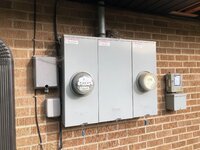
GSHP is electric only, water to water. It is metered separately from the primary service. I also have high-efficiency mod-con boiler effectively in parallel with the GSHP, so I can heat the house from either. Official name for this is "Energy Controlled Service (Non-demand Metered)", but commonly referred to as "Dual Fuel". Base rate is significantly less than standard service with catch that they can demand that I shut it off at any time. In order to qualify for the plan, it requires "alternative energy sources capable of supplying up to 30% of the annual heating needs during any heating season." (e.g. natural gas boiler in my case).

See rate code A05 here - https://www.xcelenergy.com/staticfiles/xe-responsive/Company/Rates & Regulations/Me_Section_5.pdf

Left meter is standard service to house. Right meter is Energy Controlled Service. Small box to the right of the meter box is Xcel controlled relay that tells me when to shut down the GSHP (thermostat wiring is just fed through the relay so that it shuts down when relay opens up).

IMG_5991.jpeg
 
Last edited:
OP
D

dziskovs

Well-known member
Joined
Dec 6, 2017
Messages
69
Location
Bowling Green, OH
1) You are overpaying for electricity.
I'm currently at $0.0659 for my 24 month locked rate. There are other company's I could have purchased from with lower rates, but those came with shorter fixed terms, monthly fees, and early termination fees. Toledo Edison's rate jumped from ~$.052 to $.0989 per kWh, so I switched in a hurry. It does not look like I have an early termination fee on mine, so I may look at changing suppliers again (there are 120 to choose from.

For December's Bill of $239.03, consumption was only $113.35, Distribution was ~$84, Cost recovery (lawyers and **** that has nothing to do with me) was ~$40.

What temperature do you keep your thermostats at?
I keep temps at 68 deg F on all three thermostats. I've played with dropping the master zone down to 66 during the day, and bumping back to 68 towards bedtime, but did that in December.

My base electrical load before the Geothermal install was around 500 kWh a month (Heating months with heat from NG furnace). With geo installed, electric use in summer months was around 1100 kWh average over 3 months with keeping the house around 68.

I'll be taking a trip into the attic this weekend to see what the state is of the insulation up there as something is not adding up. Master zone should not have 2X runtime as the rest of the upstairs.. There are no returns in the master bedroom, but door is always left wide open, so I'm wondering if room is getting pressurized somehow and just pushing all the new warm air either up or out of the room causing zone to run 75% of the time. It runs for 15-30 minutes, then off for 15 minutes, then back on to maintain temp at the thermostat. I've placed a separate thermometer in the room to gauge if the thermostat is reading accurately, and it seems to be pretty consistent in most locations of the room with thermostat reading.

The other piece of the puzzle that I think is contributing is the supply ducts to the master.
1.) The master zone is furthest away from the furnace
2.) after exiting the main trunk, the supplies are all in a hidden rim joist (parallel to the walls) with little to no insulation, and I can feel cold air blowing through there from outside, so that has to be lowering the actual supply temp at the vents (at least some).
 

wyliesdiesels

Well-known member
Joined
Aug 14, 2012
Messages
20,032
Location
Modesto, CA
some of ya'll would go brankrupt if you had california's kWh rates which in some places and tiers is close to 50¢/kWh :eek: :shocking::shocking:
 
OP
D

dziskovs

Well-known member
Joined
Dec 6, 2017
Messages
69
Location
Bowling Green, OH
Wow. I just looked at my bill and it is $429.77 for 2847 kwh.
Fee's being what they are, on your total bill, you are paying $.1509/ kWh; based on my numbers, I'm at $.1390/ kWh so mine is actually slightly cheaper with regards to total bill/ total kWh.
 

wssix99

Well-known member
Joined
Mar 2, 2011
Messages
5,161
Location
Chicago, IL
Fee's being what they are, on your total bill, you are paying $.1509/ kWh; based on my numbers, I'm at $.1390/ kWh so mine is actually slightly cheaper with regards to total bill/ total kWh.
Maybe, including fees. Our fees are out of control. It depends on how one slices it. $75 of fixed fees is outrageous.
 

wssix99

Well-known member
Joined
Mar 2, 2011
Messages
5,161
Location
Chicago, IL
some of ya'll would go brankrupt if you had california's kWh rates which in some places and tiers is close to 50¢/kWh :eek: :shocking::shocking:
If I was in California, I'd have solar on my roof. It doesn't quite pay off like I want it to where I'm at, yet. ... but we're getting close.

My biggest problem is my heaviest power usage is at night - so I'd need a battery system in addition to solar panels. If my POCO purchased my power during the day, I'd be golden for solar. (We have a lot of nuclear baseload in IL, so they don't want to buy power from homeowners, yet.)
 

wssix99

Well-known member
Joined
Mar 2, 2011
Messages
5,161
Location
Chicago, IL
GSHP is electric only, water to water. It is metered separately from the primary service. I also have high-efficiency mod-con boiler effectively in parallel with the GSHP, so I can heat the house from either. Official name for this is "Energy Controlled Service (Non-demand Metered)", but commonly referred to as "Dual Fuel".
This certainly lowers your power consumption - and lowers your power usage during the peak times. ...But your gas consumption increases to make up the difference, so its not apples-to-apples with the GSHP-only system the OP has.

Likewise, not all wells are the same either. As pointed out above, we have closed loop wells. An open loop system would lower our consumption considerably if it was allowable in our areas.
 

wyliesdiesels

Well-known member
Joined
Aug 14, 2012
Messages
20,032
Location
Modesto, CA
If I was in California, I'd have solar on my roof. It doesn't quite pay off like I want it to where I'm at, yet. ... but we're getting close.

My biggest problem is my heaviest power usage is at night - so I'd need a battery system in addition to solar panels. If my POCO purchased my power during the day, I'd be golden for solar. (We have a lot of nuclear baseload in IL, so they don't want to buy power from homeowners, yet.)
you will still have to pay fixed meter fees and a tru-up as the power you sell to the power co will be at whole sale rates and the power you use beyond what your system provides will be at retail rates

solar reimbursement in cali is Fd up
 
OP
D

dziskovs

Well-known member
Joined
Dec 6, 2017
Messages
69
Location
Bowling Green, OH
January's official bill showed up at it was $512.45 for 3720 kWh.

I noticed on the zoning panel yesterday, that I was getting a resistance lockout error, and had HVAC company come out and take a look this morning. Basically when OAT (outside Air temp) was below 30F, it was locking out the compressor, and running resistance heat only vs running some combination of compressor and resistance heat to maintain 68F setpoint in the house. I'm guessing this may be some of the high electrical usage since we had 10-15 days below 30F in OH in January, and a few days in December were the same.

Getting warmer days the next few weeks, so no way to actually test the theory as resistance heating shouldn't come on unless its below 30F out.

I did find out that my Trane thermostats only show "Heat". I have no visibility to Stage 1 heat, Stage 2 Heat, or Resistance Heat on thermostats or history. Only way I can see it is looking with the service tool, or looking for Y1, Y2, or W call on Zone panel. The resistance lockout error didn't show up in any of my alerts on thermostat either, so display panel on arzel zone board is the only thing I was able to look at.

So far in Feb, I'm using about 65 kWh/ day, so I'll probably run out over next few days to see if daily usage has dropped with warmer weather and changing the settings on compressor lockout temp.
 

wssix99

Well-known member
Joined
Mar 2, 2011
Messages
5,161
Location
Chicago, IL
I noticed on the zoning panel yesterday, that I was getting a resistance lockout error, and had HVAC company come out and take a look this morning. Basically when OAT (outside Air temp) was below 30F, it was locking out the compressor, and running resistance heat only vs running some combination of compressor and resistance heat to maintain 68F setpoint in the house.
This doesn't make any sense. I'm not sure why anyone would set up the zoning system to do this unless they are thinking air-source heat pump and not a ground-source heat pump. The performance of your unit should not be held back by the outside temperature.

Any unit will need to work harder as the temperature drops, but you shouldn't have a hard limit like that. (This is another area where my HVAC 'professionals' failed me... I also had to go back and reprogram all my thermostats and zoning system. They screwed that stuff up, too. I have all the settings saved off in a file and hard copies in case I ever need to restore the system. The amount of settings across the heat pump, zoning system, and thermostats is mind boggling!!!)

This is also why folks I have talked to have a manual disconnect on the resistance heat - so it can't run unless we absolutely want it to and if the heat pump can't keep up. I'm sure this is the source of your high power usage for the month! Last month was cold, but not cold enough to need resistance heat... at all.

As a side note - your Climatemaster board will have a jumper that gets physically cut if you are running glycol in your well. If not cut, it limits your LWT to above 32 degrees so the system doesn't freeze. Knowing your glycol percentage and checking this jumper is another thing to confirm to make sure you are running optimally.
 
OP
D

dziskovs

Well-known member
Joined
Dec 6, 2017
Messages
69
Location
Bowling Green, OH
This doesn't make any sense. I'm not sure why anyone would set up the zoning system to do this unless they are thinking air-source heat pump and not a ground-source heat pump. The performance of your unit should not be held back by the outside temperature.

Any unit will need to work harder as the temperature drops, but you shouldn't have a hard limit like that. (This is another area where my HVAC 'professionals' failed me... I also had to go back and reprogram all my thermostats and zoning system. They screwed that stuff up, too. I have all the settings saved off in a file and hard copies in case I ever need to restore the system. The amount of settings across the heat pump, zoning system, and thermostats is mind boggling!!!)

This is also why folks I have talked to have a manual disconnect on the resistance heat - so it can't run unless we absolutely want it to and if the heat pump can't keep up. I'm sure this is the source of your high power usage for the month! Last month was cold, but not cold enough to need resistance heat... at all.

As a side note - your Climatemaster board will have a jumper that gets physically cut if you are running glycol in your well. If not cut, it limits your LWT to above 32 degrees so the system doesn't freeze. Knowing your glycol percentage and checking this jumper is another thing to confirm to make sure you are running optimally.
Yeah, they changed the setting to OFF, so now it will continue to operate compressor below 30F.

For the zoning, The had all 3 zones set to default 50% weight as well, when should be setup as Z1= 50%, Z2=25%, Z3=25%, and AH Threshold to 50%, so my understanding is that anytime a single zone called for Heat, it would stage up the blower to high stage. (It has been blasting Z2 and Z3 since install, so I'm changing these to actual zone size will help reduce the noise/ airflow slightly.

On the load center, I've got 3 breakers, 1st stage heat, geo, and 2nd stage heat. There are 2 banks of resistance heaters, so small resistance heater is 1st stage heat, and emergency resistance heater is "2nd stage heat".

Tech did confirm that the jumper is cut and that system should be fine to function well below freezing with glycol mix in the system.
 

Fav Onefour

Well-known member
Joined
Jul 14, 2022
Messages
709
Location
MN cold and hot
Wowza!
Glad you figured out the resistance heat.
I bet the zone thresholds were default settings.
Maybe I missed it somewhere? Is your system using a plenum coil exchanger or water storage? We have a coil setup and I came close to throttling the system down too far when I lowered zone thresholds. Sounds like you are a numbers guy and like playing with this stuff. If it's a coil exchanger, monitor the temp differential across. If you are adding humidity in winter, the summer cooling startup will need good airflow.
 
To avoid these ads, REGISTER NOW!
Top Bottom