whateg01
Well-known member
Maybe that's a feature intended to make you put it on so the distraction stops....
Having a constant beeping because a seatbelt isn't used, or is not fastened, causes distractions that can cause accidents.



Maybe that's a feature intended to make you put it on so the distraction stops....
Having a constant beeping because a seatbelt isn't used, or is not fastened, causes distractions that can cause accidents.
A lot of construction materials are “wet”.Conductive materials can trip the saw stop like really wet woods, most or all of which you shouldn’t be cutting on a table saw. I guess we could agree to disagree. I‘d say saw stop doesn’t limit the functionality of a sensibly used table saw. The plastic guards really do.
I can cut all of that on a sawstop without it tripping. I suppose the extra step it takes might serve as a reminder to be extra careful since the user knows the safety net is removed.A lot of construction materials are “wet”.
Sometimes this is because the material is left outside in the rain.
In a lot of cases though, it’s simply because construction wood is not dried to a low moisture content, because the high moisture content makes the material more flexible, easier yo work in some ways, and even helps with screwing and nailing the material, as well as helping those fasteners hold better as the lumber slowly dries out over time.
Pressure treated lumber in addition to having a high moisture content may also have additives that will trip the SawStop system.
Other construction materials like insulation have foil coatings for performance reasons.
Some pre finished coated materials like moldings and painted wood materials used in cabinets have foil layers to help prevent water intrusion, or as a vapor barrier.
There are also people who use tablesaws with specialty blades for cutting sheet metal.
I recall an article mentioning it about one tool maker, maybe the founder of Bridge City Tools, using a metal blade to cut sheet brass for squares.
Humans have been drinking alcohol since the Neanderthal days.Alcohol related deaths are 140k a year
In the United States alone.
If it was a new invention, there is zero chance it would be legal. Table saws aren't going anywhere
Not debating merits of alcohol here. There are plenty of studies out there that address it and the science is not completely clearHumans have been drinking alcohol since the Neanderthal days.
Plenty of other animals drink alcohol as well, usually in the form if fermented fruit, because it’s “nice” to get sh!tfaced occasionally.
As for distilled alcohol, it’s a tradeoff with something like beer or wine.
Beer and wine usually gave a certain amount of methanol, but both also have vitamins and minerals that can be beneficial.
Properly distilled alcohol should have a much lower amount of methanol, but the vitamins and minerals etc. get removed.
I should note, I’m not advocating being an alcoholic, or consuming alcohol when it can impair function and cause dangerous situations, but alcohol is consumed for reasons, which can have heath benefits.
My worry, is that the extra step will just cause people to leave a saw running, without the safety system engaged, or that turning the safety system off will become so automatic, that a tired worker will do so without even thinking about it, which leaves the same dangerous system in place, as tablesaw workers getting complacent with safe tablesaw use, before the SawStop system even existed.I can cut all of that on a sawstop without it tripping. I suppose the extra step it takes might serve as a reminder to be extra careful since the user knows the safety net is removed.
The one time I attempted a rip cut on a PT 4x4 with my SawStop, I thought I was OK as I had laid the piece against the blade and noted there was no indication of conductive material. But once inside the piece, it did sense conductive material and it cut off the saw’s power, stalling the saw as I was steadily feeding the piece in. I was initially puzzled and thought I had either tripped the safety brake or bumped the start / stop paddle with my hip, but no, there was no trip, and the paddle was still pulled out in the "run" position.I can cut all of that [wet wood, high moisture content wood, and pressure treated wood] on a sawstop without it tripping.
My behavior around my SawStop is no different with or without the safety brake being active. A table saw is a dangerous tool, and the safety brake feature is merely the last resort that might save a severe hand or arm injury when all other safety precautions have failed me. I don’t count on it doing this and act like a bonehead because it’s there, however.I suppose the extra step it takes might serve as a reminder to be extra careful since the user knows the safety net is removed.
Good for you, I suppose.The one time I attempted a rip cut on a PT 4x4 with my SawStop, I thought I was OK as I had laid the piece against the blade and noted there was no indication of conductive material. But once inside the piece, it did sense conductive material and it cut off the saw’s power, stalling the saw as I was steadily feeding the piece in. I was initially puzzled and thought I had either tripped the safety brake or bumped the Start/Stop paddle with my hip, but no, no trip, and the paddle was still pulled out.
Then I noticed a flashing red/greeen light sequence on the control box, which I had to check out in the user manual. The explanation was that the controller knew it wasn’t seeing a finger touch, but it also knew that if the cut was allowed to continue, any real touch might not be properly detected and the safety brake not actuated. So it did the best thing it could for the situation, which was to remove power and not let me cut any further.
I simply pushed the paddle back in, overrode the safety feature with the key, restarted the cut, and finished it as I would on any ordinary table saw.
My behavior around mySawStop is no different with or without the safety brake being active. A table saw is a dangerous tool, and the safety brake feature is merely the last resort that might save a severe hand or arm injury when all other safety precautions have failed me. I don’t count on it doing this and act like a bonehead because it’s there, however.
The buyers of the macho modelI'm not sure I understand. Who is the "they" in your post?
Saws with Sawstop technology were sold by the inventor until he sold the company to a German company.There isn't a law preventing the owner of the tech from selling directly to the consumers that want it, so why doesn't he do that? That way everybody can decide if the level of risk is worth it (everybody can have their cake and eat it too, with or without 10 fingers).
The problem with the macho model is that YOU end up paying macho man's bill. If he can't work anymore he goes on welfare. If he hires a lawyer he causes whomever he sues to go out of business or raise prices for everybody. The Germans understand this phenomena more than anybody else. Their safety laws make OSHA, EPA and the Consumer Protection Agency look like children they are that strict. Ever wonder why you can't buy a fixed based router in Europe? That's why it’s Plunge Routers Only in Europe as they consider these safer. Also, ever see a European table saw’s rip fence. They stop before the edge of the back of the blade so there can be no kickback.The buyers of the macho model
Their finger is gone. The customer can except responsibility for that, or contact a missing finger lawyer
And he kept trying to force the technology thru legislation as a safety requirement, which would gave forced all new saws manufactured to license his technology, or require his saws to be the ones for sale.Saws with Sawstop technology were sold by the inventor until he sold the company to a German company.
Euro power tools have pluses and minuses as far as safety.The problem with the macho model is that YOU end up paying macho man's bill. If he can't work anymore he goes on welfare. If he hires a lawyer he causes whomever he sues to go out of business or raise prices for everybody. The Germans understand this phenomena more than anybody else. Their safety laws make OSHA, EPA and the Consumer Protection Agency look like children they are that strict. Ever wonder why you can't buy a fixed based router in Europe? That's why it’s Plunge Routers Only in Europe as they consider these safer. Also, ever see a European table saw’s rip fence. They stop before the edge of the back of the blade so there can be no kickback.
I think a riving knife is the best piece of equipment to have on a table saw to prevent kickback, and it adds very little cost to the saw. Whereas, a rip fence, shortened or not, will do very little to help out when a piece “springs out” on you while being cut.Stopping a tablesaw fence before the end of a cut may help prevent kickback, but it also leads to no guidance at the end of a cut.
I agree on riving knives.I think a riving knife is the best piece of equipment to have on a table saw to prevent kickback, and it adds very little cost to the saw. Whereas, a rip fence, shortened or not, will do very little to help out when a piece “springs out” on you while being cut.

My neighbor is an ER physician at the local hospital designated as the trauma center, so he sees some of the worst of the shop and industrial injuries in the metro area. According to him, table saws cause some of the most severe injuries, often involving amputations of fingers or even half a hand, but drill presses of all things are the most common occurrence, albeit with less severe injuries. Typical anecdote he hears is that someone tried to hand-hold sheet metal while punching through with a larger diameter bit; this typically won’t amputate but it will cut to the bone.My brother is a doctor at a hospital and said he sees several victims of tablesaw accidents a year. He is also a bit into wood working, he says he wouldn't buy a tablesaw without safety technology like the sawstop.
SawStop makes people angry, because the inventor was an egotistical @*******, who tried yo force “his technology”, on the American public, while claiming his saws were “better”, and should be the only ones sold.I have personally watched a sawstop save most of a hand. "BOOM" and everyone needed new pants not new limbs. The operator was learning the craft. Not distracted, just making a more complicated cut and things went a little sideways quicker than expected.
The day I saw it save that hand was the day I contacted dealers to get one.
To their great credit, they are extremely well made saws. A SawStop is the only machine in my extensive machine collection that is not an industrial 1940's-1970's American or German or Swiss iron. They could have made it a lot cheaper/less accurate, and to their credit, they made it nice.
I'm not the only one -- I know multiple shops that are all the best old American iron (Delta/Oliver/Yates/etc./etc.) that have a few SawStop cabinet saws in the middle.
I have never understood why SawStop makes people so angry. I have a lot of hours around 3 of their cabinet saws and one of the contractor models and I am absolutely NOT relaxed around a table saw just because it has a sawstop...it can still launch a kickback through you (happened to the guy at my local lumber yard) or malfunction and forget to stop eating your hand...
Yes, it is quite loud. And there’s more to it than just noise.I have personally watched a sawstop save most of a hand. "BOOM" and everyone needed new pants not new limbs.
There is. They are called SendCutSendI agree on riving knives.
I wish there was a company, that custom made riving knives, in various thicknesses, and various sizes, so you could optimize safety for blades with different thicknesses of kerf and for the blade plate thickness, as well as allowing the use of smaller diameter blades.
SawStop’s initial plan was not to be a table saw builder, but merely to license their technology to others already established in the market.SawStop makes people angry, because the inventor was an egotistical @*******, who tried yo force “his technology”, on the American public, while claiming his saws were “better”, and should be the only ones sold.
Then, when Bosch took his lead, mostly due to all his claims about regular tablesaws being “unsafe”, he sued Bosch to have their saws removed from the American market. (By American, I mean USA, as that is how the BBC uses the term)
First off, he didn’t “invent” the technology, at least the most important parts of detecting flesh with capacitance, or quickly dropping the blade.
Detecting blade flesh contact existed in at least two separate patents, before SawStop saws were even invented, or the “inventor” had the idea, and both patents mention industrial equipment, including power saws.
Cut off saws were the blade rises from below, then quickly drops down beneath the cutting table existed for decades before the sawstop, as did the Norsaw, were you raise the saw blade up from below on a lever handle attached to the motor, and then drop that handle so the saw blade lowers. (Sort of a reverse miter saw, but also designed so the saw can be used for ripping, or large cross cutting, like a tablesaw).
The riving knife design is a nice safety feature, and was not standard on a lot of major US tablesaws at the time the SawStop saw was “invented”, but riving knives were hardly unknown at the time, since the knives are standard on European saws, snd had been probably for decades at that point.
I think one video or article I read mentioned dome of the other safety features on the SawStop being similar to the Swiss/French Inca saws, but the “inventor” of SawStop claimed to have come ip with the ideas independently, without knowing about the Inca design.
For not only an attorney, but a patent attorney, the SawStop “inventor” was either the laziest, or sh!ttiest researcher possible, or he specifically “left out” information on previous patents and prior art concerning safety features found on his saws.
Most of these things I mentioned would have been found by going thru the back issues of a single woodworking magazine like Fine Woidworking, which would just require a decent public library, and looking thru various industrial machinery and supply catalogs, and woodworking dealer catalogs, practically all of which could have been requested for free when the “genius” patent attorney “invented” his technology.
Another major issue with the SawStop design, is that it is just a fancy US style tablesaw, modeled after the fairly standard Delta or Powermatic US style tablesaws, but with the flesh sensing technology, and supposedly made nicely.
If all you want is a standard American style circular saw, but with the fancy flesh sensing technology, this is fine.
However, there are plenty of other “tablesaw” designs, that were arguable better and safer than the standard US designs.
The SawStop “inventor” didn’t use a lot of those design features, even though many, or even most, were not under patent any longer.
Sliding tables on tablesaws go back decades, and are somewhat standard on European tablesaws that are sold in the USA.
The sliding tables vary, but some have the one half of the tablsaw to sliding, on one side of the blade.
This us usually accompanied by clamping spots or points, that allow a piece to be fastened to the top, and easily run thru the saw blade, without the users hand coming anywhere near the blade. ( not available on SawStop saws)
Overhead blade guards, blade guards, that attach to the tablesaw frame or cabinet, rather than mounting on the saws splitter or riving knife are another safety feature SawStop didn’t use.
Since these guards hang over the blade, rather than being mounted directly behind the blade, the overhead guards can be easily moved out of the way for grooving. These were standard on some Inca tablsaw, and woodworking equipment suppliers like Garrett Wade carried aftermarket versions. I’m not sure when SawStop came out with their version, but it certainly wasn’t available as standard when the saws were first released.
The Northfield is also just over $22,000 before tax and shipping. It is heavy duty to the extreme. A woodworking business that needs this kind of saw is probably better off with more specialized equipment rather than this behemoth. There are all kinds of specialized woodworking machines for production shops that many of us have never even heard of.Also, calling the SawStop Industrial saw an “Industrial” saw, when you compare it yo something like the Northfield, is sort of a joke.
#4 Saw w/Rollertop
www.northfieldwoodworking.com
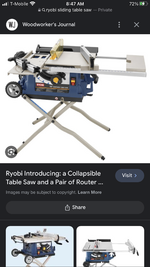
Ryobi made a couple version.The Northfield is also just over $22,000 before tax and shipping. It is heavy duty to the extreme. A woodworking business that needs this kind of saw is probably better off with more specialized equipment rather than this behemoth. There are all kinds of specialized woodworking machines for production shops that many of us have never even heard of.
The high school I went to had mostly Northfield Machinery equipment in the wood shop. The radial arm saw and the lathes were not Northfield. I loved the Northfield machines in woodshop class. The 14" table saw was a beast and had a really nice sliding fence. It would cost between $85,000 and $100,000 to buy those machines in today's dollars.
Only a fool would trust electronics to protect their body parts. The saw safety devices will be like airbags and other electronics that periodically have masses of faulty parts sneak into the supply chain.The one time I attempted a rip cut on a PT 4x4 with my SawStop, I thought I was OK as I had laid the piece against the blade and noted there was no indication of conductive material. But once inside the piece, it did sense conductive material and it cut off the saw’s power, stalling the saw as I was steadily feeding the piece in. I was initially puzzled and thought I had either tripped the safety brake or bumped the Start/Stop paddle with my hip, but no, no trip, and the paddle was still pulled out.
Then I noticed a flashing red/greeen light sequence on the control box, which I had to check out in the user manual. The explanation was that the controller knew it wasn’t seeing a finger touch, but it also knew that if the cut was allowed to continue, any real touch might not be properly detected and the safety brake not actuated. So it did the best thing it could for the situation, which was to remove power and not let me cut any further.
I simply pushed the paddle back in, overrode the safety feature with the key, restarted the cut, and finished it as I would on any ordinary table saw.
My behavior around my SawStop is no different with or without the safety brake being active. A table saw is a dangerous tool, and the safety brake feature is merely the last resort that might save a severe hand or arm injury when all other safety precautions have failed me. I don’t count on it doing this and act like a bonehead because it’s there, however.

A lot of interesting comments here regardingSawstop looks to be interested in the “greater good”
SawStop Dedicates Its Patent for Public Use, Boosting CPSC Rule to End Table Saw Amputations
SawStop Dedicates Its Patent for Public Use, Boosting CPSC Rule to End Table Saw Amputationswww.cpsc.gov
Only a fool would trust electronics to protect their body parts. The saw safety devices will be like airbags and other electronics that periodically have masses of faulty parts sneak into the supply chain.
Probably doesn't matter anyway.
Airbags also occasionally kill people, including children, which is the reason certain airbags can be deactivated.Airbags save 10s of thousands of lives every year