To avoid these ads, REGISTER NOW!

Fully Welded Service/Utility Carts - are they stronger?

The Critic

Well-known member
Joined
Aug 18, 2008
Messages
675
Location
CA
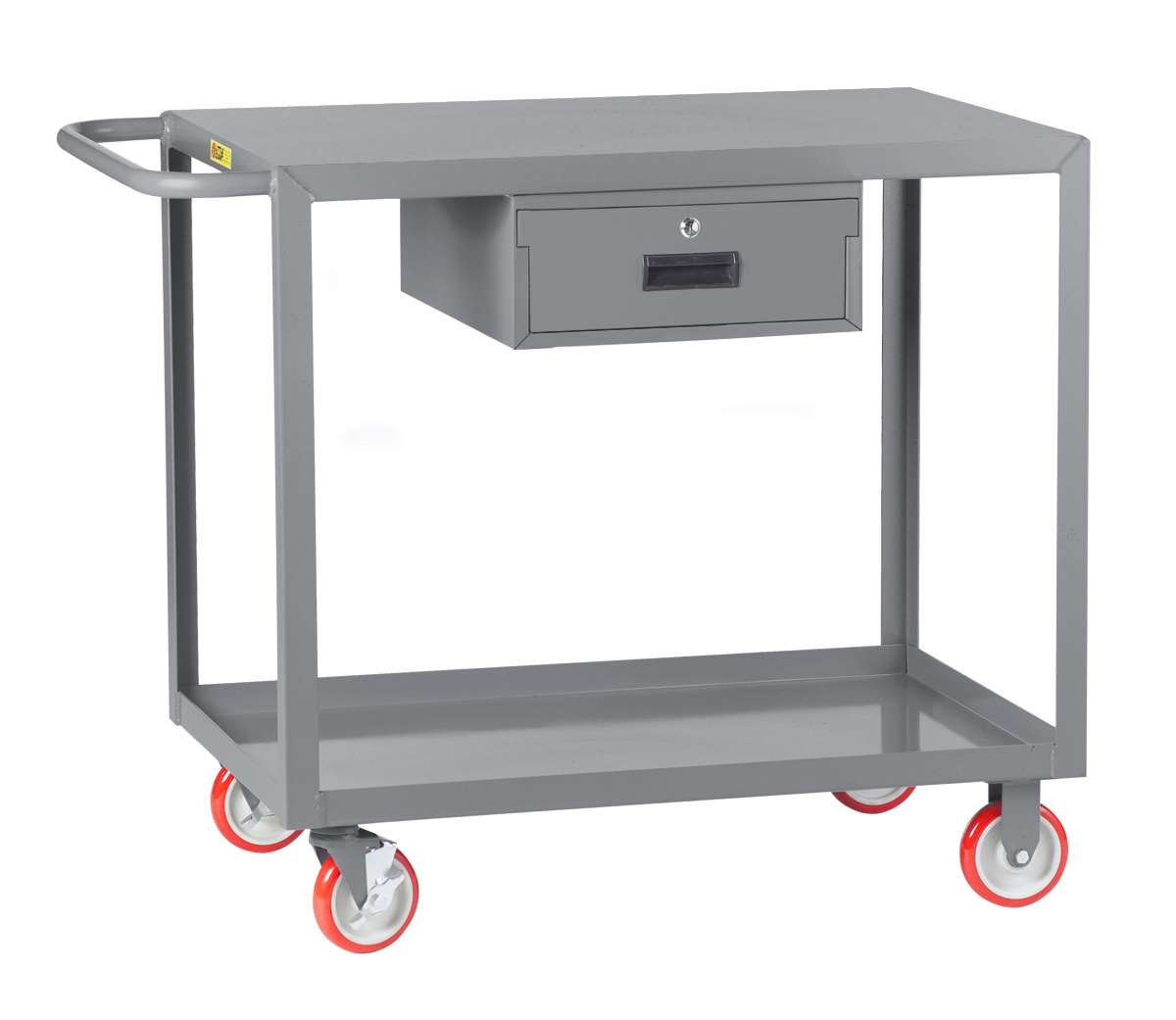
I am in the market for a service/utility cart. I am undecided between one with drawers and one without, but I have noticed that higher-end options are advertising a "fully welded construction."

Are fully welded carts much more durable than ones that are bolted together?

Examples:
 
To avoid these ads, REGISTER NOW!

nadogail

Well-known member
Joined
Jan 23, 2009
Messages
31,961
Location
Coronado, CA
IMHO, good welds won't loosen like nuts and bolts have been known to.

Fully Welded Carts will be more expensive to ship and store; therefore we have bolt together models.
 

nadogail

Well-known member
Joined
Jan 23, 2009
Messages
31,961
Location
Coronado, CA
A Fully Welded device, be it a Cart or Rack, is going to be stronger than the same thing bolted together; if you design it to be bolted together rather than welded, it should be adequate for the purpose.
 

Firebrick43

Well-known member
Joined
May 12, 2015
Messages
14,060
Location
West central Indiana
At cat we had a lot of welded little giant carts on every line.

A new line was set up and some muckety muck that didn’t get it and bought bolted together carts that were actually heavier than the welded one, but shipping was much cheaper.

It didn’t matter however as the were always loosening up so we put nylon nuts on everything.

Even then someone would catch a pallet or curb with 300lbs setting on top and the frame would twist and have to be loosened and retightened to correct it.

Finally we made 1””x3/16” diagonal braces between the legs on both sides and bolted them which solved the tweaking issue but limited access to the bottom shelf and still were not as nice as the welded carts.
 
Last edited:

sparky 1971

Well-known member
Joined
Oct 9, 2018
Messages
7,972
Location
Central Iowa
I have had both types of metal carts, but didn't have either long enough to notice a difference in durability, but I did have to go back through the bolt together cart and install lockwashers on everything. I hated both of the noisy bastards so one day I threw them in the dumpster and bought a couple of Rubbermaids, which are awesome.
 

Steve_P

Well-known member
Joined
Sep 15, 2010
Messages
5,185
I've always been absolutely shocked with how much weight those Rubbermaid plastic carts handle every day - giant electric motor and pump combos that one person can't lift.
 

AEAdam

Well-known member
Joined
May 27, 2023
Messages
2,756
Location
SE PA
Welded carts should be stiffer and nicer. Our tool boxes are all welded. They are spot welds not continuous welds. Fastened carts’ holes will eventually bear out and elongate, if loaded heavily, leaving the cart wobbly.

I’m joining the others: I have several different plastic carts and love them. You can find lots of different styles and prices. Ironically, I bought a bolted together plastic version from harbor freight and it’s my least favorite. The bolt areas collect crud, the components were warped and misshapen. My rubbermaid carts have one piece trays and are really nice and straight and easy to clean.
 

toolenthusiast

Well-known member
Joined
Jan 21, 2017
Messages
723
Ok, hear me out - after all, we’re DIY type people here.

Modern automotive unibodies are stiffer and more durable than they’ve ever been despite being made of increasingly thin sheet metal. The biggest reason for this is lap joints filled with epoxy and fastened mechanically. The fasteners provide tensile strength and the epoxy provides shear strength, which is the part that’s normally lacking in bolted-together carts. (The glue prevents torsion, which prevents the fasteners from loosening, which prevents the glue from shearing, which prevents torsion, which prevents the fasteners from loosening…)
  1. Choose the cheap bolt-together cart that fits your needs
  2. Enjoy cheap shipping because it will arrive to you as a smallish, ready-to-assemble kit
  3. Leave $10 in your budget for some JB Weld
  4. Find somewhere warm with a level floor (heated garage? kitchen counter? master bath?)
  5. Add JB Weld in between the parts of the cart as you assemble it loosely
  6. Tighten up all the fasteners and wait for the glue to cure
  7. ???
  8. Profit!
 

Jswain

Well-known member
Joined
Apr 26, 2013
Messages
2,462
Location
Calgary, AB
Welded carts are usually heavier gauge steel. If you want a heavy duty cart that's probably what you're going to want to look at.

Bolt together carts are the flimsy, almost weightless carts that you can give a shake with a moderate load and watch the whole thing wobble. If you want a cheap, light duty cart this is probably what you're going to look at.

Also x2 on the Rubbermaid industrial carts but I don't know what they are worth in comparison.
 

dogdog

Well-known member
Joined
Nov 15, 2011
Messages
12,711
I wonder why aircraft’s frames are not welded but riveted or bolted… at least it used to be that way not sure now.
 

Jswain

Well-known member
Joined
Apr 26, 2013
Messages
2,462
Location
Calgary, AB
I wonder why aircraft’s frames are not welded but riveted or bolted… at least it used to be that way not sure now.
I would guess that would be to not affect the properties of the materials being joined that need to be light and flex without breaking as it soars through the air at mach chicken. Ever watch the wings on takeoff/landing

Lightweight and flex aren't things I would look for in a utility cart.
 

dogdog

Well-known member
Joined
Nov 15, 2011
Messages
12,711
Yes, dunno, never test a weld joint for shear strength. but with bolts you know, except when it's stove bolts.
 

reader2580

Well-known member
Joined
Dec 31, 2014
Messages
14,537
Location
Minneapolis, MN
My employer has some welded carts that are probably 30 years old and still going strong. We moved the carts from one facility to another and just about every department in the facility wanted to claim them. The only downside is the large pneumatic tires need air every year or so.

i bought a cart for my garage a few years back and it Is welded too.
 

rust in the eye

Well-known member
Joined
Oct 2, 2017
Messages
2,789
Location
Chicagoland
Ok, hear me out - after all, we’re DIY type people here.

Modern automotive unibodies are stiffer and more durable than they’ve ever been despite being made of increasingly thin sheet metal. The biggest reason for this is lap joints filled with epoxy and fastened mechanically. The fasteners provide tensile strength and the epoxy provides shear strength, which is the part that’s normally lacking in bolted-together carts. (The glue prevents torsion, which prevents the fasteners from loosening, which prevents the glue from shearing, which prevents torsion, which prevents the fasteners from loosening…)
  1. Choose the cheap bolt-together cart that fits your needs
  2. Enjoy cheap shipping because it will arrive to you as a smallish, ready-to-assemble kit
  3. Leave $10 in your budget for some JB Weld
  4. Find somewhere warm with a level floor (heated garage? kitchen counter? master bath?)
  5. Add JB Weld in between the parts of the cart as you assemble it loosely
  6. Tighten up all the fasteners and wait for the glue to cure
  7. ???
  8. Profit!
Not JBWeld but maybe some automotive panel bonding adhesive. THAT stuff just doesn't let go, ever.
 

Firebrick43

Well-known member
Joined
May 12, 2015
Messages
14,060
Location
West central Indiana
Adhesives work in modern cars because they have a huge amount of surface area at the joints.

The bolted together carts might have 2 square inches per joint, its not very much.
 

Hohn

Well-known member
Joined
Aug 25, 2016
Messages
2,644
Location
Diesel Central, Indiana
I am in the market for a service/utility cart. I am undecided between one with drawers and one without, but I have noticed that higher-end options are advertising a "fully welded construction."

Are fully welded carts much more durable than ones that are bolted together?

Examples:
This engineer says the correct fastening system for those joints is solid riveting.

No distortion due to welding, no residual stress from muscling through the weld distortion. Rivet preload arrests crack initiation at the holes. The joints are almost all loaded in shear.

I know, it's harder to train the Chinese laborers in solid riveting, but properly done, it's superior IMO for this application.
 

Hohn

Well-known member
Joined
Aug 25, 2016
Messages
2,644
Location
Diesel Central, Indiana
I wonder why aircraft’s frames are not welded but riveted or bolted… at least it used to be that way not sure now.
Wonder no more, I will tell you.

Welding is no-go for several reasons:
  • A hot process, it destroys the metallurgy (heat treat, microstructure, etc) of whatever you had in the part before it was joined
  • High residual stress results from cooling shrinkage. And what's worse, it's residual TENSILE stress. This promotes fatigue cracking.
  • Rivets are lighter weight
  • Rivets provide residual *compressive* stress, which is actually an improvement in fatigue life (this is how shot peening and such work).
More than anything else, solid rivets are used because aircraft are skinned and structured with aluminum alloys and fatigue is THE overriding concern.

Also, solid rivet behavior is VERY well understood-- there's no mystery in the rivets or how they work because the tech is so highly developed thanks to some pretty amazing work done from the 1920s until the 1960s.
That said, there are a lot of "threaded" fasteners in airplanes as well, but they aren't bolts and nuts. Rather they are torque-to-fracture type bolts.


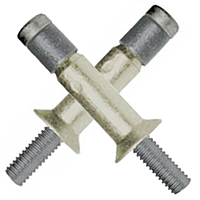
Hi Loks are a good example of the current state of the art:


Where steel fasteners are used, you see things like Jo Bolts:


These are the fasteners I saw the most crawling around inside B1s and C130s back when my job was fixing leaks on internal fuel tanks. I'm sure the tech is still pretty current since aviation is slow to adopt new tech.
 
Last edited:
To avoid these ads, REGISTER NOW!

Jgaz

Well-known member
Joined
Dec 16, 2016
Messages
1,662
Location
AZ
Dont sleep on the (Rubbermaid/Uline) poly carts if they meet your specs

Was always astonished at the beating they can take
I've always been absolutely shocked with how much weight those Rubbermaid plastic carts handle every day - giant electric motor and pump combos that one person can't lift.
I agree 100% on the Rubbermaid carts.
We used to abuse and overload them constantly in an automotive environment.
They just plain handle the abuse. No bolted together cart I had experience with came anywhere close
 

jpaw

Well-known member
Joined
Dec 23, 2018
Messages
525
Location
Michigan
My 5 drawer hf cart is red loctited together and the only thing that has come loose in over 10 years are the spot welds on the lid..lol
 

dchawk81

Well-known member
Joined
Jul 31, 2014
Messages
14,370
I agree 100% on the Rubbermaid carts.
We used to abuse and overload them constantly in an automotive environment.
They just plain handle the abuse. No bolted together cart I had experience with came anywhere close
Thirded. Don't own any myself but every place I've worked with them, they were fantastic.
 

JradM

Well-known member
Joined
Sep 4, 2019
Messages
1,817
Location
Alberta
Ok, hear me out - after all, we’re DIY type people here.

Modern automotive unibodies are stiffer and more durable than they’ve ever been despite being made of increasingly thin sheet metal. The biggest reason for this is lap joints filled with epoxy and fastened mechanically. The fasteners provide tensile strength and the epoxy provides shear strength, which is the part that’s normally lacking in bolted-together carts. (The glue prevents torsion, which prevents the fasteners from loosening, which prevents the glue from shearing, which prevents torsion, which prevents the fasteners from loosening…)
  1. Choose the cheap bolt-together cart that fits your needs
  2. Enjoy cheap shipping because it will arrive to you as a smallish, ready-to-assemble kit
  3. Leave $10 in your budget for some JB Weld
  4. Find somewhere warm with a level floor (heated garage? kitchen counter? master bath?)
  5. Add JB Weld in between the parts of the cart as you assemble it loosely
  6. Tighten up all the fasteners and wait for the glue to cure
  7. ???
  8. Profit!
I like this idea. As a bolt-together cart owner, I might try this myself.

I also think using rivets is an interesting idea, but then where do I get rivets to fill the big bolt holes? And with rivets that large, how would I install them? this the sort of plan that requires me to invest in new tools just to fix my current tools?

I have a Rubbermaid cart too, and it is solid. No regrets about that purchase. My bolt-together cart is for welding and fabricating though, so plastic isn't going to work.
 

Hohn

Well-known member
Joined
Aug 25, 2016
Messages
2,644
Location
Diesel Central, Indiana
I like this idea. As a bolt-together cart owner, I might try this myself.

I also think using rivets is an interesting idea, but then where do I get rivets to fill the big bolt holes? And with rivets that large, how would I install them? this the sort of plan that requires me to invest in new tools just to fix my current tools?

I have a Rubbermaid cart too, and it is solid. No regrets about that purchase. My bolt-together cart is for welding and fabricating though, so plastic isn't going to work.
If the bolts are coming loose, it's likely just a problem of the short grip length of thin materials. This is partly why rivets and similar plastic-deformation fasteners are better in thin goods.
But the easy option here is just put a spacer in with a longer bolt.

Or some Nord Lock washers, which work very well in thin materials. McMaster has them as "wedge lock" washers.


Steve_P

Well-known member
Joined
Sep 15, 2010
Messages
5,185
I wonder why aircraft’s frames are not welded but riveted or bolted… at least it used to be that way not sure now.

The simple answer is that high strength aluminum alloys return to base aluminum strength from welding at the HAZ. Unless the weldment is retempered. Difficult for massive structures. So, for 6061-T6 you go from ~36 KSI yield to 10 KSI at the HAZ. Some alloys like 7075 are essentially unweldable.

Second, harder to see, is that it will then fail in fatigue at that weld joint. nearly every time. High cycle fatigue failures, and airplanes see high cycle fatigue all during flight, nearly always occur at a welded joint, even in materials like mild steel with a stronger filler metal than base metal. Because a weld produces a million tiny disconituities; and those pretty ones, the stack of coins on the side, are the worst.
 
OP
T

The Critic

Well-known member
Joined
Aug 18, 2008
Messages
675
Location
CA
a couple of Rubbermaids, which are awesome.
I've always been absolutely shocked with how much weight those Rubbermaid plastic carts handle every day - giant electric motor and pump combos that one person can't lift.
Like this?
 

Hohn

Well-known member
Joined
Aug 25, 2016
Messages
2,644
Location
Diesel Central, Indiana
The simple answer is that high strength aluminum alloys return to base aluminum strength from welding at the HAZ. Unless the weldment is retempered. Difficult for massive structures. So, for 6061-T6 you go from ~36 KSI yield to 10 KSI at the HAZ. Some alloys like 7075 are essentially unweldable.

Second, harder to see, is that it will then fail in fatigue at that weld joint. nearly every time. High cycle fatigue failures, and airplanes see high cycle fatigue all during flight, nearly always occur at a welded joint, even in materials like mild steel with a stronger filler metal than base metal. Because a weld produces a million tiny disconituities; and those pretty ones, the stack of coins on the side, are the worst.
Fatigue is directly related to yield strength because for a fatigue cycle to occur, some microscopic plastic deformation must occur.
So that massive loss of Sy on the HAZ ends up looming very, very large for high cycle fatigue.
 

Hohn

Well-known member
Joined
Aug 25, 2016
Messages
2,644
Location
Diesel Central, Indiana
The simple answer is that high strength aluminum alloys return to base aluminum strength from welding at the HAZ. Unless the weldment is retempered. Difficult for massive structures. So, for 6061-T6 you go from ~36 KSI yield to 10 KSI at the HAZ. Some alloys like 7075 are essentially unweldable.

Second, harder to see, is that it will then fail in fatigue at that weld joint. nearly every time. High cycle fatigue failures, and airplanes see high cycle fatigue all during flight, nearly always occur at a welded joint, even in materials like mild steel with a stronger filler metal than base metal. Because a weld produces a million tiny disconituities; and those pretty ones, the stack of coins on the side, are the worst.
The stack of dimes has stress concentrations at the edges that give its shape.
That's why critical structural welds want a smooth, caulk-like weld bead and a premium is placed on having no undercut where a crack can initiate.
 

sparky 1971

Well-known member
Joined
Oct 9, 2018
Messages
7,972
Location
Central Iowa

Firebrick43

Well-known member
Joined
May 12, 2015
Messages
14,060
Location
West central Indiana
Well, I challenge you to pull apart a two square inch joint of this stuff.
I pulled apart more than that before as well as VHB adhesive. Start prying up an end and pull 90 degrees or more from the lap and it comes apart.

Both have insane pull lap strength but peel strength is pretty lousy and twisting shear even worse which the latter two is what would be applied at the end of a 30” vertical angle piece on a bolted cart.
 

larry_g

Well-known member
Joined
Apr 28, 2007
Messages
16,880
Location
oregon
It's cool to pay attention to the cart construction, but pay attention to the castors that it rides on. A fine cart on ****** castors is no fun.

lg
no neat sig line
 

JradM

Well-known member
Joined
Sep 4, 2019
Messages
1,817
Location
Alberta
This thread went off the rails as far as this hobbyist cart-owner is concerned. Too bad because I was looking for actionable advice!

My cart occasionally works itself loose. I've just tightened up the bolts when that happens - but the hardware that came with my cart isn't the highest grade to begin with. I could easily swap for better bolts, I probably already have something suitable in my parts organizers.

To recap, we've got the following suggestions:
  • nylon nuts, nordlock washers, locktite,
  • apply JB weld or automotive adhesive to the joints,
  • use longer bolts with spacers,
  • use rivets instead,
  • weld it,
  • don't weld it because of stress concentration and metal fatigue,
  • change the castors.

It sounds like riveting is the "best", but I assume we're talking about solid head rivets where you need an air hammer with a special bit, bucking bar, sold rivets, etc? If so, getting into that seems like it could cost more than my cart.

Upgrading the fasteners, applying locktite and JB welding the joint seems easier to action. I like the advice about using longer bolts with spacers too, but I'm pretty sure the bolts ends will intersect in the corners if I do that.

Or I could just weld it. It is my welding cart after all.
 

toolenthusiast

Well-known member
Joined
Jan 21, 2017
Messages
723
I also think using rivets is an interesting idea, but then where do I get rivets to fill the big bolt holes? And with rivets that large, how would I install them? this the sort of plan that requires me to invest in new tools just to fix my current tools?
I’d just use the epoxy and the original bolts
 

Firebrick43

Well-known member
Joined
May 12, 2015
Messages
14,060
Location
West central Indiana
I've never had a welded cart but I went from bolted to Rubbermaid. The difference is night and day. The Rubbermaids are indestructible.
We had some rubbermaid at cat for lighter stuff and I personally own a large and medium Rubbermaid. I won’t knock them.

But for heavy cast iron and steel parts, the Little Giants shown in post one are well above the bar that rubbermaids set.
 

rust in the eye

Well-known member
Joined
Oct 2, 2017
Messages
2,789
Location
Chicagoland
I pulled apart more than that before as well as VHB adhesive. Start prying up an end and pull 90 degrees or more from the lap and it comes apart.

Both have insane pull lap strength but peel strength is pretty lousy and twisting shear even worse which the latter two is what would be applied at the end of a 30” vertical angle piece on a bolted cart.
Understood, I stand corrected.
 

Firebrick43

Well-known member
Joined
May 12, 2015
Messages
14,060
Location
West central Indiana

Making sheet metal triangular gussets, say 6"x6" or larger(or even a side panel), glued with automotive adhesive on the side of the corners would probably work great as it would extol its pull shear strength.
 
To avoid these ads, REGISTER NOW!
Top Bottom