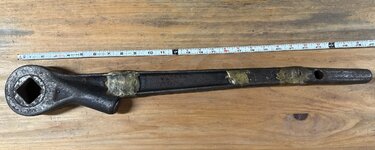
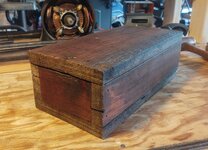
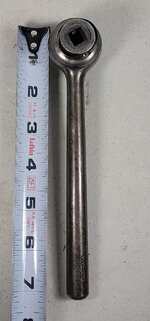
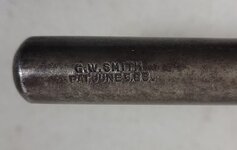
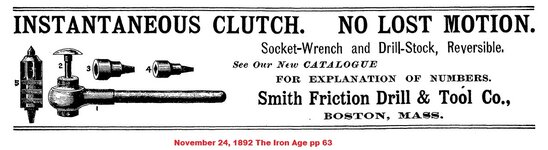
Thanks. I'll have to look closer later, but they look pretty standard.
Indeed, classifications can be very helpful. Note, though, that the classification symbols you are citing were not in use in 1883. The patent was not submitted with those, if that's what you're thinking. I'm not sure, but I don't think the USPTO even started classifying patents until 1899, believe it or not. In fact, the ones you are citing were established in 2013 and 2015. They are Cooperative Patent Classification (CPC) system symbols - something relatively modern in which the European Patent Office (EPO) and USPTO are trying to globalize classifications. Sadly, the USPTO has abandoned US classifications. They are mainly historical now.
I don't know what site you are using for patent research (guessing Google Patents?), but if you use the USPTO site, it will provide you the current CPC
and the current US classifications, still, thankfully.
Here, for example, is an excerpt of the USPTO's doc viewer for Smith's first 1883 patent.
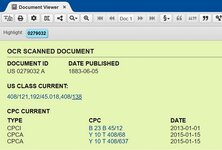
All of them are hyperlinked so you can easily click on the numbers and read the classifications.
Note that the document viewer does not provide dates for when the US Classification system symbols were established, because of the aforementioned abandonment, but you can look those up on the USPTO site
here.
For your convenience, US class 408/121, is "Cutting by use of rotating axially moving tool" / "Tool or tool-support with thrust-applying ratchet", and 408/138, is "Cutting..." / "Tool or Tool-Support with thrust-applying machine-engaging screw". US class 192/45.018 is "Clutches" / "Spring-biased ball or rollers." I haven't figured out how to look up subclasses, but Class 408 was established in
1971 and Class 192 was established in
1920.
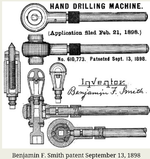
You might get a little more satisfaction out of how the second 1883 and the 1889 patents for the Smiths "Hand-Drilling Machines" were later classified by the USPTO. The USPTO also applies them to 408 and 192, but adds US class 81/53.2, which is "Tools" / and "Stud removal and emplacement" and 81/59.1, which is "Tools" / "Ball or roller wedge". Note that 81/53.2 and 81/59.1 are subindents of 81/52, which is "Wrench, Screwdriver, or Driver." Again, I don't know when those subclasses were established, but Class 81 was established in
1901.
You can find the whole index to the USPTO classification system, A to Z, by name,
here. Here are the USPTO Classes that the USPTO grouped under Ratchet, including Drills (408) and Wrenches (81)...

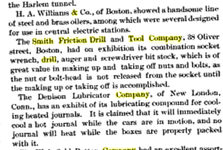
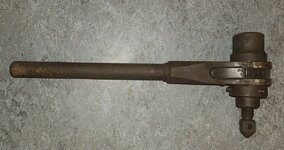
In my interpretation, the classification history accurately reflects the pedigree of this tool as coming out of the ratchet drill industry and market with expansion to bolt, screw and nut turning, i.e., wrenches. The combined classes mirror its "Combination" marketing.