To avoid these ads, REGISTER NOW!

Load Calculation for Garage Shop with Machinery

Mirage_Man

Member
Joined
Jul 2, 2020
Messages
15
Hello, I'm hoping someone can shed some light on how to go about proper sizing of a mini split system for a small 350sq.ft. garage shop. This is a shop that is used full time for production of small parts.

Details of the shop.

Located in Tampa Bay area of Florida
350 sqft. 8'6" ceiling
Cinderblock walls no insulation
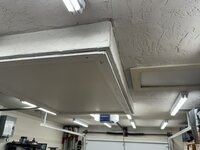
Plasterboard ceiling no insulation above
Newer insulated single car garage door (R9 I think) Door faces SE
One side aluminum door with Miami style slat glass crank out panels on NE side (no windows otherwise in space)
Concrete slab floor

Machinery Metal lathe with 3HP motor (states 2.2kw) Run on and off during production
10HP Rotary Phase Converter (7kw) Run continuously while in shop
30- 4ft. LED lights (32w each, 960w total)
Stereo running most of the time while working (100w ?)
Milling machine 2HP motor (1500w? Run periodically)
40 gallon electric water heater is also in the space.

Would like to be able to keep the shop at 72 degrees or less in the summer when it routinely gets into the mid 90's outside.

Can anyone give me advice on the proper size mini split for this application while not having issues with lack of moisture removal and humidity?
 
  • Like
Reactions: lmg
To avoid these ads, REGISTER NOW!

jack stand

Well-known member
Joined
Feb 29, 2012
Messages
3,335
Location
Lakes Region Maine
Have you investigated a turn key system (hiring it out) as you sound busy running your business in this space?
It's a legitimate business expense and you just make a phone call. 👍
I understand that you can't really oversize a M/S system and have the short cycle problems of a traditional system as it's variable speed compressor.
 
OP
M

Mirage_Man

Member
Joined
Jul 2, 2020
Messages
15
Have you investigated a turn key system (hiring it out) as you sound busy running your business in this space?
It's a legitimate business expense and you just make a phone call. 👍
I understand that you can't really oversize a M/S system and have the short cycle problems of a traditional system as it's variable speed compressor.

Idk in my research I’ve found that you absolutely CAN over size a minisplit variable system. That’s what I’m trying to avoid. Not removing the humidity that will condensate at colder temps on the various metals of the machines is a problem I’d like to avoid. Not to mention the prospect of working in a cold clammy environment all day. Then on the other side of the coin not having enough capacity so that the system struggles to keep up with the brutal Florida summer heat.
 
OP
M

Mirage_Man

Member
Joined
Jul 2, 2020
Messages
15
If you don't want to hire it out you can use the Manual J and Manual S calculators at loadcalc.net
I did look at that but there were no options for cinder block construction or the fact that the garage is attached to the house on one side. Nor for a garage door, multiple lights, machines, water heater etc. best I could get with the options available said like 9000btu. I have a 7portable 7000btu unit in there now and it’s pretty useless so I know 9000 ain’t gonna cut it.
 

PCustoms

Well-known member
Joined
Jul 23, 2011
Messages
22,772
Location
VT
I did look at that but there were no options for cinder block construction or the fact that the garage is attached to the house on one side. Nor for a garage door, multiple lights, machines, water heater etc. best I could get with the options available said like 9000btu. I have a 7portable 7000btu unit in there now and it’s pretty useless so I know 9000 ain’t gonna cut it.
Anyway you can add some insulation?

350sqft isn't big. Seems the heat from outside is going to overpower your equipment heat load.
 
OP
M

Mirage_Man

Member
Joined
Jul 2, 2020
Messages
15
Anyway you can add some insulation?

350sqft isn't big. Seems the heat from outside is going to overpower your equipment heat load.
Unfortunately not really. There’s no access to the attic crawl space a to speak of atm. The house’s central system air handler, supply and return ducts take up most of the space above the garage. The walls inside the garage are a sand finish plaster over the block walls. The one good thing I did was to get an insulated garage door when I replaced it a couple years ago. That made a big difference over the old uninsulated door.
 
OP
M

Mirage_Man

Member
Joined
Jul 2, 2020
Messages
15
Maybe someone can explain how this formula relates to the phase converter motor? What I mean is when I searched what the wattage was of a 10hp electric motor best I could find is that it’s up to 7.5kw per hour. Now in my situation it spends a good amount of time idling and not under load unless I’m actually running the lathe. I hat has me confused is if it just take the formula above and multiply by the 7.5kw number that means a 2 ton system to compensate for the motor alone and I know that can’t possibly be right. I know I’m totally missing something.
 

ericm

Well-known member
Joined
Apr 17, 2016
Messages
1,963
Location
Southern Oregon
You can probably ignore the small amount of friction, so the closest estimate would be the actual watts that are being consumed. Not the nameplate watts on the motors it's powering.
 

fitter30

Well-known member
Joined
Jun 23, 2019
Messages
2,973
Location
Peace Valley,mo
Is your plaster walls over block painted? RH travels from high to low just like temperature. RH is where most of the work in a ac system not cooling the air.
 
OP
M

Mirage_Man

Member
Joined
Jul 2, 2020
Messages
15
Is your plaster walls over block painted? RH travels from high to low just like temperature. RH is where most of the work in a ac system not cooling the air.

Yes they are painted. They are just like the exterior walls inside the house. There are furring strips between the block and back of the plasterboard. The house was built in the 70's in the short time before they switched to modern drywall. There are strips of what is similar to drywall nailed to the studs on the interior walls and and furring strips on the exterior then a hand applied sand finish plaster over the board. Same thing for the ceilings i.e. plasterboard then a hand applied finish. I will take some pictures and attach them shortly.
 
OP
M

Mirage_Man

Member
Joined
Jul 2, 2020
Messages
15
Here are a few pictures...
 

Attachments

  • IMG_7266 (Medium).jpeg
    IMG_7266 (Medium).jpeg
    159 KB · Views: 23
  • IMG_7269 (Medium).jpeg
    IMG_7269 (Medium).jpeg
    148.8 KB · Views: 18
  • IMG_7268.jpg
    IMG_7268.jpg
    738.6 KB · Views: 21
  • IMG_7267.jpeg
    IMG_7267.jpeg
    704 KB · Views: 29

PCustoms

Well-known member
Joined
Jul 23, 2011
Messages
22,772
Location
VT
Dumb question, you did vent the portable AC externally, right?
 

Tall dude

Member
Joined
Dec 3, 2023
Messages
22
I have never not had enough power adding 100 Amps. It is aways cheaper to do it first.
 
To avoid these ads, REGISTER NOW!

PCustoms

Well-known member
Joined
Jul 23, 2011
Messages
22,772
Location
VT
Mini Split systems are sized by SQ foot coverage. I don't feel the OP has a valid concern there.
Doubling down?

You didn't read the thread, and gave an electrical capacity answer when the question was about an AC.

And if you read his posts, he does indeed have a valid concern, as HVAC is not simply sized for the size of the room.

Literally, he is asking how to do a proper load calculation to size his system because of some unique heat loads.
 

Tall dude

Member
Joined
Dec 3, 2023
Messages
22
Doubling down?

You didn't read the thread, and gave an electrical capacity answer when the question was about an AC.

And if you read his posts, he does indeed have a valid concern, as HVAC is not simply sized for the size of the room.

Literally, he is asking how to do a proper load calculation to size his system because of some unique heat loads.
Hey you are out of line.
 

jack stand

Well-known member
Joined
Feb 29, 2012
Messages
3,335
Location
Lakes Region Maine
Idk in my research I’ve found that you absolutely CAN over size a minisplit variable system. That’s what I’m trying to avoid. Not removing the humidity that will condensate at colder temps on the various metals of the machines is a problem I’d like to avoid. Not to mention the prospect of working in a cold clammy environment all day. Then on the other side of the coin not having enough capacity so that the system struggles to keep up with the brutal Florida summer heat.
I'm curious what or where you saw this. I have experienced too big cooling with a traditional, 25 years ago equipment and the short cycling a lack of humidity control.
I questioned the guy that came out to quote me about this worry and iirc he said that it's not nearly the worry of a traditional set up.
My 5 or 6 years with it seems to back him up. When we give up on our preferred open windows and outside air and turn on the ac it runs hard until it satisfies the t-stat and then "putts along" seemingly barely running and I've checked, there is condensate dripping from both outside lines and the house is on target.
Maybe he just sized it right and we definitely don't have the same cooling needs (maine/ fl).
Most of my comment on hiring it out is proper sizing is "on them" and expressing all of your concerns initially further separates you. 👍
 
OP
M

Mirage_Man

Member
Joined
Jul 2, 2020
Messages
15
I'm curious what or where you saw this. I have experienced too big cooling with a traditional, 25 years ago equipment and the short cycling a lack of humidity control.
I questioned the guy that came out to quote me about this worry and iirc he said that it's not nearly the worry of a traditional set up.
My 5 or 6 years with it seems to back him up. When we give up on our preferred open windows and outside air and turn on the ac it runs hard until it satisfies the t-stat and then "putts along" seemingly barely running and I've checked, there is condensate dripping from both outside lines and the house is on target.
Maybe he just sized it right and we definitely don't have the same cooling needs (maine/ fl).
Most of my comment on hiring it out is proper sizing is "on them" and expressing all of your concerns initially further separates you. 👍
This is one article I found.


metlmunchr

Well-known member
Joined
Sep 10, 2011
Messages
1,278
You can't get any idea of what you need by comparing to a single hose portable. They cool the air, but the condenser air is pulled from the space so half or more of your cooled air is blown out across the condenser and that air is made up to the space by sucking in unconditioned air around any leaking space such as around garage doors, windows, man doors, etc.

All the power pulled by the RPC is converted to heat eventually, regardless of direct heat loss due to inefficiency or mechanical power output that is eventually converted back to heat. To know what that amount is, just check the motor amperage with an amprobe and convert that figure to watts. If the RPC is used only on the lathe, then check the amperage while the lathe is making your heaviest cut (turning, boring, drilling, etc) as that will give you the max for the RPC. Same thing for the lathe or mill. Just measure the amperage and convert. I'd assume you aren't running both the lathe and the mill at the same time, and if that's true then just use the larger figure rather than both readings.

The lights of course are heating directly in relation to the stated wattage, so that's a simple one. A 40 gal heater is going to lose 1.5 to 2 kW-hr to the space per day, or on the order of 60 to 85 watts per hour. There's likely a label on the stereo that shows its amperage, so just convert that to watts and add to the total.

I don't know about the RPC as I've never owned one, but I'm confident the remainder of the interior loads aren't going to add up to a significant amount, particularly in comparison to the heat gain on an uninsulated building. I'm sure there are calculators available for heat gain on concrete block buildings given the number of them that exist in FL, but I can't point to anything offhand. But, modeling it as an uninsulated wood structure should give results plenty accurate for your case since both are pretty close in resistance to heat flow.
 
OP
M

Mirage_Man

Member
Joined
Jul 2, 2020
Messages
15
You can't get any idea of what you need by comparing to a single hose portable. They cool the air, but the condenser air is pulled from the space so half or more of your cooled air is blown out across the condenser and that air is made up to the space by sucking in unconditioned air around any leaking space such as around garage doors, windows, man doors, etc.

All the power pulled by the RPC is converted to heat eventually, regardless of direct heat loss due to inefficiency or mechanical power output that is eventually converted back to heat. To know what that amount is, just check the motor amperage with an amprobe and convert that figure to watts. If the RPC is used only on the lathe, then check the amperage while the lathe is making your heaviest cut (turning, boring, drilling, etc) as that will give you the max for the RPC. Same thing for the lathe or mill. Just measure the amperage and convert. I'd assume you aren't running both the lathe and the mill at the same time, and if that's true then just use the larger figure rather than both readings.

The lights of course are heating directly in relation to the stated wattage, so that's a simple one. A 40 gal heater is going to lose 1.5 to 2 kW-hr to the space per day, or on the order of 60 to 85 watts per hour. There's likely a label on the stereo that shows its amperage, so just convert that to watts and add to the total.

I don't know about the RPC as I've never owned one, but I'm confident the remainder of the interior loads aren't going to add up to a significant amount, particularly in comparison to the heat gain on an uninsulated building. I'm sure there are calculators available for heat gain on concrete block buildings given the number of them that exist in FL, but I can't point to anything offhand. But, modeling it as an uninsulated wood structure should give results plenty accurate for your case since both are pretty close in resistance to heat flow.
Thank you for your reply. It was very helpful! You make some excellent points and suggestions. Based on the information I supplied what do you think would be the proper sized system for the space? I have been seriously considering an 18000btu system for fear that a smaller one won’t cool to the desired temps.
 

gleman

Well-known member
Joined
Jun 24, 2019
Messages
3,016
Location
Michigan And Florida too!
I was in the same situation as you.

I installed an access hatch in the garage to get around the HVAC gear and blew in insulation. Made a big difference in my garage.

What's the price difference between the 12 or 15 vs. the 18?
 

metlmunchr

Well-known member
Joined
Sep 10, 2011
Messages
1,278
Thank you for your reply. It was very helpful! You make some excellent points and suggestions. Based on the information I supplied what do you think would be the proper sized system for the space? I have been seriously considering an 18000btu system for fear that a smaller one won’t cool to the desired temps.
I think you can safely go with an 18,000 btu unit. This unit from Pioneer https://www.pioneerminisplit.com/pr...-mini-split-air-conditioner-heat-pump-230-vac will go as low as 5400 btu. Your light load alone will be about 3300 btu, and the idling amperage of the RPC will be at least 25% of the motor's full load amps. Those two should give you more than the 5400 btu minimum. I'm a fan of the Pioneer units as I've had a couple of them for a few years and they have performed flawlessly. And the price is hard to beat.

You may also find you need some exhaust once you install the mini. Right now you're getting fresh air due to the operating nature of the portable unit. As a long time machine shop owner, I know that any use of coolant or cutting oil can make for some foul air pretty quickly and you need to bring in some quantity of fresh air. The 18K unit will also give you the excess capacity to handle whatever fresh air you bring into the space.
 
OP
M

Mirage_Man

Member
Joined
Jul 2, 2020
Messages
15
I think you can safely go with an 18,000 btu unit. This unit from Pioneer https://www.pioneerminisplit.com/pr...-mini-split-air-conditioner-heat-pump-230-vac will go as low as 5400 btu. Your light load alone will be about 3300 btu, and the idling amperage of the RPC will be at least 25% of the motor's full load amps. Those two should give you more than the 5400 btu minimum. I'm a fan of the Pioneer units as I've had a couple of them for a few years and they have performed flawlessly. And the price is hard to beat.

You may also find you need some exhaust once you install the mini. Right now you're getting fresh air due to the operating nature of the portable unit. As a long time machine shop owner, I know that any use of coolant or cutting oil can make for some foul air pretty quickly and you need to bring in some quantity of fresh air. The 18K unit will also give you the excess capacity to handle whatever fresh air you bring into the space.
After speaking at length with customer service this morning I ended up ordering an 18000btu system from Senville. The stellar customer service that they seem to offer is what made me choose them over Pioneer which is the other brand I was looking at. Time will tell if I made the right choice.

I will update this post once it’s installed with my thoughts.

Thanks to everyone that shared their feedback!
 
Last edited:

snmiedo

New member
Joined
Aug 5, 2013
Messages
2
Location
Scottsdale, AZ
Doubling down?

You didn't read the thread, and gave an electrical capacity answer when the question was about an AC.

And if you read his posts, he does indeed have a valid concern, as HVAC is not simply sized for the size of the room.

Literally, he is asking how to do a proper load calculation to size his system because of some unique heat loads.
#TOOL
 

u3b3rg33k

Well-known member
Joined
Dec 18, 2017
Messages
4,048
Idk in my research I’ve found that you absolutely CAN over size a minisplit variable system. That’s what I’m trying to avoid. Not removing the humidity that will condensate at colder temps on the various metals of the machines is a problem I’d like to avoid. Not to mention the prospect of working in a cold clammy environment all day. Then on the other side of the coin not having enough capacity so that the system struggles to keep up with the brutal Florida summer heat.
you can if you try, but most mfg's list their turndown ratio/minimum BTU somewhere.

also check to see if the unit you ordered has a "dehumidify" mode. they'll run really low airflow and a super cold coil (but not ice up) for the purpose of managing humidity over room temperature.
Motor btu's calculation

Electrical Motors - Heat Loss

Heat loss from an electrical motor to the surroundings.
www.engineeringtoolbox.com


Awesome, thank you so much!
I'm gonna disagree with those numbers. in a closed box, a motor is a 100% efficient heater. an 85% efficient motor makes 15% of heat in the motor housing, and 85% of the heat is made by whatever it's driving.
 

hefnerconstructionlc

Well-known member
Joined
Nov 1, 2016
Messages
665
Location
Kansas
Too late but coolcalc.com has a really good manual j calc. With it you can change your wall assemblies to reflect different materials. You can also size individual rooms and air flows. And also orient the building with the direction to make sure you're getting the right heat gain on each room. You can also had windows and doors to account for that. It really is a pretty comprehensive software. And it's all free. I have used it many times and gotten very good results for my builds.
 
OP
M

Mirage_Man

Member
Joined
Jul 2, 2020
Messages
15
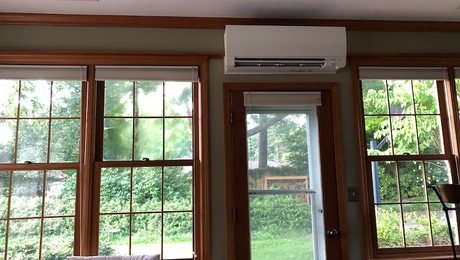
I installed the 18000btu system. It’s working well. If I had it to do again I’d probably go 24000btu now that I’ve been living with it for a week or so. In the heat of the day the temps in the garage rise to around 75 when it’s in the low 90’s outside. I would prefer to be able to keep it at 70ish. Maybe at some point in the future I’ll find a way to get some insulation in the attic. BTU the measured relative humidity is around 40% which feels great.

Here are a few pics of the install. I ended up running the lines in this backwards C configuration to meet the minimum length requirement for the line set rather than coiling up the excess behind or under the condenser. I think it’s a cleaner look. And yes I did a slightly steeper than 1/4”/ft pitch on the top section to allow for proper drainage of condensation.

img_7540-jpeg.2124175
IMG_7542.jpegIMG_7448.jpeg
 

Attachments

  • IMG_7540.jpeg
    IMG_7540.jpeg
    807.1 KB · Views: 45
Last edited:
To avoid these ads, REGISTER NOW!
Top Bottom