In 1981 I was able to buy my first new motorcycle. I wanted to buy a mid size street bike, and I looked at the Kawasaki GZ550, the GPZ550, the Yamaha 550 Seca, and the Suzuki GS 550. The GS seemed a bit dated to me, and I’d just had a Kawasaki 175 scrambler with middlin results so I decided on the Yamaha – a 1981 XJ550RH to be exact.
Rider Magazine has a nice retrospective on the Seca 550 here:

 ridermagazine.com
A quote from the article: Two things a motorcycle manufacturer has to look out for when introducing a new model: the competition and the economy. Yamaha got the competition right when it introduced the XJ550 Seca in 1981, as mid-size bikes had not been very popular during the horsepower wars of the late 1970s. Honda had recently upsized its rather boring CB550 to the CB650, while Suzuki’s GS550E had been around for quite a while. Newish but not dazzling was Kawasaki’s KZ550, which was soon slightly hotted up, with problems, for the GPZ550 version.
While this new Yamaha was the cat’s pajamas…to use a 100-year-old phrase that means it is doing what it is supposed to do extremely well. The engine had been around a while, with all problems sorted out, an in-line four with two shim-adjusted valves per cylinder and two chain-driven overhead camshafts.
The Seca makes a bit over 50 HP at 10K RPM. I am sad to say that in my younger and stupider years I was able to verify that it would do 10K RPM in top gear with a passenger which was 120 MPH plus. But I digress...
I rode the bike solid for about six years, but after I bought my 1987 FZ700 I rode it less and less. So I eventually gave the 550 to my BiL some time in the early to mid 90s. He rode it for a few years and then he parked it in his garage where it sat for the next 25 years. It was last registered in 1999 but I expect that it was sitting for a long time before the registration was allowed to expire.
So time moves on, and my BiL is cleaning out his house and downsizing, so I now have my old bike back again. It cost me $1200 to have it shipped from CA to GA which is I am certain more than it is worth. (Although it was cheaper to have it shipped than drive out there and trailer it back.) But it’s part of my personal history, an old friend, and I’d like to get it running again and ride it, so there we are.
I am calling this thread a resurrection, but I have to admit that at this point I just don’t know whether it will run again or not. I know that it needs new tires and a new chain, but I’m starting on the engine first to make sure that I can get it running without any unobtanium parts before I start spending money on the chassis.
I got my first motorcycle when I was in high school. It was a Honda "enduro" - a CL175. That was followed by a Kawasaki 175. I was generally strapped for money during this time so I did all of the maintenance and repair myself. I continued that with the Seca so working on it now is still very familiar for me. Except that due to age some things just don't disassemble like they used to...
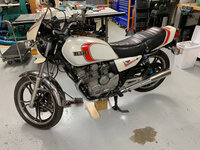
Here she is in her current beauty:
I’ve got $350 of misc parts on order – a few are cosmetic, but most are for the engine. New filters, plugs, o-rings here and there, etc. As you’d expect, there are no new chassis parts available like fairings, fenders, or decals. But there are still a lot of the basic parts available so I am hopeful.
Very fortunately I saved my old valve shims and the special tool for adjusting the valves. A quick check shows that you probably can’t buy the shims any more, so it’s good that I’ve got 8-10 of them that I can swap around. Although they are a standard size and there may be shims for a later model that would work. I also still have the special tool for synchronizing the carbs as well, so that is good.
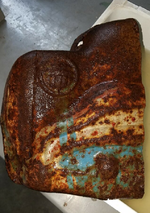
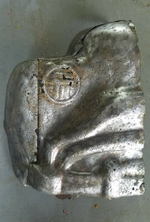
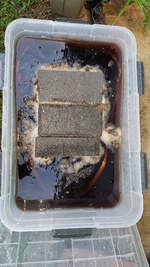
The Seca has four Mikuni 28 mm carburetors. I am starting there, as I expect them to be a mess. The first thing up is to remove the tank. Bummer. The tank while in generally good shape does have rust on the inside. I can fix that, at least I think I can “good enough” with a chain and a lot of vinegar and time. But that’s for later.
A shot of the carbs:

The carbs came off about as I’d expect. The rubber boots from the air filter to the carbs look just as good (if dirtier) than when I had the bike. Good news! But the intake manifolds are showing their age with a few cracks. They are solid and the cracks do not go through, but I’d prefer no cracks as all. Hmm. New manifolds are $70+ each and I need four of them. As the manifolds are solid it looks like they’ll get a little high temp. RTV on the cracks for insurance and then back they go.
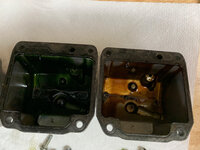
So on to the carbs themselves. I try to drain the carbs but nothing comes out. So off to remove the bottoms and then I discover that the 25+ year old gas has changed to a green oil. I had expected more of a brown varnish. But wait – one carb does have a brown oil/varnish. Why the carbs are different I have no idea.

So green, olive green, dark green, and brown. Given that they all came from the same gas tank I've got no idea as to why they are all different colors.
Here are two of the float bowls:
I have the main and pilot jets out and I’m sure that I can clean them up ok. But I am stuck on the floats and the float valves as they simply will not move. My next step will be more carb cleaner and an attempt to get them out so I can continue on the carbs. I do have the special YICs tool that I need to synchronize the carbs, but if possible I’d really prefer to keep the carbs attached so I don’t need to synchronize them. Stay tuned for an update in a couple of days...
Rider Magazine has a nice retrospective on the Seca 550 here:
Retrospective: 1981-1983 Yamaha XJ550 Seca | Rider Magazine
Story by Clement Salvadori. Photos by Terry South. Two things a motorcycle manufacturer has to look out for when introducing a new model: the competition
ridermagazine.com
A quote from the article: Two things a motorcycle manufacturer has to look out for when introducing a new model: the competition and the economy. Yamaha got the competition right when it introduced the XJ550 Seca in 1981, as mid-size bikes had not been very popular during the horsepower wars of the late 1970s. Honda had recently upsized its rather boring CB550 to the CB650, while Suzuki’s GS550E had been around for quite a while. Newish but not dazzling was Kawasaki’s KZ550, which was soon slightly hotted up, with problems, for the GPZ550 version.
While this new Yamaha was the cat’s pajamas…to use a 100-year-old phrase that means it is doing what it is supposed to do extremely well. The engine had been around a while, with all problems sorted out, an in-line four with two shim-adjusted valves per cylinder and two chain-driven overhead camshafts.
The Seca makes a bit over 50 HP at 10K RPM. I am sad to say that in my younger and stupider years I was able to verify that it would do 10K RPM in top gear with a passenger which was 120 MPH plus. But I digress...
I rode the bike solid for about six years, but after I bought my 1987 FZ700 I rode it less and less. So I eventually gave the 550 to my BiL some time in the early to mid 90s. He rode it for a few years and then he parked it in his garage where it sat for the next 25 years. It was last registered in 1999 but I expect that it was sitting for a long time before the registration was allowed to expire.
So time moves on, and my BiL is cleaning out his house and downsizing, so I now have my old bike back again. It cost me $1200 to have it shipped from CA to GA which is I am certain more than it is worth. (Although it was cheaper to have it shipped than drive out there and trailer it back.) But it’s part of my personal history, an old friend, and I’d like to get it running again and ride it, so there we are.
I am calling this thread a resurrection, but I have to admit that at this point I just don’t know whether it will run again or not. I know that it needs new tires and a new chain, but I’m starting on the engine first to make sure that I can get it running without any unobtanium parts before I start spending money on the chassis.
I got my first motorcycle when I was in high school. It was a Honda "enduro" - a CL175. That was followed by a Kawasaki 175. I was generally strapped for money during this time so I did all of the maintenance and repair myself. I continued that with the Seca so working on it now is still very familiar for me. Except that due to age some things just don't disassemble like they used to...
Here she is in her current beauty:
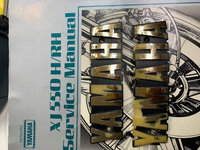
I’ve got $350 of misc parts on order – a few are cosmetic, but most are for the engine. New filters, plugs, o-rings here and there, etc. As you’d expect, there are no new chassis parts available like fairings, fenders, or decals. But there are still a lot of the basic parts available so I am hopeful.
Very fortunately I saved my old valve shims and the special tool for adjusting the valves. A quick check shows that you probably can’t buy the shims any more, so it’s good that I’ve got 8-10 of them that I can swap around. Although they are a standard size and there may be shims for a later model that would work. I also still have the special tool for synchronizing the carbs as well, so that is good.
The Seca has four Mikuni 28 mm carburetors. I am starting there, as I expect them to be a mess. The first thing up is to remove the tank. Bummer. The tank while in generally good shape does have rust on the inside. I can fix that, at least I think I can “good enough” with a chain and a lot of vinegar and time. But that’s for later.
A shot of the carbs:
The carbs came off about as I’d expect. The rubber boots from the air filter to the carbs look just as good (if dirtier) than when I had the bike. Good news! But the intake manifolds are showing their age with a few cracks. They are solid and the cracks do not go through, but I’d prefer no cracks as all. Hmm. New manifolds are $70+ each and I need four of them. As the manifolds are solid it looks like they’ll get a little high temp. RTV on the cracks for insurance and then back they go.
So on to the carbs themselves. I try to drain the carbs but nothing comes out. So off to remove the bottoms and then I discover that the 25+ year old gas has changed to a green oil. I had expected more of a brown varnish. But wait – one carb does have a brown oil/varnish. Why the carbs are different I have no idea.
So green, olive green, dark green, and brown. Given that they all came from the same gas tank I've got no idea as to why they are all different colors.
Here are two of the float bowls:
I have the main and pilot jets out and I’m sure that I can clean them up ok. But I am stuck on the floats and the float valves as they simply will not move. My next step will be more carb cleaner and an attempt to get them out so I can continue on the carbs. I do have the special YICs tool that I need to synchronize the carbs, but if possible I’d really prefer to keep the carbs attached so I don’t need to synchronize them. Stay tuned for an update in a couple of days...

 So I ordered $250 worth of intake manifolds today. While I was there I ordered new pins as well. Let's hope that Yamaha has the parts in stock still. So far I've been mostly lucky, but the flasher lens I needed was changed from "available" to "out of stock".