
You are using an out of date browser. It may not display this or other websites correctly.
You should upgrade or use an alternative browser.
You should upgrade or use an alternative browser.
Anyone collect vintage Taps and dies?
- Thread starter Galaxie-Ed
- Start date
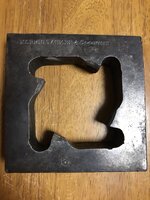
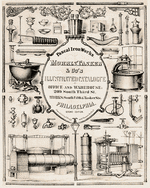
Thanks for the tip on Robert Briggs. It looks like Briggs (with the Morris Tasker Co. and otherwise), takes us back to the origins of pipe threading, at least in the US. By all accounts, Briggs was quite the whiz-kid engineer, and was had a big hand in developing and introducing standards for tubing, piping, and associated threading.Look up Robert Briggs on Graces Guide.
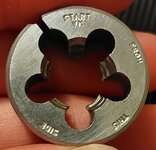
Can you ascertain if the thread is NPT @11 1/2 TPI or BSP @ 11 TPI
https://www.gracesguide.co.uk/Robert_Briggs_(1822-1882)
https://www.nc-chap.org/chap/tasker.php
http://www.firehydrant.org/pictures...ker was founded by,as Morris, Tasker & Morris.
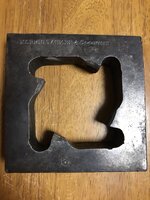
The Morris Tasker die is a cool piece of history, and having grown up in northern Wilmington DE, their Philly & New Castle DE locations were right out my back door. I'll see if I can figure out the true TPI of this die.
Attachments
Skiff Builder
Well-known member
Old Radar
Well-known member
Now that's art!! Too bad the proprietor was forced to discourage thieves by using conduit straps before they were all taken.
RTM
Well-known member
C'mon, you know Skiff is going back with his hollow leg (not for drinking) and a screwdriver.
four.cycle
Well-known member
thanks, humber2 
This man was quite a piece of work
Morris Tasker / Morris, Tasker & Co. Ltd, 230 So. Third St., Philadelphia, PA (1880) 209 So. Third St. (1860) / taps, dies, cast iron and malleable steel / http://www.firehydrant.org/pictures/morris.html / https://friendsofmountmoriahcemeter...ndustrialist-inventor-millionaire-and-pastor/ / https://libwww.freelibrary.org/blog/post/2980 / https://www.gracesguide.co.uk/Robert_Briggs_(1822-1882) /
patent (?) 1842 hydrant
patent (?) 1876 valve (?)
This man was quite a piece of work
Morris Tasker / Morris, Tasker & Co. Ltd, 230 So. Third St., Philadelphia, PA (1880) 209 So. Third St. (1860) / taps, dies, cast iron and malleable steel / http://www.firehydrant.org/pictures/morris.html / https://friendsofmountmoriahcemeter...ndustrialist-inventor-millionaire-and-pastor/ / https://libwww.freelibrary.org/blog/post/2980 / https://www.gracesguide.co.uk/Robert_Briggs_(1822-1882) /
patent (?) 1842 hydrant
patent (?) 1876 valve (?)
Attachments


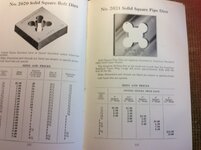
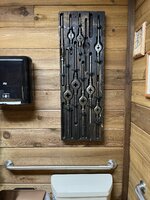
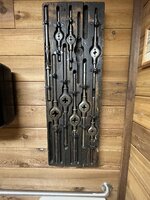
Found these hanging on the mens room wall in a bar at Grand Rivers , Kentucky
That style of set was known as Full Mounted with each die set in its own holder.
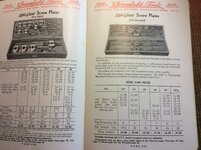
Private Lugnutz
Well-known member
Here's a brand I didn't find on this thread: Morris Tasker & Co. Limited.
Found these hanging on the mens room wall in a bar at Grand Rivers , Kentucky
Interesting flow of thoughts. Tools are often ornately decorative without really trying!Now that's art!!
Here is something I posted in reply to a series of dies posted by @glenmore on the 2020 Garage Sale thread...
Followed by an elaborating post, linked here, where I provided this as an example of what I meant...Private Lugnutz said:The way you have them laid out like that reminds me of several things all at once, including, and not in any order of significance, ancient symbols, crop circle alphabets, the symbols on the Roswell I-Beam, the Led Zeppelin Zoso logo, and hieroglyphics. Seriously.

Old Radar
Well-known member
I remember that!
Lesserstore
Well-known member
I got this 1975 Craftsman Kromedge tap and die set on ebay for $95 on ebay as a user set. It looks like it was hardly used and the taps and dies are still sharp. I didn't know who made these older taps and dies, I knew the more recent US made Craftsman ones were made by Vermont American, and on some forum posts (not GJ) seemed to have thought these older sets were made by Hanson. However, browsing through Hanson catalogs they never had chrome plating their taps and dies, but Vermont American did. A side note about VA, they started in 1947 as American Saw and Tool, and in 1948 started supplying circular saw blades to Sears and started making taps and dies in 1957 for "industrial use" and commercial use in 1958, which is when Sears started selling Kromedge taps and dies. All the tools in this set are coded VM except the screwdriver and thread gage.
The pictures on ebay showed it with a crowntop logo manual copyrighted 1968, and after I got it I looked under the bottom insert to see if there was anything I could date by like a receipt, but I found a like new 1975 dated manual and a drill chart. I wonder if it came with both or the older one just got stuck in there later on. I'm pretty sure this was made in 1975 because of the logo on the box and in 1976 Sears changed the model number and included an larger t handle tap wrench.
Vermont American's history page on its website (which still says copyright 2014 so I'm surprised its still up): https://vermontamerican.com/vermont-american-history/
The pictures on ebay showed it with a crowntop logo manual copyrighted 1968, and after I got it I looked under the bottom insert to see if there was anything I could date by like a receipt, but I found a like new 1975 dated manual and a drill chart. I wonder if it came with both or the older one just got stuck in there later on. I'm pretty sure this was made in 1975 because of the logo on the box and in 1976 Sears changed the model number and included an larger t handle tap wrench.
Vermont American's history page on its website (which still says copyright 2014 so I'm surprised its still up): https://vermontamerican.com/vermont-american-history/
Attachments
-
 20230708_203027.jpg527.4 KB · Views: 14
 -
 20230708_202909.jpg295 KB · Views: 13
 -
 20230708_202846.jpg443.6 KB · Views: 12
 -
 20230708_202721.jpg152.6 KB · Views: 12
 -
 20230708_202635.jpg244.8 KB · Views: 13
 -
 20230708_202431.jpg547.9 KB · Views: 11
 -
 20230708_202419.jpg716.4 KB · Views: 13
 -
 20230708_202356.jpg471.1 KB · Views: 17
While we're talking about little known brands another one that made excellent products and is still in business is Reiff & Nestor from Lykens, Pa. When I worked for what was Flinchbaugh Products in Red Lion Pa. we bought several special taps from them. Also there is Brubaker Tool from Millersburg, Pa. They were formed in 1881 and are still in business. Just a little bit of gee whiz info.
d42jeep
Well-known member
After a search, I was happy to see that Lugz had done all the necessary research on these thread files. I found this Jaw brand one in the sleeve at yesterday’s estate sale. I was hoping that it was the earlier Reiff & Nestor brand.I have to say, respectfully, after doing a little poking around, I am even more leery about the 'French thread file story' as the origins of JAWCO that Mr. Williamson, Jr. told 4.c.
As I said, it seems to willfully ignore the famous and popular aforementioned Reif & Nestor tool, patented in nearby Lykens, PA, for what sure looks to be an earlier version of the same exact tool that Jaw Mfg of Reading would later make.
Reif & Nestor had been around for a long time. They had tremendous street cred.
They trademarked the name NU-TRIX for a 4-sided thread file in 1927, patented the 4-sided file in 1928, re-upped the TM in 1938, and, as I said, made and sold them for decades prior to, during, and after WWII. Here's a postwar ad.
The earliest ads I can find for a Jaw Mfg thread file is 1955. It was a very small classifieds box.
When they started advertising it with photos, it was called the NU-THRED (admittedly, a much better name than Reif & Nestor's, but clearly a direct copy effort!) and it looks exactly like the NU-TRIX tool that Reif & Nestor were making for decades, in shape, function, and TPI sizes!
Here's the TM story in a nutshell. Reif & Nestor TM'd NU-TRIX in 1927, first use 1927. JAW TM'd NU-THRED in 1979, claims first use 1946, which I suppose might be the pre-JAW Krome compan Mr. Williamson mentioned. But in 1946 the NU-TRIX tool they obviously copied (again, not French in origin, but a from an old established company one county to the west in Pennsylvania) had already been around for 20 years.
It looks to me like the patent that ran out was Reif & Nestor's, not French, and they moved to an area where the resources and labor for making it were already existing.
I don't mean to be harsh. Strictly speaking, it all seems technically legal. And I appreciate Mr. Williamson even picking up the phone to take 4.c's call about the solid nut type chasers, which is very unusual. But it's a little fishy.



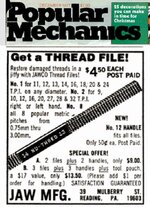
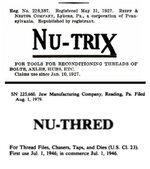
-Don
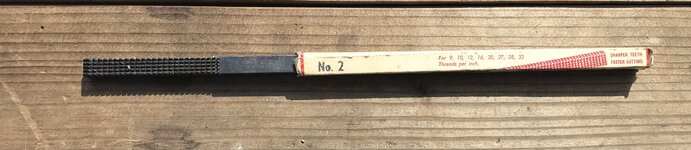

RTM
Well-known member
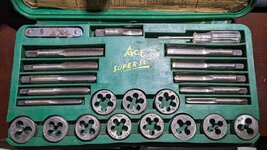
Here is a set I found on FBMP a few months back. Henry L Hanson Ace Super Set #614. Looks like its from around 1969., similar to Mallen's, and apparently Provincial's too. Mine is complete, all taps and dies are there, just a bit out of order originally. I even have the paper contents sheet (back side is blank, just barely visible in the catalog cut. Included sizes are 4 x 36, 6 x 32, 8 x 32,10 x 24, 10 x 32, 12 x 24 Machine Screw; 1/4x 20, 5/16 x 18, 3/8 x 16, 7/16 x 14, 1/2 x 13 National Coarse (NC); 1/4 x 28, 5/16 x 24, 3/8 x 24, 7/16 x 20, 1/2 x 20 National Fine (NF) and 1/8" Pipe (NPT)



Last edited:
After a search, I was happy to see that Lugz had done all the necessary research on these thread files. I found this Jaw brand one in the sleeve at yesterday’s estate sale. I was hoping that it was the earlier Reiff & Nestor brand.
-Don
I see an unusual selection of TPI there.
There’s no 13 and 27 appears to be the only NPT option.
Does anyone have the set #1 to see what it offered?
Private Lugnutz
Well-known member
11, 12, 13, 14, 16, 18, 20 & 24. There's an ad for one in the research Don linked to. It was the thread restorer that the US Army Ordnance Dept specified for all 2nd echelon toolsets during WWII. They made them for Snap-on's Blue-Point brand, as well. I have a few and I have posted them here in this thread earlier. See posts #295, #303, and #322.Does anyone have the set #1 to see what it offered?
Tostal
Well-known member
I came across these taps recently - not really vintage, probably c. 1970's but reminded me of my early days in the motor trade. They're 12BA (which I think is the smallest BA size) and 5BA (never had need for this size, don't know where it was used, only ever needed 2BA and 4BA). "Warrior" was a well-known/respected British manufacturer of taps/dies, not sure if the Co. still exists.


T~
T~
Tostal
Well-known member
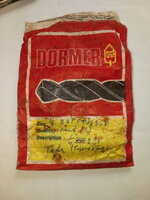
Some more taps, these are made by Dormer - sizes are 1/8 in. BSP. I've included pics of the storage bag they were supplied in.


T~
T~
dutchgray
Well-known member
I think BA standard goes all the way down to no26I came across these taps recently - not really vintage, probably c. 1970's but reminded me of my early days in the motor trade. They're 12BA (which I think is the smallest BA size) and 5BA (never had need for this size, don't know where it was used, only ever needed 2BA and 4BA). "Warrior" was a well-known/respected British manufacturer of taps/dies, not sure if the Co. still exists.
T~
You won't really see anything smaller than 12 though.
The odd number sizes are supposed to be non preferred so you almost never find much of those.
Tostal
Well-known member
Thanks for the info, I was assuming that 12BA was the smallest size as my set of o/e spanners only goes this small.I think BA standard goes all the way down to no26
You won't really see anything smaller than 12 though.
The odd number sizes are supposed to be non preferred so you almost never find much of those.
I'm relieved I probably won't encounter anything smaller than 12BA - I could barely see the threads on this size
.T~
d42jeep
Well-known member
I found this set last Sunday.

-Don
-Don
dutchgray
Well-known member
Bought this one recently

Its a Clarkson 2" 4tpi Acme has one broken cutter right at the end but the thread is finished by then.
Its a Clarkson 2" 4tpi Acme has one broken cutter right at the end but the thread is finished by then.


AntiqueBen
Well-known member
- Joined
- Aug 4, 2021
- Messages
- 1,442
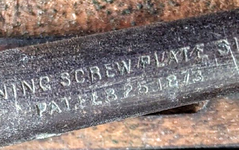
I bought a little Wiley & Russell no. 0 tap & die set today. I usually see large tap & die sets, but this one caught my eye. It's very small. The dies are dated 1877 & the handle has the 1873 patent date. The complete label in the lid is still intact which is nice to see. Anyone know anything about this no. 0 set? I've never seen one this small.
Attachments


AntiqueBen
Well-known member
- Joined
- Aug 4, 2021
- Messages
- 1,442
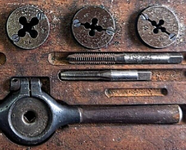
Anyone know what the small slot in this set is missing? At first I thought it was missing a tap, but it looks like there only 5 dies & it already has the 5 taps. What's in the handle doesn't look like a die. It looks like the piece to hold the taps so you can use the handle for both taps & dies. So, what would go in the little tiny slot?
Attachments
Provincial
Well-known member
The pin for the clamp screw on the handle.Anyone know what the small slot in this set is missing? At first I thought it was missing a tap, but it looks like there only 5 dies & it already has the 5 taps. What's in the handle doesn't look like a die. It looks like the piece to hold the taps so you can use the handle for both taps & dies. So, what would go in the little tiny slot?
AntiqueBen
Well-known member
- Joined
- Aug 4, 2021
- Messages
- 1,442
Thanks Provincial. That makes perfect sense & would fit that slot perfectly.The pin for the clamp screw on the handle.
AntiqueBen
Well-known member
- Joined
- Aug 4, 2021
- Messages
- 1,442
I found this ad showing what size dies the different sets have in them. At the bottom it mentions only the no. 0 set includes a "tap wrench" which is probably just a pin for the clamp screw like you said. Your answer is confirmedThe pin for the clamp screw on the handle.

Attachments

RTM
Well-known member
This should be what the pin looks like. Not sure I’d call it a tap wrench, gotta poke around more. Maybe tomorrow.The pin for the clamp screw on the handle.


The Wiley & Russell Mfg. Co. : 1898 : Wiley & Russell Manufacturing Co. : Free Download, Borrow, and Streaming : Internet Archive
20 p., illus., 21.3 cm, trade catalog
archive.org
Yup, pretty sure the Tap Wrench is the die looking object with the square hole to grab the square end of the tap, and spin it with the stock.
Multiple entries in the catalog say “tap wrench fitted in stock”, pages 2-7 x4, and look, a picture too.

Last edited:
AntiqueBen
Well-known member
- Joined
- Aug 4, 2021
- Messages
- 1,442
So obviously the pin is not the tap wrench. I'm glad to see a picture of this pin because I'll probably have to make one for my set. I'm sure this pin was the first thing to get lost out of this set. To find an original would be impossible. I wonder if this pin was stamped or marked in any way.... we'll probably never know....unless someone out there has a no. 0 set & still has their pin.
454ragtop
Well-known member
The pin is a simple lathe job, easy enough to figure out what the likely dimensions were by the slot in case and the hole in the screw. If you have number drills, see what size fits nice in the hole and use that as a guide for the turned down section. I doubt very much it had any markings on it. Do the sizes of the taps and dies match that catalog listing? They look bigger maybe.So obviously the pin is not the tap wrench. I'm glad to see a picture of this pin because I'll probably have to make one for my set. I'm sure this pin was the first thing to get lost out of this set. To find an original would be impossible. I wonder if this pin was stamped or marked in any way.... we'll probably never know....unless someone out there has a no. 0 set & still has their pin.
AntiqueBen
Well-known member
- Joined
- Aug 4, 2021
- Messages
- 1,442
I just recently got an old Atlas Lathe, so this will be a fun first project.The pin is a simple lathe job.
I noticed that too. I just purchased this online, so I don't have it yet. I messaged the seller about the tap & die sizes. I also told him about the pin. Who knows, he may have it somewhere & not realize what it's for. I'll post when I find out.Do the sizes of the taps and dies match that catalog listing? They look bigger maybe.
Stand by....
RTM
Well-known member
Of the few I can read in your photo, I see 1/4 and 3/16”, and something with a leading 5, so looks close.
AntiqueBen
Well-known member
- Joined
- Aug 4, 2021
- Messages
- 1,442
I can't find out the sizes from the seller until tomorrow. They are all Wiley & Russell, I just hope they match the die sizes.Of the few I can read in your photo, I see 1/4 and 3/16”, and something with a leading 5, so looks close.
AntiqueBen
Well-known member
- Joined
- Aug 4, 2021
- Messages
- 1,442
Years ago I acquired an old leather handle toolbox from a gentleman that was stuffed full of taps & dies. It also had some miscellaneous bits & bobs in there too. I finally took it all out of there & put it in a more appropriate tool box so you can at least see what you got. While going through this stuff I found a mystery tool. I doubt it's tap & die related, but I could be wrong. It's a steel pin that comes to a very sharp point & has a knurled knob on the top. It's 2-1/2" long. It has to have a specific purpose. This look familiar to anyone??
Attachments

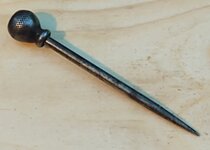


A scriber from a combination square head. Looks like Starrett, but they all may have a similar knurling. Often missing from older square heads.Years ago I acquired an old leather handle toolbox from a gentleman that was stuffed full of taps & dies. It also had some miscellaneous bits & bobs in there too. I finally took it all out of there & put it in a more appropriate tool box so you can at least see what you got. While going through this stuff I found a mystery tool. I doubt it's tap & die related, but I could be wrong. It's a steel pin that comes to a very sharp point & has a knurled knob on the top. It's 2-1/2" long. It has to have a specific purpose. This look familiar to anyone??
AntiqueBen
Well-known member
- Joined
- Aug 4, 2021
- Messages
- 1,442
Your right. I would have never figured that one out.A scriber from a combination square head. Looks like Starrett, but they all may have a similar knurling. Often missing from older square heads.
AntiqueBen
Well-known member
- Joined
- Aug 4, 2021
- Messages
- 1,442


RTM
Well-known member
Geez, come on. "It's a useless pointy thing with no value. Send it to me for proper disposal" is supposed to be the right answer.A scriber from a combination square head. Looks like Starrett, but they all may have a similar knurling. Often missing from older square heads.
Just a caveat, there are size differences between the older and newer scribers. I think the newer ones are thinner, and there is a copper or brass piece inside the hole to help retain them. New ones won't fit in older heads, which don't have a brass piece, after I bought a few from Starrett replacement parts.