To avoid these ads, REGISTER NOW!

Sizes Above 19mm that are Skippable? Not Common?

oldschoolcraft

Well-known member
Joined
Dec 31, 2017
Messages
1,829
Location
Bay Area, California
I know it's heresy to skip sizes but I have a full set of 1/2" Drive sockets and Combination wrenches up to 1 1/2 in SAE and up to 38mm in Metric. No skips!

I've been hunting for cheap high end tool deals with good success the last few weeks. I am buying speciality tools as I find great deals like:
  • crowfeet
  • crowfeet flare
  • torque adapters
  • swivel universal impact sockets
  • stubby wrench
  • 4 way angle wrench
I'm working on a full set up to 19mm, but above 19mm I want skips because I will never use most of these tools, but if I can find a Snap On crowfoot for 80% off retail in a large size I'll probably never use, but is a common size, then I will buy it just in case. But the same deal for an obscure size I definitely will never use is just clutter.

I dont have a specific need for large sizes, just want a wish list for deals of potentially useful tools. I already have at least two ways to turn every fastener above 19mm in 1mm and 1/16" increments up to 1 1/2" and 38mm even in sizes that dont exist, but I dont want a 31mm torque adapter (if it even exists)

Is every 1/16" increment a size of some useful fastener in SAE or are some skipped?

These are the potentially skippable Metric sizes up to 50mm I've identified based on major tool companies skipping them for certain sets as well as older GJ threads I found (which claim 21, 22, 24, 27, 30, 32, 41, 46, 50 are standard sizes)
  • 20mm
  • 23mm
  • 25mm
  • 26mm
  • 29mm
  • 31mm
  • 33mm
  • 37mm
  • 39mm
  • 40mm
  • 42mm
  • 43mm
  • 44mm
  • 45mm
  • 47mm
  • 48mm
  • 49mm
At bigger sizes I think it's reasonable to overlap SAE with similar metric and I can get whichever tool I get a cheap deal on first:
  • 27mm = 1 1/16"
  • 30mm = 1 3/16"
  • 35mm = 1 3/8"
  • 38mm = 1 1/2"
  • 46mm = 1 13/16"
Which means maybe I try to get every 1/16" increment plus also 21, 22, 24, 32, 41, 50

I dont mean to hurt feelings with skips, but there's middle ground between "why are you buying tools you'll never use" and "buy no skips up to industrial oil equipment sizes" and I think if I can find amazing deals on common large sized tools, I should buy them, and can always resell later if needed. Imagine you bought all of these tools lightly used at 70% off 1990s retail Snap On pricing, you would have easily retained a store of value to resell them today. That's where I'm coming from, looking through estate sales but, I dont want useless tools even if the price is incredible, I want potentially useful tools.
 
To avoid these ads, REGISTER NOW!

dukefx

Well-known member
Joined
Aug 24, 2022
Messages
391
If we are talking combination wrenches 42 mm is an extremely common size in plumbing. Even the Knipex pliers wrenches have a setting for that. I think it's safe to skip for sockets and other tools tho.
 

f121

Well-known member
Joined
Dec 8, 2018
Messages
2,080
Location
UK
23mm is common. Suspension bolts, tow bars etc. I use it a lot.

Rest of that list I’d probably skip. It’s rare I go past 36mm so can’t comment above that.
 

Robinson1

Well-known member
Joined
Jun 22, 2015
Messages
834
Location
Kentucky
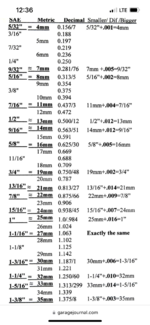
I keep this chart saved on my phone and use it regularly as reference. It was originally screenshotted from a garage journal post
 
OP
O

oldschoolcraft

Well-known member
Joined
Dec 31, 2017
Messages
1,829
Location
Bay Area, California
Kinda helps if we know if you are a bicycle mechanic or a heavy equipment mechanic or something in between? The tools you need have to fit the machines you work on.
I can get by with what I plan on doing with everything up to 19, plus 22, 24, 27, and 30. The only 21s I come across are lug nuts and I already have a no skips set of 1/2" drive sockets up to 38mm. That's my "at least I have something that might work" set.

I dont know what plans I have for the future, I like to work on a variety of stuff, only limited by space and tools. If I decide to get into working on X thing, I'd rather not have to pay full price for new tools in the moment, and I dont want to gradually spend years collecting deals I find.

I'm creating a wish list of useful tools that I can spend the next few years looking for amazing deals. I want to buy every size that is in use. 31mm is not in use to my knowledge. I did get a 31mm combination wrench and a 31mm 1/2" drive socket, just to have no skips. Maybe I'm wrong and there is something, maybe an off spec fastener fits that size better.

But, I'm not going to try to get no skips of every speciality tool like crowfeet, angle wrenches, and torque adapters. I want to limit to actual fasteners that are in use. So I want a list of sizes that I can skip so if I come across it, I know I can skip it. Or since tools might not even exist in those sizes, so I know what I'm still missing.

Maybe I've gotten lucky but I've gotten some steals on nearly new Snap On tools this last month at crazy discounts, stuff I probably will never need, but are nice to have in case the need arises and I could resell if I decide to pare down. But I dont want to buy a bunch of ****, even if it's a good price, that has no functional use.
 

Dave455

Well-known member
Joined
Mar 19, 2013
Messages
5,829
Location
Sussex, England
With regard to metric, I don’t personally think it makes a huge difference if a size is below 19mm or above, if a size isn’t used by any of the standards, there isn’t much point owning it!

Now, I know there are some folks who treat wrenches much like slotted screwdrivers, and just take the next nearest. These folks always want sets without skips, but they are in effect misusing their tools, as they will have up to a mm of slop if used on an SAE or Whitworth bolt. This is not the way to go.

The difference below 19mm is that most of the sizes in 1mm increments are used by one standard or another. Above 19 it’s a different story, and only relatively few sizes are used.

O.P. - you state that GJ threads CLAIM that 21, 22, 24, 27 etc are the standard sizes, but you seem in doubt.

If so, go and look at the relevant standard sizes. ANSI cover American Metric, DIN for the older German, JIS for Japanese and ISO for everything else.

If you do that, you will find that the sizes quoted are correct. You will very rarely need anything else.

But… if you keep looking long enough you will find all sorts of odd sizes used for special requirements (e.g. heavy pattern) and indeed also many old national standards that use different sizes, but your chances of finding these are slim!

I don’t think there is much point in finding out which SAE sizes can be substituted for which metric, unless you already own a load of SAE. If you don’t, just buy the correct metric size!
 
OP
O

oldschoolcraft

Well-known member
Joined
Dec 31, 2017
Messages
1,829
Location
Bay Area, California
With regard to metric, I don’t personally think it makes a huge difference if a size is below 19mm or above, if a size isn’t used by any of the standards, there isn’t much point owning it!
I think every size from 8mm to 19mm is in use. Every so often we get a thread asking about 9mm and 11mm and we get tons of people saying they are both in use. So that's why I mention above 19mm because that's when people start to admit there is no 20mm or 31mm fasteners they've ever seen.

I don’t think there is much point in finding out which SAE sizes can be substituted for which metric, unless you already own a load of SAE. If you don’t, just buy the correct metric size!
I agree with you in principle if you're outfitting a toolbox with new tools. But what I'm trying to do is source high quality tool truck level tools for huge discounts, which is possible given a long enough time frame. If I have a gap in my collection for a Crowfoot wrench and the 27mm is 50% off retail price but the 1 1/16" is 80% off retail price, but the tool is effectively the same, then I should get the SAE version.

Or perhaps one of metric or SAE isn't available at all but the other is popping up.

Thank you for the detailed reply :cool:
 

VolvoRyan

Well-known member
Joined
Dec 29, 2019
Messages
1,339
Location
Kentuckiana, USA
Why are you buying all of this stuff?? You may not need any of it.

Things that turn fasteners, especially impact sockets, are ultimately consumables. Why anyone would buy used Snap-On (other than as a collector) boggles my mind a bit. The tools *do* wear over time, and you have no warranty. You're not supporting American industry, so that avenue is null, too. I've plenty of flat-rated Snap-On sockets that are loose and wiggly compared to a shiny new Tekton.

-Ryan
 
OP
O

oldschoolcraft

Well-known member
Joined
Dec 31, 2017
Messages
1,829
Location
Bay Area, California
Why are you buying all of this stuff?? You may not need any of it.

Things that turn fasteners, especially impact sockets, are ultimately consumables.
I've had success at estate sales recently where nearly new tools are available at very cheap prices. I agree that they may be consumables but many of these were used only a few times, if at all.

The only impact sockets I'm considering is some of the expensive universal ones from tool trucks, if they are very cheap and in good condition. I do run Sunex and Tekton impact sockets as my primary for the reasons you mention.

What I'm referring to are things like Crowfoot, Flare Crowfoot, Torque adapters, and 4 way angle wrenches where most of them go unused because they aren't daily drivers for most people. There's a good chance I'll never need any of it, but if I can piece together a Snap On Crowfoot set for 80% off retail price, and it's virtually new, it seems worthwhile to have just in case.
 

Dave455

Well-known member
Joined
Mar 19, 2013
Messages
5,829
Location
Sussex, England
I think every size from 8mm to 19mm is in use. Every so often we get a thread asking about 9mm and 11mm and we get tons of people saying they are both in use. So that's why I mention above 19mm because that's when people start to admit there is no 20mm or 31mm fasteners they've ever seen.


I agree with you in principle if you're outfitting a toolbox with new tools. But what I'm trying to do is source high quality tool truck level tools for huge discounts, which is possible given a long enough time frame. If I have a gap in my collection for a Crowfoot wrench and the 27mm is 50% off retail price but the 1 1/16" is 80% off retail price, but the tool is effectively the same, then I should get the SAE version.

Or perhaps one of metric or SAE isn't available at all but the other is popping up.

Thank you for the detailed reply :cool:
I understand where you are coming from.

In the bigger sizes, used tools are the way to go if you can. The larger sizes don’t hold their value like the smaller ones, but you generally find much less wear, if any.

I’ve faced the same issues in the U.K. where I would love to be able to find used metric tools as they do in Europe, but the majority of good used here are Whitworth or SAE sizes.

Because I really don’t like substituting SAE for metric, I’ve held out and acquired the metric sizes I wanted, generally new, but often on some sort of deal.

The 21, 22, 24, 27, 30 and 32 I use an awful lot. Beyond that, they are really specialised tools for specific jobs - e.g. 46mm for BMW hub nuts.
 

VolvoRyan

Well-known member
Joined
Dec 29, 2019
Messages
1,339
Location
Kentuckiana, USA
The 21, 22, 24, 27, 30 and 32 I use an awful lot. Beyond that, they are really specialised tools for specific jobs - e.g. 46mm for BMW hub nuts.

Speaking of specialized, I just got a 36mm GearWrench ratcheting combo wrench to run the special tool for Volvo 240 trailing arm bushings. No other earthly reason to have it. I've 36mm sockets, but they're clunky in this situation.

-Ryan
 
OP
O

oldschoolcraft

Well-known member
Joined
Dec 31, 2017
Messages
1,829
Location
Bay Area, California
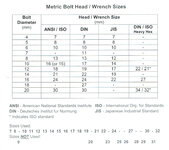
Maybe this will help:
bolt head and wrench size chart.jpg
Thanks Jeff, that is where I got the numbers from I posted in my OP. But as you see from the replies, people show up saying 23mm is used often. Also the chart cuts off at 32mm and while I dont have immediate plans to work on huge stuff, it would be nice to know what's a standard metric size above 32.

I think what I need is a table that says:

Standard Metric Sizes: 21, 22, 24, 27, 30, 32
Non-Standard but Used Metric Sizes: 23 (according to @f121 )
Sizes NEVER used: 31mm, 37mm

The standard ones are easy, I think from the table you shared it aligns with my past research. But the other two categories are unknown to me.
 

f121

Well-known member
Joined
Dec 8, 2018
Messages
2,080
Location
UK
Thinking about it, I usually see 23mm on nyloc nuts.

No skips below 19mm makes sense, above it, less so unless the gaps in the rack bother you (bothers me too, but not enough to fill them).

I’d be more interested in trying to build out a useful ratchet collection than zero skips sockets.
 

AJHD

Well-known member
Joined
Jan 4, 2020
Messages
3,042
Location
AZ
23mm is common. Suspension bolts, tow bars etc. I use it a lot.

Thinking about it, I usually see 23mm on nyloc nuts.

Have any specific examples? I can't recall using a 23mm wrench or socket.

I'd say for automotive 21mm, 22mm and 24mm I think is the largest I use, aside from common axle nut sizes. Not even sure the last time I used a 24mm.

Also unsure of the fastener size when using a pair of pliers or an adjustable wrench. Especially when working on hydraulics. Speaking of which, 30mm and to a lesser extent 36mm were commonly used sizes, at least on Caterpillar.

Can't really speak for SAE. Only sizes I really remember using were 1", 1-1/4" and 1-1/2" working on CAT.

When you get above 30mm wrenches get very large and sockets get heavy.
 

Dave455

Well-known member
Joined
Mar 19, 2013
Messages
5,829
Location
Sussex, England
Thanks Jeff, that is where I got the numbers from I posted in my OP. But as you see from the replies, people show up saying 23mm is used often. Also the chart cuts off at 32mm and while I dont have immediate plans to work on huge stuff, it would be nice to know what's a standard metric size above 32.

I think what I need is a table that says:

Standard Metric Sizes: 21, 22, 24, 27, 30, 32
Non-Standard but Used Metric Sizes: 23 (according to @f121 )
Sizes NEVER used: 31mm, 37mm

The standard ones are easy, I think from the table you shared it aligns with my past research. But the other two categories are unknown to me.
The table posted by Jeff is bang on, although 15mm is generally an ANSI size.

As to the “non standard but used” sizes, you can only really obtain these by looking at the older standards.

Working from memory, which isn’t totally reliable -

23, 26 and 29 were used by the old French standard. You will find them on things like Renault 8’s and 16’s (12’s too I think), Citroen DS (I think) and things like military vehicles (Panhard for sure).

There was an old Swedish standard that used Whitworth threads with metric bolt heads. That used sizes like 23, 28 and 33. The standard is surprisingly common, and you find it on a lot of machine tools.

Bear in mind that a lot of the metric threads have also evolved over the years. Many countries who were early adopters of metric adopted “S.I.“ metric (Systeme Internationale) only switching to ISO metric later on.

Germany, for example, has had at least 3 DIN metric standards, being S.I., early ISO, and current ISO. They have largely managed to retain similar size bolt heads, and only in recent years have switched 17’s and 19’s for 16’s and 18’s.

Japan switched to ISO, and the dimple that you see on some Japanese screws doesn’t (contrary to popular misconception) represent JIS, but rather ISO JIS. There were some older bolt head sizes that differed from the current ones, but I can’t recall what they were. (31 comes to mind).

Personally, I wouldn’t bother chasing tools for these older standards unless you go out and buy a vehicle or machine that uses them.
 
To avoid these ads, REGISTER NOW!
OP
O

oldschoolcraft

Well-known member
Joined
Dec 31, 2017
Messages
1,829
Location
Bay Area, California
Thanks everyone the metric standards seem pretty clear and I'm on board with sticking with 21-22-24-27-30-32

Is there any SAE size standards? Or is everything in 1/16" increments fair game? I dont have any immediate plans to take apart CAT tractors, but who knows. If I wind up finding some dirt cheap high quality tools in like new condition, I'd buy them to keep in storage just in case I get into big boy stuff.

I got the idea from a poster here several years back that found a whole set of like 20 slugging wrenches for like $80. When retail price is $80 each. He had no idea what he'd use them for, but at that price, it's so cheap, it's hard to pass up.

Basically what I'm doing is making a wish list because while it sounds stupid to want tools I may never need, it will save me money in the long run. or so I tell myself. Because when I'm looking at some tools in an estate sale, and they are dirt cheap, if they aren't on my wish list, I can pass.

I've been very tempted by some deals I've seen recently like Snap On combination wrenches for $15 each in like new condition. But I'm not interested in trying to resell them and they dont fit in my collection. So by having a nice wish list, if I see stuff outside of it, I can safely pass on it.
 

AEAdam

Well-known member
Joined
May 27, 2023
Messages
2,788
Location
SE PA
You can't predict the need for every tool. Like I said either earlier or elsewhere, covering the basics, then a smattering of specials is all you can do. I encountered a need for 21mm 12pt. So I bought a set of 1/2" 12pts. Not the end of the world. And when you consider the cost of maintenance (recall my recent thread) even retail truck tool prices could be a wash or a savings over sending a repair you can do to a service center.
 

rust in the eye

Well-known member
Joined
Oct 2, 2017
Messages
2,810
Location
Chicagoland
I don't understand your desires here. Without any clear idea of what tasks on what machines there is little advice to offer you. If you're aiming at simply collecting a bunch of truck brand tools at low prices then you seem to be doing fine already.
There is quite the dichotomy in a fellow who buys a set of slugging wrenches he admits he'll never use that is also interested in skipping wrench sizes. To what end?
 

u2slow

Well-known member
Joined
Nov 20, 2011
Messages
3,611
Location
BC
20, 22, 23mm are practically pointless. Skipped on most wrench sets. I've bought most of the smaller increments above 1" one at a time as i needed them. Same can be said for a lot of tools actually.

This idea of having everything in advance never made sense to me. What kind of working-class stiff has the funds for that?
 

steve855

Well-known member
Joined
Dec 30, 2019
Messages
65
Location
PA
Basically what I'm doing is making a wish list because while it sounds stupid to want tools I may never need, it will save me money in the long run. or so I tell myself.

At least you recognize that it sounds stupid, no offense meant. I don't think buying stuff you don't need now, or maybe ever, will save money in the long run,

I get the feeling from various threads that you want to be ready for everything, but you haven't yet done much, wrenching-wise. Have you ever pulled an intake manifold or cylinder head? Split the cases on a motorcycle engine? Changed struts, control arms, wheel bearings on a car or light truck? Replaced a clutch? No disrespect from me if you haven't, we all start somewhere. When I was 19 I changed the engine in my 77 firebird in my dad's barn. I had some beat up 1/2" drive SK sockets, ratchet, extensions, and craftsman wrenches. Chain fall hanging from a big white oak barn beam to lift with. Didn't have much experience or knowledge at the time either. I realize this sounds like an old man rant, but my point is not that I'm some genius mechanic- it's that I made it work with those tools because that was my only car and I had places to go. I'm much better equipped with tools now, years later. I have a mix of SK, Snap-on, Craftsman, Tekton, Wright, Stahlwille, HF and some that I'm forgetting. Beyond the basic hardline stuff, I've tried to acquire quality tools as needed, rather than own every tool that was ever made. For example, I don't own a 36mm crow foot socket. Never needed one. If I ever have a project that requires one, I'll buy it. Seems unlikely but who knows. I know this isn't the GJ way, but I don't buy tools I won't use.

I think you're putting too much time & effort into building out a 100% complete set of tools for every concievable situation , and in reality there's no such thing. My advice is start taking on some real projects and very quickly you'll know for certain what you need, rather than guessing or doing hours of research for the "what-ifs".
 

mreisner

Well-known member
Joined
Jun 25, 2019
Messages
913
Location
North of Detroit
I used a 20 mm Crowfoot just today. Had a leaking feed line on an injector on a John Deere tractor. How a 50 year old tractor ended up with metric injectors is beyond me, but the Crowfoot set that I had had a 20 mm in it and it saved the day. Standards were close but were going to round it off and it had a 19 and 21 mm flare wrench but it would have rounded it off before it got tight and stopped the leak.
 

john.k

Well-known member
Joined
Jun 4, 2024
Messages
1,200
Location
Brisbane Qld Australia
69mm is probably 2& 3/4 " ,a common size of pinion nuts on truck diffs .......most of the old timers used hammer and chisel on big nuts they didnt have tools to fit ..........surprisingly effective .
 

AEAdam

Well-known member
Joined
May 27, 2023
Messages
2,788
Location
SE PA
At least you recognize that it sounds stupid, no offense meant. I don't think buying stuff you don't need now, or maybe ever, will save money in the long run,

I get the feeling from various threads that you want to be ready for everything, but you haven't yet done much, wrenching-wise. Have you ever pulled an intake manifold or cylinder head? Split the cases on a motorcycle engine? Changed struts, control arms, wheel bearings on a car or light truck? Replaced a clutch? No disrespect from me if you haven't, we all start somewhere. When I was 19 I changed the engine in my 77 firebird in my dad's barn. I had some beat up 1/2" drive SK sockets, ratchet, extensions, and craftsman wrenches. Chain fall hanging from a big white oak barn beam to lift with. Didn't have much experience or knowledge at the time either. I realize this sounds like an old man rant, but my point is not that I'm some genius mechanic- it's that I made it work with those tools because that was my only car and I had places to go. I'm much better equipped with tools now, years later. I have a mix of SK, Snap-on, Craftsman, Tekton, Wright, Stahlwille, HF and some that I'm forgetting. Beyond the basic hardline stuff, I've tried to acquire quality tools as needed, rather than own every tool that was ever made. For example, I don't own a 36mm crow foot socket. Never needed one. If I ever have a project that requires one, I'll buy it. Seems unlikely but who knows. I know this isn't the GJ way, but I don't buy tools I won't use.

I think you're putting too much time & effort into building out a 100% complete set of tools for every concievable situation , and in reality there's no such thing. My advice is start taking on some real projects and very quickly you'll know for certain what you need, rather than guessing or doing hours of research for the "what-ifs".
mmmmm. disagree with a few things (but not everything)

Not stupid to buy tools, full stop. Truck tools hold their value so you aren't losing much. Buying meth is stupid.

Agree some of the stuff @oldschoolcraft seems interested in are things I personally haven't found a need for. So that's good info to share and good for him to ask. He's not the only one with these questions.

As an avid reader of this forum, and others like it, my reality tells me the old tales about rebuilding Dad's chevy with little more than a screwdriver and set of open end wrenches are a little.....not bull, but with respect, irrelevant. You can't change a head light on a modern VW without a LOT of speciality tools. Hex sockets, pliers and screwdrivers will absolutely not get it done.

I have some interior work in my near future. That's generally miserable work that shops charge a lot for. There are tools one could buy now to make that work a little easier. (e.g. swivel torx, plastic pry bars, wobble extensions, ratcheting screwdriver)

So the concept is a good one. We just need to keep sharing our experiences. I don't own any slug wrenches. If I can't get it with my 1000ftlb Snap On gun or my SHLF80A, I'm sending it somewhere. Not hitting wrenches with hammers if I can help it. I don't own ANY sockets over 36mm, and my 36mm is like a mastercraft or something I bought in an autoparts store. I think my impacts stop at 27mm or so. I also don't have an obstruction wrenches, or deep offsets. I'd like to own both but have not yet found a need.
 

BTL-A4

Well-known member
Joined
Feb 28, 2018
Messages
1,255
Location
Santa Clarita
Seems like the bigger sizes are for specialty fasteners for specific purposes. For example, I needed a 1-1/16" socket for the oil pressure sensor on my truck. I probably won't need it again, but it was good to have for that one time. I saved several hundred dollars on labor, so the $10 or so I spent on the socket was well-spent. I don't seem to need anything between 3/4" and 1-1/16" at the moment, but if I do, I'll just buy what I need. No use wasting money and space in my toolbox on tools I don't need/won't ever use.
 
OP
O

oldschoolcraft

Well-known member
Joined
Dec 31, 2017
Messages
1,829
Location
Bay Area, California
I get the feeling from various threads that you want to be ready for everything, but you haven't yet done much, wrenching-wise.
Correct!
Have you ever pulled an intake manifold or cylinder head? Split the cases on a motorcycle engine? Changed struts, control arms, wheel bearings on a car or light truck? Replaced a clutch? No disrespect from me if you haven't, we all start somewhere.
Intake manifold, 3 engine mounts, 1 transmission mount, thermostat, alternator, radiator, radiator fan, water pump, coolant hoses, power steering hoses, trans fluid drain and flush, oil changes, various small electrical wiring troubleshooting. Not a lot at all. That's basically one to two days work for a professional mechanic.

I think you're putting too much time & effort into building out a 100% complete set of tools for every concievable situation , and in reality there's no such thing. My advice is start taking on some real projects and very quickly you'll know for certain what you need, rather than guessing or doing hours of research for the "what-ifs".
I can't (or at least won't) buy a house until if and when the housing market crashes, so all I have now is time to prepare. Assuming I can get one eventually, I want to be able to hit the ground running. There's going to be so much needed at the point of buying the house, that if I have to delay car mechanic tinkering until after I do all of the house stuff and then build out a tool kit.

What I'm trying to do now is gradually put together all of the tools that are high value, low volume, not too difficult to store, that I can get decent deals on. Rather than waiting until I get the house and then I get antsy to start doing stuff and wind up paying full price for things.
 

lamesalegend

Member
Joined
Jun 18, 2011
Messages
17
I have 3 sets of tools. I've never come across sizes other than these for the work I do. SAE is used more than Metric for me. For some reason I've never liked having double sizes i.e. a 19mm and a 3/4" or a 27mm and a 1 1/16" in my tools set. If it's a double size I have the larger of the two. So these are the sizes that I have in all 3 tools sets both wrench and socket.
5.5mm socket only
6mm
1/4"
7mm
8mm
11/32"
3/8"
10mm
7/16"
12mm
1/2"
13mm
14mm
9/16"
15mm
16mm
17mm
11/16"
18mm
3/4"
13/16"
21mm
22mm
7/8"
24mm
1"
1 1/16"
1 1/8"
29mm socket only used once on a ford axle nut
1 3/16"
32mm
1 5/16"
34mm
1 3/8"
36mm
 

steve855

Well-known member
Joined
Dec 30, 2019
Messages
65
Location
PA
mmmmm. disagree with a few things (but not everything)

Not stupid to buy tools, full stop. Truck tools hold their value so you aren't losing much. Buying meth is stupid.

Agree some of the stuff @oldschoolcraft seems interested in are things I personally haven't found a need for. So that's good info to share and good for him to ask. He's not the only one with these questions.

As an avid reader of this forum, and others like it, my reality tells me the old tales about rebuilding Dad's chevy with little more than a screwdriver and set of open end wrenches are a little.....not bull, but with respect, irrelevant. You can't change a head light on a modern VW without a LOT of speciality tools. Hex sockets, pliers and screwdrivers will absolutely not get it done.

I have some interior work in my near future. That's generally miserable work that shops charge a lot for. There are tools one could buy now to make that work a little easier. (e.g. swivel torx, plastic pry bars, wobble extensions, ratcheting screwdriver)

So the concept is a good one. We just need to keep sharing our experiences. I don't own any slug wrenches. If I can't get it with my 1000ftlb Snap On gun or my SHLF80A, I'm sending it somewhere. Not hitting wrenches with hammers if I can help it. I don't own ANY sockets over 36mm, and my 36mm is like a mastercraft or something I bought in an autoparts store. I think my impacts stop at 27mm or so. I also don't have an obstruction wrenches, or deep offsets. I'd like to own both but have not yet found a need.
Tools are definitely a better investment than meth, I agree with you there. The engine swap on 1977 Pontiac can be done with just basic SAE size tools. That job would have been much easier and more pleasant with a better kit- cordless impacts, swivel sockets, ratcheting wrenches and such. I had no idea going into it what tools would be needed, just figured I'd use dad's tools. I didn't know what I didn't know. All I really had going for me was determination and the physical flexibility of being young. I could repeat that same job today with the same limited tool selection, but i sure wouldn't want to. After that project was completed, I had a much better idea of what tools we didn't have that we really should have.

Modern cars require a lot more tools, agreed. It's not just convenience either, some of those specialty tools are mandatory. I regularly work my early 2000s BMW, early 2000s GM, my son's C4 Corvette, and more motorcycles than I want to list, so I need all the SAE and all the metric. Last year I had a fairly big job on the BMW and I didn't own any e-torx sockets, so I bought a set of them. I didn't need them for the previous 35 years of wrenching, so I didn't own them up until that point. Stuff like that I buy as needed. I usually have a few days to prepare and with the amount of info that's now at your fingertips, it's easy to know what tools are needed beforehand for most jobs. At my day job we occasionally run into a situation that needs a specific tool we don't have. Mcmaster-Carr, it shows up at 10:30 the next morning. I have the flexibility to work on something else until then.

I now own a fair number of motorcycle specialty tools because I use them. I don't own 1" drive sockets because I don't work on heavy equipment. Let your work guide your tools purchases is what I'm trying to say. OP doesn't know what he needs yet because he doesn't know what he'll be working on. He wants enough tools to be able to work on anything and everything, which I would argue is impossible. Get the basic stuff covered in SAE & Metric, then add as needed.
 

steve855

Well-known member
Joined
Dec 30, 2019
Messages
65
Location
PA
Correct!

Intake manifold, 3 engine mounts, 1 transmission mount, thermostat, alternator, radiator, radiator fan, water pump, coolant hoses, power steering hoses, trans fluid drain and flush, oil changes, various small electrical wiring troubleshooting. Not a lot at all. That's basically one to two days work for a professional mechanic.


I can't (or at least won't) buy a house until if and when the housing market crashes, so all I have now is time to prepare. Assuming I can get one eventually, I want to be able to hit the ground running. There's going to be so much needed at the point of buying the house, that if I have to delay car mechanic tinkering until after I do all of the house stuff and then build out a tool kit.

What I'm trying to do now is gradually put together all of the tools that are high value, low volume, not too difficult to store, that I can get decent deals on. Rather than waiting until I get the house and then I get antsy to start doing stuff and wind up paying full price for things.
OK, it kinda makes more sense now. I couldn't figure out why you would want so many tools to work in your buddy's driveway but I get it now.
 

yellowbox

Well-known member
Joined
Dec 9, 2008
Messages
4,683
Correct!

Intake manifold, 3 engine mounts, 1 transmission mount, thermostat, alternator, radiator, radiator fan, water pump, coolant hoses, power steering hoses, trans fluid drain and flush, oil changes, various small electrical wiring troubleshooting. Not a lot at all. That's basically one to two days work for a professional mechanic.


I can't (or at least won't) buy a house until if and when the housing market crashes, so all I have now is time to prepare. Assuming I can get one eventually, I want to be able to hit the ground running. There's going to be so much needed at the point of buying the house, that if I have to delay car mechanic tinkering until after I do all of the house stuff and then build out a tool kit.

What I'm trying to do now is gradually put together all of the tools that are high value, low volume, not too difficult to store, that I can get decent deals on. Rather than waiting until I get the house and then I get antsy to start doing stuff and wind up paying full price for things.
you are from the bay area , that housing market aint never gonna crash , quit screwing around buying **** you are not gonna use and
get yourself a house first , then continue to piss away money on this hobby
 
To avoid these ads, REGISTER NOW!
Top Bottom