kaymccampbell
Well-known member
Put tools away. Fiddled with the soon-to-be tub lighting. Made lists. Tuned the little pediment core. Cleaned. Dusted. Charged batteries. Hunted for and found plaster of Paris, not in the form I desired.


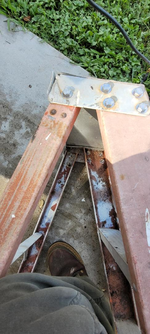
As much of a safety nut as you are, I can’t even believe you were using that ladder.lolI have an old 8 ft fiberglass ladder, which had the rivets for the thinner legs at the top plate pull-out/rust-out. I used my old HFT side grinder (an orange case, probably 25 years old) to remove all the rivets holding all the fasteners for the fat (front) legs as well as the skinny (rear) legs to the top plate. A BFH and a center punch was helpful in punching out all those failing/failed rivets. The rivets were replaced with 5/16" X 1" SS hex head screws, flat washers, and nylok nuts. It's much stronger now.
I also replaced the folding A-arms holding the front/rear ladder legs together, using the same procedure and fasteners.
The ladder was a 'found on the side of the road' item, years ago. Still functional, after a bit of work.
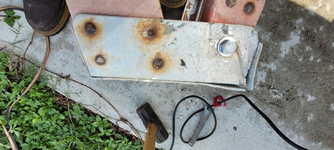
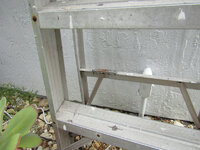
The bad, rusted-out fasteners:
One SS hex head screw already in-place.
Seeing how-bad the rivets were, I wasn't going to use it without replacing them.
The SS hex head screws/nylok nuts are seen here.
I think those bolts are worth more than the rest of the ladder.I have an old 8 ft fiberglass ladder, which had the rivets for the thinner legs at the top plate pull-out/rust-out. I used my old HFT side grinder (an orange case, probably 25 years old) to remove all the rivets holding all the fasteners for the fat (front) legs as well as the skinny (rear) legs to the top plate. A BFH and a center punch was helpful in punching out all those failing/failed rivets. The rivets were replaced with 5/16" X 1" SS hex head screws, flat washers, and nylok nuts. It's much stronger now.
I also replaced the folding A-arms holding the front/rear ladder legs together, using the same procedure and fasteners.
The ladder was a 'found on the side of the road' item, years ago. Still functional, after a bit of work.
The bad, rusted-out fasteners:
One SS hex head screw already in-place.
Seeing how-bad the rivets were, I wasn't going to use it without replacing them.
The SS hex head screws/nylok nuts are seen here.
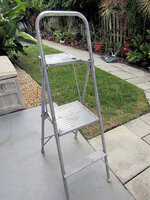
Philip, I'm the likely the least qualified safety adviser on the GJ but I'd shorten that ladder to something like four feet. A fall from 5 or 6 feet might leave a mark or put a body part in a cast. If that ladder was old when you got it, there's no way of knowing how much UV damage has been done to the fiberglass. The rivets you've replaced is a start but you don't put any weight on those. The rusty rivets that attach the steps to the rails look pretty rusted and those rivets hold your full weight. If a ladder step lets loose it will be a complete surprise and you'll be headed for the ground at a rapidly increasing rate.The ladder was a 'found on the side of the road' item, years ago. Still functional, after a bit of work.





No. Which is very confusing. I'll be asking lots of questions before I leave tomorrow with the truck.But did they replace the battery?
Chasing a long cold start issue on the 06 Silverado. Cleaned the throttle body, and wrapped a little Teflon tape around he grommet on the MAP sensor.
The irony is not lost on me.lolA cold start issue? In Florida?
Which engine…I have an 06 as well…Chasing a long cold start issue on the 06 Silverado. Cleaned the throttle body, and wrapped a little Teflon tape around he grommet on the MAP sensor.
Slow leaking injectors, or leaking fuel rail pulse damper, causing a dry rail?The irony is not lost on me.lol
Starts and runs perfect for the rest of the day, even after sitting for 8 to 10 hours. But first thing in the morning, it can take three or four long long cranks to get it going. So long I’m concerned I’m getting the starter too hot.
It has good fuel pressure, good spark, no leaking fuel pressure regulator???
Ive read too much ethanol in the gas can cause it, or possibly a small vacuum leak that goes away once every thing warms up?
4.3Which engine…I have an 06 as well…
Starts fine after 8 or 10 hours of sitting during the day, just doesn’t like mornings, like me..lolI just replaced a fuel pump in a 05 suburban due to a long start after several tries. Regulator was leaking down.
I get instant 65 psi of fuel pressure right at the turn of the key. I would think if the rail was draining it would take a second or three to build pressure?Slow leaking injectors, or leaking fuel rail pulse damper, causing a dry rail?
I had the same issue on an 01 4.7 Dakota. It had one injector leaking down.Chasing a long cold start issue on the 06 Silverado. Cleaned the throttle body, and wrapped a little Teflon tape around he grommet on the MAP sensor.
Had a bad injector about a year ago, so I replaced the whole spider injector. And the fuel pressure is good, I would think if I had a leaking injector the pressure would drop off pretty quick.I had the same issue on an 01 4.7 Dakota. It had one injector leaking down.
The problem was easy to diagnose once I pulled the plugs. The bad injector was fouling the spark plug on that cylinder.
A few months ago I had a no start, that was cured when I replaced the cam and crank sensor. I figured they both had the same mileage.One option given to me was a bad cam sensor?
None, which really irritates me..lolAny codes set?
Not necessarily. My old leaking down car went to full pressure at the turn of the key. Are you reading the pressure with a mechanical gauge, or through the ECU? A lot of ECUs remember what they were doing when they shut down and put that data out for a second before generating a new snapshot on startup.4.3
Starts fine after 8 or 10 hours of sitting during the day, just doesn’t like mornings, like me..lol
I get instant 65 psi of fuel pressure right at the turn of the key. I would think if the rail was draining it would take a second or three to build pressure?
I’m using a gauge at the fuel rail.Not necessarily. My old leaking down car went to full pressure at the turn of the key. Are you reading the pressure with a mechanical gauge, or through the ECU? A lot of ECUs remember what they were doing when they shut down and put that data out for a second before generating a new snapshot on startup.
I can appreciate being frugal and repairing rather than throwing something away, but one minor failure and the cost of a new ladder will be tiny in comparison. I’ve fallen off a few sketchy ladders in my time, but that was when I was younger and dumber. I’ve stopped doing a few things when the potential recovery from injury outweighs the pennies saved.I have an old 8 ft fiberglass ladder, which had the rivets for the thinner legs at the top plate pull-out/rust-out. I used my old HFT side grinder (an orange case, probably 25 years old) to remove all the rivets holding all the fasteners for the fat (front) legs as well as the skinny (rear) legs to the top plate. A BFH and a center punch was helpful in punching out all those failing/failed rivets. The rivets were replaced with 5/16" X 1" SS hex head screws, flat washers, and nylok nuts. It's much stronger now.
I also replaced the folding A-arms holding the front/rear ladder legs together, using the same procedure and fasteners.
The ladder was a 'found on the side of the road' item, years ago. Still functional, after a bit of work.
The bad, rusted-out fasteners:
One SS hex head screw already in-place.
Seeing how-bad the rivets were, I wasn't going to use it without replacing them.
The SS hex head screws/nylok nuts are seen here.
As much of a safety nut as you are, I can’t even believe you were using that ladder.lol
Philip, I'm the likely the least qualified safety adviser on the GJ but I'd shorten that ladder to something like four feet. A fall from 5 or 6 feet might leave a mark or put a body part in a cast. If that ladder was old when you got it, there's no way of knowing how much UV damage has been done to the fiberglass. The rivets you've replaced is a start but you don't put any weight on those. The rusty rivets that attach the steps to the rails look pretty rusted and those rivets hold your full weight. If a ladder step lets loose it will be a complete surprise and you'll be headed for the ground at a rapidly increasing rate.
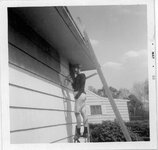
Full Disclosure: I have made many mistakes when it comes to ladders. In 1968 (three years before OSHA was born) my tallest ladder was four feet high and had no safety warnings so I used all but the top step to paint our first house with a spray gun. The extension ladder would have been safer but holding a spray gun with a quart of latex paint with an outreached arm was too close to a torture technique my father used to prove how weak I was as a kid.
A decade later (47 years ago) I bought a super cheap 6-foot aluminum step ladder. The skinny leg eventually buckled on me and I landed on a sturdy hedge. No stitches or casts and using logic similar to yours I reinforced the part that buckled. As @niget2002 points out, stainless hardware would have exceeded the cost of the ladder.
I inherited a short stepladder from my mother-in-law and use it all the time. I suspect it's older than my 6-foot POS but I feel really secure standing on it.
It might be a post-OSHA ladder because the thing that looks like a step at the top is neatly engraved with reminders.
Your post triggered me so once again I visited Jeff's River of Stuff. Knowing how poorly my cheap-*** 6-foot aluminum ladder performed and how uncomfortable its narrow steps are on my bare feet, I looked for the most expensive 6-foot ladder Jeff offers. It appears to be very safe and only $232.97 a month for 12 months.
I'm not sure I'll be alive in 12 months and certainly don't want my widow to be stuck with installments (remember, we don't have a mortgage or car payments or credit card balances that include interest charges). I looked for the least expensive 6-foot ladder and rejected the first few for the first "Jeff's River Choice" at $11.67 a month for 12 months. It's on sale so I decided to pay the full price ($69.99 [22% off]) for the reason mentioned above.
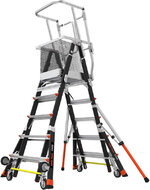
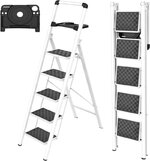
I hesitated for a moment before placing my order because the page showed me a 6-step ladder for about double the price. The cheaper one isn't really a 6-foot ladder and it's not even a 6-step ladder. The 6-step that's on sale for just shy of twice the price caught my eye...
... but I immediately rejected this one because -- see first photo -- I would be standing on that 6th step with pneumatic nailer in hand and the box of nails between my feet. The company offering the 6-step ladder is also named WOA WOA (made me think twice).
I can appreciate being frugal and repairing rather than throwing something away, but one minor failure and the cost of a new ladder will be tiny in comparison. I’ve fallen off a few sketchy ladders in my time, but that was when I was younger and dumber. I’ve stopped doing a few things when the potential recovery from injury outweighs the pennies saved.
One of the maintenance mechanics at my former employer was a frugal guy that drove me crazy by insisting that **** ladders were “good enough”. I pissed him off a few times by running over a sh!t ladder with a 15,000# lift truck to render it garbage.
Next time, in made him use a demo saw to chop one up into little pieces. He was one thick-headed SOB.