To avoid these ads, REGISTER NOW!

Rotary SP09 Concrete Anchors

600SL

Well-known member
Joined
Apr 26, 2012
Messages
1,794
Location
Connecticut
I just purchased a used Rotary SP09 lift. It calls for 3/4" 5-1/2" Anchors to be torqued to 150Ft-lb. All of the anchors I can find in that size range have a torque specification of 110Ft-lb. I would like to get longer anchors for deeper embedment in to my 7" slab so purchasing from Rotary is not an option. Are the 110 Ft-Lb Hilti or Redheads suitable and if so do I torque to 110 or 150 Ft-Lb?

Thanks
 
To avoid these ads, REGISTER NOW!

crazylunker

Well-known member
Joined
Sep 2, 2014
Messages
198
Location
Connecticut, Trumbull
I have to same lift and I purchased the anchor kit with shims on ebay several years ago. I went 110 lbs with epoxy, just checked earlier this year and all were the same, perfect. I don't remember the vendor but it was someone who just sold garage equipment. At the time I also replaced the hose but the cable looked good, in hindsight for piece of mind I should have done the cable as well but so far so good.
 
Last edited:
OP
6

600SL

Well-known member
Joined
Apr 26, 2012
Messages
1,794
Location
Connecticut
I have to same lift and I purchased the anchor kit with shims on ebay several years ago. I wont 110 lbs with epoxy, just checked earlier this year and all were the same, perfect. I don't remember the vendor but it was someone who just sold garage equipment. At the time I also replaced the hose but the cable looked good, in hindsight for piece of mind I should have done the cable as well but so far so good.

The problem with getting the kit from Rotary is it uses the minimum 5-1/2" depth anchor. I would prefer to go with a 7" anchor to get my anchors near the rebar level. My rebar is set at 2" above the base, so that puts it in the 4-1/4" to 5" range.
 

crazylunker

Well-known member
Joined
Sep 2, 2014
Messages
198
Location
Connecticut, Trumbull
The problem with getting the kit from Rotary is it uses the minimum 5-1/2" depth anchor. I would prefer to go with a 7" anchor to get my anchors near the rebar level. My rebar is set at 2" above the base, so that puts it in the 4-1/4" to 5" range.
I have been using for equipment and diesel trucks without an issue, I had one of the trucks in the air for 2 months while doing a transmission conversion. One thing I did notice was the lift grows a surprising amount with temperature.

I had screw jacks under the truck for stability and barely touching. we had a warm couple day in feb and I noticed about a 1/2" gap between the jack and the chassis. The lift was resting on the locks the entire time with the hydraulics relieved.

All that being said my slab is 5" thick 4000psi with no rebar just wire (the lift was an afterthought and the slab was never intended to hold one)
 

pattenp

Well-known member
Joined
Jun 4, 2008
Messages
10,175
Location
Virginia - USA
My Challenger lift calls for 150ftlb torque for setting the anchors, then calls for 80ftlbs final/maintenance torque.
 
OP
6

600SL

Well-known member
Joined
Apr 26, 2012
Messages
1,794
Location
Connecticut
My Challenger lift calls for 150ftlb torque for setting the anchors, then calls for 80ftlbs final/maintenance torque.

Thanks. Just looking at my manual. All it says is 150ft-lb installation torque. No mention of a maintenance torque, but it does make sense. It may explain why this guy is having issues with wedge anchors. I'm still debating anchors or studs and epoxy.


wssix99

Well-known member
Joined
Mar 2, 2011
Messages
5,162
Location
Chicago, IL
The problem with getting the kit from Rotary is it uses the minimum 5-1/2" depth anchor. I would prefer to go with a 7" anchor to get my anchors near the rebar level. My rebar is set at 2" above the base, so that puts it in the 4-1/4" to 5" range.
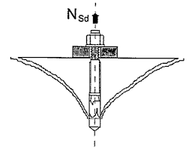
You can use the anchors that came with your lift and rest easy. Installing to your rebar gets you no benefit. All anchors (mechanical and epoxy) develop their strength through a stress cone in the concrete:
1722624822909.png

The rebar is not involved in that cone. (If you installed to the rebar, the cone would still shoot up above it.)

For two anchors of a similar dimension, the torque spec will change depending on the metallurgy of the anchor. If you are looking at two similar anchors with different torque specs, they should have different tensile properties.


Thanks. Just looking at my manual. All it says is 150ft-lb installation torque. No mention of a maintenance torque, but it does make sense. It may explain why this guy is having issues with wedge anchors.
That guy doesn't know what he is doing. The disclaimer in his video states not to follow him and that he's not an engineer. It shows and he has made several mistakes.

The best thing you can do is not make the same mistakes. Buy a brand new drill bit before your project. Use a quality hammer drill - rent one if you need to. This will give you a clean hole and smooth sailing with the anchors.

I used several drill bits to install my lifts and don't regret it. I would bet the guy in the video used an old bit and the two holes he is having problems with were the last two he drilled...

I'm still debating anchors or studs and epoxy.
There are many threads on this and many reasons why the mechanical anchors give better assurance and insurance for safety and reliability.

One doesn't need to be an expert to put a video on the internet, but your lift manufacturer knows what they are doing. There are reasons they supplied you with those parts and they did not give you epoxy instructions. Unlike the boys on YouTube, they are experts and know what they are doing.
 
OP
6

600SL

Well-known member
Joined
Apr 26, 2012
Messages
1,794
Location
Connecticut
You can use the anchors that came with your lift and rest easy. Installing to your rebar gets you no benefit. All anchors (mechanical and epoxy) develop their strength through a stress cone in the concrete:

1722624822909.png

The rebar is not involved in that cone. (If you installed to the rebar, the cone would still shoot up above it.)

For two anchors of a similar dimension, the torque spec will change depending on the metallurgy of the anchor. If you are looking at two similar anchors with different torque specs, they should have different tensile properties.


That guy doesn't know what he is doing. The disclaimer in his video states not to follow him and that he's not an engineer. It shows and he has made several mistakes.

The best thing you can do is not make the same mistakes. Buy a brand new drill bit before your project. Use a quality hammer drill - rent one if you need to. This will give you a clean hole and smooth sailing with the anchors.

I used several drill bits to install my lifts and don't regret it. I would bet the guy in the video used an old bit and the two holes he is having problems with were the last two he drilled...


There are many threads on this and many reasons why the mechanical anchors give better assurance and insurance for safety and reliability.

One doesn't need to be an expert to put a video on the internet, but your lift manufacturer knows what they are doing. There are reasons they supplied you with those parts and they did not give you epoxy instructions. Unlike the boys on YouTube, they are experts and know what they are doing.

Thanks for the reply. Since this is a used lift I don't have the anchors that came with it and I will need to purchase new ones. Forget the rebar if I go with a deeper anchor wouldn't the cone get bigger. Might be over kill but I do have 7" 4500 PSI concrete and since I have to purchase new anchors, I don't see 7" anchors costing too much more that the 5.5" anchors the lifts are usually shipped with. I believe the manufactures ship these lifts with 5.5" anchors because the minimum concrete spec is 4-1/4". Since I have 7", I would think there would be a benefit with longer anchors like 7" or 8".

As far as new drill bits. I have 10 holes to drill. Would 2 bits cover it. I was at HD today they had two styles of drill bit. One with 2 flutes and another with 4 flutes. The 4 flute drill was for concrete with rebar. I don't plan on drilling into the rebar, but the 4 flute bit looked like it might drill a cleaner hole. I also considered pilot drilling the holes with a 1/2" bit. The 1/2" pilot bit would be centered in the hole by making a starting divit with the 3/4" bit, then drilling the full depth with the 1/2" bit followed by the full size 3/4" bit. Would you have any thoughts on pilot drilling.

The thing I like about the mechanical wedges is it still leaves me with an epoxy solution if one should pull out. I did see another video from a professional installer that recommended epoxy with the wedge anchors. He drilled the holes to 3/4" and just coated the anchors with epoxy before installation. Torqued each one while the epoxy was wet. Seems like it couldn't hurt.
 

wssix99

Well-known member
Joined
Mar 2, 2011
Messages
5,162
Location
Chicago, IL
The thing I like about the mechanical wedges is it still leaves me with an epoxy solution if one should pull out.
This is how the lift manufactures work. Epoxy is a back-pocket option that they can use if people get in trouble.

I did see another video from a professional installer that recommended epoxy with the wedge anchors. He drilled the holes to 3/4" and just coated the anchors with epoxy before installation. Torqued each one while the epoxy was wet. Seems like it couldn't hurt.
You might keep in mind that professional installers are not professional engineers and have no qualification that requires that they actually know how these things work or are designed. They are supposed to only read the instructions and be skilled in following them. Unfortunately, many don't even do that and can do dangerous things, like this example. (Wedge anchors will move a little bit, particularly in their first few months, which require re-torqueing. Epoxy could gum up the mechanical anchor and cause all sorts of bad things to happen.)

Thanks for the reply. Since this is a used lift I don't have the anchors that came with it and I will need to purchase new ones. Forget the rebar if I go with a deeper anchor wouldn't the cone get bigger.
Yes. With some anchor bolts there are negatives to doing this, but probably not in this case. I would see if you can find the spec for the anchor bolt that the lift manufacturer provides and match that. At that point, I expect you will find similar torque specs.

As far as new drill bits. I have 10 holes to drill. Would 2 bits cover it. I was at HD today they had two styles of drill bit. One with 2 flutes and another with 4 flutes. The 4 flute drill was for concrete with rebar. I don't plan on drilling into the rebar, but the 4 flute bit looked like it might drill a cleaner hole. I also considered pilot drilling the holes with a 1/2" bit. The 1/2" pilot bit would be centered in the hole by making a starting divit with the 3/4" bit, then drilling the full depth with the 1/2" bit followed by the full size 3/4" bit. Would you have any thoughts on pilot drilling.
The more expensive bit will give you a much cleaner hole. IMO - the headaches you will avoid will be worth the expense to have one of these. Murphy's law dictates that you will hit rebar in your floor.

When I did my lifts, I used a brand new regular bit. With a good drill and the new bit, the holes drilled like butter. ... until I hit rebar. At that point, I switched to my rebar cutting bit and had no problems.

If you use the rebar cutting bit for the whole deal, it will be super-easy.
 
OP
6

600SL

Well-known member
Joined
Apr 26, 2012
Messages
1,794
Location
Connecticut
This is how the lift manufactures work. Epoxy is a back-pocket option that they can use if people get in trouble.


You might keep in mind that professional installers are not professional engineers and have no qualification that requires that they actually know how these things work or are designed. They are supposed to only read the instructions and be skilled in following them. Unfortunately, many don't even do that and can do dangerous things, like this example. (Wedge anchors will move a little bit, particularly in their first few months, which require re-torqueing. Epoxy could gum up the mechanical anchor and cause all sorts of bad things to happen.)


Yes. With some anchor bolts there are negatives to doing this, but probably not in this case. I would see if you can find the spec for the anchor bolt that the lift manufacturer provides and match that. At that point, I expect you will find similar torque specs.


The more expensive bit will give you a much cleaner hole. IMO - the headaches you will avoid will be worth the expense to have one of these. Murphy's law dictates that you will hit rebar in your floor.

When I did my lifts, I used a brand new regular bit. With a good drill and the new bit, the holes drilled like butter. ... until I hit rebar. At that point, I switched to my rebar cutting bit and had no problems.

If you use the rebar cutting bit for the whole deal, it will be super-easy.

Some good points. I did do some more research and looked at the 20K lift specifications. I was thinking that they would require more concrete thickness and therefore specify a longer anchor. Surprisingly the 20K lift only requires 4-1/4" thick concrete with 5.5" anchors just like the 9K lift to comply with ANSI/ALI ALCTV standards, but there are 7 of them instead of 5. But for IBC (International Building Code) it requires 5" thick using epoxy installed studs or 6" thick using Anchors. The 20K lift also specifies the anchor manufacture as Hilti Kwik Bolt III and specifies a torque of 110Ft-Lb. I believe the 150FT-Lb may have been a typo in the 9K manual as 110Ft=Lb ~ 149NM.

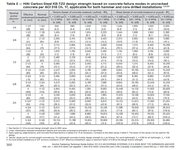
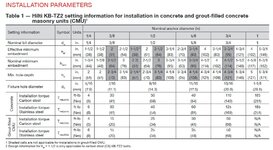
The Hilti Kwik Bolt III is no longer available in carbon steel and has been replaced by the Hilti TZ2. Data for the Hilti TZ2 shows a 40% greater load using 5-1/2" embedment (5" anchors) over a 4" embedment (5.5" anchors), so the longer anchors should perform better in a 7" thick slab.

I'm going to try to call Rotary and Hilti this week to get there take.

As far as hitting the rebar, I have to find it first even if I have to rent or contract a radar scanner because my radiant heat lines are attached to it.
SPO20 installation.jpgHilti TZ2 installation 2.jpgHilti TZ2 installation.jpgIMG_20230822_153239454.jpg
 

crazylunker

Well-known member
Joined
Sep 2, 2014
Messages
198
Location
Connecticut, Trumbull
Thanks for the reply. Since this is a used lift I don't have the anchors that came with it and I will need to purchase new ones. Forget the rebar if I go with a deeper anchor wouldn't the cone get bigger. Might be over kill but I do have 7" 4500 PSI concrete and since I have to purchase new anchors, I don't see 7" anchors costing too much more that the 5.5" anchors the lifts are usually shipped with. I believe the manufactures ship these lifts with 5.5" anchors because the minimum concrete spec is 4-1/4". Since I have 7", I would think there would be a benefit with longer anchors like 7" or 8".

As far as new drill bits. I have 10 holes to drill. Would 2 bits cover it. I was at HD today they had two styles of drill bit. One with 2 flutes and another with 4 flutes. The 4 flute drill was for concrete with rebar. I don't plan on drilling into the rebar, but the 4 flute bit looked like it might drill a cleaner hole. I also considered pilot drilling the holes with a 1/2" bit. The 1/2" pilot bit would be centered in the hole by making a starting divit with the 3/4" bit, then drilling the full depth with the 1/2" bit followed by the full size 3/4" bit. Would you have any thoughts on pilot drilling.

The thing I like about the mechanical wedges is it still leaves me with an epoxy solution if one should pull out. I did see another video from a professional installer that recommended epoxy with the wedge anchors. He drilled the holes to 3/4" and just coated the anchors with epoxy before installation. Torqued each one while the epoxy was wet. Seems like it couldn't hurt.
I only used one drill bit and still use the same bit for other purposes, as well as the bit was several years old before the lift install, Keep the hole as powder free as possible whenever drilling concrete. I always run a vacume right against the bit while drilling(normally use one of my hvac suit vacs) you will be amazed how fast the filter get clogged.
 
OP
6

600SL

Well-known member
Joined
Apr 26, 2012
Messages
1,794
Location
Connecticut
I only used one drill bit and still use the same bit for other purposes, as well as the bit was several years old before the lift install, Keep the hole as powder free as possible whenever drilling concrete. I always run a vacume right against the bit while drilling(normally use one of my hvac suit vacs) you will be amazed how fast the filter get clogged.

I will probably start with one new bit and see how the first column goes. I have seen how bits get old and don't perform well and end up over sizing the hole. But you can tell by the bits performance. If it gets slow to drill its time to replace.
 

wssix99

Well-known member
Joined
Mar 2, 2011
Messages
5,162
Location
Chicago, IL
I believe the 150FT-Lb may have been a typo in the 9K manual as 110Ft=Lb ~ 149NM.
I'll bet that's it!!!

As far as hitting the rebar, I have to find it first even if I have to rent or contract a radar scanner because my radiant heat lines are attached to it.

I would definitely use the shorter anchors and stay away from that zone. Your radiant is at least 1 1/2" from the bottom of the slab, so you don't have a lot of insurance. Renting a scanner is a good move, but I think you will have a hard time getting all the holes to avoid the lines unless the pour was planned for them.

I had to anchor some rack shelving right above my lines and drilled very carefully to make sure I didn't go down too deep...
 
OP
6

600SL

Well-known member
Joined
Apr 26, 2012
Messages
1,794
Location
Connecticut
I'll bet that's it!!!


I would definitely use the shorter anchors and stay away from that zone. Your radiant is at least 1 1/2" from the bottom of the slab, so you don't have a lot of insurance. Renting a scanner is a good move, but I think you will have a hard time getting all the holes to avoid the lines unless the pour was planned for them.

I had to anchor some rack shelving right above my lines and drilled very carefully to make sure I didn't go down too deep...

Unfortunately the rebar is on a 2" chair, radiant heat is the highest point and the top of the tubes should be 3.25" from the bottom, or 3.75 from the top. That means short or long anchors I will still need miss it.
 
OP
6

600SL

Well-known member
Joined
Apr 26, 2012
Messages
1,794
Location
Connecticut
Called Rotary. They said the proper torque is 150Ft-Lb and they confirmed the SPO9 lift used Hilti anchors. The newer lift they sell today come with Fastenal Anchors., which means an approved supplier with the lowest bid. I believe the guy was just reading off the same manual I have. I called Hilti, they said they do not have a 3/4" wedge anchor that can be torqued to 150Ft-Lb. But they do have an epoxy in 3/4" anchor that can be torqued up to 165Ft-Lb. The Hilti epoxy anchors are not a threaded rod, they are special anchor just for epoxy.

I'm going with the Hilti 7" TZ2
 
OP
6

600SL

Well-known member
Joined
Apr 26, 2012
Messages
1,794
Location
Connecticut
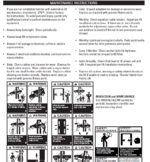
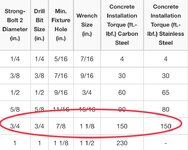
Finally got my heating system up and running so I was able to scan the floor with a FLIR camera to see where the radiant lines were. That and a broken leg put me out of commission for a few months. Just installed the lift at 110ft-lb and came back to read this. All went well at 110ft-Lb now I'm going to bring it up to 150ft-Lb. I also found, NOT in the installation manual, but in the Operation and Maintenance manual. That every 3 months I should recheck torque to 65 ft-lb. So I guess its a one time torque to 150ft-Lb and thereafter 65ft-lb. every 3 months. See right side column about 1/2 way down.

1740779988324.png
 

wssix99

Well-known member
Joined
Mar 2, 2011
Messages
5,162
Location
Chicago, IL
Call Rotary customer service and get the correct answer. Torque requirements (in an anchor bolt) are a function of the characteristics of the bolt and nothing else.

110 sounds right for a 3/4" bolt. 150 feels high. 65 is definitely too low and is probably from a generic copy/paste job in the manual. The instructions for these lifts (no matter the manufacturer) are a little sloppy and have inconsistencies. I can't count the times I have had to go back and sort out corrections for my Bend-Pak lifts.
 
To avoid these ads, REGISTER NOW!
OP
6

600SL

Well-known member
Joined
Apr 26, 2012
Messages
1,794
Location
Connecticut
Call Rotary customer service and get the correct answer. Torque requirements (in an anchor bolt) are a function of the characteristics of the bolt and nothing else.

110 sounds right for a 3/4" bolt. 150 feels high. 65 is definitely too low and is probably from a generic copy/paste job in the manual. The instructions for these lifts (no matter the manufacturer) are a little sloppy and have inconsistencies. I can't count the times I have had to go back and sort out corrections for my Bend-Pak lifts.

I did call rotary and Hilti. See post 16. I also found all the lift manufactures are specifying an initial torque of 150ft-Lb and a reduced torque after. Rotary has the lowest inspection torque of 65ft-Lb, BendPak was higher at 85-95, and pattenp mentioned 80ft-Lb for Challenger.
 

dave*99

Well-known member
Joined
May 5, 2009
Messages
4,269
Location
Coastal NJ
Retorque spec on wedge anchors is always lower than initial installation torque. You don't want to pull the anchors out. During installation, you are expanding the wedges. During retorque you are confirming nothing has loosened. They are different operations.

I don't see the need to reengineer this. I've had my Rotary SPOA10 in 2 different garages. Wedge lock 5 1/2" anchors. If Rotary felt more support was needed, they would use larger base plates and more holes. Not longer bolts.
This is evidenced by the plate size of the 20K lift.

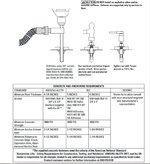
Rotary manual:
1740855601545.png
 
Last edited:

wssix99

Well-known member
Joined
Mar 2, 2011
Messages
5,162
Location
Chicago, IL
I did call rotary and Hilti. See post 16. I also found all the lift manufactures are specifying an initial torque of 150ft-Lb and a reduced torque after. Rotary has the lowest inspection torque of 65ft-Lb, BendPak was higher at 85-95, and pattenp mentioned 80ft-Lb for Challenger.
Sorry I missed that. As mentioned above, the spec is dependent on the bolt. If the other lifts are using a weaker steel in the bolts, they will have a lower torque. Torque is required to tension the bolt. This not only gets the anchor to "dig-in" to the concrete, but it stretches the bolt like a wet noodle. (The stretch is dependent on the properties of the bolt.) As the bolt stretches, the threads of the bolt develop increased friction on the nut. <- This is what keeps the nut from twisting off and is the most important thing.

Over time, things will settle and you will need to re-torque the bolts. The need to do this will diminish over time. I was retorquing every month when I first installed my lift and now I check every year and it's all solid.

I would follow Hilti's spec. It looks like their 3/4" bolt is 110 ft-lb and 150Nm:


Also, as was pointed out above - the manuals are sloppy. I wouldn't be surprised if the 150 comes from someone misreading the Nm figure and inserting it in the manual. The 65 number could be from an old bolt before Rotary switched to Hilti.

Hilti's instructions should be definitive and you should just need to maintain the torque at their spec constantly. For extra comfort, you could call Rotary back and bang on the ceiling, shove their document and Hilti's spec in front of a Rotary engineer's face and ask them to explain themselves. <- My wife is really good at this and is a pit bull when in "Karen mode." I should find a way of making money off this as a service. (It feels like we need to do more and more of this as companies press the work offshore.)
 
OP
6

600SL

Well-known member
Joined
Apr 26, 2012
Messages
1,794
Location
Connecticut
Sorry I missed that. As mentioned above, the spec is dependent on the bolt. If the other lifts are using a weaker steel in the bolts, they will have a lower torque. Torque is required to tension the bolt. This not only gets the anchor to "dig-in" to the concrete, but it stretches the bolt like a wet noodle. (The stretch is dependent on the properties of the bolt.) As the bolt stretches, the threads of the bolt develop increased friction on the nut. <- This is what keeps the nut from twisting off and is the most important thing.

Over time, things will settle and you will need to re-torque the bolts. The need to do this will diminish over time. I was retorquing every month when I first installed my lift and now I check every year and it's all solid.

I would follow Hilti's spec. It looks like their 3/4" bolt is 110 ft-lb and 150Nm:


Also, as was pointed out above - the manuals are sloppy. I wouldn't be surprised if the 150 comes from someone misreading the Nm figure and inserting it in the manual. The 65 number could be from an old bolt before Rotary switched to Hilti.

Hilti's instructions should be definitive and you should just need to maintain the torque at their spec constantly. For extra comfort, you could call Rotary back and bang on the ceiling, shove their document and Hilti's spec in front of a Rotary engineer's face and ask them to explain themselves. <- My wife is really good at this and is a pit bull when in "Karen mode." I should find a way of making money off this as a service. (It feels like we need to do more and more of this as companies press the work offshore.)

I do believe the 150ft-Lb is a real installation torque as it is the same for all lift companies using the 3/4" anchors. Interesting though is the re-torque value is higher 90 ft-Lb for the 12,000 Rotary.
Retorque spec on wedge anchors is always lower than initial installation torque. You don't want to pull the anchors out. During installation, you are expanding the wedges. During retorque you are confirming nothing has loosened. They are different operations.

I don't see the need to reengineer this. I've had my Rotary SPOA10 in 2 different garages. Wedge lock 5 1/2" anchors. If Rotary felt more support was needed, they would use larger base plates and more holes. Not longer bolts.
This is evidenced by the plate size of the 20K lift.

Rotary manual:
1740855601545.png

Keep in mind Rotary is basing the bolt length on a minimum 4.25" concrete. If you have thicker concrete might as well use it, but agree its not required. Also the 20 K lifts use more anchors.
 

dave*99

Well-known member
Joined
May 5, 2009
Messages
4,269
Location
Coastal NJ
And Rotary only requires 3 1/4” embedment of the anchors. I’m not saying long anchors will hurt. But I don’t believe a deep set 5 1/2” anchor will ever fail if properly installed.
I have 12” of concrete under my lift posts.
So I had room for longer anchors……
 
OP
6

600SL

Well-known member
Joined
Apr 26, 2012
Messages
1,794
Location
Connecticut
And Rotary only requires 3 1/4” embedment of the anchors. I’m not saying long anchors will hurt. But I don’t believe a deep set 5 1/2” anchor will ever fail if properly installed.
I have 12” of concrete under my lift posts.
So I had room for longer anchors……
It will not fail if properly installed and I wouldn't go out and buy new anchors if 5.25's came with the lift. But as pointed out in post 7 you can see how the anchors work and obviously deeper anchors will increase the bearing area of the cone. The picture below shows a failure where the anchors held perfectly as designed but the concrete gave out, possibly due to poor concrete. Poor concrete is not something you can easily test for with out taking core samples at the time of the pour and having them laboratory tested. Such testing is limited to large corporate or government contracts. So in the case below, perhaps the concrete really didn't make the 3500PSI spec but in that case longer anchors may have mitigated the poor quality concrete. So if you have to purchase new anchors and you have the concrete to use them by all means do so.

1740873957498.jpeg
 

ConCretin

Well-known member
Joined
Jan 20, 2011
Messages
3,379
Location
Central Maine
Interesting failure. I wonder if @ConCretin can tell us what went wrong. Kinda looks like a skim coat is on that concrete.
You can't really see the anchors themselves to see what might have failed but I agree, it looks like there was some kind of overlay over the slab. This could suggest the slab itself wasn't in the best condition.
 
Last edited:

wssix99

Well-known member
Joined
Mar 2, 2011
Messages
5,162
Location
Chicago, IL
I do believe the 150ft-Lb is a real installation torque as it is the same for all lift companies using the 3/4" anchors. Interesting though is the re-torque value is higher 90 ft-Lb for the 12,000 Rotary.

This is not a universal figure. Here's the BendPak table. 110 ft-lb (MAX)
1740952443840.png
You'll see in the table that:
- Indeed, torque is a function of the bolt.
- 150 ft-lb is a proper torque for a 3/4" class 4.8 bolt, but not the anchor bolt... (This is another place where wires can get crossed with a manual writer. ... or tech support reader)
 

GCS

Well-known member
Joined
Dec 12, 2014
Messages
315
Location
Oklahoma
Simpson 3/4” anchor bolts call out 150 LB/FT…
 

Attachments

  • IMG_2438.jpeg
    IMG_2438.jpeg
    106.8 KB · Views: 12
OP
6

600SL

Well-known member
Joined
Apr 26, 2012
Messages
1,794
Location
Connecticut
Simpson 3/4” anchor bolts call out 150 LB/FT…

Interesting. These fasteners all look the same but different specs. Simpson also requires a minimum of 6" concrete for the shorter bolts and 8.75" for the longer bolts. It would make sense that you could torque to a higher value with ~ 2 inches of concrete left below the hole.
 

wssix99

Well-known member
Joined
Mar 2, 2011
Messages
5,162
Location
Chicago, IL
Simpson 3/4” anchor bolts call out 150 LB/FT…

NOT the bolt that the OP specified above. There is also a link to Hilti's document above. The OPS bole is 110. The torque will be different for different bolts, even from the same manufacturer.
 

crazylunker

Well-known member
Joined
Sep 2, 2014
Messages
198
Location
Connecticut, Trumbull
Finally got my heating system up and running so I was able to scan the floor with a FLIR camera to see where the radiant lines were. That and a broken leg put me out of commission for a few months. Just installed the lift at 110ft-lb and came back to read this. All went well at 110ft-Lb now I'm going to bring it up to 150ft-Lb. I also found, NOT in the installation manual, but in the Operation and Maintenance manual. That every 3 months I should recheck torque to 65 ft-lb. So I guess its a one time torque to 150ft-Lb and thereafter 65ft-lb. every 3 months. See right side column about 1/2 way down.

1740779988324.png
I have a feeling the 150 initial is the seat the wedge and they inspection torque of 65 is just used as an indicator of the wedge/pin coming loose. More than likely any of the anchors staying above 65lbs is fine for normal lift use and the initial specs are just required by the anchor mfr.
 

PLUM72

Member
Joined
Sep 14, 2017
Messages
20
Adhesive anchors might be a better choice here. They are generally stronger than a wedge and better for dynamic loads. Use high strength B7 threaded rod. The rod can be cut to the embedment that works best for your concrete depth. Whatever anchor you choose, you should follow the anchor manufacturers install and torque recommendations. The Red Head A7+ adhesive is not difficult. See their install video...https://youtu.be/pq2pVCI6Svg
 
OP
6

600SL

Well-known member
Joined
Apr 26, 2012
Messages
1,794
Location
Connecticut
Adhesive anchors might be a better choice here. They are generally stronger than a wedge and better for dynamic loads. Use high strength B7 threaded rod. The rod can be cut to the embedment that works best for your concrete depth. Whatever anchor you choose, you should follow the anchor manufacturers install and torque recommendations. The Red Head A7+ adhesive is not difficult. See their install video...https://youtu.be/pq2pVCI6Svg

Sounds good but not a single lift manufacture, I could find, recommends them?
 

BobnCO

Well-known member
Joined
Apr 2, 2023
Messages
209
FYI - I recently purchased a used Rotary 9,000 (I know some of you would not, and would have been right (feel better now ; ) as it needed some work) and went through all the discussions here and elsewhere. All the guys including lift installers and industrial concrete guys who claim adhesive anchors are technically superior convinced me. That and having been a commercial builder and having at least one out of ten wedge anchors seem to f’up upon install and/or not bite…. (And apparently at that point Rotary thinks adhesive anchors are hunky dory) I bought rated manufactured studs (not just cut threaded rod) and associated rated nuts from Fastenal. Turned out great (move fast with the epoxy!). Not climbing under the F‘n cars… priceless (testing with my smallest truck)
 

Attachments

  • IMG_7450.jpeg
    IMG_7450.jpeg
    696.8 KB · Views: 13

Aahz

Well-known member
Joined
Feb 4, 2006
Messages
417
Location
Chicago, IL
When an OEM Lift manufacturer (Rotary in this case) gets their lift certified by ALI / ETL, the anchor manufacturer and model of the anchor must be listed as part of the process, I believe. The lift OEM is not going to approve any anchors other than the ones used during the test. That's not to say other anchors cannot be used or are not safe or anything like that... they just don't want the liability of approving someone utilizing something that has not been tested in the application.
As a professional lift install company, there are times when we use epoxy anchors due to issues with the floor. It's acceptable for a couple of the anchors on each baseplate to be epoxied, but if you need to epoxy all of them, the floor has bigger issues than the epoxy is going to solve. In that case, it's recommended to saw cut out a 4' x 4' slab around each baseplate and repour the slab, tying it into the existing floor.
Rest assured, the OEM's know their products and don't expect anyone to re-engineer these issues on their own.
 
To avoid these ads, REGISTER NOW!
Top Bottom