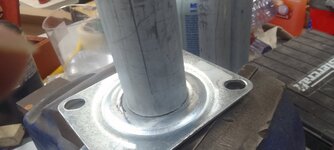
I'm in the NOPE camp.
Too many negatives with your idea.
Welding on zinc is not so good. For you (breathing in the zinc oxide fumes gives you "metal fume fever" in the short term) or for the weld puddle (bad for the weld metallurgy).
Welding WILL distort your plate caster geometry. How much and how badly that will affect the caster operation is unknown. As an example, I once welded some angle iron to some 1/4" thick steel plate with my 'little' MIG machine (240V input but only max 175 amp output) with IIRC .030 solid wire and C25 in short-circuit transfer mode GMAW (not spray mode). Not very big welds, more of some stitch welds spaced apart and not a continuous long bead. The opposite FACE of the plate from the weld beads got ****-back from the weld bead contraction and now has plainly visible, tactile, and measurable 'craters' on that face.
What proposed welding process? TIG won't tolerate the zinc at all and you'll insta-trash your tungsten. MIG will be iffy as far as a quality weld goes. FCAW and SMAW (aka stick) as flux/slag processes will 'tolerate' the zinc coating the most, depending on the specific wire or stick being used.
But you ALWAYS get the best weld when you have CLEAN bare steel (or any metal that you are trying to weld) without any plating or grease or oil or paint or rust or anything that is not clean shiny bare metal.
Acid will remove the zinc. Muriatic acid will remove zinc PDQ, and the fumes will also mess up any steel in the area. And how are you going to rinse and/or neutralize the acid without getting it into the caster tracks/race or the actual caster bearing balls? And the now bare steel after the zinc is removed by the acid will usually rust very quickly right after you rinse the acid off.
Part of the reason that a plate caster has the plate bigger than the caster bearing area is for mounting and for securing the plate 'outside' of the bearing area to make a stiffer and stronger mounting with less wobble all around. If a plate caster could be made with less plate material and still function properly, I'm sure that the caster companies would do so. A stem caster is smaller in the mounting area but is typically NOT as strong or sturdy or durable as a plate mounted caster.
Fixed on using the pipe and sticking a caster on the end of it? Rig up a stem caster into the end of the pipe (see note about having/using a long coupling nut and not just sticking the threaded stem into just a few threads worth of mounting area) or weld a mounting plate onto the end of your pipe and then bolt that to the plate caster.
What and why are you trying to do with your plate caster on the end of a pipe idea?