To avoid these ads, REGISTER NOW!

Is this idea code compliant?

DGersic

Well-known member
Joined
Mar 12, 2017
Messages
6,383
Location
DeKalb, IL
This may sound a bit crazy or weird, but bear with me a minute and I’ll explain why I want to do this.

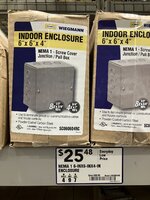
Can I use a box like this one as an unconventional outlet cover?
IMG_5528.jpeg

The back story:

We own a cottage on the Jersey Shore. No pics of that right now, it’s half a continent away. Because it’s slab on grade, since Sandy we’ve been dealing with flooding issues. I’ve discussed this in other threads. What we have, right now, is a standard sump pump pit burried in the “yard”, with fabric sleeved drain tile and surface drains. The pump ejects to the street. When all is working, we don’t flood. Earlier this week, heavy rain combined with an electrical failure, and we flooded.

When this was originally installed and wired, they used an interior 20A circuit that feeds the bedroom wall outlets, stabbed wire through the wall to the outside, and installed a box with an “in use” weather cover and a GFCI outlet. As I understand it, the outlet being outside requires it to be GFCI. What failed, and flooded us, is the GFCI. Got somebody to push the reset button, and the pump quickly emptied the flooded yard.

The 20A circuit has wall outlets, two table lamps, and a bathroom ceiling lamp fixture on it. The GFCI is T‘d off of this in the middle and is not protecting anything downstream. The pump draws (spec sheet) 10A, so the circuit has plenty of capacity. I got a handyman guy to replace the GFCI outlet on the theory that the unknown age GFCI was wearing out and nuisance tripping.

The GFCI is a weak link in our flood protection plan. I don’t like GFCI in general, I’ve personally seen GFCI outlets trip for no reason at all, trip when there is lighting nearby, and fail outright. Having one supporting a sump pump seems like a bad idea, but being an outside outlet, it’s required.

An option is just to replace it with a normal outlet. Not code compliant. But this outlet isn’t intended for use by people, its only purpose is to support the pump. The risk involved in unplugging the pump and plugging in something else is not a concern. But I do like to be code compliant and safe.

So, here is the crazy part. I’d like to eliminate the “outside” part of this, thereby removing the need for a GFCI outlet. I’d also like to get it off of the shared circuit.

1. New 20A breaker in panel. There is plenty of room.

2. Run 12-2 Romex up, over, and down in to the wall cavity. The walls are 2x4 studs, with no insulation in the cavity, and there are no ceilings.

3. Inside the wall cavity, mount a 1 gang box, with the open side facing down. Install a single 20A outlet in the box, facing down.

IMG_5532.jpeg

4. Cut a 6x6 hole in the wall, to insert this junction box, modified. I can cut a round hole in the top to mate it with the round face of the outlet. I can cut a hole in the bottom and install a gromet to protect the pump cords from any sharp edge or rubbing damage.

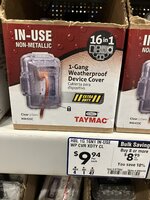
5. On the outside wall, install an “in use” cover like this to act as a pass through.
IMG_5531.jpeg

I can then route the two cords (pump + float switch) through the wall to the inside outlet. The box becomes, in effect, an unusual outlet cover, protecting the cords, plugs, and outlet from tampering or damage, while still being accessible for eventual pump replacement. Since the outlet is “inside”, I no longer need it to be a GFCI.

While admittedly unusual, is this reasonably code compliant? Are there any safety issues I’m not seeing in having an outlet “in” the wall within a covered box?

The only code issue I can think of is that I can’t staple the romex inside the wall cavity.
 
To avoid these ads, REGISTER NOW!

PCustoms

Well-known member
Joined
Jul 23, 2011
Messages
23,517
Location
VT
That's a lot to read....

What tripped the GFCI in the first place?

Pretty sure the fact that the pump is outside, and obviously used in a wet location, drives the need for the GFCI, but I may be wrong.

Can you get a hardwired pump?
 

dcg9381

Well-known member
Joined
Jun 20, 2018
Messages
11,927
Location
Austin, TX
While admittedly unusual, is this reasonably code compliant? Are there any safety issues I’m not seeing in having an outlet “in” the wall within a covered box?
There's a lot there to follow, maybe a diagram or photo would be better. Can you place an outlet in an "unreachable" space and be code compliant? Probably not. Reference: "Section 314.29 of the National Electrical Code requires that all outlet boxes be accessible without removing any part of the building or structure."

Would I do it anyway in your case if prevents flooding? Probably.

Done "otherwise" correctly, the only safety issue that I see is your suggestion of moving to non-GFI in a known wet location.

Personally, if you're subject to flooding, I'd want 2 sump pumps (both on isolated circuits) and a battery backup.
I would want a "septic alarm" down there on a float, again, separate circuit, to let me know things are not working.

Would I do it without GFI? I don't like doing that in wet locations. There are times I'll break the rules - my shop does not have GFI circuits - but it's not a wet location. I did just do a non-GFI on an above ground outdoor "lake pump", but I was replacing 1950s electrical and definitely improved the situation.

Is the tripped GFI on the breaker or on an outlet?

Another "simple" idea that worked for me is installing a wifi camera in the same circuit as the pump. Not for the camera, but because my phone tells me when a camera goes offline - this alerts me to a power outage on that circuit.
 
OP
D

DGersic

Well-known member
Joined
Mar 12, 2017
Messages
6,383
Location
DeKalb, IL
That's a lot to read....

What tripped the GFCI in the first place?

Pretty sure the fact that the pump is outside, and obviously used in a wet location, drives the need for the GFCI, but I may be wrong.

Can you get a hardwired pump?

Yeah, I know. Better to include as much detail as possible vs. having to do 20 questions.

Unknown why the GFCI popped. Could be that it’s old, I’ve seen GFCI here at home wear out with age and start randomly tripping, solved by replacing with a new one. Could be lighting, I’ve seen the ones here at home trip with a nearby strike. Could be an actual ground fault detected, I guess, though that seems least likely.

Here in Illinois, a GFCI is not required for a sump pump. Even though a pump is, by design, going to be in a wet location.

The “outside” part is an unusual wrinkle, yes, but is there any real difference between having it outside the house envelope by being outside the wall vs. being under the basement floor?

Is a hardwire pump even a thing? Never seen one. Everything I’ve seen plugs in to an outlet.
 
OP
D

DGersic

Well-known member
Joined
Mar 12, 2017
Messages
6,383
Location
DeKalb, IL
There's a lot there to follow, maybe a diagram or photo would be better. Can you place an outlet in an "unreachable" space and be code compliant? Probably not. Reference: "Section 314.29 of the National Electrical Code requires that all outlet boxes be accessible without removing any part of the building or structure."

Would I do it anyway in your case if prevents flooding? Probably.

Done "otherwise" correctly, the only safety issue that I see is your suggestion of moving to non-GFI in a known wet location.

Personally, if you're subject to flooding, I'd want 2 sump pumps (both on isolated circuits) and a battery backup.
I would want a "septic alarm" down there on a float, again, separate circuit, to let me know things are not working.

Would I do it without GFI? I don't like doing that in wet locations. There are times I'll break the rules - my shop does not have GFI circuits - but it's not a wet location. I did just do a non-GFI on an above ground outdoor "lake pump", but I was replacing 1950s electrical and definitely improved the situation.

Is the tripped GFI on the breaker or on an outlet?

Another "simple" idea that worked for me is installing a wifi camera in the same circuit as the pump. Not for the camera, but because my phone tells me when a camera goes offline - this alerts me to a power outage on that circuit.

Quick drawing illustrating the description above.

IMG_4980.jpeg

The outlet would be no more unreachable than any other covered outlet. Unorthodox orientation, in that it’s not sticking out of the wall, but remove a couple of screws, and there it is. No part of the structure has to be removed for access to it.

Two or more pumps, battery backup, all would still be hampered by being stuck in to a GFCI outlet. If that goes, then nothing works anyway. Two GFCI outlets, in parallel, are maybe less likely to fail at the same time than one is.

An alarm is only helpful if someone is there, or can be there, to deal with it. Cottage is in New Jersey, I’m in Chicago. I can get somebody there, but not necessarily “right now”. More like “probably some time today” is what I’d expect, at best.

What popped is the GFCI outlet. The breaker and remainder of the circuit, were not affected.
 

dcg9381

Well-known member
Joined
Jun 20, 2018
Messages
11,927
Location
Austin, TX
The outlet would be no more unreachable than any other covered outlet. Unorthodox orientation, in that it’s not sticking out of the wall, but remove a couple of screws, and there it is. No part of the structure has to be removed for access to it.
You need interpretation from some of the sparkies here on "...be accessible without removing any part of the building or structure."

I see AV "boxes" all the time with 120V power that have covers on them and are in the wall. My take would be as long as the outlet is "accessible" by removing some screws, you're good... That's not building or structure. But I'm no sparkie or code inspector.

Two or more pumps, battery backup, all would still be hampered by being stuck in to a GFCI outlet. If that goes, then nothing works anyway. Two GFCI outlets, in parallel, are maybe less likely to fail at the same time than one is.
GFI should not fail unless there is a fault. A pump failure is possible, especially since you're "remote" I'd want two.

An alarm is only helpful if someone is there, or can be there, to deal with it. Cottage is in New Jersey, I’m in Chicago. I can get somebody there, but not necessarily “right now”. More like “probably some time today” is what I’d expect, at best.
Have internet there? You need a "remote notification" - I use a camera as it tells me when the power source is down even when I'm not home. I'm sure there are other solutions.


What popped is the GFCI outlet. The breaker and remainder of the circuit, were not affected.
I prefer it on a breaker.. But if it's a real GFI fault, that's not going to help.
 

justsam

Well-known member
Joined
Aug 20, 2010
Messages
1,268
Location
Penngrove, California
My personal experience at my own home/shop is that GFCI receptacles in an outdoor environment do fail over time unrelated to faults from devices plugged into them. Over a ten year span I can think of three seldom used outdoor GFCI receptacles that when I got ready to use them, had no power. My response has been to replace them with a non GFCI WR receptacle and install a GFCI breaker in the circuit. None of these have failed or false tripped. Granted GFCI WR rated GFCI outlets have no doubt improved over time and may be a different story today. If I can keep active electronic circuitry, such as in a GFCI out of the weather, that is my choice. If the breaker does trip, perhaps due to leakage current in your pump, the inside location of the GFCI may be an issue for you however, and a good indication to replace pump.
 
OP
D

DGersic

Well-known member
Joined
Mar 12, 2017
Messages
6,383
Location
DeKalb, IL
You need interpretation from some of the sparkies here on "...be accessible without removing any part of the building or structure."

I see AV "boxes" all the time with 120V power that have covers on them and are in the wall. My take would be as long as the outlet is "accessible" by removing some screws, you're good... That's not building or structure. But I'm no sparkie or code inspector.

Exactly. Is “accessible” sufficiently squishy here in definition to allow something other than the standard wall outlet and cover? I see various outlet box options for recessed outlets for AV use. I see “in use” covers, protected covers, locking covers, all sorts of other covers for plugs and switches. Nothing structural needs removing, though the parts are assembled unconventionally.


GFI should not fail unless there is a fault.

Agreed, they should not. My experience with GFI outlets is that they do fail. I have two on my house outside, and have had to replace both of them. Both are in outside, weather cover protected, boxes. Inside. I have a couple of them in the kitchen, and those have also failed and have had to replace them. I’ve seen them trip for “no reason”, just hit the reset button and they go back to working fine. I’ve seen them trip during storms when there was a nearby lighting strike, just hit the reset button and they’re fine again.


Have internet there? You need a "remote notification" - I use a camera as it tells me when the power source is down even when I'm not home. I'm sure there are other solutions.

Yes, we have Internet service. I might add some kind of circuit monitor that could alert us if this circuit goes down. That won’t help if the whole house goes down. Then you get in to backup batteries that need to be maintained and alerted, and maybe the internet service hardware needs battery backup too.

I‘m not installing a generator. There’s a limit to how much reasonable protection I can build in to this.

Cameras are a hard no. It’s also a rental property, and no renter wants a camera anywhere in the building.


I prefer it on a breaker.. But if it's a real GFI fault, that's not going to help.

I have not worked with GFI breakers. Code here requires Arc Fault breakers now. When I rewired my garage with a sub panel I had to install those. They seem more reliable than GFCI outlets, and are certainly more expensive. I’m not opposed to installing one in the panel if I do run this as a dedicated circuit, though I’m not currently thinking that I want to.
 

dcg9381

Well-known member
Joined
Jun 20, 2018
Messages
11,927
Location
Austin, TX
Cameras are a hard no. It’s also a rental property, and no renter wants a camera anywhere in the building.
I get it. A camera is the easiest way that I know to get a "notification" to my phone. Its going to be a little tricky though, because in a total outage the internet would also be down. So you have to keep the internet up also to get a "push" notification. Even with a non-camera device. There are a bunch of power-only notification devices now:
I have not worked with GFI breakers. Code here requires Arc Fault breakers now. When I rewired my garage with a sub panel I had to install those. They seem more reliable than GFCI outlets, and are certainly more expensive. I’m not opposed to installing one in the panel if I do run this as a dedicated circuit, though I’m not currently thinking that I want to.
Likely code requires AFCI/GFCI (dual purpose) breakers now. They have their own set of issues with high start-up current devices like pumps and motors.

Modern AFI/GFI and GFI breakers are easy. The just have one additional wire that goes to neutral. I hate hunting for the GFI "outlet" that faulted.
 
Last edited:

wyliesdiesels

Well-known member
Joined
Aug 14, 2012
Messages
20,074
Location
Modesto, CA
code issues aside with the exterior GFCI protected receptacles, I would not want a NON-GFCI protected circuit, that feeds equipment in a potentially flooded area. reason being if a cord gets frayed or motor shorts to chassis or stray current somehow energizes things it shouldnt energize, you will now have flood water that can shock someone and potentially electrocute them.

say everyone is getting evac'd and a rescue worker wades through chest deep water to get up to your house to see if anyone is inside. well if there is a ground fault but no GFCI, theyre gonna get shocked. It happens more than is reported.

The GFCI tripped either because its bad or you have a ground fault. Replace the GFCI. if it still trips, investigate the pump and cord....

and you cannot run cordage through a wall. what you propose has several code violations and serious safety concerns
 
Last edited:

dave*99

Well-known member
Joined
May 5, 2009
Messages
4,286
Location
Coastal NJ
I live on the coast in NJ too. Send me your address so I know to never walk down your street.
I was flooded during Sandy so I respect your flooding concern.

I have a sump pump in the basement of an inland house. It has been on a GFCI outlet for 30+ years. Never had a nuisance trip. The pump runs regularly and is usually sitting in water.

My dads house has an outdoor receptacle protected by an indoor GFCI. It tripped. Water got into the outdoor box because the cover was not sealed well by the gasket on the box/cover interface. Check that.

Perhaps you can find a 12V pump or a safer way to achieve your goals. Some have battery backup.

Plugging a sump pump in your yard into an unprotected outlet - especially a pump that has tripped a GFCI in the past..... no thanks.

As Wylie said...

 
OP
D

DGersic

Well-known member
Joined
Mar 12, 2017
Messages
6,383
Location
DeKalb, IL
code issues aside with the exterior GFCI protected receptacles, I would not want a NON-GFCI protected circuit, that feeds equipment in a potentially flooded area. reason being if a cord gets frayed or motor shorts to chassis or stray current somehow energizes things it shouldnt energize, you will now have flood water that can shock someone and potentially electrocute them.

say everyone is getting evac'd and a rescue worker wades through chest deep water to get up to your house to see if anyone is inside. well if there is a ground fault but no GFCI, theyre gonna get shocked. It happens more than is reported.

The GFCI tripped either because its bad or you have a ground fault. Replace the GFCI. if it still trips, investigate the pump and cord....

and you cannot run cordage through a wall. what you propose has several code violations and serious safety concerns

I want it to be safe, but I also want it not to flood because the outlet failed. I don’t trust GFCI outlets to not randomly fail. And anybody wading through chest deep water out there is already getting shocked, the non GFCI wall outlets are only a foot or so off the floor.

Outlet has been replaced. NJ is getting rain storms, with more to come. Pump is running, house is not flooding. So it seems that this is yet another GFCI outlet failure. That makes them seem unreliable.

Is there a better way to wire this? A better brand of GFCI outlet that doesn’t fail?

I‘ll double check the pump when I’m out there in a couple weeks. I’ll double check the gaskets, outlet, wiring, and everything else too.
 
OP
D

DGersic

Well-known member
Joined
Mar 12, 2017
Messages
6,383
Location
DeKalb, IL
I live on the coast in NJ too. Send me your address so I know to never walk down your street.
I was flooded during Sandy so I respect your flooding concern.

I have a sump pump in the basement of an inland house. It has been on a GFCI outlet for 30+ years. Never had a nuisance trip. The pump runs regularly and is usually sitting in water.

My dads house has an outdoor receptacle protected by an indoor GFCI. It tripped. Water got into the outdoor box because the cover was not sealed well by the gasket on the box/cover interface. Check that.

Perhaps you can find a 12V pump or a safer way to achieve your goals. Some have battery backup.

We’re out on the barrier island, not just coastal. Sandy was a hopefully once in a lifetime event. Power was cut, and no pump can keep up with the foot of ocean that came through. I don’t expect to protect against that.

This was the storms that came through on Tuesday. From the radar I saw it looked like heavy rain, but nothing worse than we’ve had before. I do expect to be able to protect against a basic rain storm.

I’ll recheck the outlet box, cover, seals, and etc. to see if there’s any water intruding. I don’t know if the old outlet was damaged, or died for some other reason. I don’t know, but will find out, if the new one is wet rated, as that seems like it couldn’t hurt just in case the seals don‘t keep all of the water out.

A 12V pump is still going to pack quite a wallop if you were to come in to contact with it. 12VDC/100A+ would give you a bad day just like 120VAC/10A would. I don’t know if a 12V pump capable of moving 7500GPH even exists.

I‘m looking for a safe way to achieve the goal of not flooding the house because a cheap GFCI outlet failed. I don’t trust GFCI outlets, I’ve seen them fail here in my house for no apparent reason. Replace the outlet is easy, unless you’re 900 miles away when it fails.
 

Max

ALLIANCE MEMBER
Joined
Jun 16, 2018
Messages
3,353
Location
Georgia
.

A 12V pump is still going to pack quite a wallop if you were to come in to contact with it. 12VDC/100A+ would give you a bad day just like 120VAC/10A would. I don’t know if a 12V pump capable of moving 7500GPH even exists.
I think you are wrong on this. Your skin has significant resistance and 12V is not a high enough voltage to overcome it.

A 12V car battery can deliver many hundreds of amps and I’ve never heard of anyone being shocked by one. Now if you stuck your tongue on the terminals you might get a shock but that isn’t a normal hazard. :)

Personally I’d never have a non GFCI outlet driving a pump in a wet environment. And it’s a violation of the NEC if you do so…
 

BrandonV

Well-known member
Joined
Jun 9, 2023
Messages
4,030
Location
Arizona
I think you are wrong on this. Your skin has significant resistance and 12V is not a high enough voltage to overcome it.

A 12V car battery can deliver many hundreds of amps and I’ve never heard of anyone being shocked by one. Now if you stuck your tongue on the terminals you might get a shock but that isn’t a normal hazard. :)

Personally I’d never have a non GFCI outlet driving a pump in a wet environment. And it’s a violation of the NEC if you do so…

Yes, the only forensically recorded deaths I am aware of involving extra-low voltage occurred with electric welders operating at around 30 to 45 VDC welding voltage. These incidents took place in developing nations (mostly China) where PPE was inadequate, the electrode placement was close to the heart, bad environmental conditions (exposure to significant amounts of water, high relative humidity) which decreased the normal conductivity of human skin, and there was prolonged exposure.
 

Attachments

  • 0379-07382901804-2.pdf
    338.9 KB · Views: 1
Last edited:

KenC

Well-known member
Joined
Dec 20, 2009
Messages
2,598
Location
oklahoma
I think you are wrong on this. Your skin has significant resistance and 12V is not a high enough voltage to overcome it.

A 12V car battery can deliver many hundreds of amps and I’ve never heard of anyone being shocked by one. Now if you stuck your tongue on the terminals you might get a shock but that isn’t a normal hazard. :)

Personally I’d never have a non GFCI outlet driving a pump in a wet environment. And it’s a violation of the NEC if you do so…
I know the theory and math, but can tell you with certainty that a solid ground contact to the battery negative about ones elbow and a solid contact with the positive with the hand of the same arm hurts. Muscle contraction that felt like it could break bone!

edit: If you're wondering, wrench in right hand on the + terminal of a starter and leaned right (really sweaty) elbow on the battery located just above the starter.
 
  • Like
Reactions: Max

Max

ALLIANCE MEMBER
Joined
Jun 16, 2018
Messages
3,353
Location
Georgia
I know the theory and math, but can tell you with certainty that a solid ground contact to the battery negative about ones elbow and a solid contact with the positive with the hand of the same arm hurts. Muscle contraction that felt like it could break bone!

edit: If you're wondering, wrench in right hand on the + terminal of a starter and leaned right (really sweaty) elbow on the battery located just above the starter.
Fair enough. I've never had that happen myself. If you've ever done the old 9V battery on the tongue trick you know that 9V can shock you, and it's just that normally your skin resistance is so high that anything under 24V isn't an issue. Did you have a cut on that arm, or was it wet, or something else?

Years ago when working at IBM I got the dubious honor of being told that I was the lab safety guy. In the training they had a table that showed how dangerous different voltages were at different currents. The table had a notation that it was built up experimentally by testing convicts that were volunteers. I suppose they got time off for being shocked. Unfortunately I've never been able to find that table online.
 
To avoid these ads, REGISTER NOW!

American Locomotive

Well-known member
Joined
Jan 8, 2017
Messages
11,014
Location
Rhode Island
Submersible pumps get moisture and water intrusion all the time. I've seen a lot that would occasionally trip GFCIs after pumping for a while, but would then be fine once they dried out for a while.

If this is a pump where people could be walking (potentially with bare feet), you're going to want GFCI protection. If this is a pump whose function is critical to your house not flooding, you're probably going to need to come up with a better solution than a mains powered pump.
 

mm08822

Well-known member
Joined
Jan 13, 2012
Messages
6,053
Location
NJ
Down the shore changes lots of things. Salt water/air is very corrosive. Recepts, gfci recepts, steel boxes, have a short life. Pvc is much better suited for that environment.

Replace what you have with new.
 
OP
D

DGersic

Well-known member
Joined
Mar 12, 2017
Messages
6,383
Location
DeKalb, IL
Hire a local electrician? Owning a vacation home comes with certain costs that should be expected, especially when used as a rental.

Yeah, I can do that (did do that). And a cleaning service. The point is to try to prevent the failure from happening.
 

rmanrman

Well-known member
Joined
Nov 2, 2012
Messages
387
There is a “In use weather tight cover” with a padlock to keep someone from unplugging or tampering with the pump cables.
 

engineer2

Well-known member
Joined
Dec 13, 2009
Messages
11,827
Location
Chicago burbs
For voltage or high water alerts look at a product called MySpool (those funny Chinese names!) They make different types of monitoring systems that either send you a text or an email if there is an issue. Their USA tech support guy is in New Jersey and he is pretty good for quick responses.
I use two of their products to monitor my 3 pumps and UPSs. Two sump pumps are in one pit each on a UPS. The sewage ejector pump doesn't run much and is only monitored for high water.
#1: dual sensor high water monitor. One for the sump pump pit and the other for the sewage ejector pump pit. They have a single channel version too. He recommended I convert it to float switches for better reliability over the grid-type water detector. Sends me a text message if a pit has high water.
#2: Three channel voltage monitor sends an email if out-of-range voltages are detected. My sump pit has 2 pumps, each on it's own UPS.
Channel 1 monitors UPS 1 battery voltage.
Channel 2 monitors UPS 2 battery voltage.
Channel 3 monitors outlet power via a wall-wart DC power supply in case of house power failure.
Costs a bit more, but covers more failure modes with almost no custom design.
 
OP
D

DGersic

Well-known member
Joined
Mar 12, 2017
Messages
6,383
Location
DeKalb, IL
There is a “In use weather tight cover” with a padlock to keep someone from unplugging or tampering with the pump cables.

Got one of those already. Had to get the two gang extra deep one because of the way the pump plug goes in to the back of the float switch plug, with the cord from the float switch plug sticking out the side.
 
OP
D

DGersic

Well-known member
Joined
Mar 12, 2017
Messages
6,383
Location
DeKalb, IL
Let's go back and answer your original question:

Is this idea code compliant?​


The answer is not "No", but "HELL, NO!"

.

Thank you. That‘s honestly exactly the answer I need. Adding in why, and the NEC references is helpful as well.
 
OP
D

DGersic

Well-known member
Joined
Mar 12, 2017
Messages
6,383
Location
DeKalb, IL
For voltage or high water alerts look at a product called MySpool (those funny Chinese names!) They make different types of monitoring systems that either send you a text or an email if there is an issue. Their USA tech support guy is in New Jersey and he is pretty good for quick responses.
I use two of their products to monitor my 3 pumps and UPSs. Two sump pumps are in one pit each on a UPS. The sewage ejector pump doesn't run much and is only monitored for high water.
#1: dual sensor high water monitor. One for the sump pump pit and the other for the sewage ejector pump pit. They have a single channel version too. He recommended I convert it to float switches for better reliability over the grid-type water detector. Sends me a text message if a pit has high water.
#2: Three channel voltage monitor sends an email if out-of-range voltages are detected. My sump pit has 2 pumps, each on it's own UPS.
Channel 1 monitors UPS 1 battery voltage.
Channel 2 monitors UPS 2 battery voltage.
Channel 3 monitors outlet power via a wall-wart DC power supply in case of house power failure.
Costs a bit more, but covers more failure modes with almost no custom design.

Thanks. I looked at those, some interesting possibilities there. Right now, I have a couple of Amazon sourced GFCI monitors arriving today. They are supposed to alert me if the power goes out. If I can get that with enough time to react, I can get a guy over there to find out why and get the power back on. Or at least know that I need to send the cleaning crew again.
 

rlitman

Well-known member
Joined
Oct 18, 2010
Messages
24,678
Location
Long Island
...So, here is the crazy part. I’d like to eliminate the “outside” part of this, thereby removing the need for a GFCI outlet. I’d also like to get it off of the shared circuit...
The pump is still outside, so you have not eliminated the "outside" part of it, nor have you reduced the need for GFCI.

In all fairness, running a dedicated circuit to this outdoor GFCI is likely the best path to eliminate nuisance tripping, and your power failure alarm should cover most scenarios when utility power is still available, but that still leaves open a lot of potential issues. What happens when your power alarm goes off, but there's no power (or internet) to get the message out? If you had it tied to a battery backed central station alarm with cellular backup communication, that would be better, and power loss is something that can be monitored in many alarm systems.

If you wanted to go absolutely nuts, you could run 12/3 to your outdoor GFCI box, and set it up as an MWBC with two different GFCIs on separate legs, and then plug into them with a mini 120V ATS. Just be sure the MWBC has a pair of handle tied breakers, and not a single 2-pole breaker.
 
OP
D

DGersic

Well-known member
Joined
Mar 12, 2017
Messages
6,383
Location
DeKalb, IL
The pump is still outside, so you have not eliminated the "outside" part of it, nor have you reduced the need for GFCI.

In all fairness, running a dedicated circuit to this outdoor GFCI is likely the best path to eliminate nuisance tripping, and your power failure alarm should cover most scenarios when utility power is still available, but that still leaves open a lot of potential issues. What happens when your power alarm goes off, but there's no power (or internet) to get the message out? If you had it tied to a battery backed central station alarm with cellular backup communication, that would be better, and power loss is something that can be monitored in many alarm systems.

If you wanted to go absolutely nuts, you could run 12/3 to your outdoor GFCI box, and set it up as an MWBC with two different GFCIs on separate legs, and then plug into them with a mini 120V ATS. Just be sure the MWBC has a pair of handle tied breakers, and not a single 2-pole breaker.

Yeah, I seem to be stuck with GFCI.

Dedicated circuit will likely be the next path I go down. Maybe that will be good enough.

The power monitor I selected seems to be based on an active ping to a central “cloud” service. It claims to let me know if it can’t phone home, so whether that’s power out at the outlet, power out to the house, or internet service is down, I’ll know. In the off season, I do have cameras installed (removed and locked away while renting), so at least some of the time I can tell the difference between power, internet, and GFCI outlet failures. Via neighbors, I can find out if there is a widespread power or internet outage. If somebody is there, they can tell me if the power is out when their feet get wet.

Some of the monitors that @engineer2 recommended seem to offer cellular connectivity in addition to internet. With battery backup, that would be a more comprehensive monitor. I’m not discounting monitoring, but monitoring only tells me that I have a problem. What I’m trying to do is find a way to prevent the problem from happening in the first place.

Completely nuts? No, not really. Running 12-3 is no more effort than 12-2. Redundant dual GFCI with an ATS is an interesting idea. That wouldn’t eliminate the possibility of GFCI failure, but would provide some remediation for when it happens. Add some monitoring to both legs, and we have what seems like a better design. I like it.
 
OP
D

DGersic

Well-known member
Joined
Mar 12, 2017
Messages
6,383
Location
DeKalb, IL
Submersible pumps get moisture and water intrusion all the time. I've seen a lot that would occasionally trip GFCIs after pumping for a while, but would then be fine once they dried out for a while.

If this is a pump where people could be walking (potentially with bare feet), you're going to want GFCI protection. If this is a pump whose function is critical to your house not flooding, you're probably going to need to come up with a better solution than a mains powered pump.

From the pumps I have taken apart, they seem pretty well sealed. Nothing is perfect, of course, and water will find a way to intrude wherever it can.

A better solution than a mains powered pump? You have something better in mind? If I could get one that ran on pixie dust and wishes, I’d buy it in a heartbeat.
 
OP
D

DGersic

Well-known member
Joined
Mar 12, 2017
Messages
6,383
Location
DeKalb, IL
If you wanted to go absolutely nuts, you could run 12/3 to your outdoor GFCI box, and set it up as an MWBC with two different GFCIs on separate legs, and then plug into them with a mini 120V ATS. Just be sure the MWBC has a pair of handle tied breakers, and not a single 2-pole breaker

You know, If I had this, with redundant plugs, I could just run two pumps in the pit. No ATS needed.
 

PCustoms

Well-known member
Joined
Jul 23, 2011
Messages
23,517
Location
VT
Seems to be a lot of wifi enabled pump monitors out there.

I'm sure some combo of pump monitor, water monitor and likely even power monitor can be established that alerts you to an issue.

Even a simple outdoor camera can tell you lots without compromising privacy.
 

rlitman

Well-known member
Joined
Oct 18, 2010
Messages
24,678
Location
Long Island
...A better solution than a mains powered pump? You have something better in mind? If I could get one that ran on pixie dust and wishes, I’d buy it in a heartbeat.
Being in an outdoor pit, I'm assuming the flow rates of 12V battery and water powered pumps just aren't going to cut it for you. i would focus on monitoring.

There's nothing wrong about having two pumps, but you still need to monitor that. Otherwise you might go for years with one dead pump and not know it had failed.
 
OP
D

DGersic

Well-known member
Joined
Mar 12, 2017
Messages
6,383
Location
DeKalb, IL
Being in an outdoor pit, I'm assuming the flow rates of 12V battery and water powered pumps just aren't going to cut it for you. i would focus on monitoring.

There's nothing wrong about having two pumps, but you still need to monitor that. Otherwise you might go for years with one dead pump and not know it had failed.

Right. Specs:

IMG_4985.jpeg

If something similar or better exists in 12V or water powered, I’m going to be surprised. 7500GpH is a lot of water to move. I have an effective almost zero lift, just enough to exit the pit (36”) and an elbow to horizontal, with a slight down slope to drain out.

Two pumps and two monitors.

Battery backup could be added as well, but my concern is still focused on the outlet failing. If house power is down, that’s a risk, but is not the risk I’m trying to manage here.

I don’t think I can physically fit two of these in the pit I have. Either need a bigger pit, or put in a second one tied to the first. If the second pit is getting water, then either the first pump has failed somehow, or can’t keep up with the incoming water.
 
To avoid these ads, REGISTER NOW!
Top Bottom