
DGersic
Well-known member
This may sound a bit crazy or weird, but bear with me a minute and I’ll explain why I want to do this.
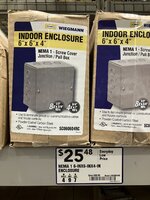
Can I use a box like this one as an unconventional outlet cover?
The back story:
We own a cottage on the Jersey Shore. No pics of that right now, it’s half a continent away. Because it’s slab on grade, since Sandy we’ve been dealing with flooding issues. I’ve discussed this in other threads. What we have, right now, is a standard sump pump pit burried in the “yard”, with fabric sleeved drain tile and surface drains. The pump ejects to the street. When all is working, we don’t flood. Earlier this week, heavy rain combined with an electrical failure, and we flooded.
When this was originally installed and wired, they used an interior 20A circuit that feeds the bedroom wall outlets, stabbed wire through the wall to the outside, and installed a box with an “in use” weather cover and a GFCI outlet. As I understand it, the outlet being outside requires it to be GFCI. What failed, and flooded us, is the GFCI. Got somebody to push the reset button, and the pump quickly emptied the flooded yard.
The 20A circuit has wall outlets, two table lamps, and a bathroom ceiling lamp fixture on it. The GFCI is T‘d off of this in the middle and is not protecting anything downstream. The pump draws (spec sheet) 10A, so the circuit has plenty of capacity. I got a handyman guy to replace the GFCI outlet on the theory that the unknown age GFCI was wearing out and nuisance tripping.
The GFCI is a weak link in our flood protection plan. I don’t like GFCI in general, I’ve personally seen GFCI outlets trip for no reason at all, trip when there is lighting nearby, and fail outright. Having one supporting a sump pump seems like a bad idea, but being an outside outlet, it’s required.
An option is just to replace it with a normal outlet. Not code compliant. But this outlet isn’t intended for use by people, its only purpose is to support the pump. The risk involved in unplugging the pump and plugging in something else is not a concern. But I do like to be code compliant and safe.
So, here is the crazy part. I’d like to eliminate the “outside” part of this, thereby removing the need for a GFCI outlet. I’d also like to get it off of the shared circuit.
1. New 20A breaker in panel. There is plenty of room.
2. Run 12-2 Romex up, over, and down in to the wall cavity. The walls are 2x4 studs, with no insulation in the cavity, and there are no ceilings.
3. Inside the wall cavity, mount a 1 gang box, with the open side facing down. Install a single 20A outlet in the box, facing down.

4. Cut a 6x6 hole in the wall, to insert this junction box, modified. I can cut a round hole in the top to mate it with the round face of the outlet. I can cut a hole in the bottom and install a gromet to protect the pump cords from any sharp edge or rubbing damage.
5. On the outside wall, install an “in use” cover like this to act as a pass through.
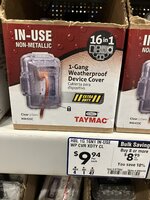
I can then route the two cords (pump + float switch) through the wall to the inside outlet. The box becomes, in effect, an unusual outlet cover, protecting the cords, plugs, and outlet from tampering or damage, while still being accessible for eventual pump replacement. Since the outlet is “inside”, I no longer need it to be a GFCI.
While admittedly unusual, is this reasonably code compliant? Are there any safety issues I’m not seeing in having an outlet “in” the wall within a covered box?
The only code issue I can think of is that I can’t staple the romex inside the wall cavity.
Can I use a box like this one as an unconventional outlet cover?
The back story:
We own a cottage on the Jersey Shore. No pics of that right now, it’s half a continent away. Because it’s slab on grade, since Sandy we’ve been dealing with flooding issues. I’ve discussed this in other threads. What we have, right now, is a standard sump pump pit burried in the “yard”, with fabric sleeved drain tile and surface drains. The pump ejects to the street. When all is working, we don’t flood. Earlier this week, heavy rain combined with an electrical failure, and we flooded.
When this was originally installed and wired, they used an interior 20A circuit that feeds the bedroom wall outlets, stabbed wire through the wall to the outside, and installed a box with an “in use” weather cover and a GFCI outlet. As I understand it, the outlet being outside requires it to be GFCI. What failed, and flooded us, is the GFCI. Got somebody to push the reset button, and the pump quickly emptied the flooded yard.
The 20A circuit has wall outlets, two table lamps, and a bathroom ceiling lamp fixture on it. The GFCI is T‘d off of this in the middle and is not protecting anything downstream. The pump draws (spec sheet) 10A, so the circuit has plenty of capacity. I got a handyman guy to replace the GFCI outlet on the theory that the unknown age GFCI was wearing out and nuisance tripping.
The GFCI is a weak link in our flood protection plan. I don’t like GFCI in general, I’ve personally seen GFCI outlets trip for no reason at all, trip when there is lighting nearby, and fail outright. Having one supporting a sump pump seems like a bad idea, but being an outside outlet, it’s required.
An option is just to replace it with a normal outlet. Not code compliant. But this outlet isn’t intended for use by people, its only purpose is to support the pump. The risk involved in unplugging the pump and plugging in something else is not a concern. But I do like to be code compliant and safe.
So, here is the crazy part. I’d like to eliminate the “outside” part of this, thereby removing the need for a GFCI outlet. I’d also like to get it off of the shared circuit.
1. New 20A breaker in panel. There is plenty of room.
2. Run 12-2 Romex up, over, and down in to the wall cavity. The walls are 2x4 studs, with no insulation in the cavity, and there are no ceilings.
3. Inside the wall cavity, mount a 1 gang box, with the open side facing down. Install a single 20A outlet in the box, facing down.
4. Cut a 6x6 hole in the wall, to insert this junction box, modified. I can cut a round hole in the top to mate it with the round face of the outlet. I can cut a hole in the bottom and install a gromet to protect the pump cords from any sharp edge or rubbing damage.
5. On the outside wall, install an “in use” cover like this to act as a pass through.
I can then route the two cords (pump + float switch) through the wall to the inside outlet. The box becomes, in effect, an unusual outlet cover, protecting the cords, plugs, and outlet from tampering or damage, while still being accessible for eventual pump replacement. Since the outlet is “inside”, I no longer need it to be a GFCI.
While admittedly unusual, is this reasonably code compliant? Are there any safety issues I’m not seeing in having an outlet “in” the wall within a covered box?
The only code issue I can think of is that I can’t staple the romex inside the wall cavity.


