To avoid these ads, REGISTER NOW!

Cost effective insulation and wall covering suggestions?

Wade1969

Active member
Joined
Sep 24, 2023
Messages
26
My shop is 30x26 with 12' ceilings. Studs and rafters are standard 16" on center. In South Carolina we have to worry about heat and humidity more than long periods of cold. What type of insulation should I use in the walls and in the ceiling? I was thinking rolled in the walls and then renting the blower machine from Lowes and blow the ceiling.
Any other suggested options? What rating insulation?


After insulation should I sheetrock the walls and ceiling or use thin OSB? Other options? I'm thinking sheetrock is most cost effective?

Thanks for the suggestions!

Wade
 
To avoid these ads, REGISTER NOW!

nadogail

Well-known member
Joined
Jan 23, 2009
Messages
32,042
Location
Coronado, CA
Almost 70 years ago the University of Alaska, was recommending Saw Dust as an inexpensive insulation. It was treated with Boric Acid to discourage bugs. Old newspaper fed through a hammer mill and treated with Boric Acid has long been standby. You can rent a blower with a minimum purchase of commercial cellulose (aka ground up news paper)
For inexpensive durable wall covering Dry Wall with FRP Panels I strong enough for commercial kitchens and McDonald's rest rooms. Mine came prefinished in white, it glued directly to the drywall.
 

Ultradog MN

Well-known member
Joined
Jan 20, 2024
Messages
794
Location
Twin Cities
My shop is 30x26 with 12' ceilings. Studs and rafters are standard 16" on center. In South Carolina we have to worry about heat and humidity more than long periods of cold. What type of insulation should I use in the walls and in the ceiling? I was thinking rolled in the walls and then renting the blower machine from Lowes and blow the ceiling.
Any other suggested options? What rating insulation?


After insulation should I sheetrock the walls and ceiling or use thin OSB? Other options? I'm thinking sheetrock is most cost effective?

Thanks for the suggestions!

Wade
I have a similar sized garage (30x33 x9'4") here in cold country. I used R15 craft faced rolls in the walls and blew in about 16" of cellulose in the ceiling.
For wall and ceiling covering I used 5/8" fire rated drywall - because I do a lot of welding and torch work in here.
You could use regular 1/2" drywall if your hobbies don't include the fire hazards.
This made for a rather snug space and I think was probably the best bang for my bucks.
I see a lot of guys who will do almost anything to avoid the taping that goes along with drywall but I was a remodeling contractor and can do that pretty easily. My friends used to call me the Mudder Fucker. Oops...
And give me 10 minutes of phone time and I could give anyone enough info to help them do very adequate taping.
I went with thinwall conduit for all my electrical. Makes it easy to add, subtract or reroute circuits, outlets, switches, etc as needed. A $25 conduit bender and a few youtube videos will have you making offsets and whatever degree bends you need like a pro.
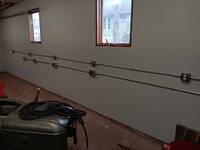
Photos show my "good enough for a shop" drywall work and some thinwall. The upper route is 110v 20a. The lower is 220v 3 phase coming out of a rotary phase converter.
 

Attachments

  • 719202464621.jpg
    719202464621.jpg
    393.4 KB · Views: 25
  • 719202463855.jpg
    719202463855.jpg
    509.3 KB · Views: 25
OP
W

Wade1969

Active member
Joined
Sep 24, 2023
Messages
26
I have a similar sized garage (30x33 x9'4") here in cold country. I used R15 craft faced rolls in the walls and blew in about 16" of cellulose in the ceiling.
For wall and ceiling covering I used 5/8" fire rated drywall - because I do a lot of welding and torch work in here.
You could use regular 1/2" drywall if your hobbies don't include the fire hazards.
This made for a rather snug space and I think was probably the best bang for my bucks.
I see a lot of guys who will do almost anything to avoid the taping that goes along with drywall but I was a remodeling contractor and can do that pretty easily. My friends used to call me the Mudder Fucker. Oops...
And give me 10 minutes of phone time and I could give anyone enough info to help them do very adequate taping.
I went with thinwall conduit for all my electrical. Makes it easy to add, subtract or reroute circuits, outlets, switches, etc as needed. A $25 conduit bender and a few youtube videos will have you making offsets and whatever degree bends you need like a pro.
Photos show my "good enough for a shop" drywall work and some thinwall. The upper route is 110v 20a. The lower is 220v 3 phase coming out of a rotary phase converter.
:D "Mudder F....... Oops... LOL!!" Thanks for the recommendation on the fire resistant drywall. I work on cars and am always doing some kind of metal cutting, grinding or welding. I did not consider the risk with standard drywall.
I am one of those guys that wants to avoid taping but III can do it. I just hate the sanding. You guys that know what you are doing don't have to sand that much. Sadly, I am not that guy!:cry:

My electrical is already run through the studs. I do have some plumbing to do for a utility sink, inside water spigots and 2 outside spigots. I was also planning on plumbing pvc airlines. I'm thinking they should be outside the drywall though in case of a leak???


Thanks!
Wade
 

chinboys

Well-known member
Joined
Jun 20, 2011
Messages
434
It's all about economics and your tolerance to cold and damp or heat and humidity.

Get a Manual J calculation done with various types of R values in the ceiling and walls from your choice of HVAC company or you can find the calculator on the internet.
Then decide on the cost-effectiveness of the type of insulation materials or combinations to get to the R design value.
Get a blower door analysis to see how tight your building is.
Decide on how often your doors or windows will be opened as heat will "transfer" via convection heat transfer.

Research your various utility rates to cool and heat your building.

Lastly, decide how you want to achieve this. How long will you be in the building to enjoy the cooling? Do you want the environment to be constant even if you aren't in the building? Are you willing to wait for the cooling to take place? FYI, the most energy consumption for HVAC systems is to remove latent heat (relative humidity) in the air space. Once the relative humidity is removed, your temps will drop (sensible heat).
I would get a heat pump system as it defaults to cooling and you can use it to get heating should you need it.
I would also install reversible ceiling fans as it will reduce your cooling or heating demands.
I would install a smart wifi thermostat that can be programmed or sense your presence (smartphone geofencing).
 

Ultradog MN

Well-known member
Joined
Jan 20, 2024
Messages
794
Location
Twin Cities
:D "Mudder F....... Oops... LOL!!" Thanks for the recommendation on the fire resistant drywall. I work on cars and am always doing some kind of metal cutting, grinding or welding. I did not consider the risk with standard drywall.
I am one of those guys that wants to avoid taping but III can do it. I just hate the sanding. You guys that know what you are doing don't have to sand that much. Sadly, I am not that guy!:cry:

My electrical is already run through the studs. I do have some plumbing to do for a utility sink, inside water spigots and 2 outside spigots. I was also planning on plumbing pvc airlines. I'm thinking they should be outside the drywall though in case of a leak???


Thanks!
Wade
Yeah, run your airlines on the wall or ceiling for access.
Here are a few tips on taping.
1) I use mesh tape on flat joints. They make a couple of types. White and gray - which is actually for cement board. I use the gray type. It is double tough. It is sticky on one side. Apply it to the joint BEFORE you mud.
71920248541.jpg

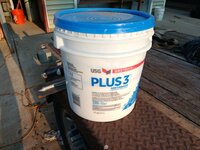
2) I use Plus 3 in the pail.

71920248554.jpg

3) Add water to it. I add water till it is like very wet mashed potatoes.

4) It is much, MUCH easier to apply 3 thin coats than one stiff, heavy coat. It took 3 coats over 3 days to do the wall in the photos in my last post. But I sanded out that entire 9x33 wall ONE time - ready for paint in about 45 minutes.

5) between coats take your taping knife and scrape the ridges and bumps off.
And these are the two tools I primarily use - 6" knife and 16" concrete trowel.

71920248610.jpg

The trowel doubles as my hawk - mud holder.

7) Keep adding water to your mud. By the time I get to the 3rd coat it is so drippy I can hardly hold it on my trowel from the bucket to the wall.

8) Some guys use wide T type trowels and do great work.
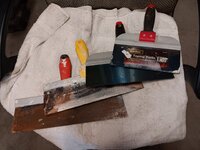
719202482023.jpg

I used them too but only for soffit work.
719202482054.jpg
 
Last edited:

racecougar

Well-known member
Joined
Jan 26, 2021
Messages
5,178
Location
Missouri
I'll suggest liner panel, especially since you mentioned automotive work. It goes up quick, you don't have to tape and paint it, and sparks bounce off of it.

252543499_10100720292401263_8545997886411820626_n.jpg
 
To avoid these ads, REGISTER NOW!

racecougar

Well-known member
Joined
Jan 26, 2021
Messages
5,178
Location
Missouri
Bet?
I'm thinking drywall is way more sound deadening than steel panels.
Cheaper - one of his criteria - too.
I didn't claim that liner panel offered more sound deadening than drywall. I refuted the "noisy" claim posed above. With insulation behind the liner panel, the building is not at all noisy.

I see where the OP questioned cost effectiveness of drywall, but nowhere claimed that cost was a criteria. Regardless, by the time you account for taping and painting, liner panel is often either a wash or even ahead in that arena.

I realize your affinity for drywall. The OP asked for other options.
 

Ultradog MN

Well-known member
Joined
Jan 20, 2024
Messages
794
Location
Twin Cities
I didn't claim that liner panel offered more sound deadening than drywall.
The OP wrote:
"After insulation should I sheetrock the walls and ceiling or use thin OSB? Other options? I'm thinking sheetrock is most cost effective?"

I suggested drywall and offered some tips on mudding.
You suggested liner panel.
I said liner panel is noisy.
You said it wasn't with insulation behind it.
I said it was more noisy than drywall - because it is.
I agree with you that the OP did not mention noise as one of his criteria.
I did.
He didn't ask about liner panel either.
You did
However, he did ask about the cost effectiveness of drywall.
I say in addition to being cheaper, it is quieter.
Oher advantages to drywall is dents and gouges are easily repaired and the color can easily be changed.
Meanwhile,
No hard feelings here and none intended for you.
But I will close this by recalling that poignant quote by the 17th century Dutch philosopher Baruch Spinoza:

" A man's intelligence is inversely proportional to his tolerance to noise."
 

dcg9381

Well-known member
Joined
Jun 20, 2018
Messages
11,887
Location
Austin, TX
After insulation should I sheetrock the walls and ceiling or use thin OSB? Other options? I'm thinking sheetrock is most cost effective?
I'd spray foam the roof deck and use fiberglass rolls in the walls if I was on a budget.
Spraying the roof deck will save you a ton of labor and materials, but is a much more expensive type of insulation... If you're going to "blow in" insulation you have to create an "attic" space.

I used OSB instead of drywall. More structural. No taping and floating. If I want to get behind the wall, I just remove a 4x8 sheet. Downside: more flammable than drywall
 

racecougar

Well-known member
Joined
Jan 26, 2021
Messages
5,178
Location
Missouri
The OP wrote:
"After insulation should I sheetrock the walls and ceiling or use thin OSB? Other options? I'm thinking sheetrock is most cost effective?"

I suggested drywall and offered some tips on mudding.
You suggested liner panel.
I said liner panel is noisy.
You said it wasn't with insulation behind it.
I said it was more noisy than drywall - because it is.
I agree with you that the OP did not mention noise as one of his criteria.
I did.
He didn't ask about liner panel either.
You did
However, he did ask about the cost effectiveness of drywall.
I say in addition to being cheaper, it is quieter.
No need to recap; I covered that above.

Meanwhile,
No hard feelings here and none intended for you.
But I will close this by recalling that poignant quote by the 17th century Dutch philosopher Baruch Spinoza:

" A man's intelligence is inversely proportional to his tolerance to noise."
So no hard feelings, but let's throw a jab in there. How very gentlemanly of you.

The OP requested knowledge on options other than OSB and drywall. I regret providing said knowledge at this point.

Good luck OP!
 

Wiz02

Well-known member
Joined
Jul 13, 2007
Messages
2,399
Location
Southeastern PA
@Wade1969 , do you have helpers or do you work alone. I work alone and plan on buying a drywall lift as I am planning on going with drywall, but I believe that metal panels are lighter and easier to install when working by yourself.
 
To avoid these ads, REGISTER NOW!
Top Bottom