To avoid these ads, REGISTER NOW!

Updating outlets and switches

cgrutt

Well-known member
Joined
Mar 4, 2016
Messages
8,362
Few quick questions that I'm sure have been asked and answered 1000x so apologies in advance.

Updating switches, dimmers and outlets in my MIL house which was built mid 1970s. Small metal boxes for the most part. I believe the wiring is 12GA but it seems much thicker and stronger than the 12 GA bought today not sure if standard changed but old wiring seems better.

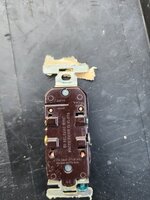
Almost all of the outlets are "backstabbed" (I think that's the right term) with "upstream" wires plugged into one set of connectors and the "downstream" wires plugged into other. I added pigtails and used the screws on side of outlets instead of the backstab holes. See pics.

Because the boxes are metal and small adding pigtails is taking up alot more space.

1. Do I need to add the pigtails or should I just backstab connections the way they were? Is one way any better or worse than other?

2. Most of the switches were not grounded so I added ground wires. Is this necessary (boxes are metal so switch is grounded when it's screwed into the box. The grounds were tied together and screwed to back of box for most part.

3. All of the old outlets have ground facing down. I installed with ground facing up. Not sure when or why I started doing that but it's been many years. Personally I like the way it looks better with ground down. Is there actually a code requirement one way or the other or is this just preference?

Thanks.


Old
20240914_152845.jpg

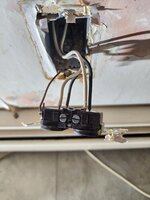
New

20240914_153819.jpg


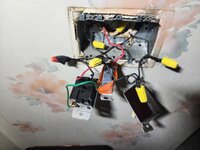
Just for laughs look at this mess...

20240914_140657.jpg
 
To avoid these ads, REGISTER NOW!

PCustoms

Well-known member
Joined
Jul 23, 2011
Messages
23,459
Location
VT
I think those old outlets are back wired. Do you loosen the screw and pull the wire out, or is the a tab to push?

You can do less, a lot less, twists outside the wire nuts. The pigtails can then be stuffed into back of box, and make a z bend with the 3 wires going to the outlet.

You can bring all wires to the outlet, but odds are that will be more difficult to push back in cleanly.
 

eejack

Well-known member
Joined
May 18, 2021
Messages
166
Location
the garden state
I personally put receptacles in ground down. I do not believe there is any code on receptacle orientation.

If you are concerned about the space inside the box, you can put both of the sets of wires onto the screw terminals. I don't like backstabbing anything. However, if you are pigtailing, try to twist a bit less.

You can use self grounding devices instead of disturbing the grounds, as the boxes are metal and already bonded.
 
OP
C

cgrutt

Well-known member
Joined
Mar 4, 2016
Messages
8,362
I think those old outlets are back wired. Do you loosen the screw and pull the wire out, or is the a tab to push?

You can do less, a lot less, twists outside the wire nuts. The pigtails can then be stuffed into back of box, and make a z bend with the 3 wires going to the outlet.

You can bring all wires to the outlet, but odds are that will be more difficult to push back in cleanly.
They were just pushed in there are slots to release the wires but I just cut them off.

20240914_182749.jpg

I pushed the pigtails to back of box the outlets went in fine.
 

Snip's

Well-known member
Joined
Apr 29, 2017
Messages
1,866
Location
Ohio
Not sure where I heard this, but I seem to remember ground up = commercial... Ground down = residential...
Might not be true...
My kitchen has some plugs sideways...
 
Last edited:

kbuhagiar

Well-known member
Joined
Dec 27, 2005
Messages
1,759
Location
Escondido, CA
Not sure where I heard this, but I seem to remember ground up = commercial... Ground down = residential...
Might not be true...
My kitchen has some plugs sideways...

I also prefer the 'ground down' orientation. Every home I have ever lived in was configured that way. In fact, it would seem to be instinctive, as all the new receptacles I have installed in the last few years have their brands/logos/ratings/writing right side up to coincide with the 'ground down' orientation.

The argument I heard a few weeks ago (from the electrical contractor who installed all the receptacles upside down in my new garage addition) is that it is a new local code requirement, reason being if a plug is partially disengaged from an outlet, much better to have the safe (ground) conductor on top, rather than the line and neutral, in case of accidental contact with those partially exposed plug prongs (say, on a kitchen counter with metal utensils).

Seems to be a bit of a stretch to me. :rolleyes:

So far, my OCD hasn't kicked in enough to make me turn 'em right side up. :LOL:
 
OP
C

cgrutt

Well-known member
Joined
Mar 4, 2016
Messages
8,362
I also prefer the 'ground down' orientation. Every home I have ever lived in was configured that way. In fact, it would seem to be instinctive, as all the new receptacles I have installed in the last few years have their brands/logos/ratings/writing right side up to coincide with the 'ground down' orientation.

The argument I heard a few weeks ago (from the electrical contractor who installed all the receptacles upside down in my new garage addition) is that it is a new local code requirement, reason being if a plug is partially disengaged from an outlet, much better to have the safe (ground) conductor on top, rather than the line and neutral, in case of accidental contact with those partially exposed plug prongs (say, on a kitchen counter with metal utensils).

Seems to be a bit of a stretch to me. :rolleyes:

So far, my OCD hasn't kicked in enough to make me turn 'em right side up. :LOL:
I recall hearing same thing about the partially exposed ground just curious if is actually code or not. I looked into it a few months ago and didn't find anything indicating it's actually a code requirement.
 

PCustoms

Well-known member
Joined
Jul 23, 2011
Messages
23,459
Location
VT
I also prefer the 'ground down' orientation. Every home I have ever lived in was configured that way. In fact, it would seem to be instinctive, as all the new receptacles I have installed in the last few years have their brands/logos/ratings/writing right side up to coincide with the 'ground down' orientation.

The argument I heard a few weeks ago (from the electrical contractor who installed all the receptacles upside down in my new garage addition) is that it is a new local code requirement, reason being if a plug is partially disengaged from an outlet, much better to have the safe (ground) conductor on top, rather than the line and neutral, in case of accidental contact with those partially exposed plug prongs (say, on a kitchen counter with metal utensils).

Seems to be a bit of a stretch to me. :rolleyes:

So far, my OCD hasn't kicked in enough to make me turn 'em right side up. :LOL:

I've seen 2 small fires start when a plug pulled partway out and conductive material (carbon fiber) fell across the leads. Can't remember what prong was up, but we added in use covers to prevent issues.

I wired my house ground up. Its a pita as everything I want to plug in with a ground seems to be molded the other way.
 

sparky 1971

Well-known member
Joined
Oct 9, 2018
Messages
8,007
Location
Central Iowa
It'll be a whole bunch easier to shove everything in the box if you use smaller wire nuts. For up to three #12's I like the orange or orange/blue twisters by Ideal. When there are four #12's, the tans come out, the orange blues are rated for four #12, but don't fit very well. I don't use reds until there are five.

https://www.homedepot.com/p/IDEAL-Twister-ProFLEX-Mini-175-Jar-30-443J/320637277

Stay away from the red/tan or yellow/tan twisters, they are pretty much the same thing, one has a soft skirt and the other doesn't. They have the same range as a red wing nut but are at least 10% bigger, probably more. Those things are enourmous.
 

sparky 1971

Well-known member
Joined
Oct 9, 2018
Messages
8,007
Location
Central Iowa
Not sure where I heard this, but I seem to remember ground up = commercial... Ground down = residential...
Might not be true...
My kitchen has some plugs sideways...
I've heard the story told every way there is to tell it, the argument usually ends when I ask for a code reference. It's continued a few times, some guys say it's in there (it isn't) and another told me it's an unwritten code. I always go ground down unless it's spec'd to be ground up, which I believe I've only seen once.
 
OP
C

cgrutt

Well-known member
Joined
Mar 4, 2016
Messages
8,362
It'll be a whole bunch easier to shove everything in the box if you use smaller wire nuts. For up to three #12's I like the orange or orange/blue twisters by Ideal. When there are four #12's, the tans come out, the orange blues are rated for four #12, but don't fit very well. I don't use reds until there are five.

https://www.homedepot.com/p/IDEAL-Twister-ProFLEX-Mini-175-Jar-30-443J/320637277

Stay away from the red/tan or yellow/tan twisters, they are pretty much the same thing, one has a soft skirt and the other doesn't. They have the same range as a red wing nut but are at least 10% bigger, probably more. Those things are enourmous.

Thanks. I was just grabbing what was on top of my coffee can. I've got orange without wings and white and yellow with wings that are smaller than red. The red actually worked really good on both 3x12 and one 5x12.

This is what I'm working with...


20240914_212252.jpg
 

sparky 1971

Well-known member
Joined
Oct 9, 2018
Messages
8,007
Location
Central Iowa
Thanks. I was just grabbing what was on top of my coffee can. I've got orange without wings and white and yellow with wings that are smaller than red. The red actually worked really good on both 3x12 and one 5x12.

This is what I'm working with...


20240914_212252.jpg
The wingless orange nuts won't work, too small. The tans look like GB brand, I've never used them but they will probably work fine. The yellow nuts will work for three wires, I don't use yellows but know plenty of people that swear by them. The wingless yellow will give your fingers a workout, but get you by.
 

Norcal

Well-known member
Joined
Mar 16, 2008
Messages
13,769
As to ground up/down, if anyone says one way or the other is the correct way, THEY ARE WRONG, it's personal preference or job specs, code is silent as to receptacle orientation, professional electrical forums shut down the topic, the only place where up is important is 30A, & 50A, receptacles where the ground or neutral depending on type, needs to be up in order for molded right angle cord assemblies to hang correctly.
 

alfredeneuman

Well-known member
Joined
Mar 3, 2011
Messages
4,593
Location
Fullerton, CA
All of the "pro" forums will routinely chastise the poster that even brings up the question on the orientation of grounds.
There is no place in the Code that requires the ground's be up or down, right or left. Period.
The only spec. I've run into was for a Kindercare preschool that required the grounds be down because the kids woulds interpret the grounds as a smilie face.
 
OP
C

cgrutt

Well-known member
Joined
Mar 4, 2016
Messages
8,362
All of the "pro" forums will routinely chastise the poster that even brings up the question on the orientation of grounds.
There is no place in the Code that requires the ground's be up or down, right or left. Period.
The only spec. I've run into was for a Kindercare preschool that required the grounds be down because the kids woulds interpret the grounds as a smilie face.
I'm not a pro and was just asking if it's actually required by code. I looked for it and didn't find it hence the question.
 
OP
C

cgrutt

Well-known member
Joined
Mar 4, 2016
Messages
8,362
Only thing I have ever seen used in residential was that ground UP was a switched outlet. All others were ground down.
Interesting. Wonder what they do when only one of the two outlets is switched?
 

Cruzan80

Well-known member
Joined
Jul 22, 2015
Messages
4,308
Location
Denver, CO
The top one was switched, the bottom was always on. The "regular" ground down outlets were always on. Think living rooms with slanted ceilings, where the switch would control a floor lamp.

Seems to be a thing in a lot of the 90-00' houses here (Denver).
 
OP
C

cgrutt

Well-known member
Joined
Mar 4, 2016
Messages
8,362
The top one was switched, the bottom was always on. The "regular" ground down outlets were always on. Think living rooms with slanted ceilings, where the switch would control a floor lamp.

Seems to be a thing in a lot of the 90-00' houses here (Denver).
Bedrooms and living room all have that in this house (mid 70s) but all of the outlets are ground down. It actually makes sense to quickly identify which outlets are switched but the different orientations would drive me nuts lol...
 
To avoid these ads, REGISTER NOW!

whateg01

Well-known member
Joined
Mar 13, 2006
Messages
11,490
Location
doo dah, kansas, usa
Thanks. I was just grabbing what was on top of my coffee can. I've got orange without wings and white and yellow with wings that are smaller than red. The red actually worked really good on both 3x12 and one 5x12.

This is what I'm working with...


20240914_212252.jpg
Be aware that if you kept any of those from things like ceiling fan installs or other kits, the ones included are usually worse than electrical tape, imo. Look inside one and you'll find that there's no metal "threads" so it's just plastic trying to grip the wire. Throw those away!
 
OP
C

cgrutt

Well-known member
Joined
Mar 4, 2016
Messages
8,362
Be aware that if you kept any of those from things like ceiling fan installs or other kits, the ones included are usually worse than electrical tape, imo. Look inside one and you'll find that there's no metal "threads" so it's just plastic trying to grip the wire. Throw those away!
Most of them are new but there may be a few I threw into can from old work. Everything I used today was new.
 

The Cobbler

Super Moderator
Staff member
Joined
Oct 24, 2013
Messages
25,983
Location
Niagara Region, Ontario, Canada
And ground up looks stupid.
it does. and here there's no code, but the normal is ground down. I was told by a friend that I've lost contact with , that the inspectors like to see the ground down so it's the last pin to come out if the plug is falling out of the wall .
however, I was on a fire job many years ago, aluminum stair nosing fell off the fridge in the basement, slid down the wall behind the fridge ,landed on the partially exposed plug, arced , caught the 1970's panelling on fire & caused major damage to the house .
I guess reasoning is up for discussion , as is the case with a lot of things
I guess too, that our plugs & receptacles are quite chinzy compared to say, the United Kingdom
 

whateg01

Well-known member
Joined
Mar 13, 2006
Messages
11,490
Location
doo dah, kansas, usa
Wouldn't it have been cool if they put more thought into the plug design so that if any of the contact was exposed, it was dead? Like much of the rest of the world! Of course, some of those parts of the world, that's the only safe thing about the electrical system.
 

rharman

Well-known member
Joined
Apr 22, 2012
Messages
8,904
Location
SoCal
I asked on here once about the "soft" wire that comes hard-attached to dimmers and things. Figured that would be great for pigtails like in your situation. Can't recall what it was called but @sparky 1971, @alfredeneuman, or @Norcal can likely answer that.

You can get a wire nut driver from Amazon, Home Depot, etc. that will ease the wear & tear on your fingers that @sparky 1971 mentioned.
 

sparky 1971

Well-known member
Joined
Oct 9, 2018
Messages
8,007
Location
Central Iowa
I asked on here once about the "soft" wire that comes hard-attached to dimmers and things. Figured that would be great for pigtails like in your situation. Can't recall what it was called but @sparky 1971, @alfredeneuman, or @Norcal can likely answer that.
When I am doing device changeouts and everything has been backstabbed, I pre-wire the devices while at a table using stranded wire (THHN/THWN), then make the wire nut connections at the box.
You can get a wire nut driver from Amazon, Home Depot, etc. that will ease the wear & tear on your fingers that @sparky 1971 mentioned.
I've never used one of those, but now that my hands, specifically my thumbs, are just about completely worn out, I am thinking I should have had something like that 30 years ago. There's no telling how many millions of wire nuts I have cranked on over the last 30 years.
 

rharman

Well-known member
Joined
Apr 22, 2012
Messages
8,904
Location
SoCal
When I am doing device changeouts and everything has been backstabbed, I pre-wire the devices while at a table using stranded wire (THHN/THWN), then make the wire nut connections at the box.

I've never used one of those, but now that my hands, specifically my thumbs, are just about completely worn out, I am thinking I should have had something like that 30 years ago. There's no telling how many millions of wire nuts I have cranked on over the last 30 years.

Yeah, stranded is a big improvement but the stuff I'm talking about is a lot easier to use than that. Type started with an "M" (???) maybe?
 

mm08822

Well-known member
Joined
Jan 13, 2012
Messages
6,051
Location
NJ
Instead of cutting off all of the back stabbed conductors, press in the release and keep the existing length.

For a simple in/out wiring of a receptacle, use the side screws of the receptacle.

Forget all of the extra pig-tailing and cramming the box full of stuff. Making it more difficult than needed.
 
OP
C

cgrutt

Well-known member
Joined
Mar 4, 2016
Messages
8,362
Instead of cutting off all of the back stabbed conductors, press in the release and keep the existing length.

For a simple in/out wiring of a receptacle, use the side screws of the receptacle.

Forget all of the extra pig-tailing and cramming the box full of stuff. Making it more difficult than needed.
Probably just me stuck in my old ways but I prefer to cut the old wires off not only because it's faster but also because I fear the old wire may have been damaged by the backstab "clamp". I just prefer to strip back some fresh wire for new connection.

Also probably just due to being stuck in my old ways I really prefer pigtailing the connection. In my view it just improves the entire circuit (downstream branch circuits are not impacted by a loose connection etc in any particular outlet. Not saying that's necessarily right it's just how I view it.

I guess I "knew" the difference between backstabbing and back wiring but back wiring (with the screw and clamp) is a new term for me. I pretty much thought of them as the same thing but see how back wiring is different and, perhaps better, than looping the wire over side screw. The outlets that we bought are "spec grade" so back stabbing isn't even an option. I may do the rest of the outlets with the back wire/clamp.

The switches aren't spec grade and only option is to back stab or wrap the wire around the screw. I see now that the back stab is limited to 14 GA wire (says so right on the switch) so I really have no choice but to use the screws as the wiring is 12 GA. That was never really an issue as I generally feel backstabbing should not be used.


@sparky 1971 just curious how you make connection with stranded wire (when you use it)? I guess I can see it being OK with the backwire clamps but wouldn't think you should use stranded wrapped around a screw (although I have come across that many times with old lamps, etc). If using the backwire clamps would this be a case where you should use a ferrule?
 

sparky 1971

Well-known member
Joined
Oct 9, 2018
Messages
8,007
Location
Central Iowa
@sparky 1971 just curious how you make connection with stranded wire (when you use it)? I guess I can see it being OK with the backwire clamps but wouldn't think you should use stranded wrapped around a screw (although I have come across that many times with old lamps, etc). If using the backwire clamps would this be a case where you should use a ferrule?
When stripping the stranded wire, don't take the insulation all of the way off. Leave it hanging off the conductor with somewhere around 1/8 to 1/4" still on the end. That way, when it wraps around the screw, the left on but stripped insulation will keep the strands from separating. At first, it's hard not to just strip it all the way off and let it fall on the floor if no other reason, habit but it gets easier. I posted a picture of it on here somewhere a while back and can again later this afternoon, but right now I don't have time, I gotta go to Church.
 

BrandonV

Well-known member
Joined
Jun 9, 2023
Messages
4,030
Location
Arizona
Probably just me stuck in my old ways but I prefer to cut the old wires off not only because it's faster but also because I fear the old wire may have been damaged by the backstab "clamp". I just prefer to strip back some fresh wire for new connection.

I agree. Every one of these connections I've released there is a significant dimple in the wire from where the spring clamp engaged.
 

mikedodge

Well-known member
Joined
Jun 27, 2017
Messages
2,850
Also probably just due to being stuck in my old ways I really prefer pigtailing the connection. In my view it just improves the entire circuit (downstream branch circuits are not impacted by a loose connection etc in any particular outlet. Not saying that's necessarily right it's just how I view it.
At the same time you're filling the boxes more then necessary with the pig tails making it more awkward to work with or having something crushed and come out of place. If its screwed down securely there shouldn't be any issues connecting that way. I'm also not a fan of the stab and rarely if ever see it used.
 

mm08822

Well-known member
Joined
Jan 13, 2012
Messages
6,051
Location
NJ
I agree. Every one of these connections I've released there is a significant dimple in the wire from where the spring clamp engaged.
If the nick is significant then cut it there and strip back. Otherwise just j-hook it and put it under the screw.
I can't say that everyback stabbed conductor I've released is damaged beyond re-use.
 

sparky 1971

Well-known member
Joined
Oct 9, 2018
Messages
8,007
Location
Central Iowa
The only damaged backstabbed wires I've seen is on the insulation that has been cooked to the point there is only about 2" of good wire left in the box. I have a hard time seeing how it's possible for the phony little spring clip to damage the conductor.
 

eejack

Well-known member
Joined
May 18, 2021
Messages
166
Location
the garden state
When stripping the stranded wire, don't take the insulation all of the way off. Leave it hanging off the conductor with somewhere around 1/8 to 1/4" still on the end. That way, when it wraps around the screw, the left on but stripped insulation will keep the strands from separating. At first, it's hard not to just strip it all the way off and let it fall on the floor if no other reason, habit but it gets easier. I posted a picture of it on here somewhere a while back and can again later this afternoon, but right now I don't have time, I gotta go to Church.

I have used the above method, but usually I just crimp a fork on the stranded wire. Cheap and fast.
 
To avoid these ads, REGISTER NOW!
Top Bottom