Denwood
Well-known member
If you're looking for efficient fresh air ventilation for a small home or shop, Panasonic has a pretty cool product which does the job while recovering energy from the air it's exhausting from your home. The Panasonic ERV exhausts "stale" from your home/shop, and pulls in fresh air from outside, recovering about 65% of heat and 35% of moisture from the inside conditioned air. In a well insulated/tight garage, this product would work well, with the provision that you would need to clean the inside air screen frequently if dust was being generated.
In our case, the shop is already pretty leaky, and only heated when in use, so this was not a garage project. Rather, our 100 yr old house though turns out to be too tight, after extensive insulation, new windows with inner acrylic air sealing panels, and attic spray foam. The Panasonic unit offered a solution, although because it's sold as a "spot" ERV, I wasn't sure how well it would work in our home. The results were surprising, given that it's only 40 CFM, and not tied into the existing HVAC system at all.


In this pdf brochure, you can see that the Panasonic ERV has a small heat recovery core and intake filters. Both are easily removed for cleaning. The unit picks up stale air from one side of the cover plate grill, and returns fresh air through the triangular opening on the other side of the cover plate. You might think that cross contamination would be an issue, however read on.
The system is 14.5 inches wide, so fits in between standard stud spacing for wall, or ceiling installation. Power consumption is 23 watts to deliver 40CFM. It's very, very quiet so from 10-15ft away, all you hear is a slight hum.
The home it's installed in is a retrofitted 100yr old house, that has become too "tight" after all the retrofits. It is two stories, with a finished basement, about 2300 sq/ft of conditioned space. Tying an HRV into the 95% efficient furnace would be very difficult due to the central furnace location and tight space. The old brick chimney that went up the house core is no longer used, and in fact has been removed entirely from the attic.
To baseline, I've been monitoring C02 concentrations in the air for the last 3 weeks. Levels have consistently been high, in the 1100 to 1300 ppm range on all but very windy days where infiltration has lowered levels somewhat. Outside "fresh" air has about 400ppm of C02 for reference. My wife has commented at times that the house seems "stuffy" after all the energy retrofits.
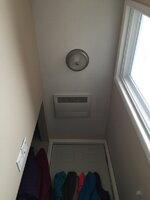
Install location at the top of our basement stairwell on the south side of the house. I'll be building an intake air solar heater to reduce energy loss, so the south side was a requirement.
Intake / Exhaust. The intake hood has its back draft flap removed. The ERV has an electronically operated damper that closes if the unit is off or in defrost mode.

The unit has an on/off switch onboard, but I elected to wire in a Z-wave controlled switch to allow both manual and automated control. The ERV has a high/low speed control, so I'm using an LFM20 isolated relay (also z-wave controlled) to toggle 20 vs 40CFM modes.

You can see the ERV on/off and speed control here in the Smarthings automation hub interface. The ERV can be managed from an iphone and/or automated so it's off when on one is home etc.

These are lowest CO2 numbers (about 10 hours after install) that we've seen this winter. This despite the C02 sensor being on the 2nd floor, (ERV is on the first floor) with zero tie in of the ERV to the HVAC system. The Lennox furnace has an ECM motor which is set to 400 CFM circulating air at all times in the house. This might suggest that fresh air mixing from a point source ERV is more effective than one might think, providing the furnace fan is running..which it would be anyway, if the HRV/ERV was tied into it.

CO2 levels seem to now run between 600 ppm (just the family cat at home!) and 850 with all four family members at home. Temps outside have been just around freezing for the last few days, with low/no winds. To be honest, I was not expecting the ERV to be adequate for the whole house, but it certainly appears to be. If you go by ASHRE 6.22, the house "needs" from 45 to 50 CFM of continuous ventilation. The C02 sensor readings though would suggest that the Panasonic ERV at 40CFM and zero HVAC tie-in is actually adequate.
In our case, the shop is already pretty leaky, and only heated when in use, so this was not a garage project. Rather, our 100 yr old house though turns out to be too tight, after extensive insulation, new windows with inner acrylic air sealing panels, and attic spray foam. The Panasonic unit offered a solution, although because it's sold as a "spot" ERV, I wasn't sure how well it would work in our home. The results were surprising, given that it's only 40 CFM, and not tied into the existing HVAC system at all.
In this pdf brochure, you can see that the Panasonic ERV has a small heat recovery core and intake filters. Both are easily removed for cleaning. The unit picks up stale air from one side of the cover plate grill, and returns fresh air through the triangular opening on the other side of the cover plate. You might think that cross contamination would be an issue, however read on.
The system is 14.5 inches wide, so fits in between standard stud spacing for wall, or ceiling installation. Power consumption is 23 watts to deliver 40CFM. It's very, very quiet so from 10-15ft away, all you hear is a slight hum.
The home it's installed in is a retrofitted 100yr old house, that has become too "tight" after all the retrofits. It is two stories, with a finished basement, about 2300 sq/ft of conditioned space. Tying an HRV into the 95% efficient furnace would be very difficult due to the central furnace location and tight space. The old brick chimney that went up the house core is no longer used, and in fact has been removed entirely from the attic.
To baseline, I've been monitoring C02 concentrations in the air for the last 3 weeks. Levels have consistently been high, in the 1100 to 1300 ppm range on all but very windy days where infiltration has lowered levels somewhat. Outside "fresh" air has about 400ppm of C02 for reference. My wife has commented at times that the house seems "stuffy" after all the energy retrofits.
Install location at the top of our basement stairwell on the south side of the house. I'll be building an intake air solar heater to reduce energy loss, so the south side was a requirement.
Intake / Exhaust. The intake hood has its back draft flap removed. The ERV has an electronically operated damper that closes if the unit is off or in defrost mode.
The unit has an on/off switch onboard, but I elected to wire in a Z-wave controlled switch to allow both manual and automated control. The ERV has a high/low speed control, so I'm using an LFM20 isolated relay (also z-wave controlled) to toggle 20 vs 40CFM modes.
You can see the ERV on/off and speed control here in the Smarthings automation hub interface. The ERV can be managed from an iphone and/or automated so it's off when on one is home etc.
These are lowest CO2 numbers (about 10 hours after install) that we've seen this winter. This despite the C02 sensor being on the 2nd floor, (ERV is on the first floor) with zero tie in of the ERV to the HVAC system. The Lennox furnace has an ECM motor which is set to 400 CFM circulating air at all times in the house. This might suggest that fresh air mixing from a point source ERV is more effective than one might think, providing the furnace fan is running..which it would be anyway, if the HRV/ERV was tied into it.
CO2 levels seem to now run between 600 ppm (just the family cat at home!) and 850 with all four family members at home. Temps outside have been just around freezing for the last few days, with low/no winds. To be honest, I was not expecting the ERV to be adequate for the whole house, but it certainly appears to be. If you go by ASHRE 6.22, the house "needs" from 45 to 50 CFM of continuous ventilation. The C02 sensor readings though would suggest that the Panasonic ERV at 40CFM and zero HVAC tie-in is actually adequate.
Last edited: