Denwood
Well-known member
I’m conducting a bit of a science experiment. Can you take an older HRV, (in this case with a known fire hazard motor), and retrofit it as an ECM miser? Model is a Venmar AVS Solo 2…apparently was quite a popular unit. The unit was slated for disposal.
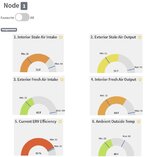
In the initial test (temp probes at all four ports) the HRV is “bench” balanced via a vane anemometer to 88 CFM, using 19 watts total power, with a measured efficiency of 89% over about four hours of testing with outside temps 37-40F. I’m using two EC fans, mounted externally.
The questions are about balancing:
1. There is a balancing chart attached, however my assumption is that it would be useless in the current configuration with the OEM motor and housings removed.
2. If I take measurements of static pressure on the door ports in the new configuration (with measured CFM on 5′ long, 6″ ducts), can I correlate these to balance once fully installed? My thinking is to take statics via the door balance ports at all the motor speeds, measure flow and basically make a new chart.
3. Once the system is fully installed, will the chart I made in step 2 be ok to determine CFM rates?
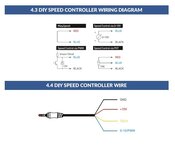
4. I am not balancing using dampers, but rather EC fan speeds as there are two separate controllers.
I’m hoping some you trade gurus out there will chime in on this one
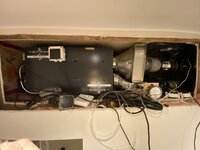
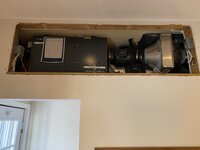
Unit in "OEM" configuration:
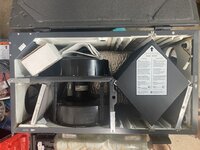
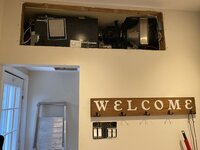
Motor and housing partially removed.

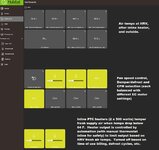
Testing with temp probes two PTC heaters to simulate 70F inside air...

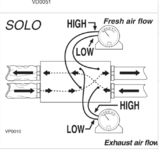
Balancing chart on the HRV.

I ran my test (heating intake air to about 70F) for about four hours. Sound was measured 1 meter from the motors at 54.5 db. Surprisingly quiet with no silencers (coming later) installed. I was able to spin up the OEM motor (just barely) and tested power use at 300 watts. The motor lower sleeve bearing (poor design that starts fires!) had enough play to allow contact between stator and rotor...so my guess is that a new one would use less power. Still, from the OEM psc motor's rated 210 watts or so, we're down to just 19 watts (including the HRV control, and two motors running).
There is a recall in effect for these, and similar units: https://globalnews.ca/news/6298646/air-exchanger-recall-canada/
You can buy a new motor, but it's $200 for the part, and uses the same (bad) sleeve bearing design. The "safety" device they send out is a plug with an embedded 3 amp fuse. It does not fix the motor issue, but will prevent a fire.
..so, a bit surprised by how well it performed!

Balanced at 89 CFM for now using a vane anemometer at intake/exhaust:

Sound measurements, about 1 meter from fans at loudest point:

Power use by two EC fans and HRV control unit:

In the initial test (temp probes at all four ports) the HRV is “bench” balanced via a vane anemometer to 88 CFM, using 19 watts total power, with a measured efficiency of 89% over about four hours of testing with outside temps 37-40F. I’m using two EC fans, mounted externally.
The questions are about balancing:
1. There is a balancing chart attached, however my assumption is that it would be useless in the current configuration with the OEM motor and housings removed.
2. If I take measurements of static pressure on the door ports in the new configuration (with measured CFM on 5′ long, 6″ ducts), can I correlate these to balance once fully installed? My thinking is to take statics via the door balance ports at all the motor speeds, measure flow and basically make a new chart.
3. Once the system is fully installed, will the chart I made in step 2 be ok to determine CFM rates?
4. I am not balancing using dampers, but rather EC fan speeds as there are two separate controllers.
I’m hoping some you trade gurus out there will chime in on this one
Unit in "OEM" configuration:
Motor and housing partially removed.
Testing with temp probes two PTC heaters to simulate 70F inside air...
Balancing chart on the HRV.
I ran my test (heating intake air to about 70F) for about four hours. Sound was measured 1 meter from the motors at 54.5 db. Surprisingly quiet with no silencers (coming later) installed. I was able to spin up the OEM motor (just barely) and tested power use at 300 watts. The motor lower sleeve bearing (poor design that starts fires!) had enough play to allow contact between stator and rotor...so my guess is that a new one would use less power. Still, from the OEM psc motor's rated 210 watts or so, we're down to just 19 watts (including the HRV control, and two motors running).
There is a recall in effect for these, and similar units: https://globalnews.ca/news/6298646/air-exchanger-recall-canada/
You can buy a new motor, but it's $200 for the part, and uses the same (bad) sleeve bearing design. The "safety" device they send out is a plug with an embedded 3 amp fuse. It does not fix the motor issue, but will prevent a fire.
..so, a bit surprised by how well it performed!
Balanced at 89 CFM for now using a vane anemometer at intake/exhaust:
Sound measurements, about 1 meter from fans at loudest point:
Power use by two EC fans and HRV control unit:
 Rather than using dampers though, you can do everything in this case by changing the EC motor speeds on intake and exhaust to dial things in. That's more efficient.