Turns out people pay a decent amount for the pieces in the case. About 30$ I'd say on average based off recent ebay sales. I decided to let it go last minute because I only wanted it for the cool case and I couldn't justify over 150 for that. But like you said "you never know" because if you think about it being a collector is basically just selective insanity ha. Someone spent 15k on a 20 year old McDonald's dipping sause and another spent 16k on a damn marble. Examples are endless, but yea I'm glad I got outbid ha. Sorry for the slight tangent but it is an interesting thought.Lathe bits? Probably not a huge collector thing, but you never know.

You are using an out of date browser. It may not display this or other websites correctly.
You should upgrade or use an alternative browser.
You should upgrade or use an alternative browser.
J H Williams vintage hand tools
- Thread starter z1kzonly
- Start date
Oldtuleguy
Well-known member
- Joined
- Nov 4, 2017
- Messages
- 10,478
Definately a cool set, but I try to limit my scope a bit as If I did not I would definately be collecting way too many tools.
Oldtuleguy
Well-known member
- Joined
- Nov 4, 2017
- Messages
- 10,478
Now your in trouble!
Private Lugnutz
Well-known member
A new member from the UK @GXA6 posted a spanner in a post linked here. I am going to reply here.
@GXA6
Your engineers' wrench is early. 2nd generation. No newer than 1924 and perhaps as old as 1913. The oval 'Brooklyn' logo is the key.
The "33" is very likely a very early model number. Model numbers (which would later become industry standard numbers, used by other mfgr's) indicated milled opening sizes, across-the-flats (AF). If it's a "33", the milled opening sizes would be 7/8" x 31/32".
The stamped "C" could be a suffix, though. As the demand for engineers' wrenches in multiple sizes continued to expand, Williams' numbering scheme was quickly overwhelmed. They started using prefixes and suffixes because the whole numbers were already taken. However, instead of making new dies, they would use the same forging blank and die. The major number (in your case "33") would be part of the die, they would just mill different openings in the ends, and stamp the suffix.
If it's a 33-C it would have milled opening sizes of 15/16" x 1".
@GXA6
Your engineers' wrench is early. 2nd generation. No newer than 1924 and perhaps as old as 1913. The oval 'Brooklyn' logo is the key.
The "33" is very likely a very early model number. Model numbers (which would later become industry standard numbers, used by other mfgr's) indicated milled opening sizes, across-the-flats (AF). If it's a "33", the milled opening sizes would be 7/8" x 31/32".
The stamped "C" could be a suffix, though. As the demand for engineers' wrenches in multiple sizes continued to expand, Williams' numbering scheme was quickly overwhelmed. They started using prefixes and suffixes because the whole numbers were already taken. However, instead of making new dies, they would use the same forging blank and die. The major number (in your case "33") would be part of the die, they would just mill different openings in the ends, and stamp the suffix.
If it's a 33-C it would have milled opening sizes of 15/16" x 1".
RTM
Well-known member
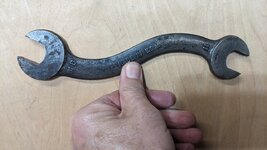
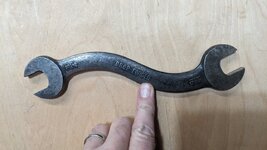
Here is a wrench I found a few weeks back at a citywide garage sale. Still sifting through the pile, slowing moving things into working locations. Not a whole lot of markings on this one, but fortunately Lugz let slip that the wrench number belonged in the Williams family. This one does not have any maker marks, so wondering if it was private labeled for someone.As I discussed upthread, at some point in the early 1920's, at the tail end of the oval logo era, these wrenches were 75B, 77B, 79, 81B, and 83B (Williams dropped the "6" prefix)
81B Made in USA and 11 on one side.
3/4 Drop Forged, and 13/16 on the other side.
IF someone can use this to round out a collection, let me know.
d42jeep
Well-known member
Here is a NAF Navy Superrench marked with a part number I had previously only seen on a Plomb combination wrench. I bought it for my NAF toolbox.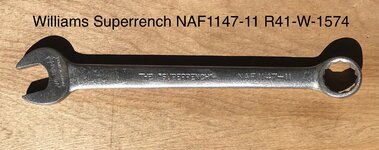
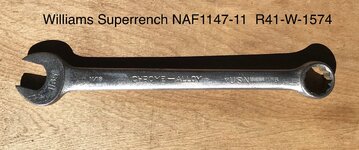

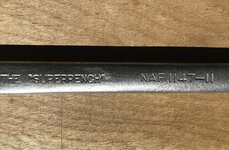
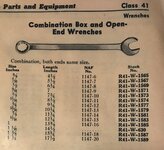

Here is my Plomb R41-W-1574 NAF1147-11 marked combination wrench for comparison.
-Don
Here is my Plomb R41-W-1574 NAF1147-11 marked combination wrench for comparison.
-Don
Last edited:
LNKMK8
Well-known member
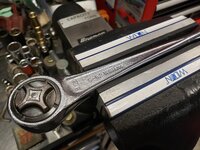
What am I doing wrong guys? I got this S-52 ratchet in a box of tools at auction. It has gotten wet at some point and the internals were rusted. I pulled it apart, soaked it in Evap-o-Rust, and everything cleaned up nicely. After putting it back together, it kept binding up. I discovered that as I ran it to the right, the threaded ring would move and tighten down until it locked up. When running it to the left, it would loosen itself until it came apart. How do you keep that threaded ring from moving?
Attachments
Beerhippie
Well-known member
Loc-Tite?What am I doing wrong guys? I got this S-52 ratchet in a box of tools at auction. It has gotten wet at some point and the internals were rusted. I pulled it apart, soaked it in Evap-o-Rust, and everything cleaned up nicely. After putting it back together, it kept binding up. I discovered that as I ran it to the right, the threaded ring would move and tighten down until it locked up. When running it to the left, it would loosen itself until it came apart. How do you keep that threaded ring from moving?
RTM
Well-known member
Is there a chance of a spacer missing that would allow you to tighten it down, without binding the works? Similar to having the right depth shoulder on a vise pivot screw, which when fully tight still allows it too pivot?After putting it back together, it kept binding up. I discovered that as I ran it to the right, the threaded ring would move and tighten down until it locked up. When running it to the left, it would loosen itself until it came apart. How do you keep that threaded ring from moving?
LNKMK8
Well-known member
That was my thought as well... I guess I could take apart another one I have and see if something is missing.Is there a chance of a spacer missing that would allow you to tighten it down, without binding the works? Similar to having the right depth shoulder on a vise pivot screw, which when fully tight still allows it too pivot?
RTM
Well-known member
And, in retrospect, it’s possible that the guts are not inserted all the way, and thus sitting too high in the body, colliding with the back. Maybe check that first, when you compare to the other ratchet, see if the anvil protrudes equally far.That was my thought as well... I guess I could take apart another one I have and see if something is missing.
Provincial
Well-known member
The lock ring appears to be sitting too high, which would support your idea of the guts being installed too high.
Beerhippie
Well-known member
Here's an odd--to me--Williams DOE engineer's:

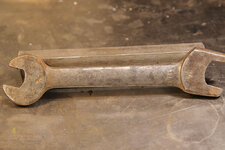
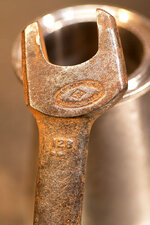
I can't make out what the cartouche says, but on this side, it's a 128...

and a 129 on this side!
The end stamped 7/16 is 11/16" AF, the one stamped 5/16 is 1/2".
I can't make out what the cartouche says, but on this side, it's a 128...
and a 129 on this side!
The end stamped 7/16 is 11/16" AF, the one stamped 5/16 is 1/2".
Private Lugnutz
Well-known member
Almost certainly the oval Brooklyn logo. It's an early wrench. Pre 1913.I can't make out what the cartouche says...
The markings are U.S.S. nut and bolt (diameter) sizes. The milled openings for a U.S.S. 5/16 x 7/16 engineers wrench should be 19/32" x 25/32", which are very close to your measurements.The end stamped 7/16 is 11/16" AF, the one stamped 5/16 is 1/2".
Not sure what's going on with the forged marks on the shank. The part number for an early Williams U.S.S. 5/16 x 7/16 DOE engineers wrench would be 28. (A 29 wrench would be U.S.S. 3/8 x 7/16 with milled openings 11/16" x 25/32".) The same die was probably also used for 29 wrenches (i.e., same OAL, same shank, same head sizes and shapes), and the milled openings were different. Later they started adding prefixes to these numbers. A 1028 was a 28 size Superrench engineers wrench, for example. A 2028 was a 28 size Obstruction wrench. Same milled opening sizes. Different configuration.
Seeing a 128 and a 129 on the flip side is a little odd. I'm a little foggy right now. I'll go through my wrenches tomorrow if @leg17 or someone else doesn't reply to this first. But off the top of my head I don't recall a single digit prefix like that.
wrenchguy
Well-known member
oval logo 1914 to 1924 i believe.
Catfishdan
Well-known member
I found a really early midget set at a garage sale. A hex drive Williams electrical set. I haven’t done much searching yet, but it looks like it is only missing the sliding t, as the 286 set didn’t come with wrenches. No dividers in the box either. Doesn’t look to have ever had them.
Attachments


Private Lugnutz
Well-known member
Faaaa-reakin' fabulous find!!! Soooo jealous. The handle has its Husky heritage written all over it.
Catfishdan
Well-known member
Thank you sir. Just wait till the sliding t arrives next week! It happened to be the only hex drive Williams piece on all of eBayFaaaa-reakin' fabulous find!!! Soooo jealous. The handle has its Husky heritage written all over it.
Private Lugnutz
Well-known member
Haha. Just figures! I'm a man of the wild and patience, but when it comes down to 1 rare, hard-to-find piece to complete a set, and I snagged the rest of the set for peanuts, I'm not opposed to turning my pocket out there.
four.cycle
Well-known member
1942 J.H. Williams
Attachments
-
 1942 Williams ad pp 64.jpg691.8 KB · Views: 23
 -
 1942 Williams ad pp 65.jpg638.1 KB · Views: 17
 -
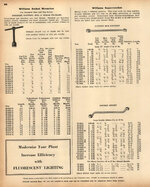 1942 Williams ad pp 66.jpg653.2 KB · Views: 16
 -
 1942 Williams ad pp 67.jpg616.1 KB · Views: 14
 -
 1942 Williams ad pp 68.jpg679.9 KB · Views: 15
 -
 1942 Williams ad pp 69.jpg626.4 KB · Views: 18
 -
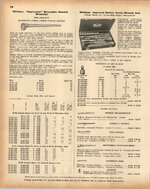 1942 Williams ad pp 70.jpg744 KB · Views: 20
 -
 1942 Williams ad pp 71.jpg699.5 KB · Views: 21
Catfishdan
Well-known member
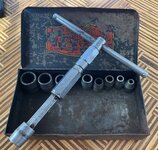
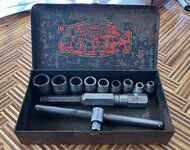
The missing piece for my 286 midget set came in today in the form of a sliding t. With the spinning extension, it seems like it would be a nice way to turn some smaller bolts…
Oldtuleguy
Well-known member
- Joined
- Nov 4, 2017
- Messages
- 10,478
Congrats on finding that sliding t!
misterbill
Well-known member
- Joined
- Dec 24, 2015
- Messages
- 676
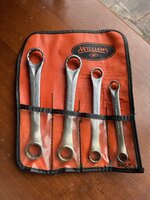
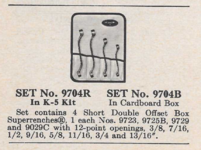
I already had the wrenches so grabbing the K-5 kit off of eBay was a no-brainer. The K-5 was used for other sets as well but here is the listing from catalog 505 (1963) for the 9704R set.
Bill
Bill
misterbill
Well-known member
- Joined
- Dec 24, 2015
- Messages
- 676
Here is some physical evidence that Williams' Vulcan branding made it into the TRW ownership era. I picked up this 1/4" drive metric 4mm-14mm set some time back.


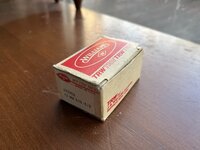
Bill
Bill

DetailSeeker
Well-known member
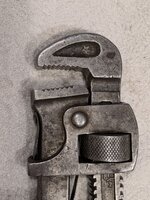
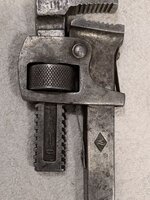
I may have missed something, but I think I have a wood-handled Stillson-pattern wrench from J. H. Williams. It has the "W in a diamond" mark, and an asterisk in the divot on the head (both sides). (It also has a later C.P.R. stamp; I'm in Ontario, so I'm guessing that's "Canada Pacific Rail".)
I can't find any examples of a Stillson-pattern wrench in the Williams catalogs, but I did find a couple of 1921 advertisements in Canadian Machinery which show one from Williams, with the note that they're "Formerly Canadian Division of The Whitman & Barnes Mfg. Co."
I was wondering if it was something specific to the Canadian branch of the company, maybe already-forged W&B stock that was just stamped with the new mark? (Or possibly something specific to WWII, since I saw here that the < W > logo was sometimes used for wrenches then. But the handle seemed a bit odd for that, both because the wood handles struck me as outdated by WWII and because the wood had split and I had to re-glue it.)
I can't find any examples of a Stillson-pattern wrench in the Williams catalogs, but I did find a couple of 1921 advertisements in Canadian Machinery which show one from Williams, with the note that they're "Formerly Canadian Division of The Whitman & Barnes Mfg. Co."
I was wondering if it was something specific to the Canadian branch of the company, maybe already-forged W&B stock that was just stamped with the new mark? (Or possibly something specific to WWII, since I saw here that the < W > logo was sometimes used for wrenches then. But the handle seemed a bit odd for that, both because the wood handles struck me as outdated by WWII and because the wood had split and I had to re-glue it.)
Attachments
-
 JHWilliams - stillson CPR.jpg133.8 KB · Views: 13
 -
 JHWilliams - stillson star.jpg152.6 KB · Views: 12
 -
 JHWilliams - stillson W.jpg158.4 KB · Views: 16
 -
 JHWilliams - stillson 1921.jpg94.7 KB · Views: 16
 -
 JHWilliams - stillson (2).jpg184.9 KB · Views: 18
 -
 JHWilliams - stillson (1).jpg166.4 KB · Views: 20
four.cycle
Well-known member
@DetailSeeker -
I do not have an answer to your question, but HERE is a 1921 "Commercial America" advertisement showing all 39 flavors of Williams' wrenches after their acquisition of Whitman & Barnes which bears a striking resemblance to your Canadian advertisement.
Interesting question. Not sure if I can find an answer, but I'm going to shoot it to somebody who might know.
you might want to keep these two links handy:
this one
and this one
and welcome to the site!
I do not have an answer to your question, but HERE is a 1921 "Commercial America" advertisement showing all 39 flavors of Williams' wrenches after their acquisition of Whitman & Barnes which bears a striking resemblance to your Canadian advertisement.
Interesting question. Not sure if I can find an answer, but I'm going to shoot it to somebody who might know.
you might want to keep these two links handy:
this one
and this one
and welcome to the site!
four.cycle
Well-known member
Stan S. said:Williams took over the Whitman & Barnes wrench line ca. 1920 / 1921 including the Whitman & Barnes Canadian operation. They kept the W&B product line in production for some time.
Stan S. said:There are some "transition" pieces with Williams overstamp on W&B made tools, but there are also pieces with only Williams markings. I presume that given Canadian "domestic production" legal protections, the Canadian products would have the appropriate markings, and if market conditions warranted, they may have kept some product lines going separate from what they were doing in the U.S.
Regards, Stan S.
Private Lugnutz
Well-known member
@DetailSeeker
Welcome to GJ, thanks for taking the time as a new member to have enough etiquette to find the correct thread, and for posting such a well-constructed query, with some of your own research and suppositions.

One more note. Williams only bought part of the company. So, during this transition period, there were W&B marks on Williams tools when other divisions of W&B were still in operation.
Welcome to GJ, thanks for taking the time as a new member to have enough etiquette to find the correct thread, and for posting such a well-constructed query, with some of your own research and suppositions.
No pipe or auto wrenches, either. I don't think they were shunned, but I do think it's indicative of where they ranked in their esteem. One gets the feeling looking through dozens of catalogs that they cut their teeth and made their mark with end wrenches, and forgings (lathe dogs, chain hoists, etc), and later, drive tools, and just never really embraced the things that were not in their original history. To qualify, the catalogs available in the public domain (on IA/ITCL) jump from 1912 to 1937 if I recall, followed by several throughout WWII and into the 50's. They wouldn't have been in the 1912, and by 1937 maybe they were a little passe. I don't know, but I have noticed the same thing.I can't find any examples of a Stillson-pattern wrench in the Williams catalogs,
I see that 4.c sought an external source to GJ for an answer, but if you search this thread (and the forum), you'll find discussions about the acquisition of W&B by Williams and the transition period producing all kinds of weird things. In addition to what 4.c's external source said about post-transition Williams era tools with just the W&B marking and Williams over-stamps on W&B markings, there are also tools with both markings. I actually have a little DOE wrench with three markings: W&B, < W >, and Globe Slicers, the name of a famous NYC deli!I was wondering if it was something specific to the Canadian branch of the company, maybe already-forged W&B stock that was just stamped with the new mark?
One more note. Williams only bought part of the company. So, during this transition period, there were W&B marks on Williams tools when other divisions of W&B were still in operation.
DetailSeeker
Well-known member
@four.cycle , @Private Lugnutz , thank you both! The answers and details are very much appreciated; I confess I didn't notice the jump in the catalog dates on IA/ITCL, and didn't think to go looking for non-Canadian advertisements after I found the Canadian one.
Will definitely look for more details on the W&B and Williams acquisition here; I don't expect to run across more of the tools particularly soon, but it'll be neat to learn.
Will definitely look for more details on the W&B and Williams acquisition here; I don't expect to run across more of the tools particularly soon, but it'll be neat to learn.
misterbill
Well-known member
- Joined
- Dec 24, 2015
- Messages
- 676
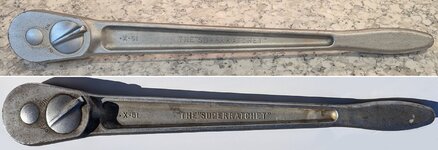
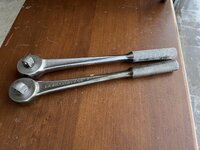
I picked up this "first generation" patent pending S-52 ratchet and finally got a few minutes to disassemble, clean and lube it. Here it is posed with a later "second generation" model for comparison. One other "first gen" feature (not shown) is that the handle is bored out for (presumably) some sort of bar extension to improve leverage.

Bill
Bill
Last edited:
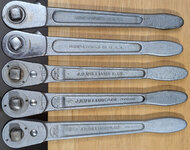
A Canadian made Williams curved adjustable.
 454912885_8815425475150436_7959667130447527224_n by wvwheaties, on Flickr
 455040042_8815425461817104_6892743443102508545_n by wvwheaties, on Flickr
454912885_8815425475150436_7959667130447527224_n by wvwheaties, on Flickr455040042_8815425461817104_6892743443102508545_n by wvwheaties, on Flickr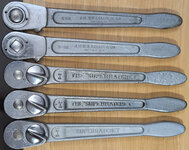
misterbill
Well-known member
- Joined
- Dec 24, 2015
- Messages
- 676
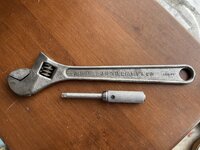
Here are a couple recent acquisitions (I went out in a snowstorm this morning for the adjustable). It took a while, but I finally found an 9/32" M-110 spinner/extension/driver. I have a box in primer and I just need to find a close match for the correct color and make/acquire a decal for a 1284 or 1288 9/32" set.

Bill
Bill
Last edited:
DetailSeeker
Well-known member
I picked up a Williams 14" Stillson-style this week, and I can't get the hook jaw out because the second thread from the end (on the inside, annoyingly) has been damaged.

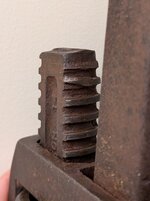
If I had a spare nut, I'd try screwing it on from the end to see if I could use it as a makeshift die, but I am skeptical of how well that would work. Is there anything I can try to repair this besides "clamp it firmly into place and try to tap the misaligned thread back into place with a flathead screwdriver that has personally offended me"?
If I had a spare nut, I'd try screwing it on from the end to see if I could use it as a makeshift die, but I am skeptical of how well that would work. Is there anything I can try to repair this besides "clamp it firmly into place and try to tap the misaligned thread back into place with a flathead screwdriver that has personally offended me"?
d42jeep
Well-known member
Take a file and remove the deformed area and it will come right apart. You don’t need much strength in that area anyway.
-Don
-Don
(Psst. Inside tip. -- If you have to use a screwdriver for a punch, don't tell us. Blame it on your wife. That's how we roll here.).....
. Is there anything I can try to repair this besides "clamp it firmly into place and try to tap the misaligned thread back into place with a flathead screwdriver that has personally offended me"?
Beerhippie
Well-known member
That's right--show some respect: Vintage flathead screwdrivers is for openin' paint cans!(Psst. Inside tip. -- If you have to use a screwdriver for a punch, don't tell us. Blame it on your wife. That's how we roll here.)