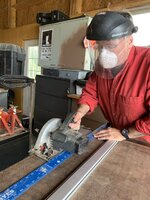
I'm mostly looking for folks to confirm or deny what I have been reading: the official manuals for all the DeWalt cordless circular saws say clearly, "WARNING: Do not cut metal, plastic, concrete, masonry or fiber cement materials with this saw."
Yet, it seems that everyone is putting Diablo blades into their woodworking saws and cutting sheet metal without hesitation. DeWalt has a few 5-1/2" saws marketed for metal work that default to lower rpms, but it seems like the larger more popular models are doing lots of double duty.
Is there a reason why DeWalt says not to do a thing that plausibly could be a legitimate warning, yet so many folks do it anyway? Is it just common knowledge that the warning is for unrealistic caution for liability purposes?
Is anyone aware of instances when someone really did get injured simply by using a metalwork blade on a typical 7-1/4" saw?
I did consult ChatGPT about this, it's description of the dangers is pasted below. Comment from humans who actually use the tools whether these issues are real?
Yet, it seems that everyone is putting Diablo blades into their woodworking saws and cutting sheet metal without hesitation. DeWalt has a few 5-1/2" saws marketed for metal work that default to lower rpms, but it seems like the larger more popular models are doing lots of double duty.
Is there a reason why DeWalt says not to do a thing that plausibly could be a legitimate warning, yet so many folks do it anyway? Is it just common knowledge that the warning is for unrealistic caution for liability purposes?
Is anyone aware of instances when someone really did get injured simply by using a metalwork blade on a typical 7-1/4" saw?
I did consult ChatGPT about this, it's description of the dangers is pasted below. Comment from humans who actually use the tools whether these issues are real?
Potential Dangers
- Excessive Heat and Sparks:
- Cutting metal generates significant heat and sparks, which can damage the saw or cause injuries.
- Sparks can ignite flammable materials nearby.
- Blade Compatibility:
- A standard circular saw may not have the appropriate speed or torque for metal-cutting blades. Metal blades often require lower RPMs to operate safely.
- Kickback:
- Metal cutting creates more resistance than wood. If the saw isn't designed to handle that resistance, the risk of kickback increases.
- Lack of Guarding:
- Standard circular saw blade guards are not optimized for metal cutting and may not properly contain flying metal debris.
- Wear and Tear:
- Prolonged use of a regular circular saw for metal can damage the motor, bearings, and other components.