To avoid these ads, REGISTER NOW!

slow death by radon or quick by CO?

OP
J

jmiller_2308

Well-known member
Joined
Nov 16, 2013
Messages
563
Location
Shakopee, MN
Not dead yet!

I turned off and capped one of the pipes and the boiler worked all night without any back draft issues. It has done this for a few days before so I'm not declaring victory just yet but I am optimistic about not getting CO poisoning.

I spent most of an hour with a candle watching air movement around the boiler with the mitigation system running and various combinations of the boiler and air exchanger on and off. I could see no deflection because of the mitigation system but I did see air movement from the makeup air to the boiler when the boiler was running.

Interesting to me was that when the door to the utility room was open there seemed to be more air movement from the doorway to the boiler than there was from the make up air. Hmm???? I asked Google about that and it said:

"If more air seems to be coming from the house than through the makeup air tubes, it likely indicates a negative pressure situation, where the house is drawing air in from outside through cracks and gaps to compensate for the air being exhausted. "​

And unfortunately the radon levels are still hovering above 6 on the short term Radon Eye tester.
 
Last edited:
To avoid these ads, REGISTER NOW!

dscheidt

Well-known member
Joined
Apr 26, 2017
Messages
2,909
And unfortunately the radon levels are still hovering above 6 on the short term Radon Eye tester.

you need to seal the joint between the floor and the wall, where there is a gap from the drainage board. Your contractor should have done that to start with. You are sucking air out of your basement, not from under your slab, and you have enough infiltration from somewhere that it's mostly outside air making up the the difference, not sub slab air.
 

pembol

Well-known member
Joined
Feb 13, 2014
Messages
276
One question - where are you measuring radon? Are you measuring in the main level or the basement? Do you have any bedrooms or frequently occupied spaces in the basement? Point being, you care about the radon level in the spaces you spend a lot of time in, primarily the bedrooms.
 

larry4406

Well-known member
Joined
Jan 27, 2006
Messages
19,581
Location
Northern Virginia
OP - do you have base molding in at the finished basement?

If so carefully remove the base, push insulation out of the way, seal that damn cactus board all the way around the interior foundation wall.

Record your manometer readings before and after sealing. Test your radon levels before and after. If your “radon pump **** pipes” are properly sealed to floor/crock you should see an increase in the vacuum with a reduction in radon. All the while no back draft.

Reinstall base after success.

If no base molding, add it so you can cut at the bottom and use it to hide the cut.
 
Last edited:
OP
J

jmiller_2308

Well-known member
Joined
Nov 16, 2013
Messages
563
Location
Shakopee, MN
you need to seal the joint between the floor and the wall, where there is a gap from the drainage board. Your contractor should have done that to start with. You are sucking air out of your basement, not from under your slab, and you have enough infiltration from somewhere that it's mostly outside air making up the the difference, not sub slab air.

The basement is mostly finished so although that is the "right way" to do it, it is also highly invasive and costly. I'm going to try everything I can before resorting to a full remodel.

One question - where are you measuring radon? Are you measuring in the main level or the basement? Do you have any bedrooms or frequently occupied spaces in the basement? Point being, you care about the radon level in the spaces you spend a lot of time in, primarily the bedrooms.

I'm measuring in a finished basement. The house is a walk out rambler with a lot of living spaces in the basement. There are 2 bedrooms but they are used as an office and a craft room. The largest use is the media room that on average gets about 2 hours of use a day. So, definitely there is daily use down there and yes that means I need to address the radon issue.

OP - do you have base molding in at the finished basement?

If so carefully remove the base, push insulation out of the way, seal that damn cactus board all the way around the interior foundation wall.

Record your manometer readings before and after sealing. Test your radon levels before and after. If your “radon pump **** pipes” are properly sealed to floor/crock you should see an increase in the vacuum with a reduction in radon. All the while no back draft.

Reinstall base after success.

If no base molding, add it so you can cut at the bottom and use it to hide the cut.

Sage advice and yes this is something I have considered but it would also be a large task ending with painting which I hate because I **** at it. It is also the dangerous slope of once I touch and repair all the walls I'm ultimately sliding into a full remodel of the basement area which is something I do not want to do at the moment - I'm just too dang old to do that large a project on the wife's schedule and too cheap to hire somebody.

--

Better news this morning. I put a better cap on the turned off pipe and radon levels were below 4 this morning. I hope that holds.
 
OP
J

jmiller_2308

Well-known member
Joined
Nov 16, 2013
Messages
563
Location
Shakopee, MN
The cactus board is ultimately way worse than I had hoped. The mitigation company has had success mitigating houses with cactus board without having to tear up walls to seal it but that seems to be an unlikely scenario for my house.

Yesterday the mitigation company came by to do a PFE test to see how much suction there was under the slab. As part of preparing I had already exposed cactus board in a couple of utility areas to inspect for possible weep holes in the cinder block and there were none. Before starting the PFE test the mitigation guy used a smoke pen and we could see huge air movement into the cactus board in the room where the mitigation system is installed. We went to another room and there was NO air movement in the cactus board there. In essence, all the suction is getting lost in the cactus pad nearest the mitigation system :(

I sealed all the cactus pad in the room with the mitigation system and we shall see if it makes any difference at all but it seems that I'll be needing to move into the living spaces next. Argh..... this is going to get ugly and expensive fast.

BTW: why the heck are smoke pencils so expensive!!!! Not egregious but really, $35 to $100 for something that smokes! Maybe I just need to take up smoking.
 

danski0224

Well-known member
Joined
Jan 29, 2005
Messages
13,534
Location
Near Naperville, IL
BTW: why the heck are smoke pencils so expensive!!!!
Because they can.

There used to be a chemical smoke generator, but then it got classified as hazmat, which made it stupid expensive to have shipped.

The only other option is a fog machine. There are small handheld ones in the few hundred dollar range.
 

PCustoms

Well-known member
Joined
Jul 23, 2011
Messages
23,516
Location
VT
Because they can.

There used to be a chemical smoke generator, but then it got classified as hazmat, which made it stupid expensive to have shipped.

The only other option is a fog machine. There are small handheld ones in the few hundred dollar range.

Burn a bundle of sage.

Ward off the bad juju while leak testing. Win win.
 

pcmeiners

Well-known member
Joined
Aug 13, 2009
Messages
7,962
Location
In the only town in Pennsylvania, Bloomsburg.
Smoke some weed, cheaper than a smoke pencil.

To seal the cactus board behind closed walls, punch pencil sized holes every 6" inches along walls, 3-4" off floor, get a mucho number of non expanding cans of great stuff and carefully shoot it downward, moving the great stuff straw often to seal the board
 
Last edited:
OP
J

jmiller_2308

Well-known member
Joined
Nov 16, 2013
Messages
563
Location
Shakopee, MN
Smoke some weed, cheaper than a smoke pencil.

To seal the cactus board behind closed walls, punch pencil sized holes every 6" inches along walls, 3-4" off floor, get a mucho number of non expanding cans of great stuff and carefully shot it down, moving the great stuff straw often to seal the board

I like this idea, both the smoking and the punched holes, but I'm not sure it will work. There is a layer of plastic that wraps from under the slap and up the wall between the inside and the cactus board that I'd need to get the l great stuff hose into. For the cavities I've done so far I had to remove insulation, slit and pull back that plastic, and then use great stuff to seal everything.

Still, this idea is a much nicer idea than ripping up a bunch of sheetrock and replacing it. A rotozip and a board make for a nice clean cut that is easier than using a knife but it multiplies the mess by at least a gazillion (or something like that). I'll have to try it on a small section before continuing with tear out.
 
OP
J

jmiller_2308

Well-known member
Joined
Nov 16, 2013
Messages
563
Location
Shakopee, MN
^^^holesaw should throw less dust

Yes, the rotozip was very messy and although it gives a nice line to lay in a new portion of sheetrock it is still extremely disruptive. Yesterday I hatched on the idea of a hole saw to make a clean but much smaller intrusion that I could hopefully use to clear away the insulation to get back to the plastic sheet covering the cactus board and then using a longer tube on a great stuff can try to clear as many cavities as possible from a given hole.

I was waiting for my egregiously expensive smoke pencil to finally arrive so that I could get a better feel for where air leaks were coming. It arrived and it shows me clearly the next area that I'll attack. Heading out this morning for more expanding foam.
 

dscheidt

Well-known member
Joined
Apr 26, 2017
Messages
2,909
I was waiting for my egregiously expensive smoke pencil to finally arrive so that I could get a better feel for where air leaks were coming. It arrived and it shows me clearly the next area that I'll attack. Heading out this morning for more expanding foam.

Get a gun for the foam. Bigger cans are cheaper, and the gun lets you control the application better (and you can do less than a can at a time. ). the cheapies you can get from Amazon are just as good as the ones dupont puts their name on, and none of them are a life time tool.
 
OP
J

jmiller_2308

Well-known member
Joined
Nov 16, 2013
Messages
563
Location
Shakopee, MN
Ugh.... putting an extension on a great stuff can worked really well - ONCE!

I inserted about a 3' section into one wall and pulled it back slowly as I dispensed the foam and it worked great. I stuck the tube in another wall, pulled the trigger, and it started to flow briefly before the extension blew off and I got blasted with spray foam - YUCK!

Luckily I wasn't hit too bad and the gloves kept my hands clean and it is a good thing I wear glasses but dang, I need to be more mindful or wearing more protective gear and also need to replace the lenses in my glasses now :(

Blower door and IR tests are finally scheduled for tomorrow. I did a walk around with my smoke pencil and really couldn't make much sense of how smoke was moving in the room. It was the middle of the afternoon with a lot of solar gain so I suspect there were some convection currents happening.
 

Denwood

Well-known member
Joined
Sep 22, 2014
Messages
4,218
Location
Thunder Bay, Ontario, Canada
Yes, the rotozip was very messy and although it gives a nice line to lay in a new portion of sheetrock it is still extremely disruptive.
I picked up a Dremel Saw Max specifically for this kind of work. It has a dust collection port which you can attach to a shop vac. Make sure you use a drywall bag in your shop vac. You can set depth and use a straightedge off the floor to make nice cuts. 1/4” ply works great for a straight edge if you rip strips to your needs. You need a pretty slim straight edge for clearance with the dust extractor port in place (my one complaint with this tool). This way you can also cut precise drywall strips to repair. Once set up you can do a room in a few minutes. Dust port shows up for a second around the middle of this clip. I pretty much wore my first Saw Max out on the last reno and had to replace it…


Then look at a froth pak, or just get a crew in to do closed cell spray foam to seal via your drywall slots. This way you can cut through the plastic vapour barrier with no concerns. I find it cost effective to get the pros in even for a small job. They are in and out in a few hours and so far have been at par or cheaper than DIY costs.

If you do have pros in, pull the house as negative as you can (close windows/doors, all exhaust fans to max), and and check for leaks before they leave so they can address missed areas. This is super critical in my experience to getting a complete air seal.

A box fan or two duct tape sealed into window openings will work to get more negative pressure.
 
Last edited:

PT Doc

Well-known member
Joined
Nov 12, 2010
Messages
3,197
Didn’t read all the responses….

Our range hood is 1200cfm. Code said anything over 400 needed a make up air system. This includes a motorized inline damper in a separate duct system to the outside that is activated when cfm sensor measures over 400cfm. This will kick on the air handler fan to move this air throughout. We also had ERV system installed to bring in fresh air. The house was built quite tight and bringing in air was highly recommended. Air flow into ERV and out was metered and ERV system was calibrated to have positive pressure. Seems to work well.
 
To avoid these ads, REGISTER NOW!

Hiball

Well-known member
Joined
Apr 30, 2009
Messages
14,032
Location
Missery
Unless I missed it, A good sign that your Radon mitigation company isn’t on the up and up is that they don’t have there own test equipment and they are relying on a customers air things meter. The ones that where accredited by the state and some agency had meters that where calibrated annually.

What kind of suction are you showing on the manometer?

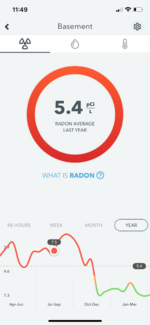
I built a house about two years ago and between me and builder we overlooked installing Radon system during the construction phase. I bought a Airthings monitor and after the initial 7 day calibration period I had elevated levels 12+ on some days. I spoke to a couple in my area and decided to install my own system on my rural property. I researched it till I was blue in the face, bought the appropriate parts and made a hole in the unfinished part of the basement, my tile drain went to daylight so that wasn’t a viable option. I seen Immediate results and could probably get things better by sealing the basement floor where it meets the wall. If I put a lighter down there, the suction will pull the flame into the crack within 10’ of the suction pit location.

IMG_6408.pngIMG_6409.png


The Above Screen shots show the yearly average and big drop after the install in Sept along with the Monthly average of 1.3 coming out of winter which is generally the worst season for radon.
 
OP
J

jmiller_2308

Well-known member
Joined
Nov 16, 2013
Messages
563
Location
Shakopee, MN
Unless I missed it, A good sign that your Radon mitigation company isn’t on the up and up is that they don’t have there own test equipment and they are relying on a customers air things meter. The ones that where accredited by the state and some agency had meters that where calibrated annually.

What kind of suction are you showing on the manometer?

I feel similarly about a company having their own equipment. My company does but it is such an expensive piece of equipment it tends to be over committed with it usually being dedicated to testing houses that need certification before being sold. My company has LOTS of equipment but only one of the calibrated devices so they are happy to use the meters I have, which really does seem odd.

The only manometer in the house are those plastic fluid leveling type attached to the mitigation stack and they are showing just below 1. I'm not sure what the "1" means but I suspect it might be inches of water.

I built a house about two years ago and between me and builder we overlooked installing Radon system during the construction phase. I bought a Airthings monitor and after the initial 7 day calibration period I had elevated levels 12+ on some days. I spoke to a couple in my area and decided to install my own system on my rural property. I researched it till I was blue in the face, bought the appropriate parts and made a hole in the unfinished part of the basement, my tile drain went to daylight so that wasn’t a viable option. I seen Immediate results and could probably get things better by sealing the basement floor where it meets the wall. If I put a lighter down there, the suction will pull the flame into the crack within 10’ of the suction pit location.

IMG_6408.pngIMG_6409.png


The Above Screen shots show the yearly average and big drop after the install in Sept along with the Monthly average of 1.3 coming out of winter which is generally the worst season for radon.

Congratulations of your success!

One of the tools my company brought in was a camera to scope the drain tile. The drain tile is clean and dry and confirms that I have never had any water issues. However, as they pushed it toward the walk out side of the house it looks like my drain tile was probably sent to "daylight" originally as it seemed to terminate in gravel just outside the foundation. It is no longer visible so we really have no idea where it might exit. However, given your experience I wonder if the drain tile going to gravel is part of the issue.

Wholly smokes... drawing a flame from 10' is a huge ****! I was unable to see anything meaningful with a flame and eventually bought the expensive smoke pencil (only expensive because why the heck does it cost $40!!!!). The smoke pencils allowed me to see some suction at the cactus board in the room where the mitigation pipe enters. All of that room is sealed now. After sealing that room the radon seemed to be the same as before but after about a week the reading appear to be finally trending below 4. I thought it was because of pressure changes but I've been through a few highs and lows as well as a snow storm and so far I'm crossing my fingers in hopes that the radon continues to stay below 4.

Blower door test and IR tests today (unless they cancel again :(). Hopefully the test will give more ideas as to what some of the issues might be and it will be interesting to see what my company does with the information. Their last thought was to drill another hole on the other side of the house and then run a temporary fan "out the window" to see if that makes a marked change. I'm not really happy with that concept as the pipe would be running through living space so again, hopefully the blower and IR tests provide something useful.
 

Hiball

Well-known member
Joined
Apr 30, 2009
Messages
14,032
Location
Missery
However, given your experience I wonder if the drain tile going to gravel is part of the issue.
I suspect it’s not helping, especially if the gravel/daylight is on the opposite side of your fan. The reading of 1 on the manometer isn’t concerning, it’s well within spec meaning it’s not sucking to daylight in the near vicinity. I’d also check to make sure it zeros out when the radon system is turned off. The lines just simply slide in that plastic frame and mine where off during shipping.

I really lucked out, considering it wasn’t planned as 2/3 of my basement is finished and it still left me with a good spot to drill my suction pit in the unfinished portion and exit the back side of the house and run up above the gutter line.

Good luck and hope you get it figured out.

My fan for anyone interested is a Festa AMG Maverick model with 4” in/out, I know I struggled when picking one out.
 

bd8134

Well-known member
Joined
Oct 16, 2008
Messages
219
Location
Franklin, MA
You are fighting really high levels but at least you now have an understanding of what is causing them and are taking steps reduce them, though it might take time and quite a bit of work.
For me, our neighborhood has multiple houses with a radon mitigation system and I have tested our house at different dates, all seemed ok. I bought an Airthings and during the summer it barked about out CO2 levels being high. I bought and installed an ERV, I connected it up via a remote relay. I use Home Assistant, a program running on a tiny computer which monitors the CO2 level and at set levels, turns on boost when it high and turns off the ERV at night time. Over winter I started getting radon levels max ~3.7. The air pressure also seemed to dip when it was higher. I readjusted the levels of the ERV so I was providing more supply air and extracting slightly more exhaust air. That helped but still high at times. I applied caulk in my exposed basement walls which had holes for when they poured the concrete, that helped. I also had installed a vent fan that picks up air from a slab that was part of our garage which is vented outside, now a living room above. I tried running this fan permanently, it supplies air next to our pellet boiler in the basement, that made the radon worse. Turning that fan off completely seemed to cause stale air to be pulled from the chimney of our pellet stove, especially when the cooker hood and cloth dryer were on. I added a unit so I could control the fan from Home Assistant, which I set to wait 20 minutes and then turn for 30 minutes when the boiler turns on. So far I have control of the CO2, no chimney smell but the radon level does creep up to 3.2 overnight when Home Assistant turns off the ERV. I might have to get Home Assistant to check for say over 2.7 radon overnight and turn on the ERV, turn off when it hits say 2.5. Radon only seems to give me trouble in the winter.
Good luck..
 
OP
J

jmiller_2308

Well-known member
Joined
Nov 16, 2013
Messages
563
Location
Shakopee, MN
The blower door test showed that my house is very tight with a reading of 2 (whatever that means). The good news is that after the enduring summer of pain last year of getting all my windows replaced they are actually installed well and don't leak a bit. The blower door test didn't find any real air leakage when walking around the house with the IR camera and feeling for drafts around any colder spots.

The IR camera also showed that the only cool spots seemed to be around framing and other expected areas so again no real indication of any leaks around the foundation or tops of the cinder block that may be contributing to radon getting into the house.

@bd8134 I also have an ERV but it isn't automated. It is on a 40% schedule so it runs roughly 24 minutes every hour. I did notice a climb in radon when it was off for an extended time when I forgot to turn it back on after a test. I have also been negligent about cleaning and replacing its filters but remedied that 2 days ago so we shall see if that makes any difference.

@bd8134, it appears you only run the ERV for radon mitigation. Is there a reason you don't use it to ventilate the house in general? I also wonder about whether it should just run all the time as that seems to be the recommendation from RenewAire with regards to my ERV.
 

bd8134

Well-known member
Joined
Oct 16, 2008
Messages
219
Location
Franklin, MA
Good news about your blower test. We had issues with our replacement windows installation also. Air leaks, visible air gaps, loose trim, insects inside the window frame which got in the house, etc. Just a bay window left to remove the inside trim on, spray foam around and correctly fit the trim, sad.
I got into the air quality fix when my son started monitoring his apartment, that is when I found my CO2 was really bad. Installing the ERV fixed that and I had the ERV come on at 8am and turns off at 10pm. I did not want to **** in too much cold air overnight if I did not need to. If I had guests around and the CO2 gets over 750 ppm, I have the ERV go into boost which is 100% and when it drops below 650, it returns to its normal run setting. My basement vent fan came at different times which was on a manual timer.

I did not have an issue with radon until the winter when the ground was frozen or it had snowed. Turning off the basement vent fan helped lower the radon but when the clothes dryer and other extractor fans were on, I sometimes got a downdraft/smell from our living room chimney when the pellet stove was off. That was when I changed the settings on the ERV to supply more air and extract just a bit more in normal run mode, that helped. I then automated my basement vent fan to turn on 20 minutes after the pellet boiler had started and run for 30 minutes, that also helped. Maybe I will automate the ERV to go into boost mode when Airthings detects a certain radon level but the levels are good now the ice has gone, maybe next year.

I bought a filter box which I plumbed into the supply hose on the ERV, it uses standard 14x20 3m Filtrete 1900 or 2400 filter and I removed the expensive internal supply filter in the ERV.
 

pcmeiners

Well-known member
Joined
Aug 13, 2009
Messages
7,962
Location
In the only town in Pennsylvania, Bloomsburg.
3.2 or 2.5 pCi/L is pretty damn small, nothing worry about, just above normal background level. In my home when I first moved in I had 75pCi/L before I install my system, now I under just under 5. CO2 levels are rarely dangerous, unlike CO levels.
 

bd8134

Well-known member
Joined
Oct 16, 2008
Messages
219
Location
Franklin, MA
3.2 or 2.5 pCi/L is pretty damn small, nothing worry about, just above normal background level. In my home when I first moved in I had 75pCi/L before I install my system, now I under just under 5. CO2 levels are rarely dangerous, unlike CO levels.
Wow, is that 75 pCi/L or 7.5 pCi/L either level is way high. The EPA recommend below 4 and the WHO say 2.7, no safe levels really. 1 is equivalent to smoking 2.5 cigarettes a day. I would just like to keep it as low possible. I would like to go out happy..
CO2 is supposed to cause headaches and sleep issues, I am just trying to keep my levels as low as possible without be too over the top. I like it when my Airthings says "Your air is good" when I swipe past the display.
 

Denwood

Well-known member
Joined
Sep 22, 2014
Messages
4,218
Location
Thunder Bay, Ontario, Canada
On the ERV issue, I would not turn it off, unless it’s summer and you have windows open. This is where automation tied to C02 levels and the ErV control is a good thing.

I monitor for VOC, Radon, CO2 and pm2.5 on all three floors. I’ve been gathering data for about 3 years now in an extensively retrofitted 1905 home. My setup is a bit different in that the automation system dials up CFM from 50 to 110 CFM in six increments.

I would only turn the ERV/HRV system off if your CO2 is in the 500 range as this would indicate you likely have windows open, or you live in a leaky house on a windy day! Otherwise Radon and VOC levels are likely to spike to very high levels. A better scenario for a family of four in a typical 2000sq/ft home is to balance the ERV at 50-60 CFM and automate boost to something like 100-110 CFM on CO2 over 800. An ERV rated for 200CFM will be at the very top of its efficiency curve at 60CFM if you look at HVIC data for the newer models.
 

bd8134

Well-known member
Joined
Oct 16, 2008
Messages
219
Location
Franklin, MA
It is just the 2 of us most of the time in a ~2,200sqft house and this is our first year monitoring air quality, we never open windows. Overnight our CO2 levels are ~460 overnight when the ERV is off. If it is more than 650 it would stay on until it is 550.
At the moment I have not set up any automations for the ERV for Radon. Overnight it was just below freezing and our radon crept up to 3.27 by 5am, ERV is set to come on @ 8am, yesterday overnight it was 2.78 overnight. Radon only seems to be an issue in the winter for us it seems.
 

pcmeiners

Well-known member
Joined
Aug 13, 2009
Messages
7,962
Location
In the only town in Pennsylvania, Bloomsburg.
Frozen ground or water logged ground seals the radon from escaping at the outside surface, far easier to exit in your basement. Radon level also varies due to barometric pressure, I bet high and low tides vary it.

"Wow, is that 75 pCi/L or 7.5 pCi/L either level is way high." like I said 75
There are home that have thousands of pCI/L , it all depends on how much uranium is below a house.

Another fun fact.....if you have radon in your well water (many homes do) and you have charcoal filter, radioactive nucleotides build up in the charcoal over years (actually becomes hazardous)..... wait long enough before changing the charcoal you could have a nuclear waste site in your basement , technically the EPA could condemn it and take you home over and throw you out.
 
Last edited:

Denwood

Well-known member
Joined
Sep 22, 2014
Messages
4,218
Location
Thunder Bay, Ontario, Canada
For sure, winter (particularly with frozen soil) is when you'll see the highest radon levels. It is exacerbated by stack effect given higher outside/inner temp deltas and therefore a higher pressure differential at the basement vs top floor.

@bd8134 , where you monitor CO2 will have a dramatic difference. If you monitor in your sleeping areas, you'll see an increase. I used to monitor just on the main floor living area, but added units to the basement and 2nd floor master bedroom. I'm using two Airthings Wave to monitor Radon/VOC/CO2, and an Ecowitt WH43 for pm2.5/pm10 and CO2. In the last year I added a bit of code to average the CO2 readings coming in from the 3 monitors so that we're not over ventilating at night at -35 C :)

Sleeping area CO2 rise (and it's a bit of a challenge) is why best practice now is supply 10-15 CFM of fresh air to each bedroom with dedicated ERV ducting. You would think CO2 levels/dilution would reflect its higher density (than room air) and show higher levels in your lowest living levels, but I've found that is not the case at all.

The image below is a bit to process but essentially the system is at 50CFM, average CO2 is 587ppm, 76% efficiency. We're exchanging about 317 watts via the HRV core (it's often at 1000 watts in colder weather!) and adding about 51 watts of power to the PTC heaters to temper the fresh air supply. Ambient temps outside are at 40F, but intake fresh air is showing 45F at the HRV, likely due to solar warming right now at the fresh air intake location. This setup is basically an older Venmar HRV, gutted to remove the old AC motor. I'm using two external 6" AC infinity inline EC fans for intake/exhaust, with 0-10 volt control for speed on each fan. The automation system (Hubitat) takes in the various inputs and sets the CFM profile as well as PTC heater wattage dynamically. If we're running the main floor high efficiency wood fireplace, the PTC fresh air heaters are disabled.

No radon mitigation is in place, but you can see the current radon in the basement is at 202 Bq/m3, so right at the threshold for mitigation if you're using Health Canada's guideline. On the 2nd floor we're at 153 Bq/m3 as all the windows up there are closed. It goes down a fair bit in summer so the yearly average is about 150 Bq/m3 at the basement, and 90 Bq/m3 on the 2nd floor.

1744322329007.png
 
Last edited:
OP
J

jmiller_2308

Well-known member
Joined
Nov 16, 2013
Messages
563
Location
Shakopee, MN
New update (not dead yet).

I sealed a large amount of the cactus pad and the radon guys moved one of the holes so now I have two pipes in different sections of the house. This allowed them to reduce the volume of the fans so it isn't as loud now and the radon levels now average around 1.

It seemed like the back drafting was under control until I noticed that it still occurs when the boiler first kicks on in the morning to provide heat for the indirect water heater but then the back drafting stops for the rest of the day - wtf????

I spent hours with a smoke pen trying to identify suction points but just went around and around without anything definitive. I then got a differential manometer to see if I could identify a negative pressure in the boiler room. What I found was that the boiler room might be slightly more negative than the house but the entire house seems to be slightly negative over outside pressure - hmmm....

I have a RenewAire EV200 HRV in the boiler room and as part of my investigation I was reading the specs on it and came across a brief mention of how in houses that have radon issues that it may be good to adjust the balance for some slight positive pressure in the house. Hmm.... I did some more experiments with my manometers and I think the HRV is currently the cause of the slight negative pressure in the house. Unfortunately my HRV is old enough that it has no built in ports for testing pressure. I ended up ordering some pressure tips from Amazon and plan to check what the actual balance on my HRV is and to see if I can push it to slightly positive.

One additional thing I noticed this morning was that I had changed to flue damper (I think that is what you call it) so that it remains open rather than closing when the boiler is off and after one test this seems to have prevented the back draft issue this morning. I have watched the damper before and it always looks like it opens and closes correctly but I remain suspicious of it or of how it might be contributing to draft up the chimney. I'm still trying to get my HVAC guy out to look the boiler over but the damper will be something I'll ask him to look at.
 

rlitman

Well-known member
Joined
Oct 18, 2010
Messages
24,678
Location
Long Island
...One additional thing I noticed this morning was that I had changed to flue damper (I think that is what you call it) so that it remains open rather than closing when the boiler is off and after one test this seems to have prevented the back draft issue this morning. I have watched the damper before and it always looks like it opens and closes correctly but I remain suspicious of it or of how it might be contributing to draft up the chimney. I'm still trying to get my HVAC guy out to look the boiler over but the damper will be something I'll ask him to look at.
If it works like mine, the switch disables the motor, so I wait until it opens for an ignition cycle and turn it off. I leave my boiler flue damper open during the summer for energy purposes. It keeps the boiler room a bit cooler, because the heat remaining in the stack after shutdown convects up before it has time to heat the room.

The damper is supposed to have a microswitch that closes when the damper is completely open, which permits the burners to fire. That should prevent the burners from lighting before the damper finishes opening, so something is odd here.
 

Denwood

Well-known member
Joined
Sep 22, 2014
Messages
4,218
Location
Thunder Bay, Ontario, Canada
New update (not dead yet).

I sealed a large amount of the cactus pad and the radon guys moved one of the holes so now I have two pipes in different sections of the house. This allowed them to reduce the volume of the fans so it isn't as loud now and the radon levels now average around 1.

It seemed like the back drafting was under control until I noticed that it still occurs when the boiler first kicks on in the morning to provide heat for the indirect water heater but then the back drafting stops for the rest of the day - wtf????

I spent hours with a smoke pen trying to identify suction points but just went around and around without anything definitive. I then got a differential manometer to see if I could identify a negative pressure in the boiler room. What I found was that the boiler room might be slightly more negative than the house but the entire house seems to be slightly negative over outside pressure - hmmm....

I have a RenewAire EV200 HRV in the boiler room and as part of my investigation I was reading the specs on it and came across a brief mention of how in houses that have radon issues that it may be good to adjust the balance for some slight positive pressure in the house. Hmm.... I did some more experiments with my manometers and I think the HRV is currently the cause of the slight negative pressure in the house. Unfortunately my HRV is old enough that it has no built in ports for testing pressure. I ended up ordering some pressure tips from Amazon and plan to check what the actual balance on my HRV is and to see if I can push it to slightly positive.

One additional thing I noticed this morning was that I had changed to flue damper (I think that is what you call it) so that it remains open rather than closing when the boiler is off and after one test this seems to have prevented the back draft issue this morning. I have watched the damper before and it always looks like it opens and closes correctly but I remain suspicious of it or of how it might be contributing to draft up the chimney. I'm still trying to get my HVAC guy out to look the boiler over but the damper will be something I'll ask him to look at.
HRV/ErV are considered “balanced” if you are within 10%. So there is no harm is pushing your supply air (fresh) up 10% over return (stale) air flow. Your HRV should have a label showing the static pressure/CFM table for both fresh and stale air flow.

Also, if you are in a predominately hot/humid environment (with dryer/cooler air inside), running a bit on the positive pressure side is fine.
 
OP
J

jmiller_2308

Well-known member
Joined
Nov 16, 2013
Messages
563
Location
Shakopee, MN
@rlitman my damper operates the same as yours. Two days ago after the boiler caused the damper to open I flipped the switch to keep it open all the time. So far no additional back drafting :)

@Denwood thanks for the comments on HRV pressure. The comment about having a slight positive pressure to aid in hot and humid environments is something I hadn't heard before. I'm looking forward to ensuring I have a positive pressure in the house and given how hot and humid it will be in MN today and tomorrow I only wish I could get that done now; unfortunately the pressure tips I ordered from Amazon appear to be in USPS limbo so I'll be waiting a bit longer :(
 
To avoid these ads, REGISTER NOW!
Top Bottom