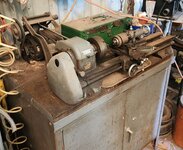
For those valuing the metal lathe, it appears to be a 6", not a 12". There are no back gears, or way to engage them. This means it is a much lighter machine, capable of less both in capacity and rigidity. I would be surprised to see it sell over $400, due to that. If it was a 12", then the $400-600 range would be a bit more accurate.
Could someone give me some tips on what to look for when purchasing a lathe? Again I am a mechanic and want the lathe just to learn on. I have zero experience with machinest work!
Ideally, you would put it on a surface plate, and see how much wear the bed has from end to end. If you can feel a ridge where the saddle slides vs the rest of the bed rail, that is another way to rough-test. Take each piece and make sure there is no slop or shake in it. If possible, turn it on, listen and see if it is making any bad noises and if everything moves freely. Check under the headstock cover for the biggest gear, see if any teeth are worn/broken (sometimes happens when trying to remove a chuck).
Based on what I see, the lathe is super basic. There should be several change gears, so you can vary the amount the lead-screw (under the bed) turns compared to the chuck. It looks like a three jaw chuck, which is ok, but not as versatile as a 4-jaw. Hopefully he has other tool holders (the thing sticking out of the cross-slide), both straight and a left-bend.
Any other accessories are helpful but could be sourced elsewhere (depending on item, $$ to $$$). Things like a steady rest (looks like a a mounted circular guide with arms sticking in), a heavier tool post, a 4jaw as mentioned, a follow rest (kind a curvy shape with two arms that would bolt behind the saddle), a micro-stop, etc.
Also see the first part about sizing. Atlas made a 6" and 12" lathe (total diameter of swing, so ~3"-6" from bed rails to center of chuck). The 6" were most commonly 18" between centers (from chuck to front top of tailstock), whereas the 12" can go from 24-36".