To avoid these ads, REGISTER NOW!

Giant Ratchets….Who Makes ‘Em?

oscarsnapkin

Well-known member
Joined
Feb 22, 2025
Messages
514
I’m only asking a strictly out of curiousity. Are there any manufacturers that make (or made) giant ratchets? I know lots of companies have a 1” ratchet, but what about something bigger? Snap-On made the L-78 1 1/2” ratchet, but I’ve never seen one made anyone else. I tried doing a google and eBay search to see if I could find anything, but it’s not an easy thing to search for as I just keep getting results for 1/2” ratchets.
 
To avoid these ads, REGISTER NOW!
OP
O

oscarsnapkin

Well-known member
Joined
Feb 22, 2025
Messages
514
I love unnecessarily large tools but have never felt the need for more than 1" drive.
Working on trucks we used mostly 1/2 and 3/4. 1” we only used for wheels. Anything larger than 1” I would imagine is more for construction, can’t imagine it in any automotive use. They sure are cool though. Gonna go check out those ratchets mentioned above.
 

Roert42

Well-known member
Joined
Jan 25, 2023
Messages
197
Location
NE Penn
I figure once you get over 1” drive the expectation is you will not apply enough force to break the driver. Under a reasonable circumstance.

IR sells a 2 1/2” drive impact gun rated at 20k ft/lbs. msrp is also $28k.

More of a piece of equipment at that point vs a tool.
 

woody 73

Well-known member
Joined
Apr 14, 2009
Messages
11,546
Location
The Great State Up North
I have no idea if the following link is a joke or not? I was hoping they would list the drive size, and they did not, but they did list the price so don't ask, (I was thinking railroad size in the $40,00 price range) At $5000.00 per socket the ratchet must be large

 
To avoid these ads, REGISTER NOW!

mikey03

Well-known member
Joined
May 17, 2024
Messages
2,140
Wright Tool makes 10" or larger sockets...I believe they are 3.5" drive.
Damn what kind of fasteners use a 10” socket? At that point don’t fo connecting something that big I figure you just unload a dump truck of steel shot in a hole and drop some thermite in until it melts down and hardens in place
 

kctgb

Well-known member
Joined
Jul 7, 2024
Messages
305
About the biggest I've ever seen, are the pipe threader ones...
I have a pipe ratchet and dies that go up to 2 inch. I tried treading 2 inch pipe with it, you have to be the hulk to thread big pipe. I’m not small and couldn’t do 2 inch and I lubricated the die and pipe a lot.
 

Tim in Indiana

Well-known member
Joined
Nov 1, 2018
Messages
91
Location
Indiana
Damn what kind of fasteners use a 10” socket? At that point don’t fo connecting something that big I figure you just unload a dump truck of steel shot in a hole and drop some thermite in until it melts down and hardens in place
About 20 years ago I made 14 double ended threaded studs and matching nuts for a large gravel processor. They were 6" diameter, around 24" long and I can't remember the thread pitch but it was a fairly fine thread. The nuts were close to the 10" hex mentioned above.

Big, heavy and very expensive.
 

1Bad55Chevy

Well-known member
Joined
Feb 20, 2025
Messages
623
I have no idea if the following link is a joke or not? I was hoping they would list the drive size, and they did not, but they did list the price so don't ask, (I was thinking railroad size in the $40,00 price range) At $5000.00 per socket the ratchet must be large


It definitely wasn't a joke. Thats crazy!
 

ecotec

Well-known member
Joined
Oct 5, 2010
Messages
5,457
Is something that big used on mining equipment or building bridges or what?
 

1Bad55Chevy

Well-known member
Joined
Feb 20, 2025
Messages
623
I thought these big bolts were normally tightened up with strike wrenches?

I am an auto mechanic and I use to be in the army.... I tell people all the time that there are rocks on the ground that are smarter then me so please don't flame me for being stupid! Lol
 

L.Cheapo

Well-known member
Joined
Oct 23, 2014
Messages
5,954
Damn what kind of fasteners use a 10” socket? At that point don’t fo connecting something that big I figure you just unload a dump truck of steel shot in a hole and drop some thermite in until it melts down and hardens in place
No idea, but I'd guess mining, cargo ships, or oil platforms.
 

Junkdrawer Dog

Well-known member
Joined
Jan 14, 2019
Messages
1,460
Location
LV NV
At my last job, for high torque fasteners, we used a device that was essentially an air motor and gearbox that turned the socket. Torque was too much for a human to hold so you had to develop fixtures and brackets to mount it to whatever you were working on. These bolts and studs were approximately 2" shank diameter. We were not very scientific, we just tightened til they wouldn't tighten any more. These were part of set up and tear down for product change overs.
 

Steve_P

Well-known member
Joined
Sep 15, 2010
Messages
5,185
We had a 6'+ long torque wrench where I used to work. No idea the drive size, but two 200+ pound guys had to pull simultaneously to get it to click.

Big stuff I'm familiar with typically uses a lot of 1-1.5" diameter studs and they're hydraulically tensioned and not torqued manually.

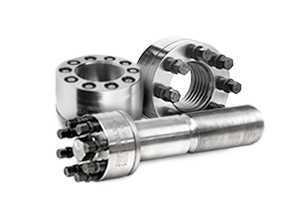
I can't remember the trade name, but we also used a split-type nut fastener where you threaded it onto a stud by hand, and then tightened ~20 smaller SHCS that were in a radial pattern thru the nut. The SHCS tightened against the "base" portion and stretched the stud. This kept the torque levels reasonable so you could do them in a confined space where the 6' wrench wouldn't fit to torque a 1.5" stud. Totally simple idea, but also genius.

Edit:
Ok, it took a few searches, but this is it: superbolt. We used the supernuts, I guess.

From the company that pioneered the only lockwashers that actually work. Again, the first time I saw these all I could think of was, "gee, that's simple....

 
Last edited:

Tim in Indiana

Well-known member
Joined
Nov 1, 2018
Messages
91
Location
Indiana
Used to be that people would take a long pipe and put big guys on it to get big torque. Now, the safety people in most businesses would have a cow if saw something like that happen.

Today you would either use a hydraulic wrench (Enerpac, Hytorc, Rapidtork, etc,) that turns the nut one tooth at a time. But friction still becomes a problem at some point.

Or they use a hydraulic tensioner that stretches the bolt to a desired length then the nut is spun down by hand and the tension released. They can measure the bolt stretch with ultrasonic or physical length. Doing it this way avoids friction issues like thread galling, inconsistent lubricity, etc. You get what you want, consistent clamp load.
 

J.A.F.E.

Well-known member
Joined
Sep 25, 2008
Messages
1,745
Location
Formerly Area 49 now Area 52
Damn what kind of fasteners use a 10” socket? At that point don’t fo connecting something that big I figure you just unload a dump truck of steel shot in a hole and drop some thermite in until it melts down and hardens in place


There is lots of stuff that use really large fasteners just most of it isn't all that visible most of the time. The nuts holding the steel wheels to the axles on the old PCC street cars look to be about 10 or 12 across the flats, at least on the ones with Westinghouse electrics. There are still a few dozen in service around the US.


1711-4.jpg

St_Louis_B3_Truck_01.jpg
 

PMD1966

Well-known member
Joined
Dec 26, 2013
Messages
182
Location
Lake Orion, Michigan
I think the Alcoa 50,000 ton press uses a bunch of 16" nuts on the tie rods.
Worked in a stamping plant for a number of years. When a new press was installed, The base went in first, then the sides, crown was last. Tie rods were pumped with hydraulic fluid to stretch them a few mm. They were tightened to the max, then the hydraulic fluid was drained.
 
To avoid these ads, REGISTER NOW!
Top Bottom